

Choosing Promotional Product Suppliers: A Buyer’s Guide


Choosing promotional product suppliers means selecting partners who deliver consistent quality, reliable delivery, and brand compliance that directly shape how your audience perceives your organization. The wrong supplier doesn’t just miss a deadline. It puts your logo on a product that fades, cracks, or arrives in the wrong color, and that damage lands on your brand. This guide gives marketing professionals and organizational buyers a structured framework for evaluating and selecting promotional product vendors, covering supplier credibility, sourcing workflows, quality control, and risk management.
What criteria should you use when choosing promotional product suppliers?
Supplier selection in the promotional products industry, formally called promotional product sourcing, starts with five non-negotiable criteria. Skipping any one of them creates predictable problems downstream.
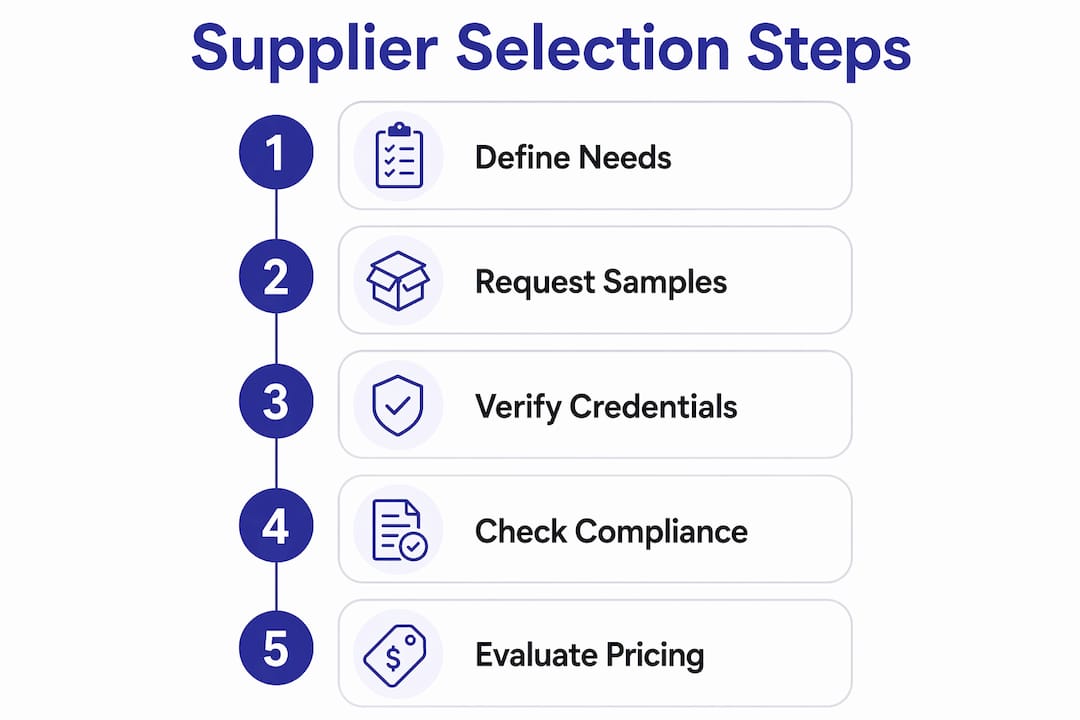
Quality consistency and reliability is the first filter. Request physical samples before committing to any order. A digital mockup tells you nothing about print registration, material weight, or color accuracy. Ask for samples from the same production run, not showroom pieces.

Supplier credibility is verifiable, not assumed. ASI membership and ASI numbers indicate industry standing and give you access to credit reports that reveal payment behavior and operational history. A supplier with an ASI number has cleared a baseline of industry verification that unregistered vendors have not.
Compliance and supply chain transparency matter more than most buyers realize until something goes wrong. PPAI recommends mapping factory ownership, product lines, export markets, subcontracting arrangements, and compliance records before finalizing any supplier relationship. A supplier who cannot answer these questions clearly is a supplier who cannot protect your brand.
Customization and decoration capabilities must match your specific branding needs. Screen printing, embroidery, laser engraving, and pad printing each produce different results on different substrates. Confirm that your shortlisted suppliers have in-house capability for your required decoration method, not just a subcontractor relationship they cannot control.
Pricing transparency and lead time assurances close the criteria list. A quote that excludes setup fees, shipping, or rush charges is not a real quote. Require fully landed pricing and written lead time commitments before approving any order.
Pro Tip: Request a sample order from every new supplier before placing a production run. A $200 sample investment can prevent a $20,000 mistake.
How can you implement a structured supplier sourcing process?
A structured sourcing process removes guesswork and reduces the back-and-forth that delays campaigns. ASI identifies five inputs that every buyer must define before approaching any supplier: product category, budget, quantity, in-hands date, and decoration requirements. Buyers who skip this step generate quote churn and schedule risk.
Follow this sequence when sourcing promotional product vendors:
- Define your inputs completely. Product category, per-unit budget, total quantity, required in-hands date, and decoration method. Vague inputs produce vague quotes and project delays that compress your timeline.
- Apply precise search filters. Use ASI’s supplier search tools to filter by price range, minimum order quantity, country of origin, decoration method, lead time, material, and sustainability attributes. Search precision keeps your options manageable rather than overwhelming.
- Request updated quotes and physical samples. Never approve a supplier based on catalog images. Require a physical sample that matches your decoration specifications.
- Place a trial order before scaling. A trial order at 10 to 20 percent of your intended volume confirms production quality, packaging, and delivery reliability before you commit your full budget.
- Document every approval. Keep written records of proof approvals, sample sign-offs, and delivery confirmations. This documentation protects you if disputes arise and creates a traceable record for future orders.
Understanding what a promotional product distributor actually does in this chain also helps buyers set realistic expectations for turnaround times and communication.
What are best practices for managing quality and brand fidelity?
Brand color accuracy is where promotional product quality most visibly succeeds or fails. A logo printed in the wrong shade of blue on 5,000 tote bags is not a minor issue. It is a brand consistency failure at scale.
Production-quality proofs are the standard tool for catching these problems before they reach the press. Physical press proofs with Delta E readings against Pantone standards give you a measurable, objective benchmark for color approval. Delta E is a numerical measure of color difference. A Delta E below 2 is generally considered acceptable for brand colors. Above 3, the difference is visible to the naked eye.
Here is a comparison of the three main proof types you will encounter:
| Proof type | What it shows | Best used for |
|---|---|---|
| Digital proof | On-screen color rendering | Initial layout and copy approval |
| Press proof | Actual ink on actual substrate | Color-critical brand approvals |
| Wet proof | Ink-wet color before drying | High-volume print runs with strict tolerances |
Beyond proofing, retain a golden sample for every brand-critical product. A golden sample is a production-approved physical piece that serves as the reference standard for all future reorders. Spectrophotometric approval and golden sample retention prevent color drift across production runs, which is a common problem when reordering from the same supplier months later.
Pro Tip: Always request a press proof for any product where Pantone color matching is specified. Digital proofs on screen cannot replicate ink-on-material color accurately.
For a detailed breakdown of why these standards matter to your brand, Discountswag’s guide on promotional product quality covers the full picture.
How do you assess supplier reliability and manage risk?
Supplier reliability is not a feeling. It is a set of verifiable data points that you either check or ignore at your own risk.
Start with financial and operational history. ASI Credit Reports give buyers access to payment behavior, operating history, and risk indicators for suppliers in the ASI network. A supplier with a strong sales record but a pattern of late payments to their own vendors is a supplier who may struggle to prioritize your order when capacity is tight.
Key due diligence steps include:
- Review contract status and partnership length before designing your compliance testing approach. PPAI recommends tailoring your review depth to the nature of the relationship. A new supplier warrants more scrutiny than a five-year partner with a clean record.
- Audit sourcing frequency and compliance document history. Suppliers who change subcontractors frequently or whose compliance certifications lapse are higher-risk partners.
- Commission factory audits for large or recurring orders. Factory audits typically cost between $800 and $3,500 and take 15 to 25 business days. That cost is modest compared to the financial and reputational damage of a failed large-scale order.
- Align supplier production schedules with your campaign calendar. A supplier whose peak season conflicts with your in-hands date needs to be identified before you sign off on a purchase order.
“Data-driven methods outperform guesswork when selecting distributor partners. Reliable relationships are built through informed decision-making, clear communication, and mutual trust supported by accurate, up-to-date data.” — ASI, Finding Reliable Distributors
For buyers sourcing in volume, Discountswag’s bulk buying guide addresses how to structure orders to reduce risk while maintaining cost efficiency.
What common mistakes should you avoid with promotional suppliers?
Most sourcing failures trace back to a small set of avoidable errors. Recognizing them before they happen is the difference between a campaign that lands on time and one that becomes a case study in what not to do.
- Choosing on price alone. The lowest quote rarely accounts for quality control, accurate color matching, or reliable delivery. A supplier who undercuts competitors by 30 percent is cutting something, and that something usually shows up in your finished product.
- Submitting incomplete order inputs. Vague buyer inputs cause quote churn and project delays. Suppliers cannot give you accurate pricing or lead times without knowing your quantity, decoration method, and in-hands date.
- Skipping sample approval before large orders. No sample approval means no quality benchmark. Without one, you have no contractual basis to reject a shipment that does not meet your standards.
- Ignoring compliance and traceability. A supplier who cannot provide documentation of their sourcing chain exposes your organization to regulatory and reputational risk, particularly for products distributed internationally.
- Underestimating lead times. Promotional product production and shipping take longer than most buyers expect. A supplier who promises a two-week turnaround on a complex decorated item is either exceptional or overpromising.
Pro Tip: Build a promotional product checklist before every campaign. It forces you to define inputs, proof requirements, and approval steps before the clock starts.
Key takeaways
Choosing promotional product suppliers correctly requires verifiable criteria, structured sourcing workflows, and documented quality approvals at every stage.
| Point | Details |
|---|---|
| Start with five inputs | Define product category, budget, quantity, in-hands date, and decoration method before contacting any supplier. |
| Verify supplier credibility | Use ASI numbers and ASI Credit Reports to check financial stability and operational history. |
| Demand physical proofs | Press proofs with Delta E readings and golden sample retention prevent color drift across production runs. |
| Audit compliance records | Review factory ownership, subcontracting, and certification history before committing to large orders. |
| Avoid price-only decisions | The lowest quote rarely reflects true quality, delivery reliability, or compliance capability. |
What I’ve learned after years of watching supplier decisions go wrong
Most buyers approach supplier selection as a procurement task. They get quotes, compare prices, and pick the lowest number that looks credible. That approach works fine until it doesn’t, and when it fails, it fails publicly. Wrong colors on a trade show giveaway. A shipment that arrives three days after the event. A product that falls apart in the recipient’s hands.
What I’ve found actually separates good sourcing decisions from bad ones is the discipline to slow down at the beginning. Defining your inputs completely before you contact a single supplier saves more time than any shortcut you could take later. Requesting a physical sample before approving a production run is not bureaucratic caution. It is the only way to know what you are actually buying.
The compliance piece is where I see the most complacency. Buyers assume that if a supplier has been in business for ten years, their sourcing chain is clean. That assumption is not safe. Subcontractors change. Certifications lapse. A supplier who passed an audit two years ago may look very different today. The PPAI supply chain review framework exists precisely because this kind of drift is common.
One more thing: do not let budget pressure push you into skipping the sample approval step. The cost of a sample is always less than the cost of a rejected shipment or a reprinted order. Patience at the proof stage is the cheapest quality control you will ever buy.
— Jerry
How Discountswag helps you source with confidence
Discountswag gives marketing professionals and organizational buyers direct access to a curated network of verified promotional product suppliers, backed by expert sourcing guidance and an extensive product catalog. Whether you need branded merchandise for a corporate event, a product launch, or an ongoing recognition program, Discountswag connects you to suppliers who meet quality, compliance, and delivery standards. Explore the full range of branded promotional products to find options that fit your campaign goals, budget, and brand specifications. For buyers who want to understand how quality affects long-term brand perception, Discountswag’s 2026 quality guide is the place to start.
FAQ
What makes a promotional product supplier credible?
A credible supplier holds an ASI number, maintains verifiable compliance records, and can provide physical samples on request. ASI membership indicates industry verification and gives buyers access to credit and operational history reports.
How many suppliers should I evaluate before choosing one?
Evaluate at least three to five suppliers per product category using consistent criteria: pricing, lead time, decoration capability, and sample quality. Trial orders with two finalists before committing to a single vendor reduce risk significantly.
What is a golden sample in promotional product sourcing?
A golden sample is a production-approved physical product retained as the color and quality reference for all future reorders. It prevents color drift and quality inconsistency across multiple production runs with the same supplier.
How do I verify a supplier’s compliance and sourcing practices?
Request documentation of factory ownership, subcontracting arrangements, and current compliance certifications. PPAI’s supply chain review framework provides a structured checklist for auditing these records before finalizing a supplier relationship.
What inputs do I need before contacting a promotional product supplier?
You need five inputs: product category, per-unit budget, total quantity, required in-hands date, and decoration method. Providing these upfront reduces quote iterations and gives suppliers the information they need to give you accurate pricing and lead times.
 Bottle Carriers
 Mugs
Mugs