

Influencer Gifting: The Brand Manager’s 2026 Playbook


Influencer gifting is a relationship starter, not a content machine. Send a product to a creator with no strings attached, and you get one of three things: a post, a conversation, or silence. The role of influencer gifting in a modern marketing program is to surface enthusiastic creators, generate authentic UGC, and feed a paid-partnership pipeline — not to guarantee reach or drive immediate conversions. The global influencer market has grown to a scale that makes gifting a logical entry point for brands that want to test creator relationships before committing budget.
Three things gifting does well, and one it does not:
- Primary role: Starts relationships, generates organic UGC, tests product-market fit with real audiences, and identifies creators worth paying later.
- What it does not reliably do: Scale reach on a deadline or drive guaranteed sales. Treat it as a pipeline tool, not a performance channel.
- Immediate action: Run a 50–100 unit pilot with nano or micro creators in your category. Vet for engagement quality, not follower count. Measure creator responses and content themes before you spend more.
Key Takeaways
Influencer gifting works best as a pipeline tool that surfaces enthusiastic creators, generates authentic UGC, and feeds paid partnerships — not as a guaranteed content or sales channel.
| Point | Details |
|---|---|
| Gifting is a pipeline starter | Treat every send as top-of-funnel; convert the best responders to paid partners within 30–90 days. |
| Vet creators before you ship | Check brand fit, engagement quality, and posting history — follower count alone is a poor predictor of post rate. |
| Invest in packaging | Clean, filmable packaging with a personal note materially improves post rates and creator perception. |
| Set realistic KPIs | Track response rate, post rate, UGC volume, sentiment, and paid conversion rate — not just reach or impressions. |
| Discountswag supports execution | Custom kits, rush ordering, and multi-address fulfillment make it practical to run a 50–100 unit gifting pilot without in-house logistics. |
Table of Contents
- What is the role of influencer gifting, and how does it differ from paid posts?
- Why do brands use gifting, and what marketing roles does it actually fill?
- When should you gift vs. pay an influencer?
- How to build and run a gifting program step by step
- What are the legal and disclosure rules for U.S. gifting programs?
- How do you measure a gifting program’s performance?
- Why do gifting campaigns fail, and how do you fix them?
- What timelines and response rates should you expect?
- How should you design the gifting experience?
- How does gifting fit into an ambassador pipeline?
- Applying gifting with promotional products: what works in the field
- What gifting programs actually teach you about creators
- Discountswag makes gifting programs easier to execute
- Sources
What is the role of influencer gifting, and how does it differ from paid posts?
Influencer gifting means sending a product to a creator at no charge, with no contractual obligation to post. The industry also calls it product seeding. The defining feature is the absence of a required deliverable — you send, they decide.
That distinction matters legally and strategically. Three models get confused constantly:
No-strings gifting sends a product and explicitly tells the creator they are not obligated to post. If they do post, the content is genuinely voluntary. This is the cleanest form for authenticity, though creators who receive a gift and post about it still have a material connection that requires disclosure under FTC guidance.
Barter (gift for post) exchanges a product for a specific deliverable — one Instagram Reel, three Stories, a TikTok. No cash changes hands, but a contractual obligation does. This is closer to a paid partnership than gifting, and 16 CFR Part 255 treats it accordingly. Brands that frame barter as “just gifting” to avoid disclosure requirements are misreading the regulation.
Paid sponsorship involves contracted deliverables, agreed creative direction, and a fee. Full stop.
The common misuse: brands send a gift, then follow up asking for a post “if you get a chance.” That phrasing creates an implied expectation, muddies the no-strings framing, and can push the arrangement toward barter territory without the paperwork to match. Be explicit about what you are offering from the first message.
Why do brands use gifting, and what marketing roles does it actually fill?
Gifting performs six distinct functions in a marketing program. Understanding which ones apply to your situation determines whether gifting belongs in your plan at all.
- Relationship starter: A well-chosen product opens a conversation with a creator who might otherwise ignore a cold pitch. It signals that you know their content and chose something relevant.
- UGC and creative discovery: Gifted posts often outperform scripted sponsored content because creators have full creative latitude. Giving creators that freedom produces more genuine content that resonates better with their audiences than tightly directed advertorials.
- Product-market testing: Sending to 50 nano creators in a niche tells you more about real-world product reception than a focus group. Their unfiltered reactions, even in DMs, are signal.
- Social proof seeding: A cluster of organic mentions builds ambient credibility, especially for new product launches where paid ads alone feel thin.
- Low-cost content generation: Gifted UGC, when you secure usage rights, can feed paid social, email, and web creative at a fraction of production costs.
- Ambassador identification: The creators who post enthusiastically, tag correctly, and engage with comments are your best candidates for paid work. Gifting surfaces them without a casting call.
Research backs the relationship-investment angle. Four experiments found that gifting can improve perceived influencer trustworthiness and brand attitude compared with paid influencer marketing. The catch: elaborate gifts can actually reduce perceived trustworthiness unless the gift is justified by a clear brand occasion. Simple, relevant, well-packaged beats expensive and over-branded.
Statistic callout: Survey data from Modash shows that many marketers report gifting as ROI-positive — but conversion to deeper paid partnerships remains low, and ghosting is common. That gap between “positive ROI” and “converts to partnerships” is where most programs leak value.
Gifting is weak for: guaranteed reach, predictable conversion timelines, and any campaign where you need specific creative assets by a deadline. For those goals, pay.
When should you gift vs. pay an influencer?
The decision comes down to what you need and when you need it. Here is a practical framework.
Map your campaign goal first:
| Campaign goal | Recommended tactic | Why |
|---|---|---|
| Brand awareness, new launch | Gift (nano/micro) | Low cost, organic feel, tests reception |
| Guaranteed content by deadline | Pay | Contracted deliverables only |
| Creative testing / UGC library | Gift, then license | Authentic creative at low cost |
| Long-term ambassador pipeline | Gift first, then pay | Vets fit before budget commitment |
| Conversion / direct sales | Pay + affiliate code | Performance tracking requires agreement |
| Product-market validation | Gift (nano) | Unfiltered feedback, no bias from payment |
Creator tier guidance:
Industry guidance recommends a tiered approach: nano creators (1K–10K followers) for realism and product testing, micro (10K–100K) for validation and niche authority, and macro for scale — though macro gifting economics rarely work without a paid component.
Gifting nano and micro creators makes economic sense because their post rates tend to be higher and their audiences more engaged. Gifting a macro creator without a paid agreement is a long shot; their inbox is full and a free product rarely moves them.
The rule of thumb: If you need guaranteed deliverables or immediate scale, pay. If you need product validation, UGC, or relationship building, gift. If you need both, gift first and convert the best performers to paid within 60–90 days.
Later’s vetting framework adds a useful lens: evaluate creators on relevance, reach, and resonance before deciding which tactic to deploy. A creator with 8,000 highly engaged followers in your exact niche may deliver more value from a gift than a 200,000-follower generalist on a paid deal.
How to build and run a gifting program step by step
A gifting program that converts to real partnerships needs structure. Here is the operational playbook.
1. Define your program objectives and budget
Set a specific goal before you order anything. “Generate UGC” is not a goal. “Collect 20 usable product posts from nano creators in the fitness category within 60 days” is. Your budget should cover product cost, packaging, shipping, and staff time for outreach and follow-up.
Program economics hinge on two numbers: your all-in cost per unit (product plus packaging plus shipping) and the expected post rate for your creator tier. Know those numbers before you scale.
2. Build your creator list
Use vetting criteria, not just follower counts. A workable checklist:
- Brand fit: Does their content style and audience match your product category?
- Engagement rate: Look for genuine interaction, not inflated follower counts.
- Content quality: Can you see yourself reposting or licensing their work?
- Posting frequency: Active creators are more likely to post; dormant accounts are a waste of product.
- Responsiveness: Check if they reply to comments and DMs — a signal of how they will treat your outreach.
- Past gifting behavior: Have they posted gifted products before? How did they handle disclosure?
3. Write your outreach message
Frame the send clearly. A no-strings outreach message should:
- Explain who you are and why you chose them specifically (one sentence, not a paragraph).
- State that you would like to send them a product to try, with no obligation to post.
- Ask for their shipping address and size preference if relevant.
- Mention that if they do share, a simple tag is appreciated and that any post should include a disclosure like #gifted.
Keep it under 150 words. Anything longer signals you are asking for more than you are saying.
4. Design the package
The unboxing experience drives post rates. What to include:
- A short, handwritten or printed personal note (not a press release).
- The product, cleanly packaged with minimal excess filler.
- A small card with your handle and a suggested hashtag — not a creative brief.
- Optional: a QR code linking to a product page for context.
What to avoid: a thick media kit, a list of posting requirements, or a discount code that implies a transactional relationship.
5. Ship and track
Use a shipping method with tracking. Log every send in a CRM or spreadsheet with: creator name, platform, handle, ship date, tracking number, and expected delivery window. Set a calendar reminder for follow-up.
6. Follow up with a cadence
Send one follow-up message 7–10 days after expected delivery. Ask if the product arrived and whether they have any questions. Do not ask for a post. A second follow-up at day 21 can check in on their experience. After that, move on.
7. Convert to paid partnerships
When a creator posts positively and engages with your brand, that is your signal. Within 30 days of their post, reach out to thank them and ask if they would be open to a paid collaboration. This is the conversion play — and it is where gifting earns its keep as a pipeline tool.
Pro Tip: Ask for usage rights in the conversion conversation, not in the gifting outreach. Requesting rights upfront signals that the “gift” was actually a content purchase, which changes the legal and relational dynamic entirely.
The table below shows a sample gifting program structure by creator tier:
What are the legal and disclosure rules for U.S. gifting programs?
The short answer: yes, disclosure is required when a material connection exists, even for no-strings gifts. A creator who receives a free product and posts about it has a material connection to your brand. FTC guidance is explicit on this point, and 16 CFR Part 255 codifies the federal rules.
Disclosure best practices for gifting programs:
- Tell creators in your outreach that any post should include a clear disclosure. Suggested language: “#gifted,” “#giftedbybrand,” or “Brand sent me this to try.”
- “#ad” is appropriate for paid posts or barter arrangements. For pure no-strings gifting, “#gifted” is more accurate, though either satisfies the disclosure requirement when placed prominently.
- Disclosures must be visible without clicking “more” on a caption. Buried at the end of a hashtag string does not count.
- On video platforms (TikTok, YouTube, Instagram Reels), a verbal disclosure at the start of the video is the clearest approach.
- Do not ask creators to use language that obscures the commercial relationship (“my new favorite product” with no disclosure is a problem if you sent it for free).
Tax considerations:
For high-value gifting programs, consult a tax advisor. The IRS treats gifts above certain thresholds as taxable income for the recipient. If your program involves products with significant retail value, creators may have a reporting obligation. Brands running large-scale programs should document the retail value of each send and consider whether a 1099 is warranted for high-value recipients. This is not a common issue for standard nano/micro gifting, but it becomes relevant for elaborate kits sent to macro creators.
When to use a simple agreement:
- Any barter arrangement (gift for post) should have a written agreement, even a one-page email confirmation.
- If you plan to request usage rights after a gifted post, document that separately in writing.
- Avoid embedding posting requirements in a gifting outreach — it converts the arrangement to barter and requires disclosure language appropriate for paid partnerships.
How do you measure a gifting program’s performance?
Gifting is not paid media. Measuring it like paid media — with ROAS as the primary metric — will make every gifting program look like a failure. The right KPIs reflect what gifting actually produces.
Primary KPIs for gifting programs:
| KPI | What it measures | Tracking method | Expected range |
|---|---|---|---|
| Creator response rate | % of outreach that gets a reply | CRM log | 20%–50% for nano |
| Post rate | % of sends that result in a post | Manual monitoring + social listening | 15%–40% by tier |
| Usable UGC volume | # of posts you can license or repurpose | Content log | Varies by pilot size |
| Sentiment / themes | Qualitative reception of product | Manual review of captions and comments | N/A — qualitative |
| Paid conversion rate | % of gifted creators who become paid partners | CRM pipeline | 5%–15% within 90 days |
| Amplification ROI | Return when gifted posts are boosted as paid ads | UTM + ad platform data | Varies by creative |
Tracking setup:
Assign each creator a unique UTM parameter on any link you share with them (product page, landing page). If you include a promo code in a follow-up after they post, make it creator-specific so you can attribute traffic and sales. Affiliate links work the same way and add a commission incentive that can increase post rates.
Log every creator interaction in a CRM. Tag each record with: tier, category, send date, post date (if applicable), content link, sentiment rating (positive/neutral/negative), and whether they converted to a paid conversation. This data is what tells you whether your gifting program is actually building a pipeline or just burning product.
Measuring creator programs against business outcomes like ROAS and CAC matters most when gifted posts are boosted as paid ads. That is where gifting crosses into performance territory and where hard attribution becomes possible.
Blend qualitative signals with quantitative ones. A creator who posts a thoughtful, detailed review with 200 comments asking where to buy the product is more valuable than one who posts a flat image with 2,000 likes and no engagement. Qualitative KPIs like UGC volume and sentiment are leading indicators of whether your gifting program is building real brand equity.
Why do gifting campaigns fail, and how do you fix them?
Most gifting programs fail for predictable reasons. Here are the top failure modes and their fixes.
-
Spray-and-pray lists. Sending to 500 creators with no vetting produces low response rates, irrelevant content, and wasted product. Fix: Cap your pilot at 50–100 creators and vet each one manually against your criteria before sending.
-
Wrong creator tier. Gifting macro creators without a paid component almost always results in silence. Fix: Start with nano and micro creators where post rates are higher and relationships are more accessible.
-
Cheap or unfilmable packaging. A product that arrives in a plain poly mailer with no personal touch signals that you do not value the relationship. Fix: Invest in packaging that is clean, on-brand, and easy to film. A $3 tissue paper insert and a handwritten card change the perception entirely.
-
Unclear outreach language. Vague messages (“we’d love to work with you!”) without a clear offer confuse creators and reduce replies. Fix: State exactly what you are sending, why you chose them, and what you are not asking for.
-
Implied posting expectations. Phrases like “we hope you’ll share your thoughts” in a gifting outreach create pressure that undermines the no-strings framing and can push the arrangement into barter territory. Fix: Use language like “no obligation to post” explicitly.
-
No follow-up system. Sending without a follow-up cadence means you miss creators who received the product but needed a nudge. Fix: Build a two-touch follow-up sequence into your CRM before the first package ships.
-
Ignoring economics. Brands that do not calculate their cost per post before launching often discover the program is financially unsustainable at scale. Fix: Run the unit economics before you commit to volume.
Pre-launch checklist:
- [ ] Creator list vetted against brand fit, engagement, and content quality
- [ ] Outreach message reviewed for implied obligations
- [ ] Packaging designed for filming and personal touch included
- [ ] Shipping tracked and logged in CRM
- [ ] Follow-up cadence scheduled in advance
- [ ] Cost per post calculated at expected post rate
- [ ] Disclosure language included in outreach
What timelines and response rates should you expect?
Plan for a 6–12 week pilot to collect meaningful signals. That window covers outreach, shipping, the creator’s decision timeline, posting, and your follow-up sequence.
Phase timeline:
- Weeks 1–2: Creator vetting, list building, outreach messages sent.
- Weeks 2–4: Products ship, tracking confirmed, first follow-up sent at day 7–10 post-delivery.
- Weeks 4–8: Posts appear (most gifted posts happen within 2–4 weeks of delivery for engaged creators).
- Weeks 8–12: Second follow-up for non-posters, conversion conversations with posters, data review.
Expected benchmarks by tier:
- Nano creators (1K–10K): Typically higher response and post rates compared to larger tiers, reflecting higher engagement though lower reach.
- Micro creators (10K–100K): Moderate response and post rates, balancing reach and accessibility.
- Mid-tier creators (100K–500K): Generally lower response and post rates for gifting without payment, reflecting the need for paid agreements at this level.
Survey data confirms that ghosting is common across all tiers. Build that expectation into your program design — a 30% post rate from a well-vetted nano list is a good result, not a failure.
Conversion timing: Offer paid work within 30 days of a positive post. Wait longer and the momentum fades. If a creator has not posted after two follow-ups and 30 days, move them to a dormant tag in your CRM and redirect that budget.
How should you design the gifting experience?
Simple, well-packaged gifts outperform elaborate ones for trust. That finding from experimental research has a practical implication: when a gift looks expensive or over-produced, audiences and creators start wondering what the brand is trying to buy. Save elaborate sends for clear brand occasions — a product launch event, a holiday, a creator’s work anniversary with your brand.
Packaging dos:
- Clean, minimal outer packaging with your brand color or logo, not a full brand takeover.
- A personal note that references something specific about the creator’s content.
- Tissue paper, a ribbon, or a simple insert that makes the unboxing feel intentional.
- Products that are photogenic on their own — texture, color, and shape matter on camera.
Packaging don’ts:
- A thick press kit or product brochure. It signals a transactional relationship.
- Excessive branded filler (branded packing peanuts, branded tape, branded everything). It reads as a marketing exercise, not a gift.
- Posting instructions or a creative brief inside the box. If you are gifting, let the creator decide how to present it.
- Cheap packaging that contradicts a premium product. The box is part of the product experience.
The trust trade-off is real. Research shows that elaborate gifts can reduce influencer trustworthiness in the audience’s eyes unless the elaborateness is clearly justified by context. A birthday box or a launch-event kit reads as occasion-appropriate. A random Tuesday send that arrives in a $200 custom crate reads as a bribe. The fix is simple: match the presentation to the occasion and let the product do the work.
Pro Tip: Film-friendly products have a natural advantage. Items with interesting textures, satisfying unboxing sounds, or a clear before/after use case get posted more often. When choosing products for a gifting kit, ask: “Would I watch a 30-second video of someone opening this?” If the answer is no, reconsider the product.

How does gifting fit into an ambassador pipeline?
Treat gifting as the top of your creator pipeline. A creator who receives a gift and posts positively is a warm lead, not a finished relationship. The path from gift to ambassador looks like this:
Seed → Respond → Test content → Paid test → Ambassador
- Seed: Send the product, no strings attached.
- Respond: Creator replies or posts. You now have a warm contact.
- Test content: Review their post for quality, tone, and audience fit. Does this creator’s content represent your brand the way you want?
- Paid test: Offer a single paid deliverable — one post, one Reel — with a modest fee. This tests their professionalism, responsiveness, and whether their content performs with a brief.
- Ambassador: Creators who deliver on the paid test and whose content drives engagement or conversions graduate to a recurring paid relationship.
Scaling checklist:
- Assign one team member (or agency contact) to own creator relationships and CRM tagging.
- Use a fulfillment partner for batch sends above 50 units to avoid internal logistics bottlenecks.
- Automate the vetting shortlist using platform tools that filter by engagement rate, category, and audience demographics — then manually review the shortlist before sending.
- Tag every creator in your CRM with tier, category, send status, post status, and pipeline stage.
- Allocate budget by tier: more units to nano for volume, fewer but higher-value sends to micro for validation.
- Review your pipeline monthly. Creators who have not converted to paid within 90 days of a positive post should be re-engaged with a new product or moved to a lower-priority segment.
Applying gifting with promotional products: what works in the field
The product you send is the first impression. Choose it with the same care you would apply to a paid creative brief.
Product types that perform well in gifting:
- Branded kits: A curated set of 3–5 complementary items (drinkware, a notebook, a tech accessory) films better than a single item and signals thoughtfulness. Customized gift kits, which align with a creator’s lifestyle or content niche, get posted at higher rates than generic swag
- Tech accessories: Wireless chargers, cable organizers, and branded earbuds are high-utility and film well. Logo tech accessories are particularly effective for creators in productivity, remote work, or lifestyle categories.
- Apparel: A well-fitted, quality garment with subtle branding gets worn and posted. Loud logos on cheap fabric do not.
- Drinkware: Insulated bottles and tumblers have broad lifestyle appeal and appear in content naturally. They also have long shelf lives, which means repeated brand exposure.
- Consumables: Candles, snacks, or skincare items create an immediate use experience that drives same-day posting.
Packing and labeling checklist:
- [ ] Outer box is clean and on-brand without being over-branded
- [ ] Personal note included, referencing the creator by name
- [ ] Products wrapped or nestled to look intentional, not thrown in
- [ ] Brand handle and suggested hashtag on a small card (not a brief)
- [ ] No posting requirements, no media kit, no discount code unless it is a follow-up send
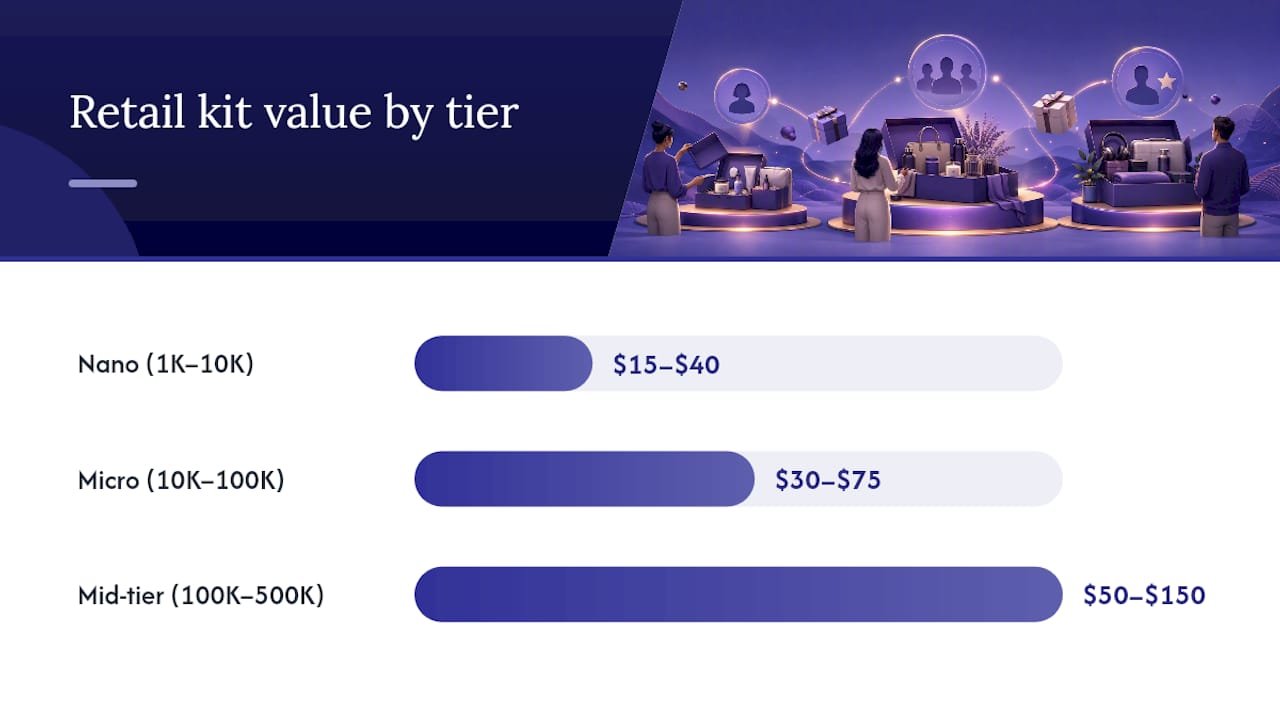
Budget bands by creator tier:
- Nano (1K–10K): Retail value $15–$40 per kit. Focus on one hero product plus a small complementary item.
- Micro (10K–100K): Retail value $30–$75 per kit. A curated 2–3 item set with quality packaging.
- Mid-tier (100K–500K): Retail value $50–$150 per kit. Higher-perceived-value items, occasion-specific packaging, and a more personal note.
For multi-address fulfillment across a large creator list, the logistics can get complicated fast. Discountswag handles custom kit creation, rush ordering, and multi-address fulfillment — which means you can ship 100 individually addressed creator packages without managing it in-house. That operational capability matters when you are running a 60-day pilot and cannot afford a two-week packaging delay.
Pro Tip: Order a small batch of your intended kit and film the unboxing yourself before sending to creators. If you would not post it, they probably will not either. This 20-minute test saves you from shipping 100 units of something that lands flat.
What gifting programs actually teach you about creators
The most underrated output of a gifting program is not the posts. It is the replies.
A creator who receives your product and sends back a genuine message — “I’ve been looking for something like this,” or “My audience asks me about this category all the time” — is telling you something no survey could. That response is a signal of authentic fit, and it is worth more than a post from someone who tagged you once and never engaged again.
The practical tip that most teams miss: in your follow-up message, do not ask “Did you get a chance to post?” Ask “What did you think of the product?” That single reframe shifts the conversation from transactional to relational. You get honest feedback, the creator feels heard, and the relationship starts on a foundation that makes a paid partnership far more likely.
Discountswag makes gifting programs easier to execute
Running a gifting program at any meaningful scale requires getting the physical execution right. Product selection, kit assembly, packaging quality, and multi-address shipping are where most in-house teams hit a wall.
Discountswag is built for exactly this kind of operation. The catalog covers the product types that perform best in creator gifting: branded drinkware, tech accessories, apparel, and curated gift sets that arrive looking intentional rather than bulk-ordered. Rush ordering means you can move fast when a campaign timeline shifts. Multi-address fulfillment handles individual creator shipments without requiring your team to manage a warehouse. And the customization options let you keep branding tasteful rather than overwhelming, which matters for post rates and creator trust. Browse the full range of promotional items for brand awareness to find products that fit your gifting budget and creator tier, then get a quote for your next pilot.
Sources
The claims and benchmarks in this guide draw from the following sources. Each one covers a distinct dimension of influencer gifting.
- Consumer perceptions of influencer gifting
- Ftc
- Ecfr
- The State of Influencer Gifting in 2026 Survey Data
- Influencer Gifting Program Guide: Structure, Post Rates & Conversion Strategy
- How Brands Should Use Influencer Gifting Campaigns In 2026
- Statista
- Blog
- Later
 Bottle Carriers
 Mugs
Mugs