

Procurement: Avoid a Six Week Production Delay on Client Gift Boxes


Client gift boxes are curated or customized packages of branded items sent to build or strengthen a business relationship. For most one-off sends under 50 recipients, a ready-to-ship curated box wins on speed and cost. For high-value accounts or a recurring program, custom branded boxes earn back the extra lead time. Whichever route you pick, control three levers: budget per recipient, branding visibility, and fulfillment handling.
TL;DR:
- Customization and branding efforts should align with client value tiers and occasion urgency, ensuring more personalized options for top-tier accounts.
- Effective logistics management requires early confirmation of minimum order quantities, drop-shipping capabilities, lead times, and proofing policies to prevent delays or errors.
- Selection of gift box type depends on need: curated boxes for speed and cost efficiency, build-your-own for control, and fully custom for branding storytelling and high impact.
- Proper segmentation of recipients and pre-approval of proof before order placement are crucial to avoid costly mistakes and ensure timely delivery.
- Gifting ROI should be tracked through renewal and referral rates, with clear tagging in CRM to analyze patterns over multiple cycles.
Table of Contents
- What Client Gift Boxes Are and When to Send Them
- Types of Client Gift Boxes: Ready-to-Ship, Build-Your-Own, and Fully Custom
- Your Checklist for Choosing and Briefing a Gift Box Vendor
- What to Put in a Client Gift Box by Budget Tier
- Logistics: Fulfillment, Scaling, and Timelines
- How Discount Swag Runs Client Gifting Programs
- Legal and Compliance Considerations for Client Gifts
- Measuring ROI on Your Client Gift Box Program
- The Real Tradeoff Nobody States Plainly
- Get Your Client Gift Boxes Moving Without the Guesswork
- Sources
What Client Gift Boxes Are and When to Send Them
A client gift box works whenever you want to mark a moment in the relationship without sending a generic thank-you email. The strongest results come from tying the send to something specific happening in the account.
Curated gifting builds goodwill that translates into retention and referrals, especially when the timing feels earned rather than automatic. A box that arrives the week a client renews reads very differently than one that shows up at random.
Common moments worth a box:
- New client onboarding, sent within the first two weeks
- Contract renewals or anniversary dates
- Major project milestones or successful launches
- End-of-year holidays and New Year kickoffs
- Simple thank-you sends after a referral or testimonial
Timing and personalization matter more than the price tag. A $40 box with a handwritten note beats a $90 box with a printed slip that could have gone to anyone.
Types of Client Gift Boxes: Ready-to-Ship, Build-Your-Own, and Fully Custom
Every gifting program eventually comes down to three formats, and each fits a different stage of the buyer relationship.
- Ready-to-ship boxes. These are pre-assembled sets you order as-is, usually shipping within a few days. Prebuilt corporate boxes commonly average between $48 and $74 per box, making them the fastest and cheapest way to cover a broad list of contacts. The tradeoff is limited branding, usually a card insert rather than logo placement on the items themselves.
- Build-your-own or modular boxes. You pick a base box and swap in a handful of items from a preset catalog. This gives you real control over dietary restrictions, themes, and price point without waiting on full custom production. It’s the middle ground most mid-size gifting programs settle into.
- Fully custom boxes. Every item, the packaging, and the insert card carry your branding, and you can build recurring programs around specific client segments. The lead time is longer and the per-unit cost is higher, but for top-tier accounts or annual programs, the branding and storytelling payoff usually justifies it.
Your Checklist for Choosing and Briefing a Gift Box Vendor
Before you request a single quote, segment your recipient list. A vendor doing this well will ask you the same question first: who are you sending to, and what’s the account worth?
Split contacts into tiers, then assign budget by tier rather than sending one flat gift to everyone. A $200 client and a $50,000 client should never get the same box.
Run through this checklist with any vendor you’re evaluating:
- Budget per recipient, including shipping, not just item cost
- Branding options, from a printed card to full logo placement on packaging and products
- Personalization, such as name printing, handwritten notes, or tier-specific contents
- Shipping model, whether you’re shipping to one office or hundreds of individual addresses
- Lead time, from order placement to delivery, especially around holidays
- Sample and proof policy, so you see a physical or digital mockup before full production runs
Ask vendors directly: What’s your minimum order quantity? Do you provide a digital proof before charging the full order? What happens if I need a rush turnaround two weeks before a launch event? A vendor who can’t answer the rush question clearly is a red flag, not a minor gap.
Pro Tip: Segment by account value before you shop for boxes, not after. Deciding “who gets what tier” first turns a vague vendor conversation into a specific request for quote, and it usually gets you a faster, more accurate price.
Digital proofing and a clear sample policy tend to be the deciding factor for corporate buyers comparing vendors, more than the catalog itself. If you want a deeper framework for segmenting recipients by relationship history before you brief a vendor, customer-history-first planning is worth reading before your next gifting cycle. For inspiration on what personalized presents actually look like at each tier, see these custom client appreciation gift examples.
What to Put in a Client Gift Box by Budget Tier
Contents should match both the budget tier and the occasion. Here is a general guideline by budget tier:
- Lower budget tiers: simple branded items like mugs, a small snack assortment, and a thank-you card.
- Mid-range budgets: higher-quality snacks, notebooks, or useful logo items, ideally with a handwritten note.
- Higher budgets: curated multi-item boxes featuring premium food, upscale branded tech accessories, and themed packaging.
Popular themes worth building around include wellness (tea, aromatherapy, a journal), gourmet (regional snacks, coffee, chocolate), office (desk accessories, tech add-ons), and eco-friendly (reusable items, sustainably sourced snacks). Regional or artisanal sourcing tends to create stronger emotional response than generic swag, because it reads as a deliberate choice rather than a bulk order.
Always confirm shipping-safe packaging for anything perishable, and ask about common allergens before including food items in a box going to dozens of unknown recipients. A handwritten or personalized note consistently outperforms a printed insert on perceived thoughtfulness, and it costs almost nothing to add. See more configuration ideas in these corporate gift set examples.
Logistics: Fulfillment, Scaling, and Timelines
The gap between a smooth gifting program and a stressful one almost always comes down to logistics you didn’t confirm upfront.
Per-box cost drops as volume rises, but minimums vary a lot by vendor, so ask early rather than assuming a discount kicks in automatically. Address collection is the other quiet failure point: for drop-shipping to individual recipients, use a secure form rather than emailing a spreadsheet around, and confirm the vendor doesn’t store addresses longer than needed for the send.
Before locking in an order, confirm:
- Minimum order quantity and where volume discounts start
- Whether the vendor supports drop-shipping to multiple individual addresses
- Standard lead time versus rush-order turnaround and any added fee
- Whether you’ll see a digital proof before the full run goes to production
- How reorders or recurring sends are handled for an ongoing program
Vendors running full-service gifting programs typically handle proofing, address collection, and volume pricing as a package, which removes most of the coordination work from your side.
How Discount Swag Runs Client Gifting Programs
Running a gifting program well means treating it as a repeatable process, not a one-off scramble every quarter. That starts with segmenting the list, locking a proof before production, and confirming addresses before anything ships.
Discount Swag builds client gift boxes with customization on packaging and items, digital proofing before full runs, and fulfillment that supports multi-address drop-shipping for lists of any size. The most common mistake buyers make isn’t picking the wrong box, it’s skipping the proof step and finding a logo placement issue after 200 units already shipped. Confirm the mockup, confirm the address list, then place the order.
Legal and Compliance Considerations for Client Gifts
Corporate gift-giving isn’t unregulated, and the rules differ by industry and by recipient’s employer.
Many companies, especially in finance, healthcare, government contracting, and law, cap what employees can accept from vendors or partners, with limits varying considerably depending on internal policy. Before sending anything above a token gift, it’s worth asking the client’s procurement or compliance contact whether their organization has a gift acceptance policy. Government employees and anyone connected to federal contracts face stricter limits, and some agencies prohibit gifts entirely regardless of value.
Tax treatment matters on your side too. In the United States, business gifts to clients have an IRS deduction limit per recipient per year, which should be considered when planning your gifting budget. Alcohol shipments carry their own layer of restriction, since interstate alcohol shipping rules vary by state and often require a licensed retailer rather than a general merchandise vendor.
None of this should scare you off gifting. It just means a quick compliance check before a large program launches saves you from an awkward return shipment or a client who has to decline the gift outright. Build that check into your process the same way you’d build in a proofing step.

Measuring ROI on Your Client Gift Box Program
Gifting ROI is easy to feel and hard to quantify unless you decide upfront what you’re tracking. Set your metrics before the boxes ship, not after.
The most useful signals are behavioral, not just anecdotal. Track renewal rate among gifted accounts versus a control group that didn’t receive a box during the same period. Watch response rate: did the client reply to a thank-you email, post about the gift, or mention it on a call within the following weeks? Referral activity in the 90 days after a send is another strong indicator, since a thoughtful gift often prompts a client to think of you when someone in their network needs a similar service.
Softer signals still count. A quick reply, a photo shared internally, or a mention in a QBR are all worth logging in your CRM against that account, even informally. Over a few gifting cycles, patterns emerge, some segments respond strongly to gourmet boxes, others barely react to anything but useful tech accessories.
Keep it simple: tag every gift send in your CRM with date, tier, and occasion, then check renewal and referral rates for that cohort two quarters later. You don’t need a dashboard, just consistent tagging and a habit of checking back.
The Real Tradeoff Nobody States Plainly
Most gifting guides treat curated and custom boxes as a simple speed-versus-branding tradeoff, and that’s only half true. The bigger tradeoff is attention versus scale. A fully custom, story-driven box demands real internal coordination, someone has to approve the proof, track the recipient list, and decide the theme. That’s manageable for 20 top accounts and unmanageable for 2,000 contacts.
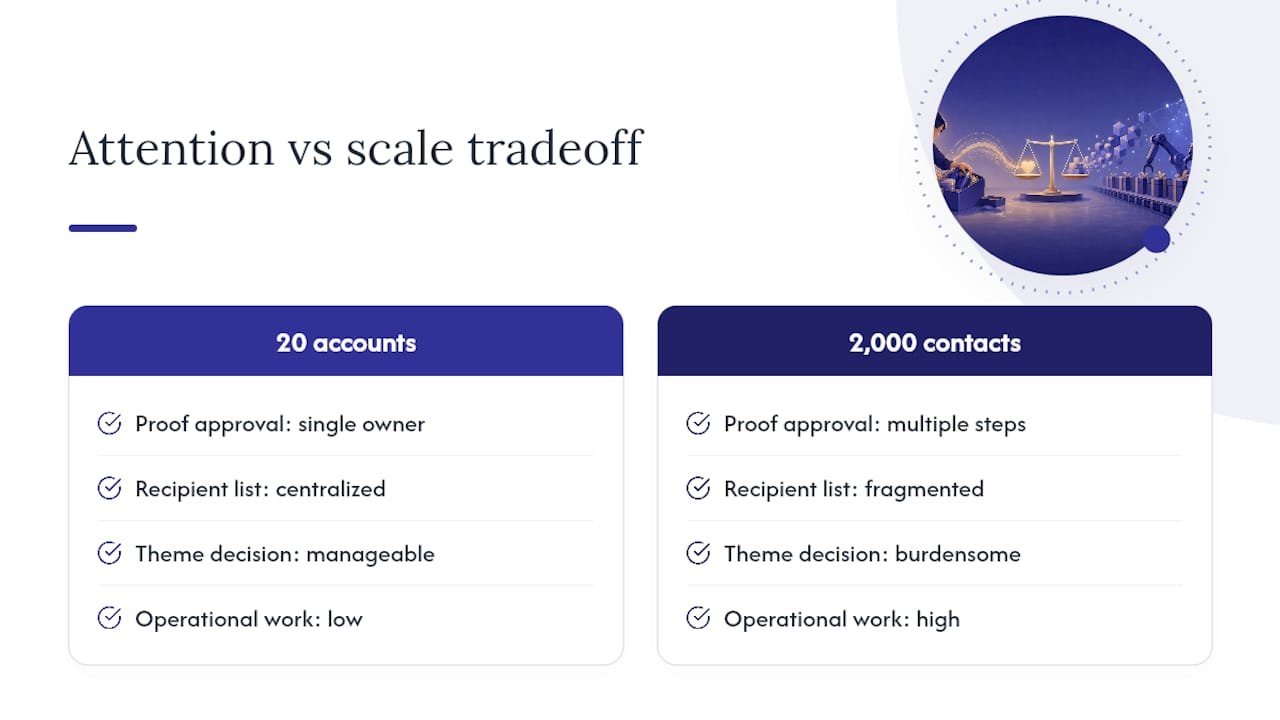
The conventional advice to “always personalize” quietly ignores this. Personalization at scale isn’t a design problem, it’s a process problem, and most programs fail not because the boxes were wrong but because nobody owned the address list or the proof approval step.
If you’re building a first program, prioritize the operational plumbing before the creative concept: segmentation, proofing workflow, and address collection. Get those right, and you can run either a $45 curated box or a $150 custom box through the same system without redoing your process every quarter. Get them wrong, and even the best-themed box arrives late, misspelled, or at the wrong office.
— Jerry
Get Your Client Gift Boxes Moving Without the Guesswork
Discount Swag is built for exactly the gap most gifting programs hit: matching branded boxes to budget without turning it into a six-week production project. You get customizable packaging and item selection, digital proofs before anything ships, and fulfillment that supports drop-shipping to single or multiple addresses.
Whether you’re sending 15 onboarding boxes this month or planning a recurring quarterly program for your top 50 accounts, the process stays the same: brief your tiers, review a proof, confirm addresses, ship. If you’re still deciding between a pure promotional item run and a full curated gift box, this breakdown of promotional products versus corporate gifts will help you pick the right service level before you request a quote.
Sources
- 25 Client Gift Ideas to Show Your Customers You Care in 2026
- Corporate Gift Boxes | Shop Curated Sets for Clients & Staff | Unboxme
- Client Gifts – JNJ Gifts and More
 Bottle Carriers
 Mugs
Mugs