


Stop W-2 Surprises: $25 Corporate Gift Tax Rules for U.S. Finance & HR


The IRS caps your deduction for business gifts at no more than $25 per recipient per year under IRC §274, and that number hasn’t moved since 1962. Client gifts fall under this cap; employee gifts almost always count as taxable wages unless they qualify as a narrow de minimis exception. Personal gift tax (Form 709) is a separate system entirely. Before you send anything, write down who got it, what it cost, and why.
TL;DR:
- Gifts to clients are deductible only up to $25 per recipient per year, and this total includes all gifts given during the year regardless of occasion.
- Gifts to employees are generally taxable wages unless they qualify as de minimis benefits, which require low value and infrequent distribution.
- Gift cards and cash equivalents are never considered de minimis and must be processed through payroll, with withholding and W-2 reporting required.
- Incidental costs like engraving, gift wrapping, and standard shipping do not count against the $25 limit if they do not add substantial independent value to the gift.
- Proper documentation of each gift must include recipient name, date, cost, description, and business purpose to substantiate the deduction during an audit.
Table of Contents
- Corporate Gift Tax Rules at a Glance
- The $25 Business-Gift Deduction Explained
- Gifts to Employees: De Minimis Fringe Benefits and Taxable Compensation
- Gift Cards, Cash, and Cash-Equivalents: Strict IRS Stance
- Incidental Costs, Valuation, and the “Substantial Independent Value” Test
- Recordkeeping Checklist and Sample Documentation
- Tax Reporting: Payroll Treatment, W-2s, and When Form 709 Matters
- Common Mistakes and Audit Red Flags
- Practical Compliance Tactics From Discountswag
- Trading Off Relationship ROI With Tax Compliance
- Source Compliant Corporate Gifts Through Discountswag
- Sources
Corporate Gift Tax Rules at a Glance
Before you approve a single order, run it through this checklist. It covers the decisions that actually trigger tax consequences, not those that just feel important.
- The $25 cap applies per recipient, per year — not per gift. Multiple smaller gifts to the same client still add up against that limit.
- Client vs. employee is the first fork in the road. Client gifts follow the $25 rule under IRC §274. Employee gifts follow de minimis fringe benefit rules in Publication 15-B, and most fail that test.
- Gift cards are never de minimis. A $15 coffee card to an employee is taxable wages, full stop, regardless of how small the amount is.
- Incidental costs (engraving, gift wrap, shipping) don’t count against the $25 cap as long as they don’t give the item substantial independent value on their own.
- Documentation is non-negotiable. Recipient name, date, cost, and business purpose need to exist somewhere before an auditor asks for them.
- Payroll gets triggered the moment a gift becomes compensation. That means withholding and W-2 inclusion, not a quiet adjustment at year-end.
Two quick scenarios show how this plays out. A $22 branded tumbler sent to a client who just renewed a contract is fully deductible, no strings attached, as long as you keep a record of the purchase and the reason. A $50 gift card handed to an employee for the holidays is a different animal: it’s fully taxable wages, subject to withholding, and needs to show up on that employee’s W-2. Same intent, completely different tax outcome.
The $25 Business-Gift Deduction Explained
Congress set the $25 limit in 1962 and never adjusted it for inflation, so a rule from that era still governs your holiday gifting budget today. IRC §274 and its regulation, 26 CFR § 1.274-3 disallow any deduction for the cost of a business gift above this per-person yearly limit. It doesn’t matter whether the gift was direct or indirect. If your company sent it, and it landed with that person, it counts.
Here’s where a lot of small business owners get tripped up: the limit is per recipient, per tax year, not per gift or per occasion. Send a client a $20 gift in March and another $15 gift in November, and you’ve exceeded the cap for that person even though neither individual purchase looks like a problem on its own. The IRS aggregates everything you gave that recipient across the year and disallows the excess.
Publication 463 also excludes certain incidental costs from the calculation. Engraving a company logo onto a pen, gift-wrapping a box, or paying for standard shipping doesn’t count toward the $25 limit, provided those costs don’t add substantial independent value. A $25 leather portfolio with a $5 engraving fee still counts as a $25 gift for deduction purposes. Swap that portfolio for one with a built-in tablet stand that costs $40 more, though, and you’ve created real value that pushes the whole item past the cap.
Special rules apply in a few less obvious situations. When a partnership gives a gift, the $25 limit applies to the partnership and each partner individually, so gifts can’t be split up to multiply the deduction. Gifts given by both a husband and wife are treated as gifts from a single taxpayer for this purpose, even if both spouses are separately involved in the business. And a gift to a company (say, a gift basket sent to “the accounting team at Acme Corp”) is generally treated differently than a gift to a named individual, since the $25 cap is built around personal recipients, not organizations.
A practical example: your sales team wants to thank the buyer at a major account with a $22 desk clock and a handwritten card. That’s clean, fully deductible, and well documented. But if the team also throws in a $30 bottle of wine for the same buyer’s assistant during the same quarter, both gifts get evaluated against that assistant’s own $25 ceiling separately from the buyer’s. Track recipients individually, not by department or occasion.
Gifts to Employees: De Minimis Fringe Benefits and Taxable Compensation
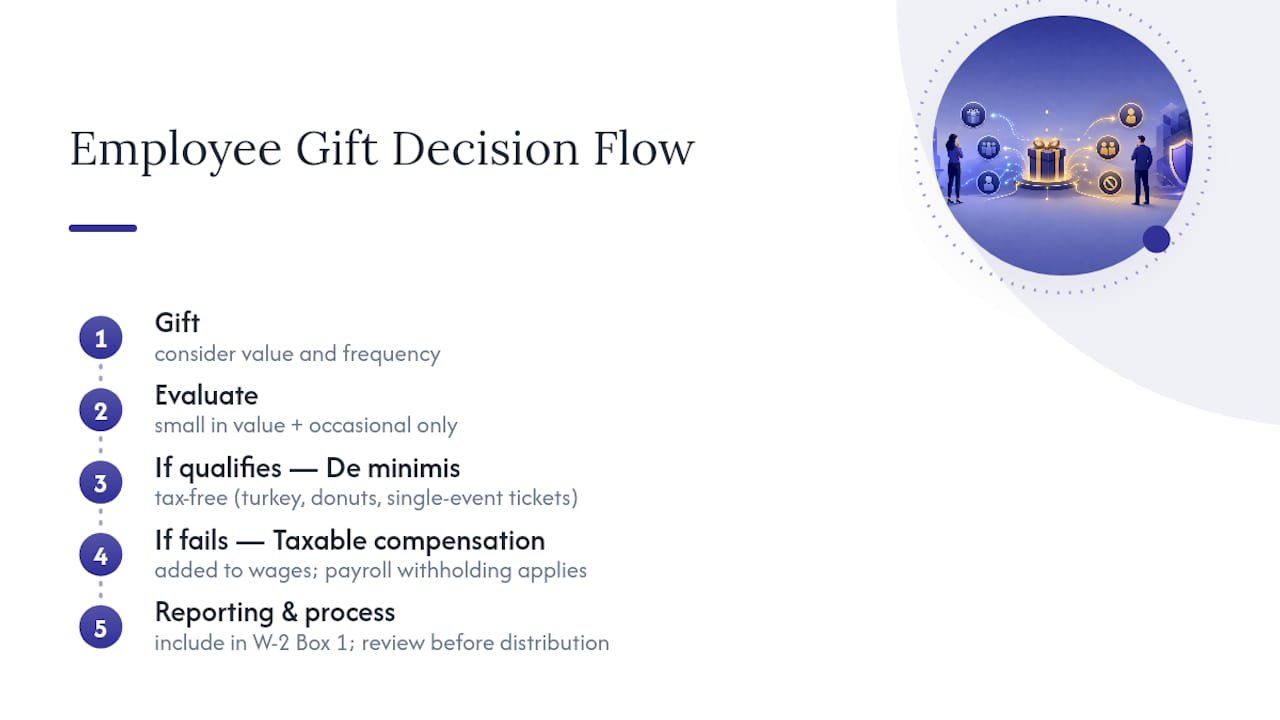
Most gifts to employees are taxable income, and that surprises a lot of HR teams who assume “gift” automatically means “tax-free.” The de minimis fringe benefit rule in Publication 15-B is narrow by design. To qualify, a benefit has to be small in value and infrequent enough that accounting for it would be unreasonable or administratively impractical. A holiday turkey, a occasional box of donuts, or tickets to a single event can often clear that bar. A $75 gift given every quarter almost certainly can’t, because frequency defeats the “occasional” requirement even when the dollar amount seems modest.
Value and frequency work together, not separately. The IRS has never published a hard dollar ceiling for de minimis gifts, which means employers have to use judgment, and judgment calls are exactly what auditors like to second-guess. A single $50 congratulatory gift for a work anniversary probably survives scrutiny. Monthly $50 “appreciation gifts” almost certainly don’t, since the pattern starts to look like disguised compensation rather than an occasional courtesy.
Employee achievement awards run under a different set of rules entirely. Tangible personal property given for length of service or safety achievement can qualify for special tax-favored treatment, but only within specific dollar caps and only when the award comes from a written, non-discriminatory plan. Cash, gift cards, vacations, and meals never qualify as achievement awards, no matter how the program is labeled internally.
Once a gift fails the de minimis test, it becomes ordinary taxable compensation, and that triggers real payroll mechanics. The value gets added to the employee’s wages for the pay period in which the gift was given, subject to federal income tax withholding, Social Security, and Medicare. It needs to show up in Box 1 of that employee’s W-2 at year-end. Waiting until December 31 to sort this out creates a scramble; the cleaner approach is flagging any gift over a modest threshold, or any recurring gift program, for payroll review before it goes out the door, not after.
Gift Cards, Cash, and Cash-Equivalents: Strict IRS Stance
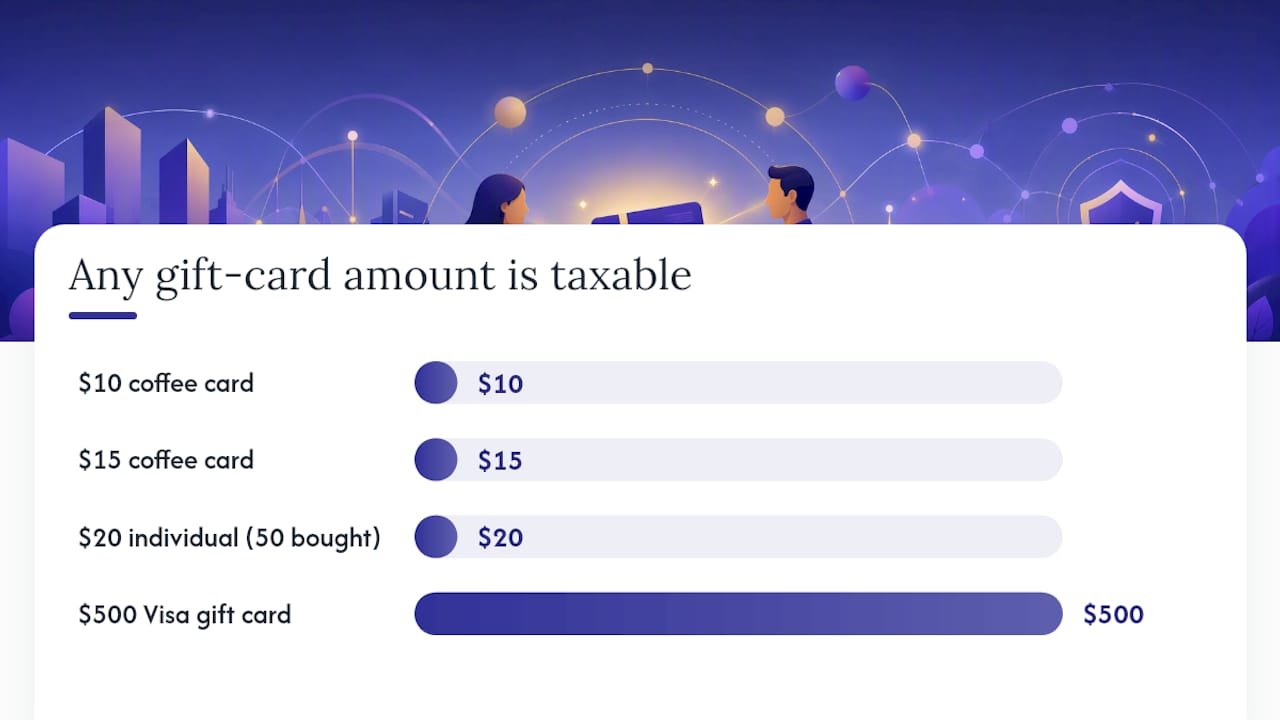
Gift cards get no exception, ever, when given to employees. The IRS treats cash and cash-equivalent items as fully taxable wages, regardless of the dollar amount involved. A $10 coffee shop card fails the de minimis test just as thoroughly as a $500 Visa gift card does. The rule isn’t about size. It’s about the form the gift takes.
This trips up more companies than almost any other corporate gifting mistake. A few patterns to watch for:
- The “small amount, no big deal” assumption. A $15 gift card feels too minor to bother with payroll, but the IRS doesn’t grade cash equivalents on a sliding scale. Any amount is taxable.
- Reloadable gift cards treated like merchandise. A reloadable coffee card functions like cash and gets taxed like cash, even though it feels closer to a physical gift than a check.
- Group gift card purchases with no individual tracking. Buying fifty $20 cards for a team event without recording who received which card creates a documentation gap that’s nearly impossible to fix retroactively.
The fix is straightforward, if unglamorous: run every gift card and cash equivalent through payroll before distribution, not after someone in accounting notices it during a year-end review. Add the value to the employee’s wages for that pay period, withhold federal income tax, Social Security, and Medicare, and confirm your state’s withholding requirements too, since most states follow the federal cash-equivalent standard. If your team has already handed out cards without processing them, correct it in the next available pay cycle rather than waiting for W-2 season. The longer the gap, the messier the correction.
Incidental Costs, Valuation, and the “Substantial Independent Value” Test
Packaging and add-ons don’t automatically blow your $25 limit, but they can if you’re not careful. The IRS excludes incidental costs like engraving, gift-wrapping, and standard shipping from the $25 calculation, as long as those costs don’t add substantial independent value to the item itself.
The distinction comes down to whether the add-on is decorative or functional. A monogram, a company logo, or a ribbon-tied box are cosmetic touches that don’t change what the gift does or how much someone could resell it for. A gift box that includes a second usable item, an upgraded material, or a feature the base item didn’t have creates real value, and real value gets counted toward the cap.
A few practical distinctions:
- Excluded (doesn’t count toward $25): engraving a name or logo, gift wrapping, a greeting card, standard ground shipping, insurance on the shipment.
- Included (counts toward $25): premium packaging that functions as reusable storage, bundled accessories, expedited shipping charged as a service upgrade rather than a delivery cost, and any add-on component with its own resale value.
When you’re sourcing gifts in bulk, structure your purchasing so these costs are visible, not buried. If a supplier bundles engraving and shipping into one flat per-unit price, ask for an itemized invoice instead. Keeping shipping, engraving, and packaging as separate line items on your invoice makes it far easier to demonstrate, if you’re ever asked, that the base gift stayed under $25 and the extras were genuinely incidental. That kind of paper trail is cheap insurance against a disallowed deduction.
Recordkeeping Checklist and Sample Documentation
Every deductible business gift needs five things on file: the date given, the recipient’s name and title, a description of the item, its cost, and the business purpose behind it. Miss any one of those fields and you’ve handed an auditor an easy reason to disallow the deduction. This isn’t a suggestion buried in Publication 463; it’s the baseline substantiation the IRS expects to see if a business gift deduction gets questioned.
A workable documentation checklist looks like this:
- Date of the gift (not the order date, the date it was delivered or given)
- Recipient’s full name and title or role, so it’s clear this was a business relationship, not a personal favor
- Item description and unit cost, itemized separately from any incidental costs like engraving or shipping
- Business purpose, even a short phrase like “client renewal thank-you” or “referral appreciation”
- Total cost per recipient for the year, tracked cumulatively, not just per transaction
Pro Tip: Build these five fields directly into your purchase order or gifting platform intake form so nobody has to reconstruct the paper trail six months later during tax prep.
Mass distributions need a slightly different approach than one-off gifts. If you’re sending the same item to 200 clients on a holiday mailing list, you don’t need 200 separate justifications, but you do need a master list tying each recipient’s name to the item and cost, plus one business purpose statement covering the whole campaign. Individual, high-value gifts (an executive gift to a single major client, for instance) warrant their own specific note explaining the occasion.
Fulfillment paperwork does a lot of this work for you automatically if you set it up right. Pick, pack, and shipping receipts from a bulk order can double as recipient-level evidence, provided the order data captures names and addresses rather than just quantities. That’s one more reason to route large gifting programs through a single documented process instead of scattered individual purchases across departments.
Tax Reporting: Payroll Treatment, W-2s, and When Form 709 Matters
Employee gifts that fail the de minimis test go straight into payroll. The value gets added to wages for the relevant pay period, subject to federal income tax and payroll tax withholding, and it needs to appear in Box 1 of that employee’s W-2 at year-end. There’s no separate “gift” reporting category on the W-2; it’s just wages.
Form 709 is a different animal entirely, and it rarely enters the picture for ordinary corporate gifting. Form 709 covers personal gift tax, filed by individuals who give more than the annual exclusion amount to any one person in a calendar year. A business handing out $22 desk gifts to two hundred clients isn’t triggering Form 709 for anyone; that’s an ordinary, deductible business expense governed by IRC §274, not a personal transfer subject to gift tax.
Form 709 becomes relevant only when a business gift starts looking like a disguised personal transfer. Gifts to shareholders in a closely held corporation deserve particular caution here. If a company gift to a majority shareholder looks more like a distribution of profit than a genuine business courtesy, the IRS can recharacterize it as a dividend or as compensation, both of which carry very different tax consequences than a simple $25 deduction. The same risk applies to gifts that route company money toward an owner’s family member with no clear business rationale. When gifting overlaps with ownership structure, loop in your tax advisor before, not after, the transfer happens.
Common Mistakes and Audit Red Flags
Most corporate gifting problems trace back to a handful of repeat offenders. Misclassifying gift cards as de minimis fringe benefits tops the list, since it’s the single most common way employers create unreported taxable wages without realizing it. Right behind it: missing recipient names or business purpose on gift records, which turns a legitimate $25 deduction into an unsubstantiated one the moment an auditor asks for backup.
A third pattern shows up around entertainment. Tickets to a game, a round of golf, or a dinner given to a client sometimes get filed under “gifts” when they should be evaluated under entertainment expense rules instead, which follow a completely different set of limitations. Mixing the two categories muddies your records and can misstate your actual deductible amount either direction.
The fixes here are mostly procedural, not legal. Standardize a gift documentation template across departments so nobody’s improvising the paper trail. Set a pre-approval threshold, maybe anything over $20, that requires a quick sign-off before purchase, catching potential de minimis violations before the gift ships rather than after. And loop payroll in early on any employee gifting program, especially recurring ones, so withholding gets handled in the same pay cycle instead of as a year-end correction nobody enjoys running.
Practical Compliance Tactics From Discountswag
Designing a compliant gifting program starts with the product decision, not the tax form. If you’re distributing an item broadly, say, branded notebooks or drinkware to an entire prospect list, keeping the unit cost low and permanently marking it with your company logo can shift the item into advertising expense territory instead of the business-gift category, which means it isn’t capped at $25 at all. That distinction between promotional advertising and a personal business gift is worth understanding before you place a bulk order.
Packaging and SKU selection matter more than most teams realize. A $22 item bundled with a $10 add on accessory can quietly cross into “substantial independent value” territory, pulling the whole package over the cap even though neither piece alone would trigger it. Choosing SKUs deliberately, and keeping bundles simple, avoids that trap.
Pro Tip: Ask your fulfillment partner for packing slips that tie each SKU to a named recipient before the order ships, not after. Reconstructing that data later, once boxes are already out the door, is far harder than capturing it at the point of fulfillment.
Invoicing practices help too. Request itemized invoices that separate the base product cost from engraving, packaging, and shipping charges. That itemization is exactly what supports the incidental-cost exclusion if your deduction ever gets questioned, and it turns a fulfillment receipt into an audit-ready document instead of just a shipping confirmation.
Trading Off Relationship ROI With Tax Compliance
Everyone assumes the more expensive gift wins the relationship. It usually doesn’t, and once you factor in tax treatment, the math gets worse for expensive gifts, not better. A well chosen $22 item with a genuine handwritten note and airtight documentation beats a $75 gift basket that trips the de minimis threshold for an employee or crosses into questionable territory for a client. The cheaper gift is fully deductible, cleanly documented, and creates zero downstream tax headache. The expensive one might generate more goodwill in the moment, but if it lands on an employee’s W-2 as unplanned taxable income, that goodwill evaporates fast.
The real failure point in most companies isn’t the tax rule itself; it’s that marketing picks the gift, HR finds out after it’s shipped, and payroll finds out during year-end review. Build the gifting decision as a three-way conversation from the start. It costs almost nothing and saves you the correction cycle every single time.
— Jerry
Source Compliant Corporate Gifts Through Discountswag
Some online distributors exist for exactly the compliance headache this article just walked through: sourcing bulk branded items that stay under the $25 threshold, or that qualify as advertising instead of a gift because they carry a permanent logo and go out broadly. Instead of guessing at unit costs and hoping your invoice breaks out engraving separately, you get itemized pricing and kit fulfillment built around recipient-level packing slips, the exact documentation your finance team needs if a deduction ever gets questioned.
Browse the difference between promotional products and corporate gifts to see which category fits your next order, or go straight to corporate gift sets built for compliant, recipient-tracked fulfillment and get a quote before your next client mailing or employee appreciation round ships.
This article is general information, not a substitute for advice from a qualified financial advisor. Consult a qualified financial professional about your own circumstances before acting on anything here.
Sources
- Income & Expenses 8 | Internal Revenue Service
- 26 CFR § 1.274-3 – Disallowance of deduction for gifts (LII / Cornell)
 Bottle Carriers
 Mugs
Mugs