


Rush Order Promotional Products: A Marketer’s Guide


Your trade show opens in four days and the branded giveaways never got ordered. Sound familiar? Rush order promotional products exist precisely for moments like this. Whether you’re managing a last-minute conference, an emergency campaign launch, or a stockout that nobody caught until Tuesday, knowing how to navigate a rush order can be the difference between showing up prepared and showing up empty-handed. This guide walks you through what rush orders actually involve, what you need to have ready before you call a supplier, and how to execute without blowing your budget or your brand standards.
Table of Contents
- Key takeaways
- Understanding rush order promotional products
- What to have ready before you place a rush order
- How to execute a rush order from start to finish
- Common mistakes that derail rush orders
- Verifying quality and timing when your order arrives
- My honest take on rush orders in marketing
- Get your rush order done right with Discountswag
- FAQ
Key takeaways
| Point | Details |
|---|---|
| Rush orders carry real trade-offs | Faster turnaround typically means fewer product options, higher costs, and reduced quality checks. |
| Artwork readiness is everything | Having print-ready files before you contact a supplier is the single biggest time-saver in any rush order. |
| One internal decision-maker wins | Multiple approvers kill rush timelines. Assign one person with full authority before you start. |
| Budget for rush fees upfront | Suppliers charge flat or percentage-based fees for expedited production, and those costs add up fast. |
| Verify before you distribute | Inspect quantity, print quality, and specs the moment your order arrives, not the morning of the event. |
Understanding rush order promotional products
So what exactly is a rush order in promotions? A rush order is any request that compresses the standard production and delivery timeline significantly, typically from a few weeks down to a few days or even 24 hours. Standard production for most branded merchandise runs 10 to 15 business days. Rush orders collapse that window on purpose, with the expectation that both the client and the supplier are moving fast and communicating clearly.
The most common rush order promotional items examples include products that are easy to customize quickly and available in pre-decorated or blank stock. Think along these lines:
- Custom pens and writing instruments — fast to imprint, widely stocked
- Branded tumblers and drinkware — high perceived value, often available for quick turnaround
- Tech accessories — phone wallets, cables, and power banks that ship fast
- Lanyards and badge holders — conference staples with short production cycles
- Branded tote bags — lightweight, inexpensive, and quick to screen print
- Custom apparel — T-shirts and polos, though rush production may limit garment color and style options
The situations that create rush orders are usually predictable in hindsight. A conference gets added to the calendar late. A client gifts program falls through with a vendor. A marketing campaign gets greenlit two weeks before the activation date. Or, most painfully, someone assumed someone else placed the order. Some suppliers can produce rush promotional items in as little as 24 hours, which sounds like a lifeline until you realize how much preparation needs to happen on your end first.
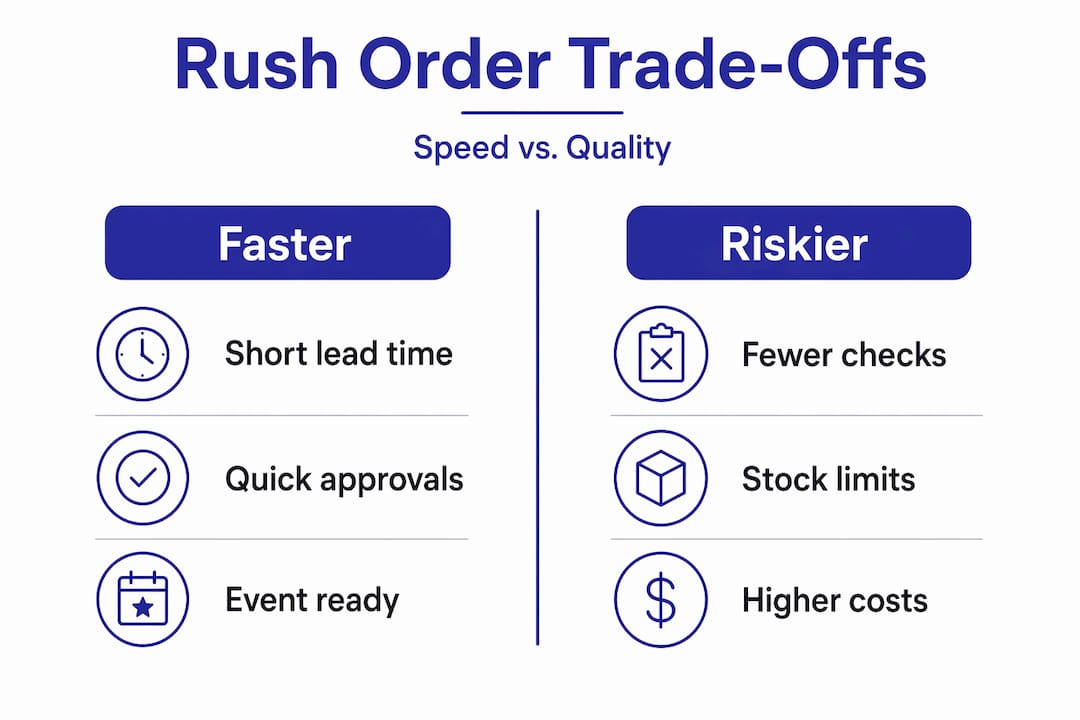
The trade-offs are real. Rush orders cut normal turnaround times from weeks to days, which reduces time for quality checks and increases the risk of errors or product substitutions. You may receive a slightly different product than you originally specified. The cost will be higher. The selection will be narrower. Going in with clear eyes about those realities makes the whole process much less stressful.
What to have ready before you place a rush order
The number one reason rush orders fail is not the supplier. It’s the client. Specifically, it’s the client arriving at the conversation without the files, approvals, or decisions already locked in. Here is what you need to have sorted before you pick up the phone or fill out an online form.
-
Print-ready artwork in the correct format. Most suppliers require vector files (AI or EPS) or high-resolution PDFs. A JPEG pulled from your website will not work. If your brand team needs to prep files, that step must happen before you contact the supplier, not after.
-
Exact quantity confirmed. Guessing on quantity wastes time and money. Know your number before you call. If you are ordering for an event, use your registration count plus a 10% buffer.
-
Sizes, colors, and product specifications locked. For apparel, have your size breakdown ready. For drinkware or tech accessories, confirm the color and finish. Changing specs mid-order on a rush timeline can push your delivery date by a full day or more.
-
A single internal decision-maker assigned. Multiple approvers from marketing, procurement, HR, and event teams slow down rush orders more than production time does. One person needs full authority to approve artwork and confirm the order without escalating.
-
Supplier cutoff times checked. Most suppliers have a daily cutoff for rush orders, often noon or 2 p.m. local time. If you miss that window, your “rush” order starts the next business day.
Pro Tip: Before any major event season, build a “rush-ready” folder in your shared drive with approved brand files in every required format, pre-approved color palettes, and a vendor contact list. When a deadline hits, you open the folder instead of scrambling.
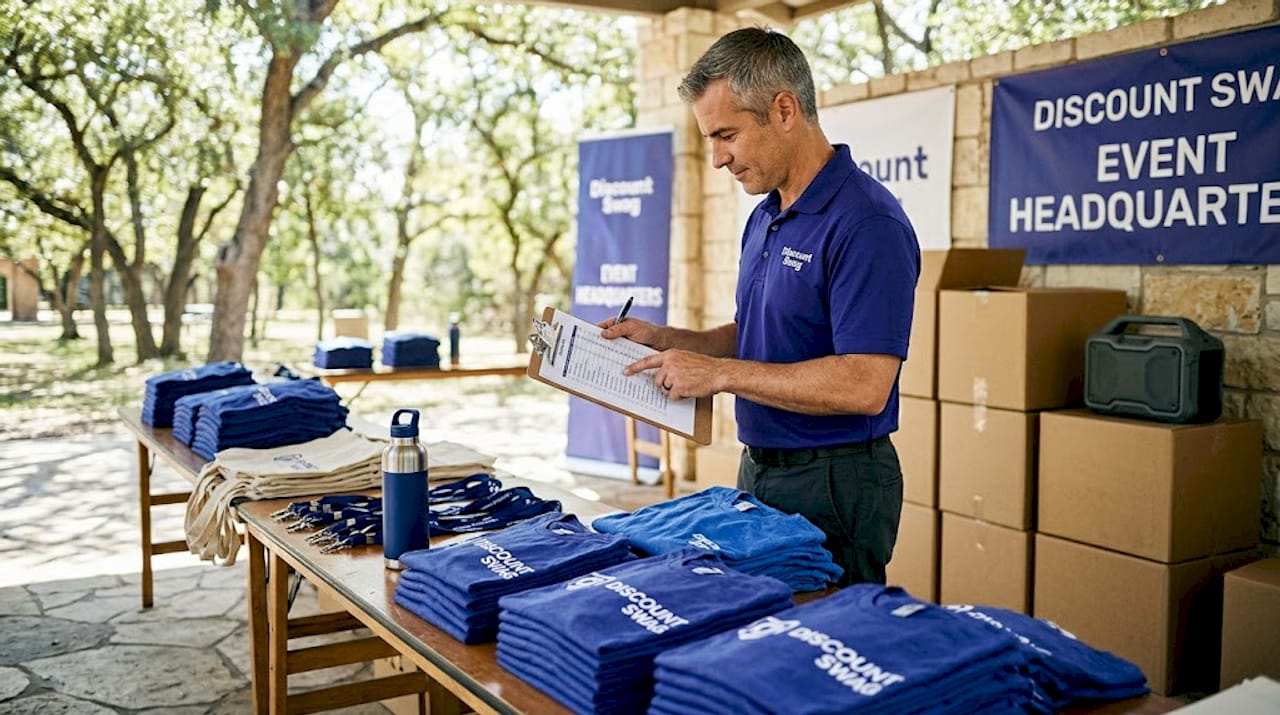
Coordinating apparel, giveaways, and event setup on one timeline with a single supplier can reduce delays and improve consistency. That principle applies even more on a rush timeline.
How to execute a rush order from start to finish
Once your files and decisions are ready, execution moves fast. Here is a step-by-step process that works for most rush order promotional products projects.
-
Identify suppliers with proven rush capabilities. Not every promotional products distributor can actually deliver in 48 to 72 hours. Ask directly: “What is your confirmed in-hands date for an order placed today?” Vague answers like “we can usually rush” are not commitments.
-
Communicate your hard deadline first. Before discussing product, tell the supplier your in-hands date. Let them tell you what is realistically achievable. This filters out options that cannot work and focuses the conversation immediately.
-
Submit complete artwork with your order. Providing complete artwork upfront, along with quantity, size, and delivery details, produces smoother rush order fulfillment. Every revision request adds hours you do not have.
-
Approve proofs within one hour. On a rush timeline, proof approval is your job as much as production is the supplier’s job. Set a calendar block for the moment you submit your order so you are ready to approve or request changes immediately.
-
Confirm shipping method and tracking. Rush production means nothing if the order ships standard ground. Confirm that overnight or two-day air is included in the quote or budget for it separately.
-
Track proactively, not reactively. Check in with your supplier at each production milestone: artwork approved, production started, production complete, shipped. Do not wait for them to call you with problems.
| Stage | Your action | Supplier action |
|---|---|---|
| Order placement | Submit artwork and confirm specs | Confirm stock and in-hands date |
| Proof stage | Approve within 1 hour | Generate and send digital proof |
| Production | Monitor via check-in call | Prioritize on production floor |
| Shipping | Confirm tracking number | Ship via agreed expedited method |
| Receipt | Inspect immediately | Remain available for issue resolution |
Pro Tip: Ask your supplier to send a photo of a finished sample before the full run ships. On rush orders, this quick visual check catches imprint errors before 500 units leave the warehouse.
Product substitutions are common in rush orders due to stock limitations. If a supplier proposes a substitution, ask for a product photo and spec sheet before agreeing. A similar item is not always an acceptable item.
Common mistakes that derail rush orders
Even well-prepared marketers hit avoidable problems on rush orders. Here are the mistakes that show up most often, and what to do when they happen.
-
Sending low-resolution or wrong-format artwork. This is the single most common delay. Your supplier cannot begin production until artwork is approved. Sending a logo pulled from a PowerPoint slide adds hours or days to your timeline.
-
Ignoring stock availability. The product you want may not be in stock at the quantity you need. Some suppliers offer low or no minimum order quantities for rush items, which gives you more flexibility, but you still need to confirm stock before assuming availability.
-
Underestimating shipping time. Production finishing on Thursday does not mean the product arrives Friday. Overnight shipping cutoffs, weekend delays, and carrier volume all affect delivery. Build in at least one buffer day between the shipping date and your event.
-
Forgetting to budget for rush fees. Suppliers charge rush fees as flat rates or percentages to cover overtime and priority scheduling. These fees apply to the product, setup, digitizing, and sometimes artwork separately. Get the full cost breakdown before confirming.
-
Having no backup plan. If your order is delayed or arrives with quality issues, what do you do? Identify a secondary product option and a secondary supplier before you need them. Even a simple branded item from a local print shop can save an event in a pinch.
If an order arrives damaged or with visible print errors, document everything with photos immediately. Contact your supplier the same day. Most reputable distributors will work to resolve quality issues quickly, but they need documentation and prompt notification to act.
Verifying quality and timing when your order arrives
Receiving your rush order is not the finish line. It is a checkpoint. Build time into your event schedule to inspect the shipment properly.
-
Count before you sign. Verify the quantity against your order confirmation before the delivery driver leaves or before you sign off on a freight delivery.
-
Check print quality on multiple units. Pull items from different boxes or locations in the shipment. Imprint consistency can vary across a production run, and catching issues early gives you time to escalate.
-
Confirm specs match what you ordered. Color, size, and product style should match your approved proof. If substitutions were made without your knowledge, that is a conversation to have with your supplier before the event.
-
Provide feedback after delivery. Whether the order went smoothly or hit problems, tell your supplier what worked and what did not. That feedback loop makes future rush orders faster and more reliable, especially if you use the same supplier again.
My honest take on rush orders in marketing
I’ve worked with enough marketing teams to know that rush orders are almost never truly unavoidable. In my experience, about 80% of “emergency” orders trace back to a planning gap that could have been caught two weeks earlier. That is not a criticism. It is just reality, and acknowledging it is the first step to fixing it.
What I’ve learned is that the teams who handle rush orders best are not the ones with the fastest suppliers. They are the ones with the tightest internal processes. A single decision-maker, print-ready files on standby, and a vendor relationship built before the crisis hits. Those three things do more for your rush order success rate than any “guaranteed 24-hour turnaround” claim from a supplier.
I’ve also seen how supplier transparency separates good partners from frustrating ones. A supplier who tells you upfront “we can do 250 units in 72 hours but not 500” is worth far more than one who takes your order and calls you on day three with problems. Ask hard questions before you commit, not after.
The best version of rush order management is treating it as a system, not a scramble. Even if you cannot avoid the tight deadline, you can control how prepared you are when it hits.
— Jerry
Get your rush order done right with Discountswag
When a deadline is real and the clock is moving, you need a partner who knows exactly what is possible and what is not.
Discountswag specializes in corporate promotional products with fast turnaround options across categories that matter most to marketing teams and event planners. From logo tech accessories like branded power banks and cables to corporate apparel and drinkware, the catalog is built for teams that need quality and speed together. Browse bulk promotional options to find items that fit your timeline and budget, or reach out directly for personalized guidance on what can realistically ship in your window. Discountswag’s team will give you straight answers on stock, turnaround, and cost so you can make confident decisions fast.
FAQ
What is a rush order in promotions?
A rush order in promotions is a request to produce and deliver branded merchandise faster than standard lead times, typically compressing a 10 to 15 business day timeline down to 1 to 5 days. Rush orders usually involve higher costs and fewer product options.
What are the most common rush order promotional items?
The top rush order promotional products include pens, branded tumblers, tech accessories, lanyards, tote bags, and basic apparel like T-shirts. These items are widely stocked and fast to customize with a logo or brand message.
How much do rush fees add to the cost of an order?
Rush fees are charged as flat rates or percentages and can apply to the product, setup, digitizing, and artwork separately. Always request a full cost breakdown before confirming a rush order to avoid budget surprises.
How do I avoid delays on a rush promotional order?
Submit print-ready artwork in the correct file format, confirm all specs upfront, assign one internal approver, and approve proofs within one hour of receiving them. Customers who provide complete details upfront consistently experience faster and smoother rush order fulfillment.
What should I do if my rush order arrives with quality issues?
Photograph the issues immediately, count the quantity, and contact your supplier the same day. Document everything before the event so your supplier can assess and respond quickly. Most reputable distributors will work to resolve issues when notified promptly with clear evidence.
 Bottle Carriers
 Mugs
Mugs