

Promotional Product Vendor Selection: 2026 Guide


Promotional product vendor selection is the process of choosing a supplier that delivers quality branded merchandise and supports your program’s full operational requirements. Most marketing teams focus on product catalogs and unit prices, then discover too late that their vendor cannot handle on-demand fulfillment, multi-location shipping, or consistent Pantone color matching at scale. The industry recognizes this process under the broader term supplier evaluation, and the best practitioners treat it as a structured procurement exercise, not a quick catalog browse. This guide gives you the criteria, checklists, and tools to make the right call in 2026.
What operational capabilities should you evaluate in a promotional product vendor?
Operational infrastructure is the main differentiator among promotional product vendors at the enterprise level, not product quality alone. Product quality is the baseline. What separates a vendor that scales with your program from one that creates headaches is how they handle the work behind the order.
Before you request a single quote, ask these diagnostic questions:
- On-demand fulfillment: Can the vendor ship individual units to employee home addresses, or do they require bulk pallet drops only?
- Minimum order quantities (MOQs): Do their MOQs align with your distribution cadence? A vendor requiring 500-unit minimums will force you to redesign a 50-person onboarding kit program.
- Address collection workflows: Does the vendor support employee self-service address entry through a store portal, or does your team manually compile spreadsheets before every order?
- Reporting and tracking: Can they provide order-level tracking, reorder alerts, and inventory reports on demand?
- Late reorder handling: What is their escalation process when a reorder arrives after a production cutoff?
- Multi-location support: Can they fulfill to offices in Chicago, Austin, and Seattle from a single order without manual splitting?
Enterprise-ready vendors provide full service scope including sourcing, decoration, company stores, storage, kitting, fulfillment, and global distribution. That full-service model matters because a gap in any one area creates program failure. Enterprise swag store programs often fail due to address and fulfillment workflow issues, not decoration quality. That finding should reset your evaluation priorities immediately.
Pro Tip: Ask every vendor shortlisted for your program to walk you through exactly how they handle an employee address change after an order is placed. Their answer reveals more about operational maturity than any sales deck.

Vendor scalability is the final test. A vendor that handles 200 units today should demonstrate a clear process for handling 2,000 units next quarter without service degradation. Ask for references from clients with programs similar in size and complexity to yours.
How to assess product quality and branding consistency
Physical sample validation avoids costly brand damage caused by inconsistent decoration or off-brand colors. A digital proof on a screen looks nothing like an embroidered logo on a navy fleece under fluorescent office lighting. Request physical samples before committing to any vendor, and evaluate them against your brand standards document.
Follow this quality assessment sequence:
- Request a physical sample of your specific product. Not a generic catalog sample. Your logo, your colors, your decoration method.
- Verify Pantone color matching. Compare the decorated item against your official Pantone reference. Even a slight shift in a brand color reads as unprofessional at scale.
- Evaluate decoration method variety. Confirm the vendor supports embroidery, screen printing, laser engraving, or heat transfer, depending on what your product mix requires.
- Apply the golden sample standard. Lock one approved pre-production unit as the quality benchmark for the full production run. Golden sample discipline reduces costly reprints and ensures large-scale brand consistency across thousands of units.
- Define your QC inspection level. For large orders, specify whether you require pre-shipment inspection at the factory or acceptance sampling at the warehouse.
The golden sample approach is the single most underused quality control tool in promotional merchandise procurement. Most buyers approve a digital proof and assume the production run will match. It rarely does without a locked physical benchmark.
Pro Tip: When evaluating a new vendor, order the same product from two competing suppliers simultaneously. A side-by-side physical comparison reveals quality differences that no spec sheet or sales call will surface.
For guidance on what quality standards to require from any supplier, Discountswag’s 2026 quality guide breaks down the key benchmarks marketing teams should hold vendors to.
What pricing and cost factors are critical when choosing promotional vendors?
The headline price on a vendor’s catalog is never the full price. Full cost disclosure is required before committing to any supplier. Buyers who skip this step routinely discover that a $4.00 unit price becomes $9.50 per unit after setup fees, individual fulfillment charges, and shipping costs are added.
Request a complete cost breakdown that covers every line item:
- Unit price at your specific order quantity
- Setup fees per decoration location and per color
- Storage fees if the vendor warehouses your inventory between distributions
- Kitting fees if items are assembled into gift sets or onboarding boxes
- Per-order fulfillment fees for individual shipments to employee addresses
- Delivery costs by destination zone, including any dimensional weight surcharges
- Rush production premiums and what triggers them
Comparing vendors on unit price alone is the most common and most expensive mistake in promotional product sourcing. Two vendors quoting $5.00 per unit can have a $4.00 per-unit difference in total landed cost once all fees are included.
MOQ structures also affect total program cost in ways buyers often miss. A vendor with a 250-unit minimum forces you to carry inventory you may not distribute for months. That inventory ties up budget and creates storage costs. Aligning vendor MOQs with your distribution cadence prevents forced program redesign and budget overruns. Always model your realistic distribution volume before accepting any vendor’s MOQ terms.
What procurement workflows and tools speed up vendor evaluation?
A structured sourcing workflow separates professional procurement from reactive buying. The standard sourcing sequence runs from defining product needs, to filtering suppliers by parameters, to quoting, to sample approval, and finally to order placement. Skipping any stage creates downstream risk.
The table below maps each stage to its key action and the risk you eliminate by completing it properly.
| Sourcing Stage | Key Action | Risk Eliminated |
|---|---|---|
| Define product needs | Specify category, quantity, decoration, and budget | Misaligned vendor proposals |
| Filter suppliers | Screen by MOQ, lead time, and credibility | Unqualified vendor shortlists |
| Request quotes | Get full cost breakdowns from 3+ vendors | Hidden fee surprises |
| Sample approval | Evaluate physical samples against brand standards | Brand color and quality failures |
| Order placement | Confirm timeline, production, and shipping milestones | Missed campaign deadlines |
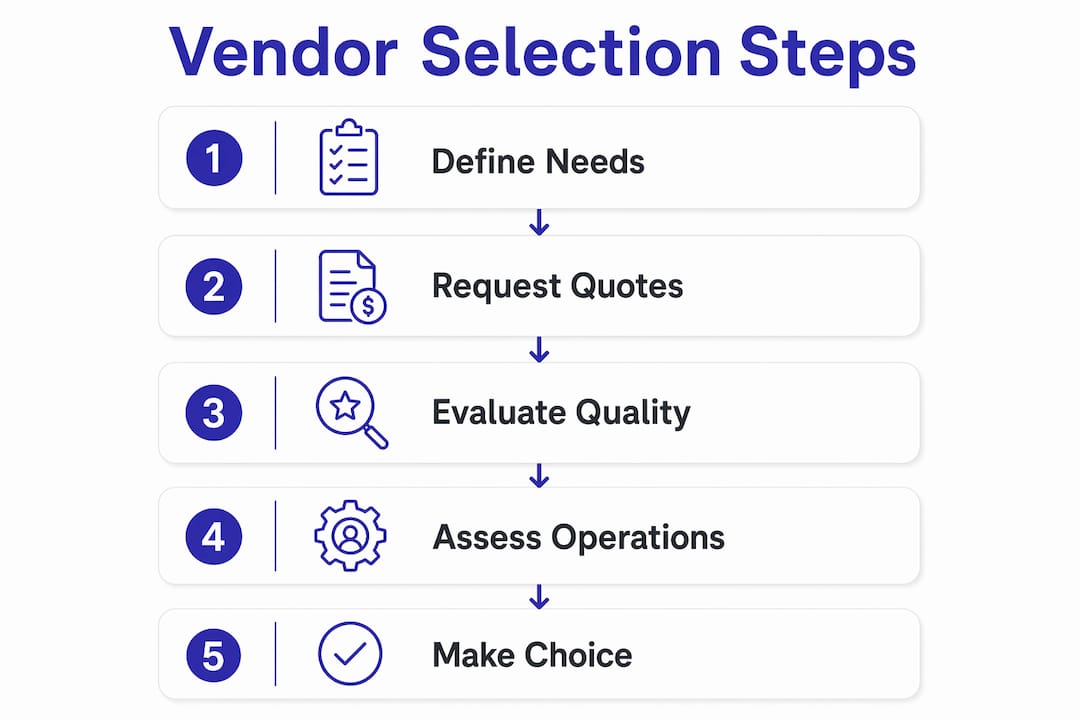
ASI’s ESP+ platform enables searching, quoting, and workflow tracking in minutes versus hours manually. For procurement teams managing multiple vendor relationships, a platform like ESP+ reduces the time spent on supplier comparison from days to hours. Supplier credibility and precision filtering drive sourcing success, so verify financial stability and client references before advancing any vendor to the sample stage.
Timeline management is where most programs slip. Simple swag programs can be set up in 1–2 weeks, but complex programs with custom decoration, kitting, and multi-location fulfillment require significantly longer lead times. A sourcing methodology that accounts for 3 days sourcing, 7 days sample approval, and 20 days production gives you a realistic planning baseline. Build that timeline into your campaign calendar before you select a vendor, not after.
For teams sourcing bulk promotional products on a budget, Discountswag’s procurement guide covers how to structure orders to maximize value without sacrificing brand standards.
Key takeaways
Effective promotional product vendor selection requires evaluating operational infrastructure, quality control discipline, and full cost transparency, not just product catalogs and unit prices.
| Point | Details |
|---|---|
| Operational fit beats product range | Assess fulfillment workflows, MOQs, and reporting before reviewing any product catalog. |
| Physical samples are non-negotiable | Always request a decorated physical sample and lock a golden sample before production runs. |
| Full cost transparency matters | Demand a complete cost breakdown including setup, storage, kitting, and delivery fees. |
| Use a structured sourcing workflow | Follow the five-stage sequence: define, filter, quote, approve, order. |
| Timeline planning prevents failure | Map vendor lead times against your campaign calendar before finalizing any supplier. |
Where most vendor selection processes go wrong
I have reviewed a lot of vendor selection processes over the years, and the pattern that keeps showing up is this: marketing teams spend 80% of their evaluation time on product aesthetics and 20% on everything else. Then the program launches, and the operational gaps surface immediately.
The most painful example is the employee swag store that goes live with no clear process for handling address changes. An employee moves. Their package ships to the old address. The vendor has no escalation path. The marketing team spends three days manually resolving one shipment. Multiply that by a 500-person company, and you have a program that consumes more internal labor than it saves.
My honest advice: bring your HR and procurement colleagues into the vendor evaluation from day one. Marketing tends to own the product decision, but HR owns the employee experience and procurement owns the contract terms. A vendor that looks great in a marketing review can fail badly on procurement’s financial stability check or HR’s data privacy requirements.
The vendors worth working with are the ones who ask you hard questions before they pitch. They want to understand your distribution cadence, your brand standards document, and your escalation expectations. A vendor who skips those questions and goes straight to the catalog is telling you something important about how they will operate once the contract is signed.
On-demand fulfillment capability is the single criterion I weight most heavily in 2026. The shift to hybrid and remote work means your branded merchandise needs to reach individuals at home addresses, not just office loading docks. Any vendor who cannot demonstrate a clean, tested workflow for individual shipments is not built for how corporate programs actually run today.
— Jerry
See what Discountswag offers for your next program
Discountswag is a U.S.-based distributor of corporate promotional products built for marketing teams that need more than a product catalog.
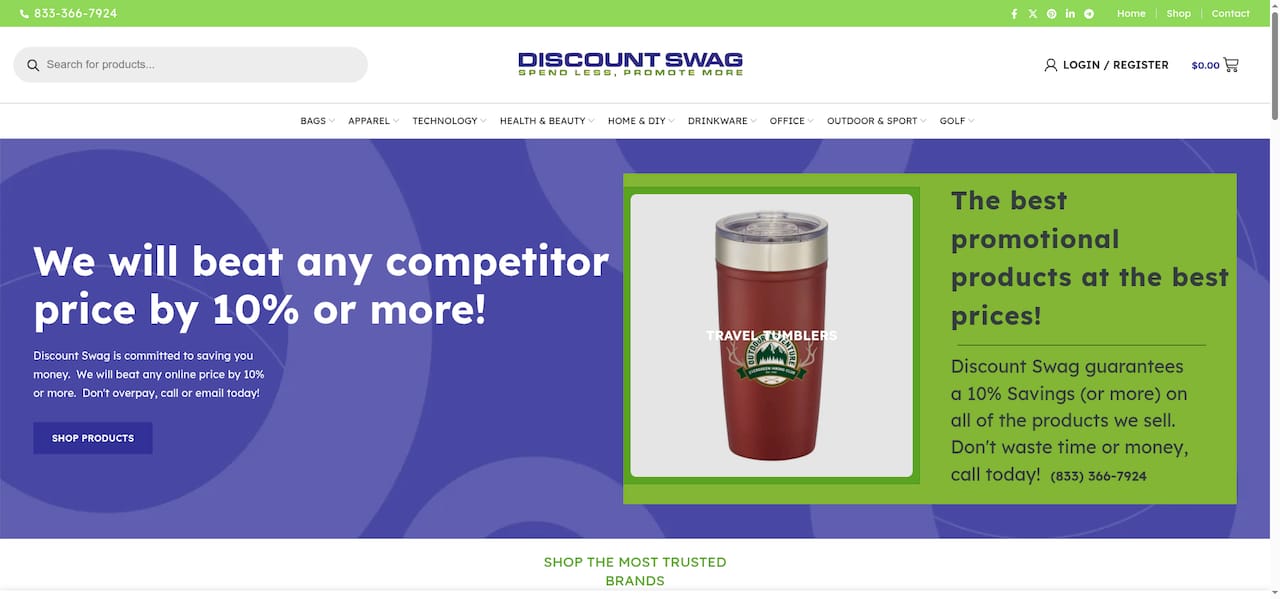
From branded merchandise for corporate programs to corporate gift sets designed for client appreciation and employee recognition, Discountswag covers the full range of what a modern marketing program requires. The catalog includes customizable apparel, drinkware, tech accessories, and event merchandise, all available with decoration options that meet brand standards. Fulfillment, kitting, and bulk ordering support are part of the offering, not add-ons. If you are evaluating vendors for a 2026 program, Discountswag is worth a direct comparison against your current supplier on total landed cost and fulfillment capability.
FAQ
What is promotional product vendor selection?
Promotional product vendor selection is the structured process of evaluating and choosing a supplier based on product quality, operational capabilities, pricing transparency, and program fit. It goes beyond catalog browsing to assess fulfillment infrastructure, MOQs, and brand consistency.
How many vendors should i quote before deciding?
Request quotes from at least three vendors to get a meaningful cost comparison. Filtering by MOQ, lead time, and supplier credibility before quoting saves time and produces more relevant proposals.
Why do enterprise swag programs fail?
Enterprise swag programs most often fail due to address collection and fulfillment workflow gaps, not decoration quality. Evaluating a vendor’s order management process is as important as reviewing their product samples.
What is a golden sample in promotional product sourcing?
A golden sample is an approved pre-production physical unit locked as the quality benchmark for a full production run. Using a golden sample reduces reprints and protects brand consistency across large orders.
How long does vendor onboarding take?
Simple programs can launch in 1–2 weeks, while complex programs with custom decoration, kitting, and multi-location fulfillment require significantly more lead time. Build vendor onboarding timelines into your campaign calendar before selecting a supplier.
 Bottle Carriers
 Mugs
Mugs