

The Role of Branded Merchandise in Brand Engagement


Most marketing budgets treat branded merchandise as an afterthought. A box of pens at a trade show. A tote bag stuffed into a swag bag. That instinct badly underestimates the role of branded merchandise in building lasting brand equity. The research tells a different story: promotional products outperform TV and digital in consumer preference, generate thousands of impressions per item, and carry a carbon footprint per memorized impression that makes digital advertising look wasteful by comparison. This article breaks down the mechanics, the psychology, and the practical application so you can start treating merch like the brand asset it actually is.
Table of Contents
- Key takeaways
- The role of branded merchandise in brand recall
- How merch builds emotional connection and loyalty
- Sustainability and the branded merchandise advantage
- Best practices for maximizing merch impact
- My take on where branded merch is actually heading
- Put your merch strategy into practice with Discountswag
- FAQ
Key takeaways
| Point | Details |
|---|---|
| Merch beats digital on recall | 85% of consumers remember the brand that gave them a promotional product, outperforming TV and digital ads. |
| Cost-per-impression is tiny | A single tote bag can generate 5,000 impressions at roughly $0.001 each, making merch one of the most budget-efficient channels. |
| Emotion drives loyalty | 83% of consumers feel appreciated when receiving branded merch, which directly improves brand perception and repeat purchase behavior. |
| Sustainability is a real advantage | Branded merchandise produces about eight times less carbon per memorized impression than digital advertising. |
| Quality determines ROI | Items that are useful, well-designed, and durable get kept for six months or longer, compounding brand exposure over time. |
The role of branded merchandise in brand recall
The standard argument for promotional products starts and ends with visibility. Your logo on a pen, your URL on a water bottle. That framing is too narrow, and it’s why so many merch programs underperform.
What actually happens when someone receives a quality branded item is more interesting. 85% of consumers remember the advertiser who gave them a logoed product. Compare that to digital display advertising, where recall rates hover in the low single digits. The difference is not the logo size. It’s the physical, repeated nature of the interaction. Every time someone uses your branded tumbler at their desk, they’re encoding a memory of your brand without you paying for an additional impression.
The cost math reinforces this. A $6 tote bag generates roughly 5,000 impressions over its lifespan, putting the cost-per-impression around $0.001. No paid social campaign comes close.
Here’s a channel comparison that illustrates why the importance of branded products often gets undervalued in media planning:
| Channel | Avg. cost-per-impression | Consumer recall rate | Lifetime impressions per unit |
|---|---|---|---|
| Promotional products | ~$0.001 | 85% | 3,300+ |
| Digital display ads | ~$0.002–$0.005 | 2–5% | Single impression |
| TV advertising | ~$0.02–$0.04 | 30–40% | Single impression |
| Out-of-home (OOH) | ~$0.003–$0.006 | 55–65% | Multiple (location-based) |
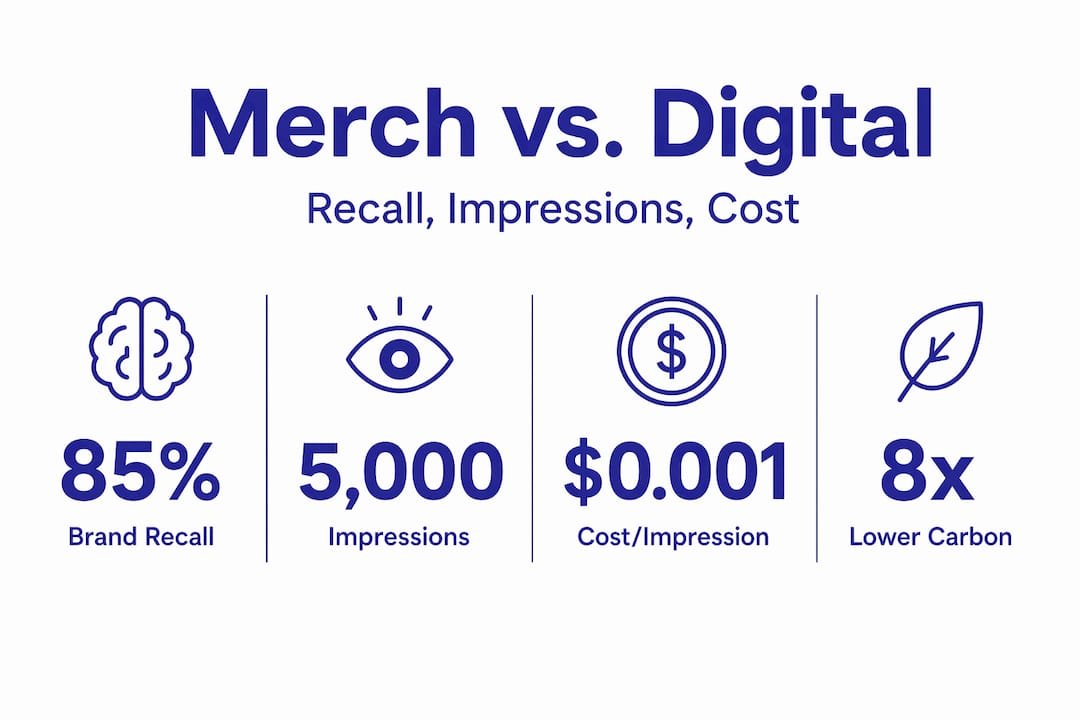
The lifetime impressions column is what separates merch from every other channel. A single item keeps working long after the initial distribution.
Pro Tip: Track impressions per item, not just units distributed. If a premium branded water bottle gets used twice a day for a year, that’s over 700 brand exposures from one object. Capture that in your reporting so leadership sees the full media value.
How merch builds emotional connection and loyalty
The benefits of promotional items go well beyond awareness. There’s a psychological dimension that most marketers miss when they think about how branded merchandise works.
83% of consumers say receiving promo products makes them feel appreciated, and 90% say it improves their perception of the brand. That combination of appreciation and positive perception is the emotional engine behind loyalty. When your customer receives a well-chosen branded gift, you’re not just reminding them you exist. You’re communicating that you understand them and value the relationship.
The role of branded employee gifts operates the same way internally. When employees receive quality branded apparel or tech accessories, 72% associate it with feelings of pride, belonging, or gratitude. That’s not a soft metric. Pride and belonging are directly correlated with retention, engagement, and brand advocacy, which means your employee merch program is doing talent strategy work simultaneously.
Here’s what the emotional benefits look like when you map them to specific business outcomes:
- Increased brand preference: Consumers who feel appreciated by a brand are more likely to choose it over a competitor at equal price points.
- Word-of-mouth amplification: A visible, attractive branded item worn or used in public triggers organic brand conversations.
- Reduced customer churn: Emotional connection creates switching costs that have nothing to do with price or features.
- Higher employee advocacy: Staff who feel recognized through branded gifts are more likely to speak positively about the company externally.
- Stronger event association: Branded merch given at events links positive emotional memories of that experience to your brand identity.
The quality of the item matters more than most brands realize. A poorly made product communicates that you didn’t care enough to invest, which actively reverses the emotional benefit you were aiming for. Product engineering and audience fit are the real ROI drivers here, not logo size or quantity ordered.
Pro Tip: Before finalizing any merch order, ask: “Would I genuinely use this myself?” If the honest answer is no, neither will your recipients. The manufacturing brand strategy principle of emotional resonance applies directly here. Choose items that signal respect for the recipient’s taste.
Sustainability and the branded merchandise advantage
Sustainability is no longer a nice-to-have in marketing strategy. It’s a board-level conversation, and your merch program has a genuinely strong story to tell, if you use the right metrics.
Branded merchandise’s carbon footprint per memorized impression is roughly eight times smaller than digital advertising. That finding flips the intuitive assumption that physical products are automatically less sustainable than digital campaigns. Digital advertising runs on data centers that consume enormous amounts of energy. Each ad impression draws power. A branded product, by contrast, spreads its production emissions across thousands of impressions over its useful life.
Promo products rank second only to out-of-home advertising on low carbon impact per memorized impression. That’s a credible sustainability claim backed by a joint PPAI and ASI study, not a marketing tagline.
Here’s how the channels compare on carbon impact:
| Channel | Carbon impact per memorized impression | Notes |
|---|---|---|
| Out-of-home (OOH) | Lowest | Static structures, minimal energy per impression |
| Promotional products | Second lowest | Emissions spread over many lifetime uses |
| Print media | Moderate | Paper production and distribution add up |
| Digital advertising | High | Data center energy consumption per impression |
| TV advertising | High | Broadcast infrastructure plus production energy |
The strategic implication for brand managers is this: when you communicate merch sustainability, skip generic eco claims. Use the carbon-per-impression metric specifically. Statements like “our branded product campaign delivered 500,000 impressions at a carbon cost eight times lower than an equivalent digital buy” are the kind of board-ready data that justify budget and build internal credibility for your merch strategy.
Supply chain control gives you additional sustainability leverage. Choosing domestic or certified suppliers, recycled materials, and durable construction lets you quantify your program’s footprint with specificity. That specificity is what separates credible sustainability leadership from greenwashing.
Best practices for maximizing merch impact
Knowing the role of promotional merchandise is one thing. Executing a program that actually delivers on that potential is another. Most programs underperform because they treat distribution as the goal. Distribution is just the start.
Here’s a practical framework for getting the most from your branded merchandise strategy:
-
Prioritize usefulness above everything else. 78% of consumers keep promotional products because they find them useful. Useful items get used, and used items generate impressions. Decorative items get thrown away. When selecting products, map them to your audience’s daily context. A developer audience responds to tech accessories and giveaways. A fitness-oriented community responds to drinkware or activewear.
-
Design for daily-use contexts. The “keep-and-repeat” principle means choosing items that fit naturally into routines. A branded tumbler used every morning generates impressions every workday. A branded notebook used in meetings gets seen by multiple people in every session. Think about where your audience spends their time and what objects already live in those spaces.
-
Build in quality signals. 65% of consumers keep branded products for six months or longer when the item is durable, well-designed, and made from quality materials. That’s six months of compounding brand exposure from a single distribution event. Cheap materials break that chain. The item gets discarded in weeks, and the brand association that follows is “they gave me something that fell apart.”
-
Match the item to the occasion. A client appreciation gift at contract renewal communicates something very different from a trade show giveaway. Contextual relevance amplifies the emotional impact. The same branded product can feel generous or generic depending entirely on when and how it’s given.
-
Measure memorized impressions, not just units out the door. Connecting memorization and retention to business outcomes is how you justify merch as a media channel, not a cost center. Survey recipients at 30, 60, and 90 days post-distribution. Track brand recall, product retention, and purchasing behavior. That data makes your next budget conversation straightforward.
-
Avoid the common traps. Low durability, poor design, and irrelevance to the recipient are the three fastest ways to waste your merch budget. Products that succeed combine usefulness, design, sustainability, and emotion, turning a physical object into a brand experience rather than a footnote.
My take on where branded merch is actually heading
I’ve watched the branded merchandise category shift dramatically over the past several years. When I started paying close attention to it, the default mindset was pure volume. Order 10,000 cheap pens, hand them out, and call it done. That approach wasn’t a strategy. It was just spending.
What’s changed is that the best marketing teams now treat merch the way they treat any other media channel: with performance expectations, audience targeting, and measurement frameworks. The brands winning with merch today are the ones that ask “will this item be used in six months?” before they sign a purchase order, not “what’s the lowest unit cost?”
The sustainability angle is where I think the biggest shift is still ahead. Most brand managers I talk to have not yet made the connection between their merch program and their company’s carbon reporting. When they see the data showing promo products’ carbon advantage over digital, it reframes the entire conversation. Suddenly the merch budget isn’t a discretionary line item. It’s part of the sustainability story.
The warning I’d give is this: emotional impact and sustainability are real advantages, but only when the product is genuinely good. A mediocre item with an eco label still communicates carelessness. The standard has to be high, because the product speaks on behalf of your brand every single time it’s used.
Measure the right things. Track impressions, not just inventory. Your merch program deserves to be judged by the same standards as any other paid media investment, and when it is, it usually wins.
— Jerry
Put your merch strategy into practice with Discountswag
Understanding the impact of merchandise branding is one thing. Finding the right products to execute that strategy is where most teams get stuck. Discountswag works with marketing professionals and brand managers who need quality corporate promotional products that actually get used, retained, and talked about. Browse tech accessories for giveaways built for modern audiences who expect products that feel premium. Explore the corporate apparel buying guide for branded clothing that employees wear with genuine pride. Or shop curated picks for client appreciation gifts designed to strengthen the relationships your business depends on. Every product category at Discountswag is selected with the keep-and-repeat principle in mind, because impressions only compound when the item stays in use.
FAQ
What is the role of branded merchandise in marketing?
Branded merchandise functions as a physical media channel that generates thousands of brand impressions per item while creating emotional connections that digital advertising cannot replicate. It supports awareness, loyalty, and brand perception simultaneously across a single campaign investment.
How does branded merchandise compare to digital ads on cost?
A $6 promotional product generates approximately 5,000 impressions at a cost-per-impression of around $0.001, which is significantly lower than digital display advertising. The key difference is that each physical item continues generating impressions for months or years after the initial distribution.
What makes branded merchandise effective for employee engagement?
The effectiveness of corporate gifts for employees comes from the emotional signals they send. When employees receive quality branded items, the majority associate them with feelings of pride and belonging, which correlates directly with retention and internal brand advocacy.
How sustainable is branded merchandise compared to other channels?
The carbon footprint per memorized impression for promotional products is about eight times smaller than digital advertising, according to a joint PPAI and ASI study. Promo products rank second only to out-of-home advertising on low carbon impact, making them a strong choice for sustainability-conscious marketing programs.
What metrics should I use to measure branded merchandise ROI?
Track memorized impressions, product retention rates at 30, 60, and 90 days post-distribution, and downstream brand recall rather than just units distributed. Connecting retention and usage data to business outcomes like brand preference and purchase behavior is what transforms merch from a cost line into a measurable media investment.
 Bottle Carriers
 Mugs
Mugs