

Cost per Impression: Promotional Products ROI Guide


Cost per impression (CPI) for promotional products is defined as the total cost of a branded item divided by the number of times that item delivers a visible brand exposure to a potential customer. According to the ASI Global Advertising Impressions Study, promotional products generate an average CPI of $0.006, making them one of the most cost-efficient advertising channels available to U.S. marketers. A $6 tote bag generating 5,000 impressions produces a CPI of just $0.001. That figure puts branded merchandise ahead of Google Ads, social media, and broadcast television on a pure cost-per-impression basis. This guide breaks down how to calculate, compare, and optimize cost per impression promotional products so your budget works harder.
How is cost per impression calculated for promotional products?
The formula is straightforward: CPI equals the total cost of the item divided by its estimated lifetime impressions. A $10 branded drinkware item generating 3,000 impressions over its lifespan produces a CPI of roughly $0.003. The math is simple. Getting the inputs right is where most marketers go wrong.
Impression estimates vary significantly by product category. Industry benchmarks from the ASI 2026 Ad Impressions Study place fleece jackets at approximately 9,000 lifetime impressions, tote bags at around 4,900, baseball caps at roughly 3,400, and pens at about 3,300. These numbers reflect how often a product is used in public, how long it lasts, and how many people see it during each use. A fleece jacket worn on a commute reaches dozens of eyes per outing. A pen used at a desk reaches far fewer.

Three factors drive impression count upward: product durability, daily utility, and public visibility. Items that people carry, wear, or use in shared spaces accumulate impressions faster than items stored in a drawer. This is why branded merchandise engagement data consistently shows apparel and bags outperforming paper-based items on total impression volume.
The second input, total cost, is where budgets get miscalculated. Unit price is only the starting point.
- Unit price — the base cost per item at your chosen quantity
- Artwork setup fees — typically charged per color or design element
- Custom mold or die charges — can reach $500 or more for unique shapes
- Shipping and freight — often 8 to 15 percent of order value
- Order management and fulfillment — warehousing, kitting, or drop-ship fees
Total promotional cost must include all five components to produce an accurate CPI. Ignoring setup and shipping inflates your apparent ROI and leads to budget shortfalls on repeat orders.
Pro Tip: Before finalizing any promotional product order, request a full landed cost breakdown from your supplier. Divide that total by the product’s industry benchmark impressions to calculate your true CPI before committing.
How do promotional products’ CPIs compare to other advertising channels?
Promotional products deliver impressions at a fraction of what digital and broadcast channels charge. Digital advertising CPMs range from $2 to $20 per thousand impressions, which translates to $0.002 to $0.020 per single impression. Social media platforms like Meta and TikTok typically sit between $0.002 and $0.010 per impression. YouTube pre-roll ads run $0.010 to $0.020. Promotional products land between $0.001 and $0.006. That gap is not marginal. It is structural.
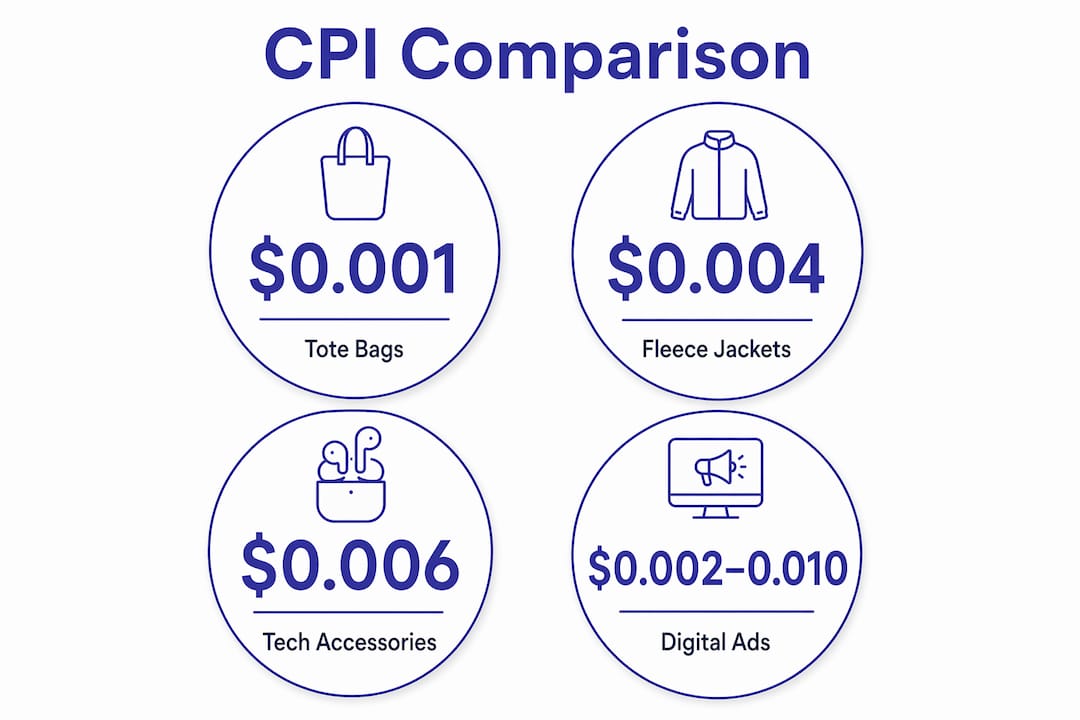
The table below compares CPI benchmarks across major advertising channels:
| Channel | Typical CPI range | Impression type |
|---|---|---|
| Promotional products | $0.001 to $0.006 | Physical, repeated, lasting months |
| Social media ads | $0.002 to $0.010 | Digital, single-view, seconds long |
| YouTube pre-roll | $0.010 to $0.020 | Digital, skippable, one-time |
| TV broadcast (national) | $0.015 to $0.030 | Passive, one-time, 30 seconds |
| Out-of-home (billboard) | $0.003 to $0.010 | Passive, repeated, location-fixed |
The numbers favor promotional products. But the more important distinction is impression quality. A digital ad impression lasts two to five seconds and competes with dozens of other stimuli on a screen. A branded tote bag carried through a farmers market delivers your logo to hundreds of people over the course of an hour, and it does so again next weekend.
“Promotional products serve as a long-term billboard creating repeated brand exposure that digital channels struggle to match in longevity and consumer retention.”
Consumer behavior data reinforces this point. 78% of consumers keep promotional products because they find them useful, and 76% report being more likely to do business with a brand that gave them one. No digital ad format produces that kind of downstream purchase intent. For CPI marketing strategies that prioritize both reach and retention, physical branded items hold a measurable structural advantage.
For context on how to build digital campaigns alongside promotional spending, digital ad best practices for 2026 offer useful benchmarks for blended media planning.
What product types yield the best cost per impression?
Not all promotional products are equal when measured by CPI efficiency. The best value promotional products combine high utility, long functional lifespan, and public visibility. The ASI 2026 data breaks down CPI by category clearly.
| Product category | Estimated lifetime impressions | Approximate CPI |
|---|---|---|
| Fleece jackets | 9,000 | Below $0.004 |
| Tote bags | 4,900 | Around $0.001 |
| Baseball caps | 3,400 | About $0.003 |
| Drinkware (mugs, tumblers) | 3,000 to 4,000 | $0.002 to $0.004 |
| Pens | 3,300 | About $0.002 |
| Tech accessories | 2,500 to 4,000 | $0.003 to $0.006 |
Fleece jackets generate the highest raw impression count because recipients wear them repeatedly in public over multiple seasons. The upfront cost is higher than a pen, but the impression longevity of high-use apparel dilutes that cost to below $0.004 per impression. Tote bags achieve the lowest CPI of any category because they are inexpensive to produce and used constantly in grocery stores, gyms, and transit systems.
Tech accessories, including branded USB drives, wireless chargers, and cable organizers, sit at the higher end of the CPI range but carry a perception premium. Recipients associate tech items with quality, which increases brand favorability beyond what the raw impression count captures. For audiences in professional or corporate settings, logo tech accessories often outperform cheaper items on brand recall even when the CPI is slightly higher.
Drinkware occupies the middle ground. A $15 insulated tumbler used daily at an office generates impressions from coworkers, meeting attendees, and coffee shop patrons. The average promotional product lifespan is approximately 8 months, but quality drinkware routinely exceeds two years of active use, compressing CPI further over time.
Pro Tip: Match product category to audience lifestyle. A tote bag is ideal for consumer-facing campaigns at retail or events. A fleece jacket works best for employee gifting or high-value client programs where the recipient will wear it publicly and repeatedly.
How to optimize promotional product pricing for the best CPI and ROI
Calculating promotional ROI requires moving beyond unit price and treating promotional products as a media buy with a full cost structure. The following practices produce the most accurate CPI calculations and the strongest return on promotional spend.
-
Calculate total landed cost before comparing products. Unit price alone misleads. A $3 pen with $150 in setup fees spread across 100 units adds $1.50 per item to your real cost. A $5 pen with no setup fee is cheaper at that quantity.
-
Use MOQ and EQP pricing to your advantage. Increasing order quantities reduces per-unit cost substantially through end quantity pricing (EQP) tiers. Ordering 500 units instead of 100 can cut unit cost by 30 to 50 percent, which directly compresses CPI.
-
Prioritize product quality over the lowest unit price. High-utility items like bags and apparel generate thousands of impressions because recipients keep and use them. A cheap item that gets discarded after one week produces zero impressions after day seven. The quality-to-impression ratio is the real driver of CPI efficiency.
-
Bundle setup costs across product runs. If you are ordering multiple SKUs, negotiate to share artwork setup fees across the order. Many distributors will apply a single setup charge when the same logo appears on multiple items in one order.
-
Align product selection with campaign duration. Short-term event campaigns benefit from high-volume, low-cost items like pens or notepads. Long-term brand awareness programs justify higher upfront investment in apparel or drinkware because the impression window extends over months or years.
-
Track impressions against campaign goals. Assign each product a benchmark impression count from ASI data, multiply by units distributed, and divide total campaign cost by total projected impressions. This produces a campaign-level CPI that can be compared directly against your digital media buys.
What are common misconceptions about cost per impression in promotional products?
Several persistent misunderstandings cause marketing teams to either overspend on low-performing items or dismiss promotional products entirely as untrackable spend.
-
Cheapest unit price equals best deal. The lowest-priced item rarely delivers the best CPI. A $1 pen discarded in a week generates 200 impressions. A $4 pen kept for a year generates 3,300. The $4 pen produces a CPI of $0.001. The $1 pen produces a CPI of $0.005. Quality wins on CPI math.
-
CPI is just the unit price divided by a guess. Impression benchmarks from ASI research are based on large-scale consumer surveys, not estimates. Using published category benchmarks produces defensible, comparable CPI figures that hold up in budget reviews.
-
Promotional products are feel-good expenses, not measurable media. Marketing professionals who treat branded merchandise as a measurable media channel, with defined CPI targets and impression projections, consistently outperform those who treat it as a line item for events or client gifts.
-
Setup and shipping costs are minor. For small orders, setup fees can represent 20 to 40 percent of total cost. Ignoring them produces a CPI calculation that is materially wrong and leads to budget overruns.
-
All impressions are equal. A promotional product impression, where a recipient actively uses a branded item in public, carries more cognitive weight than a passive digital ad view. Consumer recall data consistently favors physical brand touchpoints over screen-based ones. Budgeting for promotional campaigns should account for impression quality, not just impression volume.
Key takeaways
Promotional products deliver the lowest cost per impression of any advertising channel, with CPI benchmarks between $0.001 and $0.006, but only when total landed cost and product utility are factored into the calculation.
| Point | Details |
|---|---|
| CPI formula | Divide total landed cost (including setup and shipping) by estimated lifetime impressions. |
| Best CPI by category | Fleece jackets and tote bags produce the lowest CPI due to high impressions and long lifespan. |
| Channel comparison | Promotional products CPI of $0.001 to $0.006 beats social media, YouTube, and TV on cost efficiency. |
| Pricing optimization | MOQ and EQP strategies reduce per-unit cost, directly improving campaign-level CPI and ROI. |
| Quality over price | High-utility items generate more impressions over time, making them cheaper per impression than low-cost alternatives. |
Why CPI changed how I think about promotional budgets
I spent years watching marketing teams agonize over the cost of a $15 tumbler while approving $10,000 in Facebook ad spend without blinking. The tumbler felt expensive because the number on the invoice was visible. The Facebook spend felt justified because the dashboard showed impressions. When I started running the CPI math side by side, the conversation changed immediately.
A $15 tumbler generating 4,000 impressions over 18 months produces a CPI of $0.004. That same $10,000 in Facebook ads at a $5 CPM delivers 2 million impressions, but each one lasts three seconds and competes with 15 other posts on a feed. The promotional product impression happens when someone is making coffee in the office kitchen, when a colleague asks where they got that tumbler, when the logo sits on a conference table during a client meeting.
The metric that shifted my thinking most was the consumer retention rate. When 78% of recipients keep a product because it is useful, you are not buying an impression. You are buying a recurring media placement that the recipient opted into. No digital format replicates that dynamic.
My advice: stop buying the cheapest item that fits the budget. Start buying the item that produces the lowest CPI across its full lifespan. That shift, from price-centric to value-centric buying, is where promotional product ROI actually lives.
— Jerry
Find promotional products built for low CPI campaigns
Discountswag carries a curated catalog of corporate promotional products selected for utility, durability, and impression efficiency. Whether you are planning a large-scale event distribution or a targeted client gifting program, the right product choice determines your campaign CPI before a single item ships.
Browse the full range of branded promotional products for marketers at Discountswag to find apparel, bags, drinkware, and tech accessories priced for bulk orders with transparent setup and shipping costs. For teams focused on maximizing impression longevity, the quality-first product guide walks through which categories deliver the strongest return per dollar spent.
FAQ
What is cost per impression for promotional products?
Cost per impression (CPI) for promotional products is the total cost of a branded item divided by its estimated lifetime impressions. The industry average CPI is $0.006, with high-performing items like tote bags reaching as low as $0.001.
How do I calculate CPI for a promotional product campaign?
Add up all costs including unit price, setup fees, shipping, and fulfillment, then divide by total projected impressions across all distributed items. Use ASI category benchmarks to estimate impressions per product type.
Which promotional products have the lowest cost per impression?
Tote bags deliver the lowest CPI at approximately $0.001 per impression, followed by fleece jackets at below $0.004 and baseball caps at around $0.003, according to the ASI 2026 Ad Impressions Study.
How do promotional products compare to digital ads on CPI?
Promotional products range from $0.001 to $0.006 per impression. Social media ads typically cost $0.002 to $0.010 per impression, and YouTube pre-roll runs $0.010 to $0.020. Promotional products match or beat digital channels on raw CPI while delivering longer-lasting impressions.
Does order quantity affect CPI for promotional products?
Larger order quantities reduce per-unit cost through MOQ and EQP pricing tiers, which directly lowers CPI. Ordering 500 units instead of 100 can cut unit cost by 30 to 50 percent, compressing campaign-level CPI significantly.
 Bottle Carriers
 Mugs
Mugs