

How to Brand Employee Gifts Without Wasting Budget

A logo on a cheap giveaway is not an employee gift. It is inventory that may never leave a desk drawer. Learning how to brand employee gifts starts with a more practical goal: choose items people will use, decorate them in a way that looks intentional, and deliver them without creating a fulfillment headache for HR or procurement.
The best branded gifts make employees feel recognized while keeping your company visible in real life. A dependable water bottle gets carried to the gym. A quality backpack travels through airports. A well-built quarter-zip becomes part of someone’s regular rotation. The brand impression lasts because the product earned its place.
Start With the Occasion and the Recipient
Branding decisions should follow the reason for the gift. An onboarding kit has a different job than a work anniversary gift, holiday package, sales incentive, or team retreat giveaway. Start by defining what you want the recipient to feel or do after opening it.
For new hires, the priority is belonging and readiness. A practical combination of drinkware, office supplies, apparel, and a welcome note gives people items they can use on day one. For employee recognition, the gift should feel more personal or elevated. Name-brand drinkware, premium outerwear, tech accessories, and curated gift sets often carry more perceived value than a large box of lower-cost items.
Audience details matter too. A field team may value durable bags, coolers, sun protection, and portable chargers. A hybrid office team may get more use from insulated tumblers, notebooks, headphones, and apparel. If your workforce is spread across climates, job functions, or age groups, a single item can still work, but it needs broad appeal. Drinkware and quality bags are reliable choices because they fit most roles and lifestyles.
Choose Products Worth Putting Your Logo On
Employees can spot a throwaway item quickly. Price matters, especially when ordering at scale, but the lowest unit cost is not always the lowest total cost. If the item has no use, your logo gets no exposure and the budget produces little return.
Look for products with a clear use case, durable construction, and a decoration area that supports your brand. Recognizable brands can be a smart choice for milestone gifts and executive programs because they add instant credibility. For larger onboarding or event orders, high-quality everyday basics may deliver better reach per dollar.
When comparing options, consider these four questions:
- Will employees use this at work, at home, or on the go?
- Does the material and product color work with your logo?
- Is the item appropriate for the quantity and occasion?
- Can it be delivered within your timeline and budget?
A premium bottle may be ideal for a five-year anniversary program but unnecessary for a 2,000-person recruitment event. Conversely, an inexpensive pen may support an event table, but it rarely carries an employee appreciation package by itself. Match the product level to the moment.
How to Brand Employee Gifts for a Polished Look
The most effective branding is clear without being overwhelming. Your logo should be easy to recognize, properly sized, and placed where it complements the product. An oversized logo can make a premium item look promotional. A logo that is too small may disappear on a dark garment or textured surface.
Start with your approved brand assets. Use a vector logo whenever possible, along with the correct Pantone, spot-color, or full-color specifications. This prevents muddy printing, inconsistent colors, and last-minute art revisions. If your logo includes fine lines, small type, gradients, or multiple colors, confirm that the selected decoration method can reproduce it cleanly.
Match the Decoration Method to the Item
Screen printing is a strong, cost-effective option for apparel, tote bags, and many flat surfaces when the design uses limited colors. Embroidery gives polos, jackets, hats, and bags a more durable, elevated finish, though detailed logos may need simplification. Laser engraving creates a subtle, premium look on metal drinkware, tools, and tech products. Full-color digital printing works well when your design includes detailed artwork, color transitions, or photography.
There is no universal best method. A one-color logo on a cotton tote may look sharp with screen printing, while the same logo on a stainless steel tumbler may look better engraved. Ask for a virtual proof before production, and review logo size, placement, orientation, and color carefully. A proof is the final checkpoint before the order becomes physical inventory.
Use Brand Color With Restraint
Product color does much of the branding work before a logo is ever applied. Ordering items in your signature color can create a strong visual connection, especially for apparel, bags, and drinkware. But brand color should not come at the expense of usability.
For example, a bright corporate color may look excellent on a tote but be less appealing for an everyday jacket. Neutral colors such as black, navy, gray, white, and natural canvas often increase the odds that employees will use the item frequently. You can still make the gift feel branded through a tasteful logo, custom packaging, a branded card, or a coordinated mix of products.
Build Gift Sets Around One Useful Theme
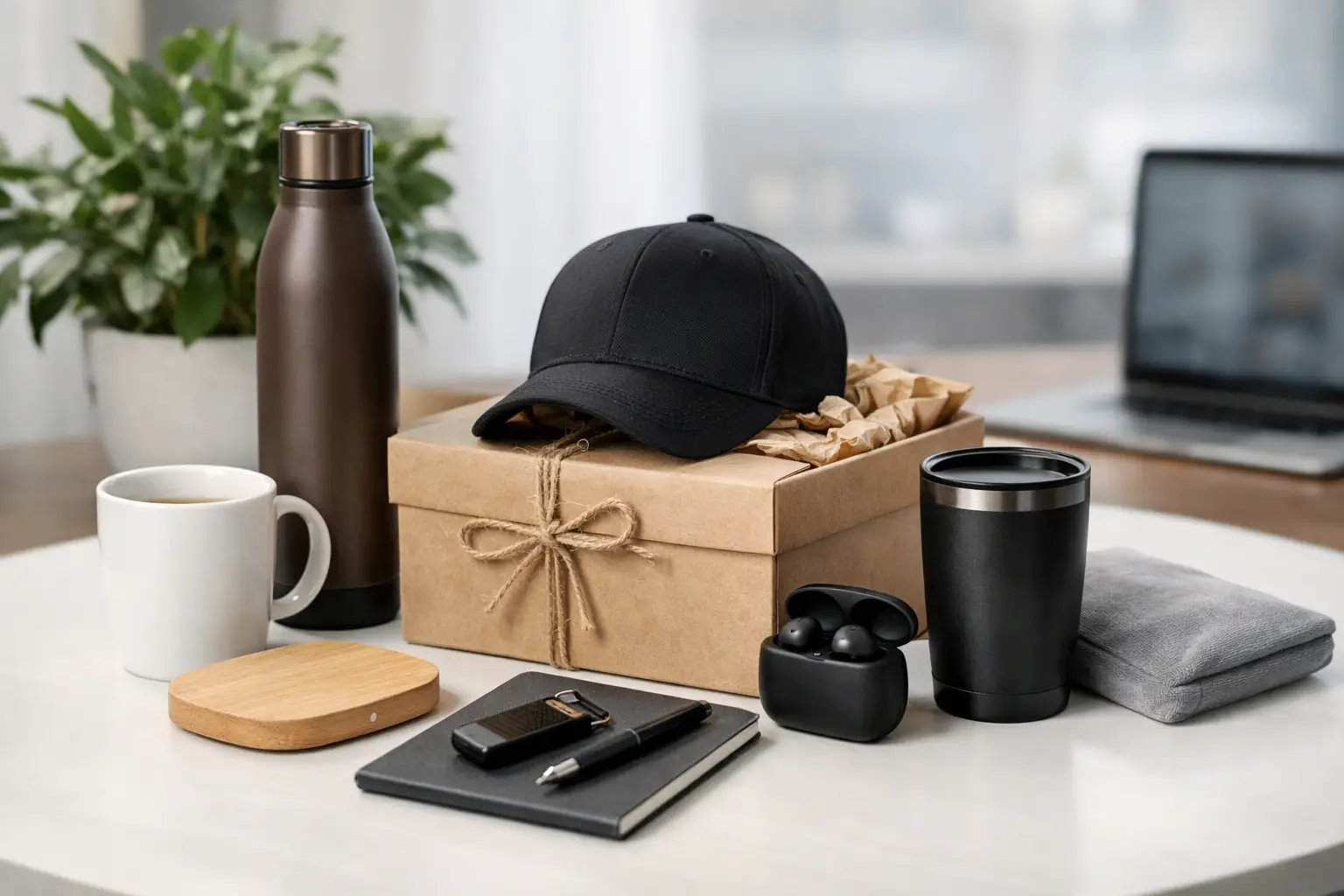
A thoughtful set feels more valuable than a random assortment of products. The items do not need to be expensive, but they should work together. A remote-work kit could include a laptop sleeve, notebook, webcam cover, and insulated mug. A wellness-focused gift can pair a water bottle with a cooling towel, fitness accessory, or self-care item. A travel set may include a backpack, charger, luggage tag, and reusable drinkware.
Keep the number of items focused. Two or three useful products in a clean presentation can feel more premium than six unrelated pieces. Add a brief message from leadership or the employee’s manager when the purpose is recognition. The message turns branded merchandise into a genuine acknowledgment.
Packaging is also part of the experience. Custom boxes, branded tissue, stickers, and inserts can make a standard set feel organized and intentional. For higher-volume programs, balance presentation against packing time and shipping costs. A fully customized box may be worthwhile for a new-hire campaign or holiday gift, while a simpler branded mailer may be the better operational choice for a large team.
Plan Quantities, Budget, and Timing Early
The earlier you plan, the more control you have over product availability, decoration options, and pricing. Rush orders can limit color choices, force substitutions, and increase freight costs. Build in time for art approval, production, quality checks, and delivery.
Your budget should include more than the product price. Account for setup charges, decoration, packaging, individual shipping, address collection, and any special handling. For remote teams, direct-to-recipient shipping is convenient, but it costs more than sending one bulk shipment to an office. For a single-location event, bulk delivery may be the most efficient option.
Ordering in volume can reduce the unit cost, but only when the extra inventory has a clear future use. If you have recurring onboarding, recognition, or recruiting needs, ordering a popular evergreen item in a larger quantity can make sense. If the gift includes a dated event theme or year-specific artwork, buy closer to the actual headcount.
Discount Swag helps business buyers compare practical options across categories, control costs, and coordinate bulk or multi-location delivery without turning swag sourcing into a separate project.
Make Fulfillment Easy for Every Employee
A great gift loses impact if it arrives late, damaged, or at the wrong address. Confirm your distribution plan before placing the order. For office delivery, decide who receives the shipment, where items will be stored, and how they will be handed out. For remote delivery, use a secure address-collection process and establish a clear deadline for employees to submit information.
If sending to homes, choose products that travel well. Fragile items, oversized packages, and complex kits can increase shipping risk and cost. Consider whether apparel sizes are needed, whether gift recipients can choose colors, and how replacements will be handled. These operational details are easy to overlook until the order is already in production.
For major programs, order a sample first. Seeing and handling the item gives you a better read on quality, scale, color, and packaging than a product image alone. It is a small step that can prevent a large and expensive disappointment.
Measure What Employees Actually Value
You do not need a complicated reporting system to improve your gifting program. Ask employees what they kept, used, and would like to receive again. Watch which items disappear first at office events. Track whether certain products generate requests for reorders or additions to your company store.
Use that feedback to build a reliable gift lineup. A few proven products, ordered intelligently and branded well, will outperform a constantly changing collection of novelty items. Give employees something useful enough to keep close, and your brand will stay close with it.
 Bottle Carriers
 Mugs
Mugs