


How to Calculate Promo Item Cost Per Unit


Your per-unit landed cost equals: (decorated unit price) + (setup/artwork ÷ quantity) + (shipping ÷ quantity) + (fulfillment & kitting ÷ quantity) + (storage & handling ÷ quantity) + (taxes & fees ÷ quantity). That single formula is what separates a real budget from a guess.
The practical first step: ask every supplier for a fully itemized quote that separates base price, decoration, setup, shipping, and fulfillment. Without that breakdown, you cannot amortize fixed charges correctly, and you will almost certainly underspend on paper and overspend in reality. The IRS business expense guide confirms promotional costs are deductible as advertising expenses when documented at this level of detail. Discountswag provides line-by-line quotes as a standard practice, which makes calculating promo item cost per unit straightforward rather than a reverse-engineering exercise.
- Decorated unit price: the product cost including your chosen imprint method
- Setup/artwork amortized per unit: one-time screen, die, or digitizing fee divided by order quantity
- Shipping per unit: total freight divided by quantity (or per-address cost for distributed drops)
- Fulfillment & kitting per unit: pick-and-pack plus assembly charges allocated proportionally by order quantity
- Storage & handling per unit: warehousing and labor allocated to the order
- Taxes & fees per unit: applicable sales tax, customs duties, and contingency
Key Takeaways
The true per-unit landed cost of a promotional item always exceeds the decorated unit price once setup, fulfillment, shipping, and taxes are amortized across the order quantity.
| Point | Details |
|---|---|
| Use the full formula | Add decorated unit price, amortized setup, shipping, fulfillment, storage, and taxes before reporting any per-unit figure. |
| Amortize setup fees | A $55 setup fee costs $2.20/unit at 25 units and —/unit at 1,000 — always quote at multiple quantities. |
| Include fulfillment in TCO | Pick-and-pack and kitting add $5.00 per kit; per-address shipping often exceeds the product cost on distributed drops. |
| Convert to CPI for comparisons | Divide total program cost by estimated impressions to compare promo items against digital channels on equal footing. |
| Discountswag | Provides itemized quotes, saved decoration assets, and multi-address fulfillment to make per-unit cost calculations accurate from the start. |
Table of Contents
- What line items belong in your per-unit cost calculation?
- How do you calculate per-unit landed cost? Three worked examples
- How are promotional item costs treated for U.S. taxes?
- How do you convert per-unit cost into Cost Per Impression?
- What budgeting mistakes cost buyers the most?
- How to use the per-unit cost spreadsheet template
- What experienced distributors see buyers get wrong
- Discountswag makes per-unit costing transparent
- Sources
What line items belong in your per-unit cost calculation?
Hidden expenses beyond the sticker price can inflate apparent per-item budgets by roughly 20–30% when buyers skip the full cost analysis for promotional items. Every line below has caused a budget overrun at some point.
Fixed costs (amortize across quantity):
- Artwork/design fees: external design work or file-prep charges billed separately from setup.
- Rush charges: expedited production premiums that are fixed per order, not per unit.
Variable costs (already per-unit or divide by quantity):
- Run charges: extra imprint colors or additional decoration locations billed per piece.
- Branded packaging/mailers: custom boxes, tissue, or poly bags priced per unit.
- Per-address shipping: each destination has its own freight cost; vendors recommend requesting itemized quotes that show this line explicitly.
- Fulfillment/pick-and-pack: warehouse labor to pull, pack, and label each order.
- Kitting/assembly: collating multiple SKUs into one box; fragile items like drinkware and tech require extra protective materials that raise both time and freight weight.
- Storage/warehousing: monthly cubic-foot or pallet fees if goods sit before distribution.
- Returns/restocking: a percentage of units that come back; budget 2–5% for large programs.
- Sales tax & customs/duties: varies by state and product origin; confirm with your vendor.
- Contingency: add 5–10% for proofing revisions, reprints, or freight surcharges during peak season (November–December freight rates routinely spike).
Pro Tip: Ask your vendor to show unit price both with and without amortized setup. That single comparison reveals how sensitive your cost is to quantity — and whether ordering 50 more units would drop your per-unit cost more than any negotiation tactic.
How do you calculate per-unit landed cost? Three worked examples
The workflow is the same regardless of order size: collect itemized quote lines, separate fixed from variable costs, amortize fixed costs across quantity, add variable per-unit costs, then add taxes and contingency.
Example 1: Small run — 50 branded pens
Setup alone adds a substantial amount to a low-priced item, but this cost decreases proportionally as order quantities increase. That is why setup fees must be itemized and amortized, not buried in a blended price.
Example 2: Mid-volume run — 1,000 branded mugs
The setup fee is now negligible. Shipping and tax become the dominant swing factors at scale.
Example 3: Branded onboarding kit (3 SKUs, 100 kits, 100 addresses)
According to Fulfyld’s fulfillment benchmarks, pick-and-pack for multi-item kits typically averages a few dollars per kit, with additional kitting surcharges and total per-order costs often more than the product cost including shipping.

The $13.00 product cost becomes $30.19 once fulfillment and per-address shipping are included. For remote employee kits, per-address shipping is often the single largest line item.
How are promotional item costs treated for U.S. taxes?
The short answer: expense them. The IRS business expense resources confirm that promotional product expenditures are generally deductible as advertising or marketing costs in the year they are incurred. You do not capitalize them as intangible assets in most circumstances.
The IFRS/IAS 38 discussion paper reinforces this: promotional and advertising expenditures are expensed when the entity gains the right to access the goods or when the advertising first takes place. A prepayment may sit as an asset on the balance sheet only until that right is obtained — then it flips to expense.
Recordkeeping checklist for audit readiness:
- Itemized vendor invoices showing setup fees, unit price, and shipping as separate lines
- Approved proofs or artwork files tied to each order
- Distribution lists or shipping confirmations documenting business purpose
- Per-address billing records for multi-location drops
- Notes on the business purpose (event name, campaign, recipient group)
One situation to flag: if you prepay for goods not yet received and have not yet gained the right to access them, that prepayment stays on the balance sheet temporarily. Confirm timing with your accountant for large advance orders.
How do you convert per-unit cost into Cost Per Impression?
Cost Per Impression (CPI) = total program cost ÷ estimated impressions over the item’s useful life. It is the metric that lets you compare a branded tote bag against a Google display ad on the same scale.
Using the kit example above: 100 kits at $30.19 each = $3,019 total program cost. A tote bag carried to work twice a week generates roughly 1,040 impressions per year. At a two-year lifespan, that is 2,080 impressions per tote, or 208,000 total impressions for the program.
| Channel | Total cost | Impressions | CPI |
|---|---|---|---|
| Branded tote (kit program) | $3,019 | 208,000 | $0.0145 |
| Digital display (est. $5 CPM) | $3,019 | 603,800 | $0.0050 |
| Branded pen (1,000 units, $4.18 landed) | $4,180 | 500,000+ | $0.0084 |
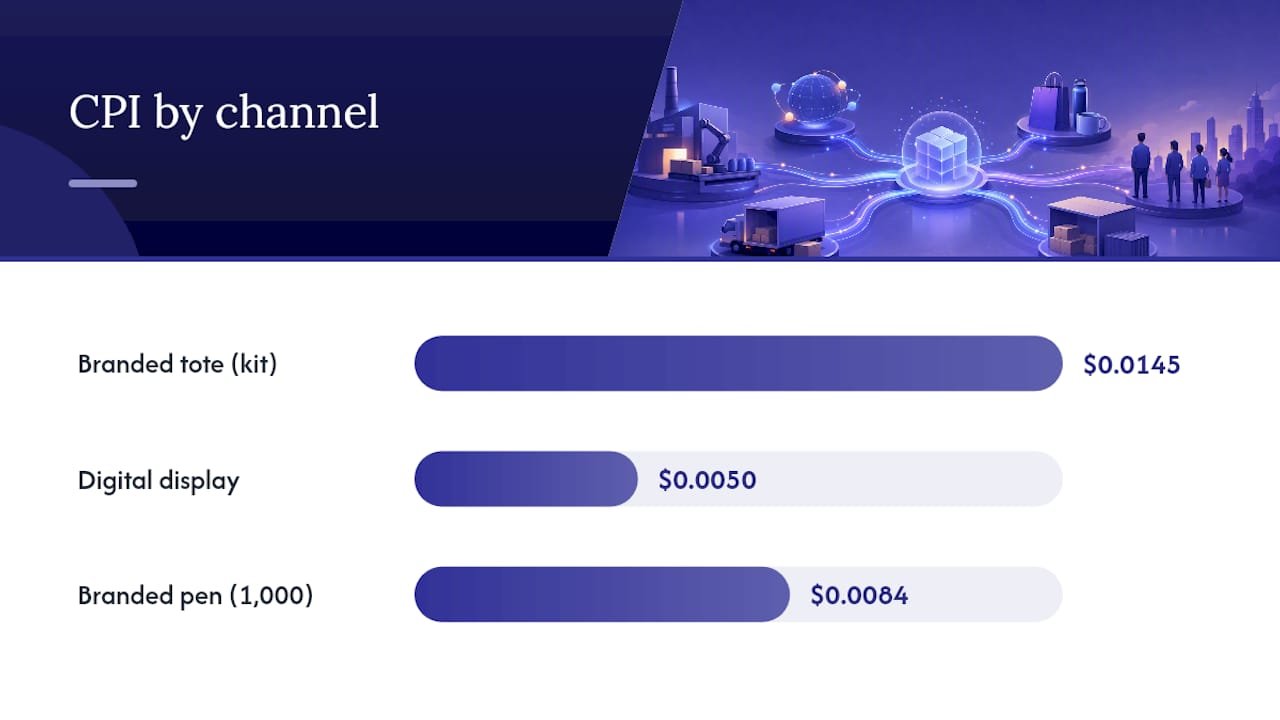
Digital display wins on raw CPI when impressions are counted mechanically. But a tote impression is a physical, repeated brand exposure with a person who chose to keep the item — a qualitatively different signal. For a deeper look at promo product ROI metrics, including lifespan assumptions by category, Discountswag’s CPI guide covers the methodology in full.
Pro Tip: Track impressions empirically when you can. Add a QR code or promo redemption code to the item. Even a rough redemption rate gives you a real denominator instead of an industry estimate.
What budgeting mistakes cost buyers the most?
The most expensive mistake is treating the quoted unit price as Total Cost of Ownership. For smart event giveaway budgeting, always start with a TCO worksheet, not a unit price comparison.
Red flags in a vendor quote:
- A single bundled “shipping & handling” line with no per-address breakdown
- No explicit setup or run charge line (it is buried in the unit price)
- No storage or returns policy stated
- Rush surcharges listed as a percentage with no cap
Negotiation questions that actually move the number:
- “Are setup fees one-time, or do you charge them on every reorder?”
- “If I reorder the identical item, will you waive setup if the assets are on file?”
- “Can I reduce imprint colors or consolidate placement to eliminate a run charge?”
- “What quantity break triggers the next lower unit price?”
- “Is there a per-address discount if I ship 50+ locations in one drop?”
- “Can I combine two SKUs on one purchase order to share a setup fee?”
Confirm reorder asset availability in writing before assuming no re-setup cost. A small change to placement, color, or substrate can trigger a new setup charge even on an “identical” reorder. For a full negotiation script and tactics guide, Discountswag’s buyer guide covers the conversation step by step.
Pro Tip: Kitting and per-address fulfillment are recurring cost drivers. Negotiating per-kit and per-address breaks often yields more savings than pushing on the per-item product price alone.
How to use the per-unit cost spreadsheet template
Download the template, then follow these steps:
- Enter each vendor quote line in the Quote Lines tab: item description, unit price, quantity, and whether the cost is fixed or per-unit.
- Set your order quantity in cell B2. Fixed costs amortize automatically.
- Enter per-address shipping in the Fulfillment tab if distributing to multiple locations.
- Add kitting surcharge and pick-and-pack rates from your fulfillment vendor.
- Set your tax rate (state + local) in cell B8.
- Enter your impressions estimate in the CPI tab to generate Cost Per Impression.
The sheet outputs per-unit landed cost and CPI on the Summary tab. For multi-SKU kits, duplicate the Quote Lines tab once per SKU and link each to the Kit Allocation tab, which splits shared costs (setup, shipping, kitting) proportionally by item value.
| Tab | Key input cells | Output |
|---|---|---|
| Quote Lines | Unit price, qty, fixed/variable flag | Amortized per-unit cost |
| Fulfillment | Per-address shipping, pick-pack rate | Fulfillment per unit |
| Tax & Fees | Tax rate %, customs estimate | Tax per unit |
| CPI | Impressions estimate, lifespan | Cost Per Impression |
| Summary | (auto) | Per-unit landed cost, CPI |
What experienced distributors see buyers get wrong
The same three errors show up repeatedly: skipping amortization entirely, ignoring per-address shipping costs on distributed drops, and assuming setup assets are always on file for reorders.
On amortization: buyers who receive a quote showing a $55 setup fee on a 25-unit order sometimes mentally round it away. At 25 units, that $55 is $2.20 per item — often more than the item itself costs to produce. Running the numbers at 25, 50, and 100 units before committing to a quantity is the single fastest way to find budget.
On reorder assets: the right question to ask is not “do you keep my files?” but “is my screen/die/digitizing file still active and production-ready?” Vendors archive assets, and retrieval sometimes triggers a reduced re-setup fee. Confirm in writing before the purchase order is issued.
Discountswag saves decoration assets as standard practice and flags asset status on reorder quotes, so buyers see immediately whether setup applies. That transparency is what makes per-unit cost calculations reliable rather than approximate.
Discountswag makes per-unit costing transparent
Discountswag gives marketing managers and procurement officers something most distributors do not: a fully itemized quote that separates base unit price, decoration, setup, shipping, and fulfillment before you commit to an order. No bundled lines, no surprise invoices.
The practical services that matter here: itemized line-by-line quoting, warehousing and 3PL, kitting and multi-address fulfillment, saved decoration assets for waived setup on identical reorders, and the downloadable per-unit cost spreadsheet described above. For distributed programs, Discountswag handles per-address shipping across the U.S. and allocates costs by destination so your TCO calculation stays accurate.
Ready to run the numbers on your next program? Request an itemized quote from Discountswag and plug the line items directly into the template. Discountswag is the publisher of this article.
Sources
- Guide to business expense resources — IRS
- IAS 38: Capitalisation of promotional goods — IFRS (meeting paper)
- Swag & promotional fulfillment benchmarks — Fulfyld
- Setup fees & run charges FAQ — Promotional Product Inc.
- Purely
This article is general information, not a substitute for advice from a qualified financial advisor. Consult a qualified financial professional about your own circumstances before acting on anything here.
 Bottle Carriers
 Mugs
Mugs