


rPET vs. Polyester: A Buyer’s Sustainability Guide

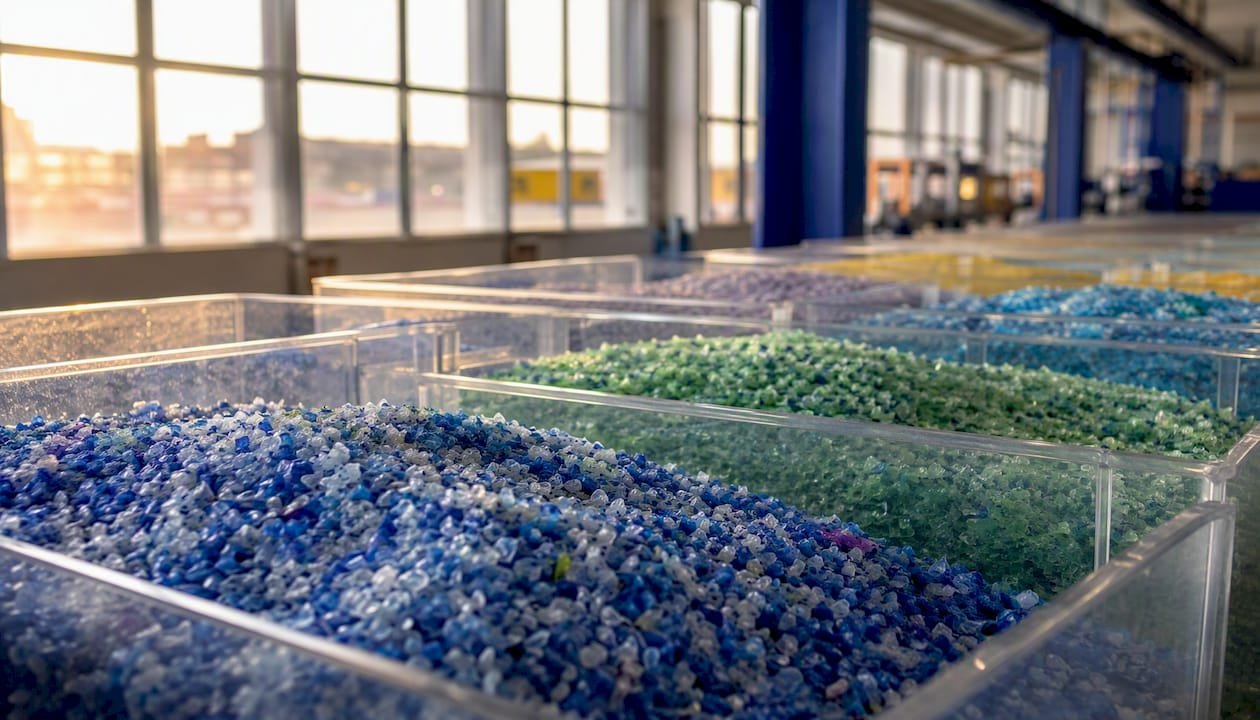
rPET is the better choice when reducing production-stage greenhouse gases and diverting plastic waste are priorities. For most commercial and promotional applications, it performs on par with virgin polyester. The trade-offs are real, though: both materials shed microplastics during washing, end-of-life recyclability remains limited without fiber-to-fiber infrastructure, and because rPET and virgin polyester are chemically identical, supply-chain fraud is a genuine risk without third-party certification. According to Textile Exchange’s recycled polyester tracking, recycled polyester’s share of the overall market is growing steadily, and the industry’s verification infrastructure is maturing alongside it.
Quick guidance by reader type:
- Consumers: Choose rPET-labeled products from brands that display a Global Recycled Standard (GRS) or Recycled Claim Standard (RCS) certificate. The environmental benefit at production is real; the microplastic risk is shared with all synthetic textiles.
- Brand buyers and procurement teams: Set a minimum recycled content threshold (typically 50% or 100% PCR), require GRS/RCS chain-of-custody documentation, and ask for batch test reports before signing off on a supplier.
- Promotional-product buyers: rPET totes, lanyards, fleece blankets, and towels are commercially available with verified documentation. Request certificates at quote time, not after the order ships.
Key Takeaways
| Point | Details |
|---|---|
| Production-stage GHG benefit | Mechanical rPET cuts GHG emissions roughly 45–70% vs. virgin polyester; the gain is real and LCA-backed. |
| Microplastics are a shared risk | Both rPET and virgin polyester shed microfibers; some lab tests show elevated counts from recycled fiber. |
| Certification is non-negotiable | rPET and virgin polyester are chemically identical; only GRS/RCS chain-of-custody certificates verify recycled content. |
| Chemical recycling is coming | Fiber-to-fiber recycling is scaling commercially but remains limited; bottle-to-fiber rPET is the practical choice today. |
| Discountswag provides documentation | GRS certificates and transaction certificates are available on request for rPET promotional items at quote time. |
Table of Contents
- How rPET and virgin polyester are actually made
- What do the lifecycle numbers actually show?
- What does the evidence say about microplastics?
- How does rPET perform compared to virgin polyester?
- rPET vs. virgin polyester: pros and cons side by side
- How do you verify recycled content claims?
- Buyer guidance for procurement and promotional-product teams
- What’s next for rPET: chemical recycling and fiber-to-fiber
- A practical note for brand buyers
- Verified rPET promotional products from Discountswag
- Sources
How rPET and virgin polyester are actually made
Virgin polyester, technically polyethylene terephthalate (PET), starts with petrochemical feedstocks: purified terephthalic acid (PTA) and monoethylene glycol (MEG), both derived from crude oil. These monomers are polymerized under heat and pressure into PET chips, which are then melted and extruded into fiber. The process is energy-intensive and draws entirely on fossil resources.
rPET, or recycled PET, starts somewhere else entirely. The most common feedstock is postconsumer PET bottles, though recovered PET from industrial scrap and, increasingly, textile waste are also used. Textile Exchange identifies two primary recycling routes: mechanical and chemical.
Mechanical recycling: the dominant route
Mechanical recycling is straightforward in concept. Collected bottles are sorted, cleaned, shredded into flake, melted, and re-extruded into fiber. It is the most commercially mature method and accounts for the vast majority of rPET fiber produced today. The limitation is that each recycling cycle can slightly degrade polymer chain length, and heavily colored or contaminated feedstock reduces output quality. Blended fabrics (polyester-cotton, for example) cannot be cleanly separated by mechanical means, so they typically cannot be used as feedstock.

Chemical recycling: the path to true circularity
Chemical recycling breaks PET back down to its monomer building blocks through depolymerization, then repolymerizes them into virgin-equivalent PET. This approach can handle colored textiles and some blended fabrics, and the output is chemically indistinguishable from virgin PET. The catch is scale: chemical recycling is still in early commercial deployment, and costs remain higher than mechanical routes. For buyers today, bottle-to-fiber mechanical rPET is the realistic, available option.
One practical figure worth knowing: roughly 25 standard 500 ml PET bottles yield approximately 1 kg of rPET fiber. That order-of-magnitude conversion is widely used in industry communications and gives buyers a concrete sense of the waste-diversion benefit per kilogram of fabric ordered.
What do the lifecycle numbers actually show?
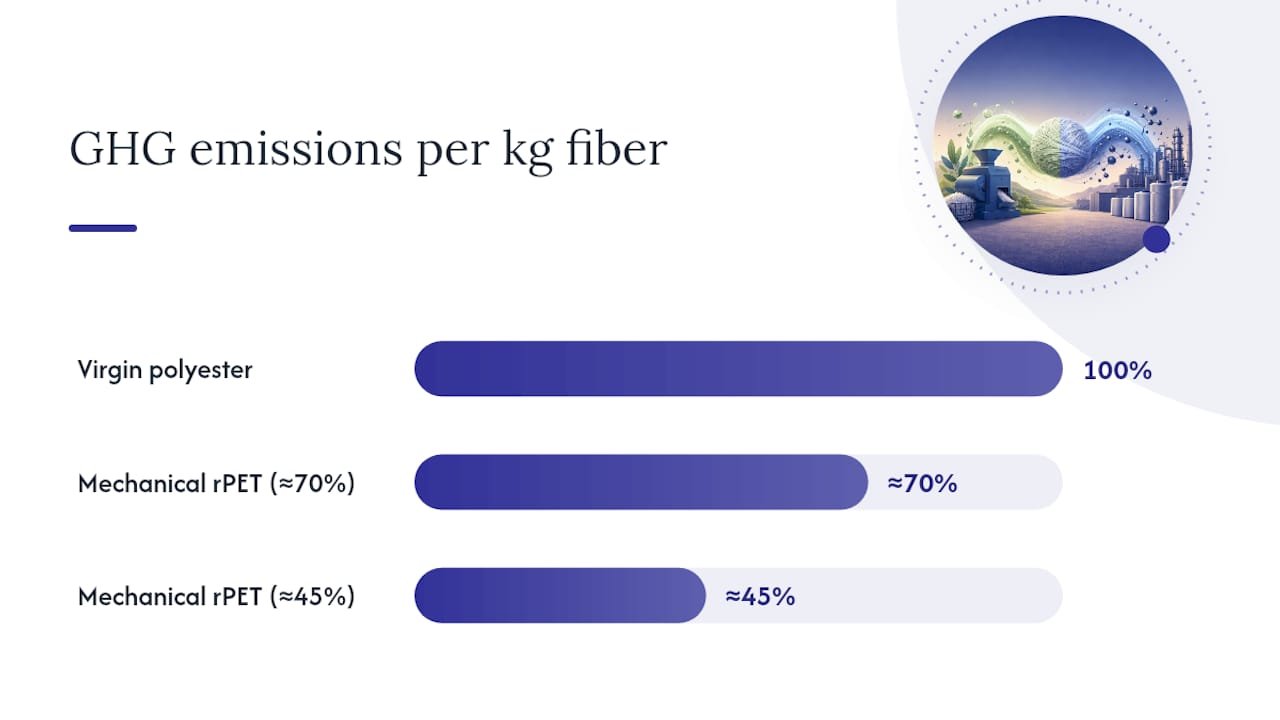
Lifecycle assessments (LCAs) are the standard tool for comparing the environmental footprint of materials across their full production chain. For the rPET vs. polyester comparison, the headline finding is consistent across multiple studies: mechanical rPET production reduces greenhouse gas emissions roughly 45–70% per kilogram of fiber compared with virgin polyester.
Energy savings follow a similar pattern. Mechanical recycling skips the energy-intensive polymerization step, so it uses substantially less process energy per kilogram of output. Water consumption is low for both materials relative to natural fibers like cotton, which requires significant irrigation. Neither polyester variant competes with cotton for agricultural land use, which is a genuine advantage for both in land-constrained contexts.
| Dimension | Virgin polyester | Mechanical rPET | Notes |
|---|---|---|---|
| GHG emissions | Baseline (100%) | ~45–70% of virgin | Range depends on grid carbon intensity and feedstock quality |
| Energy use | Baseline (100%) | Substantially lower | Skips polymerization; exact savings vary by facility |
| Water use | Low | Low | Both far below cotton |
| Fossil resource use | High (PTA + MEG from crude oil) | Low to moderate | Residual energy inputs still fossil-derived |
| Land use | Minimal | Minimal | No agricultural land required |
Important caveats: LCA results shift based on the carbon intensity of the electricity grid where recycling happens, transport distances between collection and processing, feedstock contamination rates, and whether the system boundary includes end-of-life. A facility running on coal power produces a very different carbon profile than one on renewables, even with identical mechanical processes.
The statistic that matters most for procurement decisions: a 45–70% reduction in GHGs per kilogram is a meaningful, LCA-backed figure, not marketing copy. But it is a production-stage number. It does not account for what happens when the garment is washed or discarded.
What does the evidence say about microplastics?
This is where the rPET story gets more complicated. Both virgin and recycled polyester shed microfibers during washing. Peer-reviewed research indexed on PubMed documents that shedding rates vary by fabric construction, fiber processing, and washing conditions, not simply by whether the fiber is virgin or recycled.
The more pointed finding comes from NGO testing. A Changing Markets Foundation laboratory analysis reported that some recycled polyester samples released higher average microplastic particle counts during washing than comparable virgin polyester samples under test conditions. The proposed mechanism: mechanical recycling can shorten polymer chains and create more fiber ends, which break off more readily during abrasion.
This does not negate rPET’s production-stage benefits, but it does mean buyers should not treat rPET as a complete environmental solution. The microplastic problem is a use-stage issue shared across synthetic textiles.
Practical mitigation steps for buyers and consumers:
- Choose tightly woven or knitted constructions over loose, brushed fabrics, which shed more.
- Wash at lower temperatures and shorter cycles; high agitation accelerates shedding.
- Use a microfiber-catching laundry bag (such as a Guppyfriend bag) or a washing machine filter designed to capture microfibers.
- For promotional items, favor end uses where washing frequency is low (totes, lanyards, cases) over high-wash items like athletic wear, where shedding accumulates faster.
Pro Tip: Ask suppliers for third-party microfiber test results, not just marketing claims. A supplier confident in their construction will have data. One who deflects the question probably does not.
How does rPET perform compared to virgin polyester?
For most commercial applications, the performance gap between rPET and virgin polyester is negligible. At its best, rPET fabric is virtually indistinguishable from virgin polyester in durability and hand feel. Tensile strength, abrasion resistance, and moisture-wicking behavior are comparable across standard fabric weights used in apparel and promotional merchandise.
Where differences occasionally surface:
- Tensile strength after multiple recycling cycles: Polymer chain degradation from repeated mechanical recycling can reduce fiber strength over time. For first-cycle bottle-to-fiber rPET, this is rarely a practical concern.
- Dye uptake: rPET can show slightly different dye absorption than virgin fiber, particularly with disperse dyes at high temperatures. For promotional items where color consistency across large runs matters, this is worth discussing with your mill.
- Clarity for packaging applications: Virgin PET is preferred for clear packaging where optical clarity is critical. For fiber applications, this distinction is irrelevant.
- Blended fabrics: Poly-cotton and elastane blends present a challenge for mechanical recycling. The blend cannot be cleanly separated, so blended rPET garments are difficult to recycle at end of life, and blended feedstock cannot easily be used in mechanical rPET production.
For technical apparel, where consistent tensile strength, precise stretch recovery, or optical uniformity matter, buyers should request mill data and sample testing. For promotional items, the performance difference between rPET and virgin polyester is not a meaningful purchasing factor.
rPET vs. virgin polyester: pros and cons side by side
| Dimension | rPET | Virgin polyester |
|---|---|---|
| GHG emissions | ~45–70% lower at production stage | Baseline; fossil-intensive |
| Energy use | Substantially lower (skips polymerization) | Higher; full petrochemical process |
| Fossil resource use | Low to moderate | High (crude oil feedstock) |
| Microplastics | Shared risk; some studies show elevated shedding | Shared risk; generally comparable or slightly lower in some tests |
| End-of-life recyclability | Limited without fiber-to-fiber infrastructure | Same limitation |
| Durability and feel | Matches virgin for most uses | Consistent baseline |
| Dye consistency | Minor variation possible | Highly consistent |
| Cost | Slight premium in many markets | Lower and more stable pricing |
| Supply availability | Growing but tighter than virgin | Abundant and stable |
| Certifications available | GRS, RCS, Bluesign, Oeko-Tex | Oeko-Tex (chemical safety only) |
rPET advantages in brief: Lower production emissions, diverts plastic waste, growing certification infrastructure, meets sustainability procurement criteria.
Virgin polyester advantages in brief: Lower cost, more stable supply, fully consistent dye behavior, no feedstock quality variability.
One-sentence recommendation: Choose rPET when production-stage sustainability and supply-chain credibility matter; choose virgin polyester when cost stability and color consistency are the overriding constraints and no sustainability mandate applies.
How do you verify recycled content claims?
Because rPET and virgin polyester are chemically identical after processing, routine lab testing cannot reliably distinguish them. A supplier can label virgin fiber as recycled with no physical evidence of fraud visible in the finished product. This makes third-party certification the only reliable verification mechanism.
The main certification standards
Global Recycled Standard (GRS), administered by Textile Exchange, is the most widely recognized standard for recycled content claims. GRS also includes social and environmental processing requirements.
Recycled Claim Standard (RCS) covers chain-of-custody for recycled content but does not include the social and environmental processing criteria that GRS requires. It is appropriate when the buyer’s goal is content verification only. Textile Exchange administers both GRS and RCS and publishes guidance on what each covers.
Bluesign focuses on chemical safety and resource efficiency in textile processing. It does not certify recycled content claims, but a Bluesign-approved fabric has been produced with restricted chemical inputs and reduced water and energy use. Relevant for buyers who want both content and processing assurance.
Oeko-Tex Standard 100 tests for harmful substances in the finished textile. Like Bluesign, it does not verify recycled content, but it confirms the product is safe for skin contact. Useful as a complementary certification, not a substitute for GRS/RCS.
Textile Exchange publishes market data, standards guidance, and the 2025 Recycled Polyester Challenge, which tracks brand commitments to increase recycled polyester use. The PET Resin Association (PETRA) provides industry data on PET resin production and recycling rates in the United States, useful for understanding domestic supply context.
Documents to request from suppliers
- Current GRS or RCS certificate (check the certificate number against the issuing body’s public database).
- Scope certificate listing the specific facility and product categories covered.
- Transaction certificates (TCs) for the specific order, confirming chain-of-custody for that batch.
- Mill traceability documentation showing feedstock origin (bottle-grade PCR, industrial scrap, or textile waste).
- Batch test reports for fiber properties (tenacity, elongation, denier) if performance consistency matters.
- Microfiber test data if the end use involves frequent washing.
The fraud risk is real. Because no physical test distinguishes rPET from virgin after processing, a certificate without a verifiable chain-of-custody trail is not meaningful assurance. Always cross-check certificate numbers with the issuing certification body’s public registry.
Buyer guidance for procurement and promotional-product teams
Translating the technical comparison into purchasing decisions requires a short, structured approach. The following checklist and sample questions apply whether you are writing an RFP for a large apparel order or briefing a promotional-product supplier.
Procurement checklist
- Set a minimum recycled content threshold: 50% PCR (postconsumer recycled) is a common floor; 100% PCR is achievable for many promotional items.
- Specify acceptable certifications: GRS is the standard for full chain-of-custody; RCS is acceptable for content-only claims.
- Request transaction certificates for each order, not just a scope certificate for the facility.
- Ask for feedstock origin: bottle-grade PCR is the most traceable; textile waste feedstock is less common and harder to verify.
- Confirm the recycling method: mechanical (dominant, lower cost) or chemical (emerging, higher cost, better for blends).
- Request microfiber test data for any item that will be washed frequently.
- Evaluate the cost premium: rPET typically carries a modest price premium over virgin polyester. Factor this into budget planning rather than treating it as a surprise.
Sample RFP and supplier questionnaire questions
- What percentage of recycled content (by weight) does this product contain, and is it postconsumer or pre-consumer?
- Which certification standard covers this product (GRS, RCS, or other), and can you provide the current certificate and transaction certificate for this order?
- What is the feedstock source (bottle-grade PET, industrial scrap, textile waste), and where is it collected?
- Is the recycling process mechanical or chemical, and at which facility?
- Can you provide batch test reports for fiber tenacity, elongation, and denier for this order?
- Do you have third-party microfiber shedding test data for this fabric construction?
Pricing and supply considerations
rPET pricing tends to track virgin polyester with a premium that fluctuates based on collection infrastructure, oil prices, and demand from brands with sustainability commitments. Locking in pricing through longer-term supply agreements or framework contracts can reduce volatility. Supply is growing but remains tighter than virgin polyester, particularly for high-PCR-content specifications. Build lead time into your planning, especially for large runs.
Pro Tip: For promotional-product orders, request GRS certificates and transaction certificates at the quote stage, before the order is placed. Suppliers who cannot produce documentation at quote time are unlikely to produce it after the order ships. Discountswag can provide this documentation on request for rPET items in its catalog.
For a broader view of sustainable swag trends and how to integrate rPET into a promotional campaign, the guidance applies directly to the procurement questions above.
What’s next for rPET: chemical recycling and fiber-to-fiber
The most significant limitation of today’s rPET supply chain is end-of-life. A fleece blanket made from rPET bottles is still difficult to recycle at the end of its useful life, because most textile collection and processing infrastructure cannot handle blended or colored fabrics at scale. Mechanical recycling, which dominates today, does not solve this problem.
Chemical depolymerization changes the equation. By breaking PET back to monomers, chemical recycling can process colored textiles and some blended fabrics that mechanical systems reject. The output is virgin-equivalent PET, which can re-enter the fiber supply chain without quality loss. This is what “fiber-to-fiber” or “textile-to-textile” recycling means in practice.
Where things stand commercially:
- Several chemical recycling projects are scaling in Europe and Asia, with commercial output expected to grow through the 2025–2028 window.
- Costs remain higher than mechanical recycling, and feedstock sorting (separating polyester from cotton blends) is still a bottleneck.
- Certification infrastructure for chemically recycled content is developing; GRS covers chemical recycling, but chain-of-custody for textile-to-textile feedstock is harder to verify than for bottle-grade PCR.
- Textile Exchange’s 2025 Recycled Polyester Challenge tracks brand commitments and is a useful signal of where demand is heading.
- Organizations like Accelerating Circularity are working to build the collection and sorting infrastructure that chemical recycling requires.
What this means for buyers today: Bottle-to-fiber mechanical rPET remains the best available, cost-effective option for most promotional and commercial applications. Fiber-to-fiber claims are worth asking about, but verify them carefully. A supplier claiming fiber-to-fiber recycled content should be able to show a GRS certificate that specifically covers that feedstock pathway, not just a general recycled-content claim.
When chemical recycling reaches commercial scale, the circularity argument for rPET will strengthen considerably. For now, the production-stage GHG reduction is the primary, evidence-backed benefit, and that benefit is real.
A practical note for brand buyers
The rPET conversation in promotional merchandise has moved past the “is it worth it?” stage. The production-stage environmental benefit is documented, the certification infrastructure exists, and the performance is there for standard promotional applications. What still trips up buyers is the documentation gap: orders placed on a sustainability claim without a transaction certificate to back it up.
My advice, drawn from working with procurement teams on branded campaigns: treat the certificate request as part of the brief, not an afterthought. If your supplier cannot produce a current GRS or RCS certificate and a transaction certificate for your specific order, the sustainability claim on your branded item is unverifiable. Discountswag can provide GRS/RCS certificates and mill traceability documentation on request for rPET items, including totes, lanyards, fleece blankets, and towels. Build that documentation step into your timeline, and you will have a sustainability story that holds up to scrutiny.
Verified rPET promotional products from Discountswag
Brands that have done the research on rPET now need a supplier who can back the claim with paper. Discountswag offers a range of verified rPET promotional items, including recycled PET fitness towels, recycled polyester lanyards, rPET fleece blankets, and laminated rPET tote bags, all available with custom branding.
GRS certificates and transaction certificates are available on request at the quote stage. Mill traceability documentation and batch test summaries can be provided for orders where procurement requires them. This is not a standard industry practice; most promotional distributors do not offer it. Discountswag does.
To request documentation or get a quote on verified rPET merchandise, visit the 2026 Marketer’s Guide to Promotional Items or browse branded merchandise options across rPET categories. Your sustainability claim should be as solid as the product carrying it.
Sources
- The Promise (and Limitations) of Recycled Polyester – ASI
- Recycled Polyester (rPET): Complete Guide to Benefits, Sustainability & Certifications – VNPOLYFIBER
- Fashion’s green strategy is making microplastics pollution worse – study
- PubMed: microfiber/microplastic research (indexed study)
- 2025 Recycled Polyester Challenge – Textile Exchange
 Bottle Carriers
 Mugs
Mugs