

Promotional Product Bulk Pricing: Cut Your Per-Unit Cost

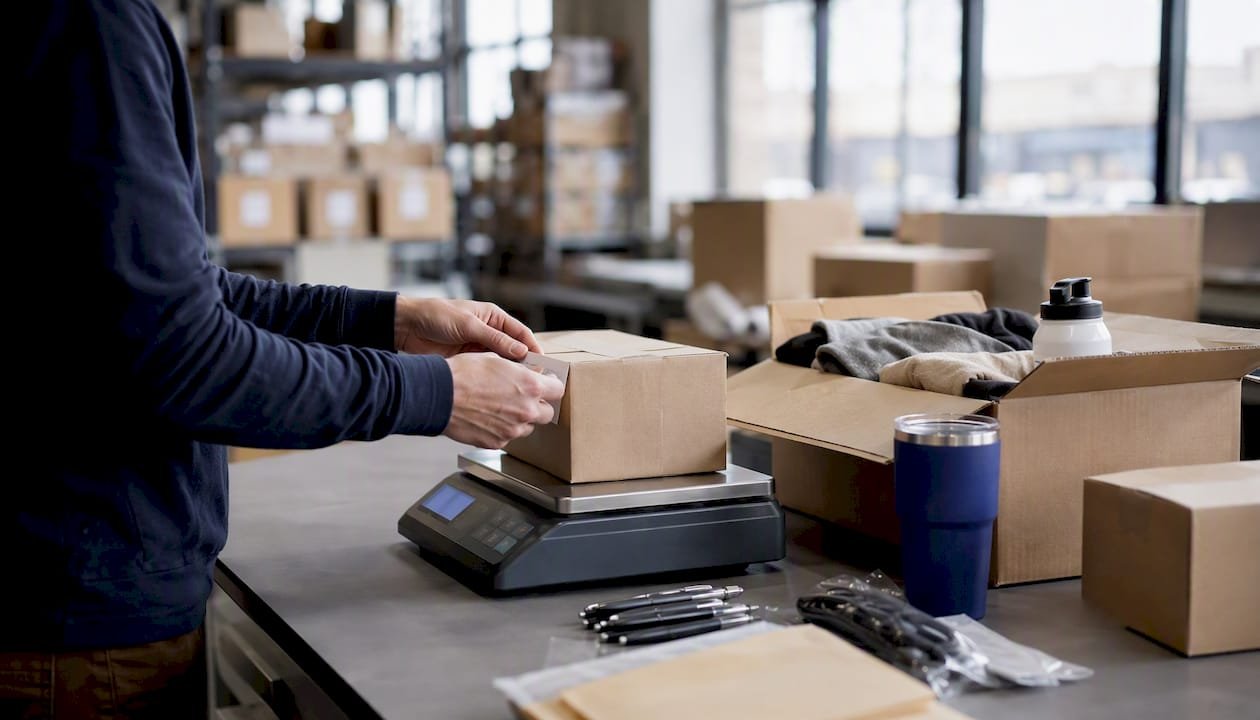
Bulk promotional product pricing typically varies widely per category, including low-cost giveaways like pens and lip balms, drinkware, tech swag, bags and totes, and branded apparel. The single biggest driver of your per-unit cost is the combination of order quantity and decoration setup fees. A $75 screen-printing setup charge spread across more units reduces the per-unit cost significantly. Beyond those two levers, the costs that most buyers underestimate include shipping and dimensional weight charges, rush production fees, case-pack minimums which can increase order size, and state sales tax on finished goods.
If you’re buying more than 250 units of any single item for a defined event or campaign, request a breakout quote from a direct distributor. If you need fewer than 100 units or can’t commit to a design, on-demand or print-on-demand is the smarter path.
Pro Tip: Ask every vendor to send you a “breakout” quote that separates item cost, decoration/setup fees, and shipping as distinct line items. A single bundled price makes it impossible to compare suppliers or negotiate individual components.
Key Takeaways
Landed per-unit cost, not list price, is the only number that matters when comparing bulk promotional product quotes.
| Point | Details |
|---|---|
| Calculate landed cost first | Use the formula: (item cost × qty + setup + shipping + fulfillment + tax) ÷ qty before comparing quotes. |
| Setup fees dilute with quantity | A $75 setup fee costs $0.75/unit at 100 units and $0.08/unit at 1,000 — quantity is the fastest way to lower it. |
| Ask for breakout quotes | Bundled quotes hide negotiable costs; separate line items let you compare vendors and negotiate each component. |
| Cumulative discounts reward repeat buyers | Committing annual spend to one vendor typically unlocks 5%–25% contract pricing on all orders. |
| Discountswag | Provides breakout pricing, decoration services, rush orders, and multi-location fulfillment for bulk promo orders. |
Table of Contents
- What actually drives a promotional product’s bulk price?
- What do bulk promotional products actually cost by category?
- How do common bulk pricing structures actually work?
- What minimum order quantities and case packs should you expect?
- How do setup, artwork, and decoration fees affect your cost?
- What shipping and fulfillment costs belong in your per-unit math?
- How to calculate your true per-unit landed cost
- How to negotiate lower bulk pricing and protect your margins
- When does bulk ordering beat smaller or on-demand orders?
- What buyers consistently get wrong about bulk promo orders
- Discountswag makes bulk pricing straightforward
- Sources
What actually drives a promotional product’s bulk price?
Order quantity is the most powerful lever, but it’s not the only one. Before you compare quotes, you need to understand every cost driver that vendors can price differently.
Primary cost drivers:
- Base item cost: The wholesale price of the undecorated product, which drops as quantity rises.
- Imprint method and color count: Screen printing, pad printing, embroidery, laser engraving, and full-color digital transfer each carry different base costs. More colors in a screen-print design mean more screens, more setup fees.
- Setup and artwork fees: Charged per imprint location, per color, or as a flat fee. These are largely fixed costs that dilute as quantity grows.
- Material and quality grade: A 100% cotton tee costs more than a 50/50 blend; a vacuum-insulated tumbler costs more than a single-wall plastic cup.
- Case packs and order increments: Many suppliers ship in fixed case quantities (e.g., 12 or 24 per case). If your target quantity doesn’t align with a case pack, you may be forced to round up.
Secondary drivers include lead time and rush fees, seasonal demand spikes around busy periods, and customs or import fees when products ship from overseas factories. Volume discount structures in B2B and wholesale markets are built around these cost layers, which is why understanding them before you request a quote puts you in a stronger negotiating position.
Pro Tip: The two places buyers get surprised most often are artwork/setup fees (especially for multi-color designs) and multi-location fulfillment charges. If your order ships to 15 different offices, each drop-ship adds a handling fee that can easily exceed the per-unit item cost on low-cost giveaways.
What do bulk promotional products actually cost by category?
The ranges below reflect typical U.S. market pricing for decorated, ready-to-ship items at common order quantities. Prices shift based on imprint method, material grade, and supplier margin.
A few factors push any category toward the high end of its range. Full-color digital printing on drinkware costs more than a single-color pad print. Embroidery on apparel costs more than screen printing and adds a digitizing fee. Woven labels and premium fabrics on bags or outerwear can double the base item cost. For apparel specifically, the custom corporate apparel buying guide breaks down embroidery versus screen-print cost differences in detail.
For buyers focused on keeping spend low, inexpensive bulk promotional products like single-color imprint pens, cotton totes, and basic lanyards consistently deliver the lowest landed cost per impression.
How do common bulk pricing structures actually work?
Understanding how a vendor applies discounts tells you whether you’re getting a real deal or just a better-looking number. Volume pricing applies a lower per-unit rate to every unit in an order once a quantity threshold is crossed. That’s different from tiered pricing, where each bracket of units gets its own rate.
The five structures you’ll encounter:
- Volume (threshold) pricing: Cross 500 units, and every unit in the order reprices at the lower rate. This creates a strong incentive to round up to the next threshold.
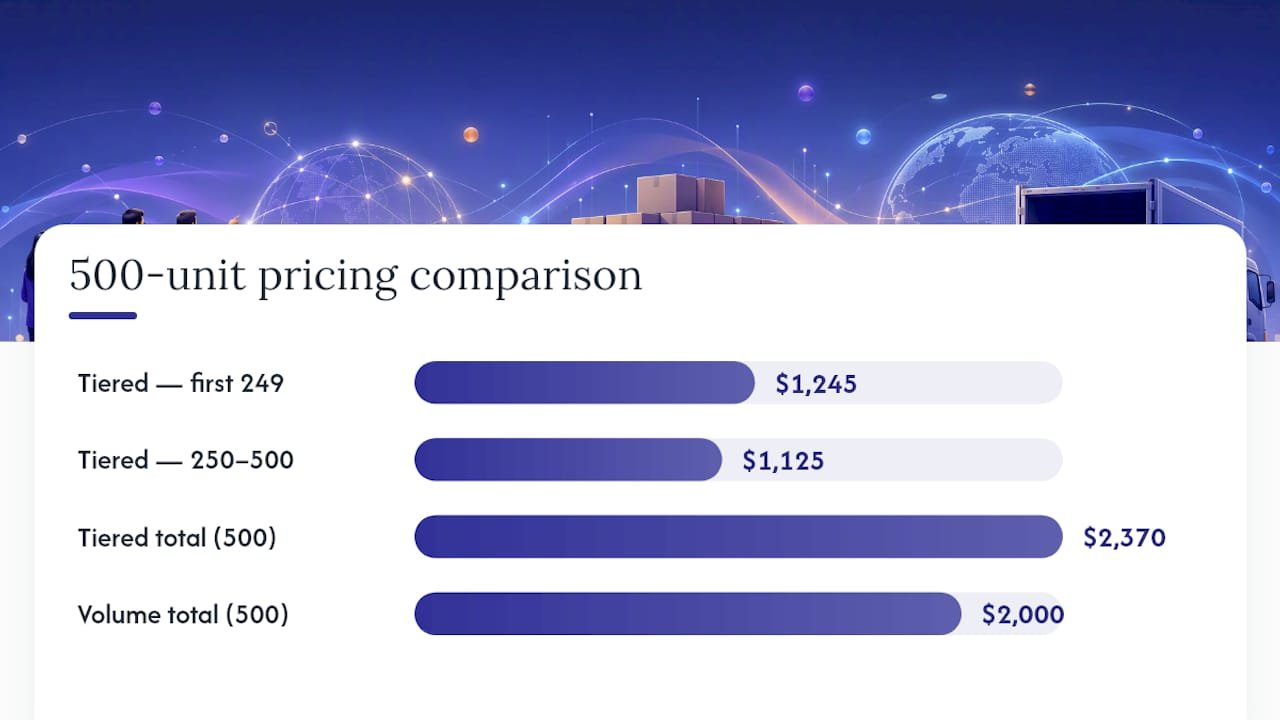
- Tiered pricing: Units 1–249 cost $5.00 each; units 250–499 cost $4.50 each; units 500+ cost $4.00 each. Each tier applies only to the units within that band.
- Graduated pricing: Similar to tiered, but the discount applies incrementally across the full quantity range rather than in discrete jumps.
- Threshold pricing: A minimum spend or quantity must be reached before any discount activates. Below the threshold, list price applies.
- Cumulative or contract discounts: Discounts based on total spend over a quarter or year, not a single order. B2B volume discounts commonly fall in the 5%–25% range, with contract pricing at the higher end for committed annual spend.
Volume pricing vs. tiered pricing — the math difference: Suppose the list price is $5.00/unit and the 500-unit threshold drops it to $4.00. Under volume pricing, an order of 500 units costs $2,000 total ($4.00 × 500). Under tiered pricing, the first 249 units cost $5.00 and units 250–500 cost $4.50, so the same 500-unit order costs $1,245 + $1,125 = $2,370. Volume pricing rewards the buyer more aggressively once the threshold is crossed, which is why it creates a “cliff effect” — buyers near the threshold have a strong financial reason to add units.
Stripe’s volume pricing guide notes that discount messaging measurably increases purchase likelihood, which is why vendors display threshold savings prominently. Use that psychology in reverse: ask the vendor to show you the exact dollar savings at the next threshold up before you decide on quantity.
What minimum order quantities and case packs should you expect?
MOQs and case packs are where a lot of buyers get tripped up, especially when they’re ordering multiple SKUs for the same event.
A single-item MOQ is the minimum number of units a supplier will produce for one decorated SKU. A case pack is the fixed quantity per shipping carton (often 12, 24, or 72 units). An order increment means you can only order in multiples of that case pack. If the case pack is 24 and you want 100 units, you’re ordering 120.
Common MOQs by category:
- Pens and low-cost giveaways: 100–250 units
- Drinkware: 24–72 units (often one case)
- Apparel: 12–72 units, sometimes with per-size minimums
- Tech items: 25–50 units
- Premium gifts and kits: 12–50 units
Some suppliers will split cases for a fee, typically $15–$50 per split. That fee can be worth it when you need an odd quantity, but it’s worth asking upfront rather than discovering it on the invoice.
Checklist for your RFQ to avoid MOQ surprises:
- Ask for the single-SKU MOQ and the case-pack size separately.
- Confirm whether per-size or per-color breakdowns count toward the MOQ or reset it.
- Ask whether the MOQ applies per decoration location or per item.
- Request the case-splitting fee in writing if you need a non-standard quantity.
- Confirm whether samples count toward the MOQ or are priced separately.
The ordering guide at Discountswag walks through these RFQ steps in detail, which is useful if you’re managing a multi-SKU order for the first time.
How do setup, artwork, and decoration fees affect your cost?
Setup fees are fixed costs, and that’s exactly what makes them so important at low quantities and so easy to ignore at high ones.
Typical setup fees by decoration method:
- Screen printing: $40–$80 per color, per location. A two-color front print plus a one-color back print = three setup charges.
- Embroidery digitizing: $25–$75 one-time fee to convert your logo to a stitch file. Usually charged once per design, then waived on reorders.
- Pad printing: $40–$60 per color.
- Laser engraving: Often a flat $30–$50 setup, sometimes waived at higher quantities.
- Full-color digital (dye-sub or DTG): Setup fees are lower ($20–$40) because no physical screens are made, but per-unit cost is higher.
Artwork fees apply when your file isn’t print-ready. Vendors typically require vector files (AI, EPS, or high-resolution PDF). If you submit a JPEG or PNG logo, expect a $25–$75 redraw fee. Providing a clean vector file from the start eliminates this charge entirely.
How setup fees affect per-unit cost at different quantities:
The setup fee’s share of per-unit cost drops from $0.75 to $0.08 as quantity scales. That’s the core math argument for bulk ordering when you have predictable demand.
Pro Tip: Reorders of the same design often waive setup fees entirely. If you’re planning a recurring program (onboarding kits, quarterly swag drops), ask the vendor upfront whether setup fees are waived on reorders and get that in writing.
What shipping and fulfillment costs belong in your per-unit math?
Shipping is the cost most buyers underestimate, and it’s the one that most often blows a budget that looked fine on paper.
Shipment types and their pricing behavior:
- Small parcel (UPS, FedEx, USPS): Priced by actual weight or dimensional weight (DIM weight), whichever is greater. Lightweight but bulky items like foam stress balls or inflatable products get hit hard by DIM weight.
- LTL (less-than-truckload) freight: Used for pallet-sized orders. Priced by freight class and weight. Generally more cost-effective per pound than parcel for large orders, but requires a loading dock or lift gate.
- International freight: Adds customs brokerage fees, import duties, and longer lead times. Relevant when products ship directly from overseas factories.
Fulfillment fees apply when your order ships to multiple locations or requires kitting. Pick-and-pack fees typically run $1.50–$4.00 per kit, and per-address drop-ship fees add $3–$8 per destination. For an employee onboarding program shipping to 200 home addresses, those fees add up fast.
Rush shipping and expedited production are the fastest ways to wreck a per-unit budget. Expedited production can add 15%–30% to the base item cost, and expedited shipping on a heavy pallet order can cost two to three times the standard rate. If your event date is fixed, build in a six-to-eight-week production window and you’ll rarely need either.
On the tax side, sales tax on promotional products varies by state. Some states tax finished goods; others exempt items purchased for resale or business use. If your company has sales tax nexus in the destination state, expect to pay or provide a resale certificate.
Pro Tip: Consolidate all items in a bulk order into a single shipment whenever possible. Splitting an order into multiple smaller shipments to hit a faster delivery date almost always costs more in total freight than a single coordinated ship date.
How to calculate your true per-unit landed cost
The formula is straightforward. The discipline is in gathering every input before you commit.
Landed cost formula:
(Item cost × Qty) + Total setup fees + Total shipping + Fulfillment fees + Tax
÷ Qty = Landed per-unit cost
Worked example: 1,000 printed travel mugs
The list price was $5.50. That gap matters when you’re presenting a budget to a CMO or comparing two vendor quotes that show different item prices but different shipping and setup structures.
A few practical notes: vendors sometimes round quantities to the nearest case pack, which can affect your total order quantity. Always recalculate with the actual shipped quantity, not just your target quantity. And when comparing quotes, make sure both vendors are quoting the same imprint method, color count, and ship-to location count. Changing any one of those variables makes the comparison meaningless.
Pro Tip: Build a simple spreadsheet with the formula above and drop in each vendor’s numbers side by side. The vendor with the lowest item price rarely wins on landed cost once setup and shipping are included.
For drinkware orders specifically, the logo drinkware bulk buying guide at Discountswag includes category-specific cost benchmarks worth checking before you finalize quantities.
How to negotiate lower bulk pricing and protect your margins
Most buyers accept the first quote. The buyers who get better pricing ask specific questions and use their spend as leverage.
Tactics that consistently move the number:
- Ask for breakout pricing. Request item cost, decoration/setup, and shipping as separate line items. This lets you negotiate each component and compare vendors accurately.
- Simplify your imprint. Dropping from three colors to two, or from two locations to one, can eliminate an entire setup charge and reduce per-unit decoration cost.
- Consolidate SKUs. Ordering 500 units of one item almost always beats ordering 250 units each of two items. Fewer SKUs mean higher quantities per item and lower per-unit cost.
- Ask about remnant stock. Suppliers sometimes have overstock of popular items in standard colors. Buying from existing inventory can cut lead time and base cost.
- Request case-splitting terms in writing. If you need a non-standard quantity, negotiate the case-splitting fee before the order, not after.
On the contract side, cumulative volume discounts reward buyers who commit to annual spend rather than placing one-off orders. If your company buys promotional products across multiple departments or events, consolidating that spend under one vendor relationship is one of the most underused negotiation levers available.
Pro Tip: Commit to an annual spend estimate in writing, even a conservative one, and ask for contract pricing against it. A vendor who knows you’ll spend $30,000 over 12 months will price your first order differently than a vendor who thinks you’re a one-time buyer.
Samples are another negotiation tool. Requesting a pre-production sample before a large order signals that you’re serious and gives you leverage to flag quality issues before production locks in. The promotional item cost negotiation guide at Discountswag covers sample strategy and script ideas in more depth.
When does bulk ordering beat smaller or on-demand orders?
Bulk ordering wins when demand is predictable and storage is manageable. It loses when designs change frequently or demand is uncertain.
Decision criteria to weigh:
- Predictable demand: If you know you’ll use 1,000 units over the next 12 months, bulk ordering locks in a lower per-unit cost and eliminates repeat setup fees.
- Storage capacity: Bulk orders require warehouse or office storage. Factor in the cost of that space, especially for apparel with size runs.
- Cash flow: A bulk order ties up capital upfront. On-demand or smaller orders preserve cash but cost more per unit.
- Design stability: If your logo, messaging, or product line changes frequently, bulk ordering creates inventory risk. On-demand or print-on-demand is safer.
- Inventory risk: Leftover branded inventory from a canceled event or rebrand is a sunk cost. Smaller orders reduce that exposure.
Three common scenarios:
- Single large event (trade show, conference, product launch): Bulk ordering almost always wins. Quantity is known, timing is fixed, and the per-unit savings on 500+ units typically outweigh storage concerns.
- Ongoing onboarding or employee program: Bulk ordering with a replenishment schedule works well here. Order a 90-day supply, track consumption, and reorder before you run out. Branded merchandise for onboarding programs benefits from this model because setup fees are waived on reorders.
- Pilot or test run: Order 50–100 units on-demand to test product quality and recipient response before committing to a large run. The higher per-unit cost is the price of information.
A useful rule of thumb: if you’ll consume more than 250 units of a single item within six months, the per-unit savings from a bulk order typically offset setup and shipping costs. Below that threshold, the math often favors smaller or on-demand orders, especially when buying in bulk requires storage you don’t have.
What buyers consistently get wrong about bulk promo orders
The most common mistake isn’t choosing the wrong product. It’s treating the item price as the total cost.
Buyers who don’t ask about case packs end up with 120 units when they budgeted for 100. And buyers who skip the SKU consolidation conversation leave real savings on the table, because a vendor who sees a $5,000 order across eight SKUs will price it differently than a $5,000 order across two.
From Discountswag’s experience working with marketing managers and procurement teams, the buyers who get the best pricing share three habits: they provide print-ready vector artwork from day one, they ask for breakout quotes rather than bundled prices, and they think about annual spend rather than single-order spend. That last one is the biggest shift. A vendor who knows you’re a repeat buyer prices your first order as an investment in the relationship, not a one-time transaction.
The bulk promotional products guide for buyers at Discountswag covers these pitfalls in detail, including how to structure an RFQ that gets you comparable, apples-to-apples quotes from multiple suppliers.
Discountswag makes bulk pricing straightforward
Most buyers spend more time decoding quotes than they do placing orders. Discountswag cuts through that by providing breakout pricing on every quote: item cost, decoration, setup, and shipping as separate line items so you can see exactly where your money goes and negotiate with confidence.
Discountswag handles bulk orders across apparel, drinkware, tech swag, bags, and premium gifts, with decoration services including screen printing, embroidery, laser engraving, and full-color digital. Rush production is available when timelines are tight, and multi-location fulfillment covers everything from single-destination pallet drops to per-address kitting for remote employee programs. Artwork support is included, so if your files aren’t print-ready, the team handles the conversion without a surprise redraw fee.
Ready to see what your order actually costs? Get a bulk quote from Discountswag and get a full breakout price in hand before you commit to anything.
Sources
- What is Volume Pricing? Benefits, Models & Tips | Salesforce
- What is volume pricing? Here’s how it works | Stripe
- Volume Discount Definition | Investopedia
- Volume Pricing: A Complete Guide for B2B Businesses | B2Bridge
 Bottle Carriers
 Mugs
Mugs