


Donor Gift Ideas That Actually Build Long-Term Support


The best donor gift confirms impact, aligns with your mission, and matches the size of the relationship it’s meant to grow. That’s the whole rule. A $15 handwritten note tied to a real outcome will outperform a $75 branded gift basket almost every time, because donors aren’t collecting objects. They’re checking whether their money did something.
Six gift types consistently deliver the highest return relative to cost:
- Mission mementos (a small object tied directly to program impact)
- Personalized thank-you notes or short videos
- Exclusive experiences (tours, behind-the-scenes access, VIP events)
- Useful branded items donors will actually keep using
- Milestone or anniversary acknowledgments tied to giving history
- Impact reports that show exactly where a gift went
Scale the gesture to the tier, not the other way around. A first-time $50 donor doesn’t need a gala invitation, and a $30,000 donor shouldn’t get the same mug as everyone else on your mailing list. Speed matters too: send acknowledgment within 24 to 48 hours whenever you can. The sections below cover the selection criteria, tier-by-tier examples, and where to source gifts without blowing your budget.
Key Takeaways
The single most important rule in donor gifting is that mission alignment and personalization drive retention more than gift cost or gift size ever will.
| Point | Details |
|---|---|
| Match gift to tier | Scale gesture and cost to donor tier instead of using one gift for every giving level. |
| Speed matters | Send acknowledgment within 24 to 48 hours to capture the highest odds of repeat giving. |
| Personalize over price | A small, specific gift consistently beats a generic, expensive one in sentimental value. |
| Track results in your CRM | Log gift type, date, and donor response to spot which gifts drive upgrades over time. |
| Source scalable items through Discountswag | Use bulk pricing and rush ordering to keep mid-tier and recurring donor gifts personal at volume. |
Table of Contents
- Donor Gift Ideas: Why They Move Retention Numbers
- How to Choose Donor Appreciation Gifts (A Practical Framework)
- Donor Gift Ideas by Tier: New, Mid-Level, Recurring, Major, and Long-Time Supporters
- Virtual and Event-Based Donor Gifts
- Donor Gift Ideas to Avoid
- How to Measure Whether Your Donor Gifts Are Working
- Sourcing Donor Gifts Without Blowing the Budget
- What Happens After the Gift: Building a Stewardship Playbook
- Using Gifts to Encourage Upgrades and Repeat Giving
- Legal and Ethical Rules for Donor Gifts
- A Fundraising Pro’s Rules of Thumb
- How Discountswag Can Help You Scale Donor Appreciation
- Frequently Asked Questions
- Sources
Donor Gift Ideas: Why They Move Retention Numbers
A gift is a mechanism, not a courtesy. It converts a transaction into a relationship, which is the entire game in nonprofit fundraising. Most organizations already know giving is concentrated at the top, following something close to an 80/20 pattern where a small share of donors drives most revenue. What fewer organizations act on is how much that concentration depends on how those top donors are treated after they give, not just when they’re asked.
Timing carries measurable weight. DonorPerfect’s research on donor appreciation shows donors are several times more likely to give again when they’re thanked within 48 hours, and that a multichannel follow-up (a call plus an email plus a handwritten note) beats any single channel alone. Waiting a week to send a thank-you isn’t a minor delay. It’s a measurable dent in your renewal rate.
The psychology behind this is straightforward. Donors give because they want to see themselves as someone who makes a difference. A gift that confirms that identity (a photo of the well their donation funded, a note from a scholarship recipient) reinforces the exact reason they gave in the first place. A generic tote bag does none of that work.
Three things separate a gift that builds loyalty from one that gets tossed in a drawer:
- It references the donor’s specific gift or campaign, not a generic “thank you for your support.”
- It shows outcome, not effort (“here’s what your $500 built,” not “we worked hard this year”).
- It arrives fast enough that the donor still remembers giving.
Platforms like DonorPerfect, NeonOne, and OneCause have built entire stewardship modules around this exact insight: gratitude that’s prompt, specific, and mission-tied retains donors. Gratitude that’s generic or slow doesn’t.
How to Choose Donor Appreciation Gifts (A Practical Framework)
Most fundraisers overthink gift selection or underthink it entirely. There’s a middle path: a short checklist you run every time, so the decision takes minutes instead of a committee meeting.
Start with these criteria, in order:
- Mission alignment. Does this gift remind the donor of what their money actually does? A tree-planting nonprofit sending a seed packet beats one sending a generic pen every time.
- Personalization. Can you add the donor’s name, their specific campaign, or a detail from their giving history? Even a single handwritten line changes how a gift lands.
- Perceived value versus actual cost. A $10 item that feels thoughtful outperforms a $30 item that feels random. Cost and impact aren’t the same axis.
- Utility. Will this get used, or will it sit in a closet? Drinkware, tech accessories, and apparel tend to survive; decorative plaques tend not to.
- Longevity. Some gifts (an annual impact report, a keepsake) are meant to last years. Others (an e-gift card) are meant to be used once, well.
- Ethical and tax considerations. Does the gift’s value risk complicating the donor’s tax deduction, or does it look like it was paid for with money meant for programs?
- Donor preference. What does the donor’s file actually say about their interests, past event attendance, or communication style?
Timing guidelines matter as much as the gift itself. Send acknowledgment within 24 to 48 hours of the gift landing. Follow up two to four weeks later with a specific impact update tied to that donation. Then set a milestone cadence, quarterly touches for major donors, annual touches for everyone else, so appreciation doesn’t happen only in December.
Budget rules of thumb: small and mid-sized organizations often cap stewardship spending at a modest percentage of the gift itself, tightening that ratio as gift size increases rather than scaling gift cost linearly. A donor who gives $10,000 doesn’t need a gift worth $500. They need a $50 to $150 gesture with ten times the personalization.

Ask your donor file these questions before you buy anything: What events has this person attended? What has their communication history shown about tone (formal versus casual)? Has anyone recorded a hobby, alma mater, or cause area they mentioned in a call?
Red flags to avoid: gifts so generic they could go to anyone, gifts expensive enough to raise questions about program spending, and messaging that could confuse a donor about tax deductibility (a gift with real market value can reduce the deductible portion of a donation, so disclose value when required).
Pro Tip: The highest-impact, lowest-cost move in donor stewardship is a printed photo of a real beneficiary with one handwritten sentence connecting it to that donor’s specific gift. It costs less than a dollar and beats almost anything you could order in bulk.
Donor Gift Ideas by Tier: New, Mid-Level, Recurring, Major, and Long-Time Supporters
Segmenting gifts by donor tier is the single biggest lever in this entire playbook. Personalization consistently outweighs price when it comes to how donors rate a gift’s sentimental value, which means a $12 personalized item can beat a $60 generic one in the same tier.
New and first-time donors
The goal here is confirmation, not extravagance. A first-time donor needs proof their money landed somewhere real.
- A welcome packet explaining exactly what their gift supports
- A handwritten thank-you note, ideally signed by a program staffer, not just development staff
- A small mission memento (a seed packet, a bookmark made from recycled program materials, a printed photo)
- A local discount or partner perk if you have in-kind relationships with area businesses
- A short “welcome to the mission” email series with photos and a first impact update
- An invitation to a low-commitment event (a virtual info session, an open house)
- A digital badge or certificate for social sharing
- A simple branded item, a sticker or small tote, only if it’s genuinely useful
Mid-level donors
These donors have proven repeat interest but haven’t hit major-gift territory. Reward consistency without overspending.
- Useful branded items: insulated tumblers, notebooks, or tech accessories they’ll actually carry
- Early or exclusive invites to donor-only events
- Access to curated content, a behind-the-scenes newsletter or program update video
- A small experiential perk, a virtual Q&A with program leadership
- A milestone acknowledgment at their second or third consecutive gift
- A printed annual impact snapshot specific to the programs they’ve funded
- Discount codes or perks from mission-aligned partner businesses
- A handwritten card at a giving anniversary, not just at year-end
Recurring donors
Recurring givers reward predictability with predictability. Give them insider status.
- An exclusive quarterly newsletter not sent to the general list
- Milestone gifts at giving anniversaries (one year, three years, five years of monthly giving)
- Invitations to insider briefings with executive staff
- Loyalty tokens: a pin, patch, or small keepsake that visibly marks tenure
- Early access to event registration before public sign-up opens
- A personal call from a board member at a significant milestone
- Recognition in an annual report’s recurring-donor section (with permission)
- A small, tiered gift set that grows slightly richer with each year of continued giving
Major donors
At the $30,000-plus threshold many organizations use to define this tier, gifts shift from tokens to high-touch experiences. In-kind partnerships help here: travel and hospitality partners frequently donate experiences like exclusive golf outings or private tours, letting nonprofits offer real luxury without absorbing the full cost.
- Private tours of program sites with executive leadership present
- Naming opportunities on a project, room, or scholarship
- Commissioned artwork or keepsakes tied specifically to their giving history
- In-kind luxury experiences secured through partner relationships
- A personalized, bound impact report showing exactly what their cumulative giving funded
- A seat on an advisory council or invitation to strategic planning sessions
- A private dinner with beneficiaries or program staff
- Hand-delivered, rather than mailed, acknowledgment for gifts above a set threshold
Long-time donors
Tenure deserves its own recognition track, separate from gift size.
- A cumulative giving history report showing total lifetime impact
- Legacy or planned-giving society invitations
- Commemorative keepsakes marking a decade or more of support
- An annual “loyalty letter” from leadership, distinct from the standard year-end appeal
- A dedicated point of contact for questions or requests
- Recognition at an annual event specifically for long-tenured supporters
- A physical or digital “wall of impact” listing years of consecutive support
- First access to new program launches before public announcement
If travel or high-cost experiences aren’t feasible, a well-produced beneficiary video costs a fraction of an in-person tour and still delivers the emotional payoff that drives renewal.
Virtual and Event-Based Donor Gifts
Remote and hybrid fundraising programs need gifts that survive shipping and still feel personal on arrival. OneCause’s guidance on virtual donor gifting points to a handful of formats that consistently translate well to a screen.
- E-gift cards to local or mission-aligned businesses
- Curated food or drink delivery timed to arrive before a virtual event starts
- Virtual experience tickets (a cooking class, a museum livestream, a concert)
- Short digital videos from beneficiaries, sent as a personal link rather than a mass email
- Downloadable mission-themed art or wallpapers for lower-tier donors
Logistics make or break virtual gifting. Ship physical items at least five to seven business days before an event to account for delays, and link fulfillment to RSVP data so VIP donors get local delivery while general attendees get digital perks. Tier your virtual gifts the same way you’d tier physical ones: e-gift cards and curated deliveries for major donors attending a virtual gala, downloadable content for the broader donor list watching the livestream.
Donor Gift Ideas to Avoid
Some gifts actively work against you. A branded crystal paperweight or oversized trophy might feel impressive at checkout, but it rarely gets used and quietly signals that your organization spends more on recognition than on programs.
The most common mistakes:
- One-size-fits-all gifting. Sending the same item to a $25 donor and a $25,000 donor tells the major donor their relationship isn’t understood.
- Expensive but generic items. Mission-aligned tokens consistently beat costly recognition pieces in sentimental value, no matter what they cost.
- Delayed acknowledgment. A thank-you gift that arrives a month later reads as an afterthought, not appreciation.
- Ignoring stated preferences. If a donor’s file notes they’ve declined swag before, sending more swag is a signal you’re not paying attention.
The fix is almost always the same: personalize what you send, tie it explicitly to a mission outcome, and ask the donor what they’d value before assuming a branded item is the safe default.
How to Measure Whether Your Donor Gifts Are Working
Track a short list of metrics, not everything:
- Retention rate by tier, comparing donors who received a personalized gift versus a generic one.
- Upgrade rate: how many donors increased their gift size within six to twelve months of receiving stewardship.
- Event attendance among donors who got an event-based gift or invitation.
- A quick post-gift survey, one or two questions, asking whether the gift felt meaningful.
- Repeat giving within 6 to 12 months, segmented by which gift type the donor received.
Run small A/B tests: a handwritten note against a printed card, or a mission memento against a branded mug, for a single donor cohort over one giving cycle. Log every result in your CRM so patterns show up across years, not just within one campaign.
Sourcing Donor Gifts Without Blowing the Budget
Good sourcing means matching the vendor to the tier. In-kind partnerships work well for major-donor experiences. Local artisans work well for mid-level mementos. For useful branded items at volume, a supplier offering bulk pricing, rush ordering, and single or multi-location fulfillment solves the logistics problem that trips up most small teams.
A quick sourcing checklist:
- Mission-aligned vendors first, generic suppliers second
- Local businesses for in-kind perks (discounts, experiences, donated goods)
- Branded merchandise suppliers for anything you need in quantity, welcome kits, event swag, milestone gifts
- Bulk pricing and tiered SKUs so a $10 item and a $40 item can share the same order and shipping timeline
Rush ordering matters more than most fundraisers plan for. Year-end campaigns compress your acknowledgment window, and a vendor that can turn around a bulk order for corporate gift sets in days rather than weeks keeps your 24 to 48 hour thank-you promise intact even during your busiest season.
Pro Tip: Preserve personalization at scale with variable data printing, running each donor’s name or a short custom line through the same production batch, or pre-signing a stack of notes by hand before a campaign launches. It costs almost nothing extra and removes the “generic” feeling that sinks bulk-ordered gifts.
What Happens After the Gift: Building a Stewardship Playbook
A gift that isn’t followed by anything is just a transaction with extra steps. A real stewardship playbook treats the gift as the opening move, not the finish line.
Within a week of sending the gift, log it in the donor’s CRM record along with the date, type, and any notes about their reaction if you have them. Thirty days later, send a specific impact update tied to what that gift funded, not a generic newsletter. At the ninety-day mark, check whether the donor engaged with any of your content, opened emails, attended an event, or referred a friend, and note it.
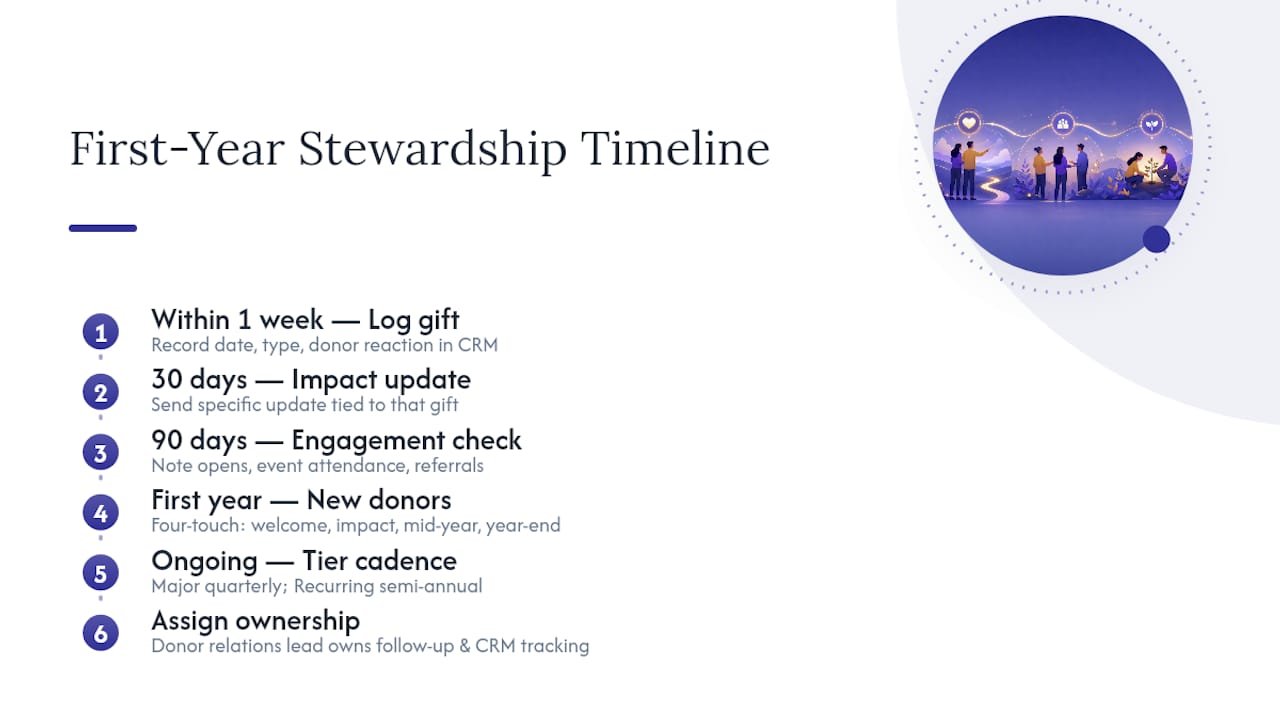
Build a cadence, not a one-off. New donors get a four-touch sequence across their first year: welcome, first impact update, mid-year check-in, year-end ask. Recurring and major donors get calendar-based touches, quarterly for major, semi-annual for recurring, that don’t always involve asking for money.
Assign ownership. Someone on staff, often a donor relations lead, should own the follow-up calendar so gifts don’t become the last contact a donor has until the next appeal. The playbook only works if a person is accountable for each step, and if the CRM tracks whether that step actually happened.
Using Gifts to Encourage Upgrades and Repeat Giving
A well-placed gift can nudge a donor toward their next gift, but only if the sequencing is right. Sending an upgrade ask immediately after a thank-you gift feels transactional; donors notice when gratitude has strings attached.
Instead, use the gift to set up a natural next conversation. A milestone gift at a donor’s third consecutive year is a good moment to mention a recurring-giving option, since you’re already celebrating consistency. A major-donor experience, a private tour or briefing, creates a natural opening for a program officer to discuss a larger, multi-year commitment, because the donor is already engaged and asking questions.

Track which gift types precede upgrades in your CRM. If donors who receive milestone acknowledgments upgrade at a higher rate than those who only get a standard thank-you, that’s a pattern worth building into your standard playbook rather than a one-time coincidence.
Legal and Ethical Rules for Donor Gifts
Gift value can affect a donor’s tax deduction. When a nonprofit gives something of real market value in exchange for a donation, the IRS generally requires the deductible portion of that gift to be reduced by the fair market value of what the donor received. A $500 monetary donation paired with a $75 gift typically means only the amount above that gift’s value is fully deductible. Disclose the value in your acknowledgment letter so donors and their accountants aren’t caught off guard.
Ethically, the core question is proportion: does this gift look like responsible stewardship of donated funds, or does it look like the organization is spending program dollars on donor perks? Boards and watchdog groups pay attention to this ratio, and so do donors themselves. Keep gifts modest relative to gift size, document in-kind partnerships clearly, and avoid gifts that could be mistaken for a quid pro quo arrangement rather than genuine appreciation.
A Fundraising Pro’s Rules of Thumb
Personalize more than you spend. A five-dollar item with a real name and a real detail beats a fifty-dollar item that could go to anyone. Confirm impact loudly and often, donors renew because they believe their money worked, not because they liked the mug. Match the gesture to the relationship stage, not the calendar. Test everything, and let donor feedback, not internal opinion, decide what earns a repeat.
How Discountswag Can Help You Scale Donor Appreciation
Once you know what each tier needs, the harder problem is getting enough of it, fast enough, without a single item feeling generic. Discountswag exists for that exact gap: bulk pricing on branded drinkware, apparel, bags, and tech items, rush ordering for compressed year-end timelines, and fulfillment to a single office or a dozen chapter locations from the same order.
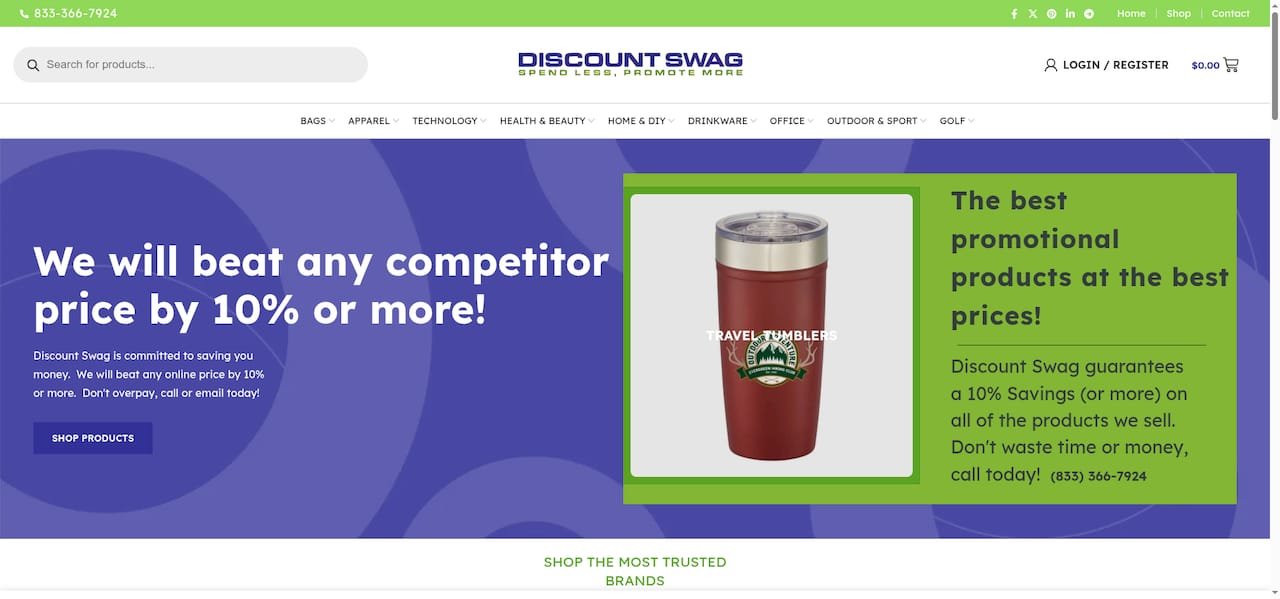
That matters most for mid-level and recurring donor tiers, where you need dozens or hundreds of gifts to feel individually chosen rather than mass-produced. Variable data printing and pre-branded SKUs let you run a batch of fifty tumblers or notebooks that still carry a donor’s name or campaign detail, without pricing yourself out of the tier. If you’re building a welcome kit for new donors or a milestone set for long-time supporters, start with a browse through branded giveaway items built for repeat use and request a quote before your next acknowledgment deadline hits.
Frequently Asked Questions
What are the best donor gift ideas for a nonprofit with a tight budget?
Handwritten notes, mission mementos under $10, and beneficiary photos with a personal line consistently outperform costlier generic items, and they scale to any budget size.
How much should a nonprofit spend on donor appreciation gifts?
Keep spending as a small percentage of the gift size, tightening that ratio as gifts grow larger rather than increasing gift cost at the same rate as donation size.
How soon should a donor gift or thank-you be sent?
Within 24 to 48 hours whenever possible. Donors thanked promptly are far more likely to give again than those thanked weeks later.
What donor gifts work best for virtual fundraising events?
E-gift cards, curated food and drink deliveries timed to the event, and short personalized beneficiary videos translate well when donors are participating from home.
Do donor appreciation gifts affect tax deductions?
Yes. When a gift has real market value, the deductible portion of the donor’s contribution is typically reduced by that value, so disclose it clearly in your acknowledgment letter.
Sources
- Thanking Donors: Donor Appreciation Examples, Resources & Tips
- Donor Appreciation Gifts — Dormie Network Foundation
- 50 Donor Gift Ideas That Will Make Supporters Smile (Neon One)
- Meaningful Donor Gifts: Recognition Ideas That Create Connection (Not Clutter) (Donor Relations)
- Engaging donors at different giving levels
 Bottle Carriers
 Mugs
Mugs