

Promo Marketing for Marketing Teams: Tactics That Drive Lift


Promo marketing is the set of short-term, incentive-driven tactics (discounts, giveaways, events, branded merchandise) that businesses use to push a specific action: awareness, trial, or a purchase. It works alongside broader branding, not instead of it. Start today with three moves: set one objective for your next promotion, pick a single primary channel, and choose one metric that proves it worked before you launch anything else.
- Set one clear objective (awareness, trial, or repeat purchase) before picking tactics
- Choose one primary channel to lead the campaign, per Shopify’s promotion mix framework
- Assign one KPI up front, not five vague ones you’ll sort out later
Key Takeaways
Promo marketing works when it pairs a single measurable objective with tight guardrails and honest incrementality testing, not raw redemption counts.
| Point | Details |
|---|---|
| Define one objective first | Awareness, trial, or conversion; pick one before choosing tactics or channels. |
| Match tactic to objective | Use the promotion mix (ads, PR, direct, sales promotion, events, digital) deliberately, not by default. |
| Build guardrails before launch | Unique codes, redemption caps, and a control group protect margin and prove real lift. |
| Measure incrementality, not volume | Holdout groups reveal what the promotion actually caused versus organic demand. |
| Use branded merchandise strategically | Discountswag supplies customizable items with rush ordering for events, onboarding, and retention moments. |
Table of Contents
- What Is Promotional Marketing, Exactly?
- What Are the Main Types of Promotional Tactics?
- Which Channels and Tactics Actually Work?
- How Do You Build a Promotional Marketing Plan?
- How Do You Measure Promo Marketing Success?
- When Should You Use Branded Promotional Products?
- What Actually Works: A Practitioner’s View
- How Discountswag Fits Into Your Promo Strategy
- Frequently Asked Questions
- Sources
What Is Promotional Marketing, Exactly?
Promotional marketing is the short-term, tactical activity that pushes people toward a specific action, using incentives like discounts, bundles, free gifts, or loyalty rewards to change behavior right now. Marketing is the broad, long-term discipline (positioning, pricing, brand voice); promotion is one lever inside it, aimed at a near-term result rather than years-long brand equity.
Promotional marketing spreads brand knowledge across multiple channels at once and functions as one piece of the classic marketing mix, not a replacement for it, according to Coursera’s breakdown of the practice. Most campaigns chase one of three goals: awareness, conversion, or trial.
- Awareness campaigns favor reach: social ads, sponsorships, branded swag at events
- Conversion campaigns favor urgency: flash sales, limited-time codes, cart abandonment offers
- Trial campaigns favor low friction: free samples, first-order discounts, referral perks
A quick gut check: if you can’t name which of those three goals a promotion serves, it’s not ready to launch.
What Are the Main Types of Promotional Tactics?
The “promotion mix” is the standard toolkit marketers pull from, and it combines advertising, PR, direct marketing, sales promotions, and personal selling into one coordinated push, per Shopify’s guide to the promotion mix. Each type earns its place by serving a different job.
- Advertising: paid social or search ads that build reach fast, usually best for awareness
- Public relations: earned media or influencer coverage that builds credibility over weeks or months
- Direct marketing: email or SMS campaigns aimed at existing contacts, strong for conversion
- Sales promotion: flash sales, BOGO offers, or coupon codes designed to trigger immediate purchases
- Personal selling: one-on-one outreach from sales reps, common in B2B deals
- Events and trade shows: in-person engagement paired with branded giveaways, strong for both awareness and lead capture
- Digital and social tactics: user-generated content and influencer posts that amplify reach when integrated with other channels
Sales promotions move product fast but carry a catch: time-limited offers and flash sales can spike returns afterward, a cost that’s easy to forget when you’re only watching top-line revenue, as Shopify’s research notes.
Which Channels and Tactics Actually Work?
Email remains one of the highest-ROI owned channels for promotional activity, largely because you already own the list and aren’t paying per impression, according to Shopify’s channel analysis. Social ads convert at higher rates among younger audiences, per Coursera’s research, which makes them a better fit for converting existing intent than for cold awareness building.
- Email: fast to launch, measurable within days, best for existing customers
- Social ads: strong for younger demographics, pair well with retargeting
- Content marketing: slower burn, builds compounding organic traffic over months
- Influencer partnerships: credibility boost, timeline varies by creator and platform
- Paid search: near-instant traffic, but cost climbs during competitive seasons
- Events: high-touch, high-cost, strong for lead capture and brand recall
- Promotional products: durable awareness and retention tool, detailed below
Cross-channel integration multiplies reach, but each channel runs on its own clock. Email and paid ads show results in days; PR and content take weeks or months to compound, per Shopify’s timeline breakdown. Segmentation and offer design matter more than incentive size. A well-targeted 10% discount to a lapsed customer segment often outperforms a blanket 25% discount blasted to everyone.
Pro Tip: Generate unique promo codes per segment or channel instead of one universal code. It’s the single easiest way to stop code leakage and see exactly which channel actually drove the sale, a guardrail Voucherify’s guide to promotion marketing flags as essential.
How Do You Build a Promotional Marketing Plan?
A promotion strategy is a coordinated, time-bound plan built on five components: objectives, audience, channel selection, timeline, and measurement, according to Monday. Campaigns that skip any one of these five tend to fail quietly, usually because teams worked in silos instead of coordinating up front.
- Set one objective. Awareness, trial, or conversion, not all three.
- Segment the audience. New customers, lapsed customers, and loyal repeat buyers need different offers.
- Design the offer. Match incentive type (discount, gift, bundle) to the objective.
- Choose your channel mix. Lead with one channel, support with two.
- Set the timeline. Most retail promotions run 3 to 14 days; longer campaigns dilute urgency.
- Build guardrails before launch. Unique codes, redemption caps, and a control group.
- Launch and monitor daily for the first 48 hours.
- Evaluate against incremental lift, not raw redemption count.
Guardrails matter as much as the offer itself. Set a redemption cap, use segment-specific codes, and hold back a small control group so you can measure what the promotion actually caused versus what would have happened anyway.
How Do You Measure Promo Marketing Success?
KPIs should match the objective you set in step one, not a generic dashboard. Awareness campaigns track reach and impressions. Engagement campaigns track click-through rate. Conversion campaigns track conversion rate, average order value, and revenue. Retention campaigns track repeat purchase rate and customer lifetime value.
- Awareness: reach, impressions, share of voice
- Engagement: CTR, social shares, time on page
- Conversion: conversion rate, average order value, total revenue
- Retention: repeat purchase rate, customer lifetime value
Incrementality testing, running a promotion against a holdout group that receives no offer, is the only reliable way to separate real lift from customers who would have bought anyway, per Uniqodo’s explanation of promotional marketing measurement. Watch for holdout contamination (control group members seeing the offer through another channel) and cannibalization, where a promotion just pulls forward sales you’d have gotten next month anyway.
When Should You Use Branded Promotional Products?
Physical promotional items earn their budget at three moments: live events, new-hire or customer onboarding, and retention touchpoints where a digital email would get ignored. Branded merchandise tends to deliver strong recall and can outperform other ad formats on direct response when the item fits the moment, according to research on promotional marketing’s advertising role.

Selection matters more than budget. Weigh brand fit, perceived value, durability, and cost per impression (a $3 pen handed out once beats a $30 item nobody uses twice) alongside your fulfillment plan for promotional items built for brand awareness. For onboarding kits specifically, look at how branded merchandise supports long-term engagement rather than one-time novelty.
Pro Tip: Bundle a physical item with a digital offer, a branded tumbler plus a QR code for 15% off online, so you can track redemption and prove the merchandise actually drove a measurable action.
What Actually Works: A Practitioner’s View
Most promotions fail for boring reasons: no clear objective, no guardrails, no way to prove incrementality. The teams that run promotions well treat every campaign like a five-part system, matching Monday.com’s framework, and they measure lift against a holdout group instead of celebrating raw redemption counts.

The most overlooked lesson: coordination beats creativity. A brilliant offer launched without a redemption cap or a segmented code structure burns margin fast. Get the guardrails right first.
How Discountswag Fits Into Your Promo Strategy
Once your objectives and guardrails are set, the execution question becomes: what do you actually hand people? Discountswag builds and fulfills branded promotional products, apparel, drinkware, bags, tech items, and event swag, with rush ordering and multi-location fulfillment so a last-minute trade show or onboarding wave doesn’t blow your timeline.
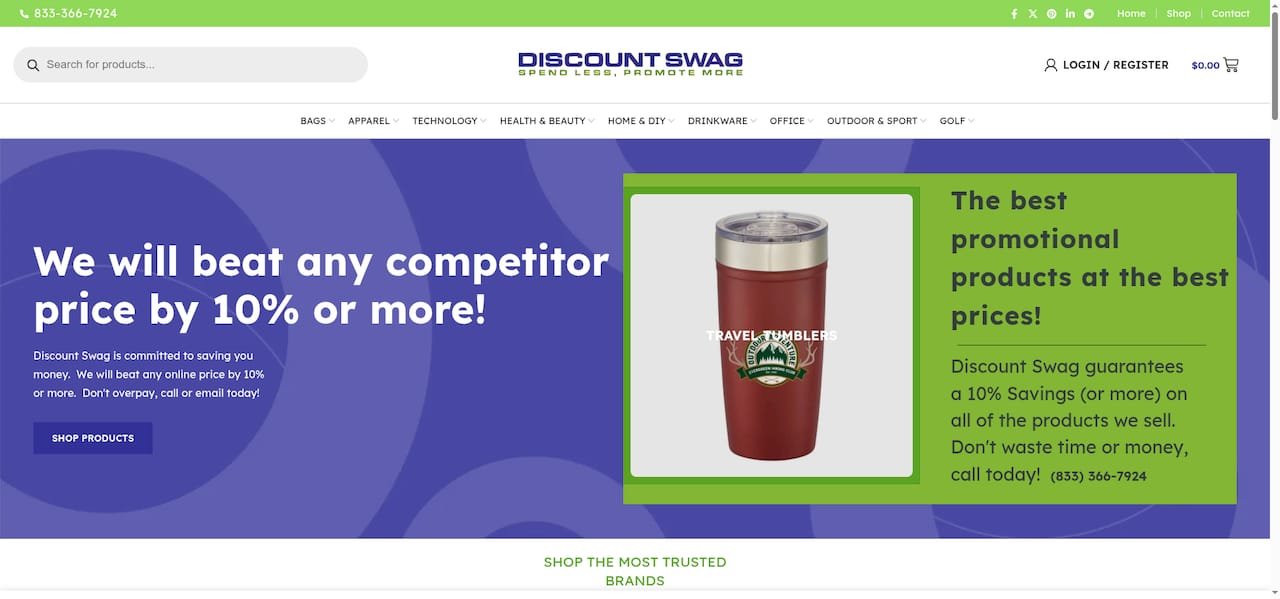
If you’re mapping items to campaign goals, start with Discountswag’s guide to branded product types to match the item to the objective instead of guessing. For awareness-first campaigns specifically, browse promotional items built for brand recall and get a quote before your next event deadline.
Frequently Asked Questions
What is the difference between marketing and promo marketing?
Marketing is the long-term discipline covering positioning, pricing, and brand strategy. Promo marketing is a short-term, tactical subset focused on driving a specific action within a defined window.
How long should a promotional campaign run?
Most sales-driven promotions run 3 to 14 days; longer windows tend to dilute urgency and blur measurement.
What KPIs matter most for promo marketing?
It depends on the objective: reach and impressions for awareness, click-through rate for engagement, conversion rate and revenue for sales, and repeat purchase rate for retention.
Are promotional products worth the cost?
Yes, when matched to the right moment, events, onboarding, or retention touchpoints, and measured by cost per impression rather than upfront price alone.
How do you prevent a promotion from hurting profit margin?
Set redemption caps, use segment-specific codes instead of one shared code, and measure results against a control group to confirm the lift is real.
Sources
- Promotional marketing: Coursera article
- Promotion Mix: Definition, Examples & Guide (2026) – Shopify
- What Is Promotional Marketing? Types, Campaigns, and How It Works | Uniqodo
- Promotion marketing: definition, tips, and examples
- Promotion Strategy: Build Campaigns That Drive Big Results 2026
 Bottle Carriers
 Mugs
Mugs