


Launch Points Based Safety Incentive Gifts in 60–90 Days for Safety Managers


The safety incentive gifts that hold up over time are branded, useful items delivered as small, frequent rewards tied to leading indicators, not lump-sum bonuses for staying injury free. Think branded gear workers actually want, distributed through a documented points system that rewards near-miss reports and hazard corrections. Discount Swag can fulfill the merchandise side with items like the Safety Alarm Keychain, but the program design has to follow OSHA guidance under 29 CFR 1904.35 to avoid rewarding silence instead of safety.
TL;DR:
- Incentive programs should focus on frequent, behavior-based rewards like PPE gear, recognition items, or micro-rewards, not outcome-based bonuses.
- Proper program design requires clear definitions, transparent records, and avoiding incentives that could discourage injury reporting or create goal conflicts.
- Delivery methods such as instant scratch cards, points platforms, or milestone kits must be planned around logistics, minimum orders, and separate safety and injury logs.
- Budgeting varies: micro-rewards and recognition items suit small teams, while larger operations need scaled budgets, with safety costs far lower than the expense of a serious injury.
- Effective communication, visible recognition, and frequent reinforcement are critical for program success, while avoiding design flaws that unintentionally promote silence or favoritism.
Table of Contents
- What Are the Best Safety Incentive Gift Ideas?
- How Do You Design a Compliant Safety Incentive Program?
- Delivery Methods: Scratch Cards, Points Platforms, or Kits?
- What Does a Safety Incentive Program Actually Cost?
- Vendor Checklist and How Discount Swag Fits the Rollout
- Beyond OSHA: Privacy, Discrimination, and Other Compliance Risks
- How Do You Measure Program Effectiveness Over Time?
- Tailoring Incentives to Different Workforce Groups
- Communicating the Program to Drive Real Participation
- What Safety Managers Get Wrong About Incentive Programs
- Get Program-Ready Safety Rewards From Discount Swag
- Sources
What Are the Best Safety Incentive Gift Ideas?
The best safety incentive gifts split into five practical categories, and the mistake most safety managers make is picking only one. A program built entirely around one big annual prize burns out fast. One built entirely around $5 gift cards feels cheap after the third quarter. The programs that stick blend categories so workers see variety and the reward always matches the size of the behavior being recognized.
PPE and on-the-job gear. This category works because it doubles as a functional tool the worker uses every shift, which reinforces the safety message every time they reach for it. Branded high-visibility vests that meet ANSI/ISEA 107 standards, hard-hat stickers for milestone achievements, durable multi-tools, rechargeable LED work lights, and stocked first-aid kits all fall here. Keep visibility public for these. A hard-hat sticker only works as recognition if coworkers can see it.
One clarification worth building into any PPE-as-reward program: if the gear is meant to supplement company-issued safety equipment rather than replace it, say so on the item or in the announcement. Workers should never wonder whether the branded vest they got as a reward is now their only compliant vest.
Recognition and award items. Engraved plaques, safety pins, milestone certificates, and wearable badges cost little per unit but carry outsized weight because they signal status, not just cash value. A shift supervisor handing over a small pin in front of the crew does more for morale than a mailed certificate. Keep these visible; that is the entire point of the category.
Tech and convenience rewards. Power banks, Bluetooth earbuds, rechargeable work lights, and compact tool kits sit in the middle price tier and work well as milestone rewards, for example, hitting 90 days without a hazard going unreported. These skew toward private distribution since they carry more perceived value and can feel awkward handed out in a group setting if not everyone earned one that cycle.
Lifestyle and family-friendly rewards. Insulated coolers, grocery gift cards, event tickets, and family meal vouchers extend the reward beyond the worker to their household, which research on reward design flags as a strong driver of perceived fairness and buy-in. These land especially well with industrial crews working shift schedules that already eat into family time.
Micro-rewards for wide participation. Scratch cards, branded tumblers, water bottles, and small gift cards are the backbone of a healthy program because they are cheap enough to hand out weekly without blowing the budget. Reward frequency research consistently finds that smaller, more frequent rewards build stronger habits than one large annual payout, which is the opposite of how most legacy safety programs were built in the 1990s.
Here is how those categories break down by tier and use case:
- PPE and gear — public visibility, low to mid cost, works for industrial and field crews especially.
- Recognition items (pins, plaques, badges) — public visibility, very low cost, works across industrial and office settings.
- Tech rewards (earbuds, power banks) — private or small-group distribution, mid to high cost, works best for milestone achievements.
- Lifestyle rewards (coolers, gift cards, family vouchers) — private distribution, mid cost, works well for shift workers and family-oriented crews.
- Micro-rewards (tumblers, scratch cards, water bottles) — public or private, very low cost, works for weekly or monthly participation drivers.
A branded tumbler program is a good example of an item that gets used daily rather than shoved in a drawer, which matters more than most managers assume when they are choosing between a mug nobody touches and one that rides in a truck cup holder every shift.
How Do You Design a Compliant Safety Incentive Program?
Start with leading indicators, not lagging ones. A leading indicator is a behavior the worker directly controls: reporting a near miss, completing a hazard correction, finishing required training, passing a self-inspection checklist. A lagging indicator is an outcome, like zero recordable injuries over a quarter, and rewarding that outcome is where most programs get into legal trouble.
OSHA’s anti-retaliation rule under 29 CFR 1904.35 specifically cautions that rate-based incentive programs, ones that pay out for low injury numbers, can discourage workers from reporting injuries at all, since a reported injury threatens the whole crew’s bonus. That is not a hypothetical risk. It is the exact mechanism the rule was written to stop. WorldatWork’s guidance on reward design backs the same conclusion: reward behaviors workers control, not outcomes they can only partially influence and might be tempted to hide.
Here is a program skeleton that holds up under scrutiny:
- Define the specific behaviors you’re rewarding. Near-miss reports, hazard corrections, PPE compliance checks, training completion, peer observations.
- Assign point values that reflect priority. A hazard correction might be worth three points; attending a toolbox talk might be worth one.
- Set a payout cadence workers can predict. Weekly or monthly micro-rewards, with a larger milestone reward at 60 to 90 days.
- Put the program in writing. A short policy document that names the eligible behaviors, the point values, and the payout schedule protects you if a claim ever gets questioned.
- Keep transparent records. Log who earned what and why, separate from injury records entirely.
- Communicate it clearly and repeatedly. A program nobody remembers exists doesn’t change behavior.
Before launch, run the program past a short gut check. Could this reward create pressure to hide an incident? Does it conflict with a production quota that might tempt a supervisor to look the other way? Is the reward tied to an outcome, or to a behavior a worker actually controls? If you can’t answer those cleanly, redesign before you order a single item.
Pro Tip: Have a supervisor from a different shift audit your point system once a quarter. It’s the easiest way to catch a rule that quietly rewards silence instead of safety before an auditor or an employee complaint catches it for you.
Research on program failures backs this up directly. A simulation-based study on safety incentive design found that programs creating goal conflict between safety and productivity tend to backfire, while behavior-based programs built with worker input avoid much of that risk.
Delivery Methods: Scratch Cards, Points Platforms, or Kits?
Instant issuance works best for immediate, in-the-moment recognition. A supervisor hands over a scratch card or a branded item right after observing the safe behavior, which keeps the reward tightly linked to the action in the worker’s mind. Points platforms suit programs with more structure, letting workers accumulate points toward a bigger reward and check their standing anytime. Quarterly kit fulfillment works well for milestone tiers, where a curated box shows up after 90 days of clean participation.
Logistics matter more than most managers plan for. Minimum order quantities, imprint lead times, and multi-site shipping can turn a simple idea into a scheduling headache if you order too close to a rollout date. Ask about rush ordering options early, request a sample before a full production run, and confirm whether the vendor can drop-ship to multiple facilities separately or requires one bulk delivery you redistribute yourself.
On the tracking side, keep your incentive records in a system entirely separate from your OSHA 300 injury logs. Log the behavior earned, the date, the point value, and the reward issued, but never cross-reference it against injury counts. That separation is what proves, if it’s ever questioned, that the program rewards action rather than punishing disclosure.
A short vendor checklist before requesting quotes:
- Confirm imprint area and method (screen print, embroidery, laser engrave).
- Ask whether PPE items carry required certification labeling.
- Get the minimum order quantity and lead time in writing.
- Clarify multi-site shipping and drop-shipping options.
- Request a sample or proof before full production.
What Does a Safety Incentive Program Actually Cost?
Budgets scale with headcount and reward frequency, not with how impressive the prizes look on a vendor’s catalog page. A small program covering under 50 employees can run effectively on a modest per-person annual budget concentrated in micro-rewards, weighted toward frequent low-cost items with a few milestone rewards. Mid-size operations with 50 to 250 workers typically need a larger per-person allocation to cover both weekly recognition items and quarterly kits. Large multi-site operations often set a per-facility budget and let site safety leads distribute it against local participation rates.
The cost comparison that matters: the National Safety Council has long tracked injury costs running into the tens of thousands of dollars per recordable incident when you factor in medical costs, lost productivity, and claims. A safety incentive budget in the low thousands per year, spread across a workforce, is a fraction of the cost of a single serious incident.
The metrics that matter go well beyond injury counts, which is the point of a leading-indicator program. Track participation rate (what share of the workforce is earning points), near-miss report volume, training completion percentages, supervisor observation counts, and attendance at recognition events. A program with rising near-miss reports and steady participation is working, even if injury counts don’t move much in month one. That’s usually a sign workers finally trust the reporting process instead of hiding problems.
Vendor Checklist and How Discount Swag Fits the Rollout
Once your program design is locked, procurement is where good intentions either turn into a working kit or stall for six weeks. A workable vendor checklist covers lead time, imprint specs, sample approval, PPE certification requirements, multi-site shipping, and suggested kit contents by reward tier.
Discount Swag supports that rollout with branded kit assembly, rush fulfillment for time-sensitive launches, and bulk discounts that scale with program size. The Safety Alarm Keychain is a good example of a low-cost, high-utility item: functional enough that workers actually carry it, branded enough to reinforce the program every time they use it.
Before finalizing any reward list, survey your own workforce. Ask what they’d actually use, whether they prefer public or private recognition, and what reward tier feels meaningful versus token. A five-question survey beats a guess every time.
Beyond OSHA: Privacy, Discrimination, and Other Compliance Risks
OSHA’s anti-retaliation rule gets most of the attention, but it isn’t the only legal exposure in a safety incentive program. Privacy comes up the moment you start tracking who earned what and why. If your points system logs health-related information, like a modified-duty status tied to a medical restriction, keep that data walled off from general safety records and limit access to HR and safety leadership only.
Discrimination risk shows up in ways that are easy to miss during design. A rewards structure that favors full-time employees over part-time or seasonal workers can look like disparate treatment if those groups skew toward a protected class. The same goes for physical challenges in a reward: a 5k walk incentive tied to safety recognition can unintentionally exclude workers with disabilities unless there’s an equivalent option.
Union environments add another layer. Incentive programs that affect pay or working conditions can fall under collective bargaining obligations, so loop in labor relations before rolling out anything that touches compensation-adjacent rewards. And if your program spans multiple states, check whether any local wage-and-hour rules treat frequent small rewards as reportable income requiring payroll handling.
The safest posture is to document eligibility criteria in plain language, apply them consistently across every eligible group, and have someone outside the safety team review the policy before launch.
How Do You Measure Program Effectiveness Over Time?
Injury counts alone tell you almost nothing in the first year of a redesigned program, and treating them as the primary metric is how well-meaning safety managers lose faith in their own initiative too early. Track a broader set of numbers instead, reviewed on a consistent monthly or quarterly cadence.
Participation rate is the first number to watch: what percentage of the eligible workforce earned at least one point or reward in the period. A flat or declining participation rate usually means the behaviors are too hard to log, the rewards feel disconnected from effort, or communication has gone quiet.
Near-miss report volume should climb as trust in the program builds, since workers only report freely when they believe doing so won’t cost them anything. Training completion rates and hazard correction turnaround times round out the leading-indicator picture. Supervisor observation counts, meaning how often frontline leaders are actively watching for and logging safe behaviors, tend to predict program health better than almost any other single number, since a program supervisors ignore dies quietly within two quarters.
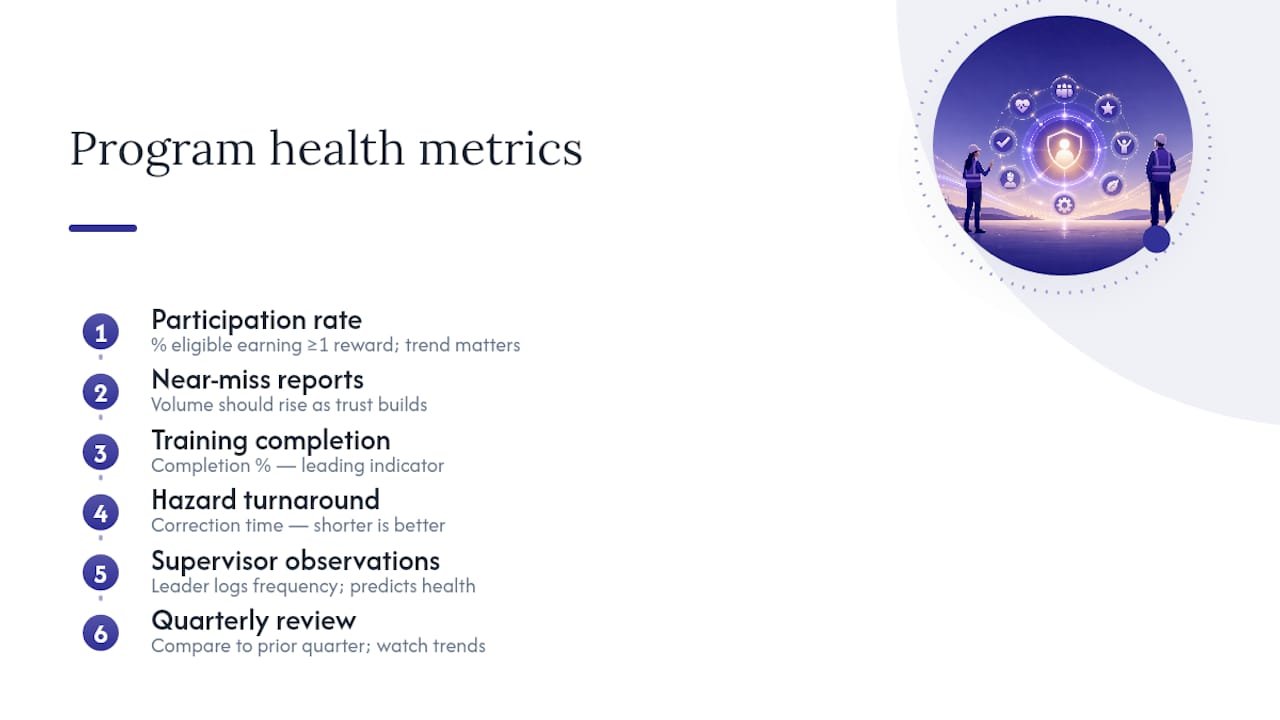
Set a quarterly review with safety leadership to compare these figures against the prior quarter, not against a fixed target. Trend direction matters more than any single snapshot.
Tailoring Incentives to Different Workforce Groups
A single reward menu rarely fits an entire workforce, and treating a warehouse crew the same as an office-based compliance team is one of the more common design mistakes. Field and industrial workers respond well to functional gear they use on shift: work lights, multi-tools, insulated gear, high-visibility apparel. Office and administrative staff, who don’t wear PPE daily, respond better to lifestyle rewards, tech accessories, or items suited to remote and desk-based roles.
Shift patterns matter too. Night-shift crews often value family-oriented rewards, like meal vouchers or grocery gift cards, more than a supervisor might expect, since those rewards give something back to a household schedule the job has already disrupted. Younger workers frequently respond better to tech and convenience items, while workers closer to retirement often lean toward practical gear or gift cards over gadgets.
Multilingual and multicultural crews need program communication translated and culturally checked, not just the reward names but the recognition style. Public recognition that works well in one crew’s culture can feel uncomfortable in another. The fix isn’t complicated: ask, don’t assume, and build in a way for workers to flag if a reward type doesn’t land for them.
Communicating the Program to Drive Real Participation
A program with excellent design and terrible communication still fails, and this is where a surprising number of otherwise solid safety incentive rollouts quietly die. Workers need to hear about the program more than once at kickoff. Repeat the message at toolbox talks, post it on break-room boards, and have supervisors mention it during routine check-ins, not just at the annual safety meeting.
Make the earning behaviors visible and simple. If a worker can’t explain in one sentence what earns them points, the program is too complicated. Post the point values somewhere workers actually look, not buried in a policy binder nobody opens after week one.
Celebrate wins publicly where appropriate, and make sure supervisors are trained to hand out recognition in the moment rather than batching it for a monthly meeting. Immediate recognition reinforces the connection between action and reward far better than a delayed one. Consider a simple leaderboard or point tracker visible at the site, since visibility itself drives participation even among workers who aren’t chasing the top spot.
What Safety Managers Get Wrong About Incentive Programs
Most safety incentive programs fail for a boring reason: they were designed to look good in a leadership meeting, not to survive contact with a real crew. Safety managers reach for the injury-free bonus because it’s simple to explain and easy to budget, and then act surprised when reporting rates drop the following quarter. That isn’t a coincidence. It’s the predictable result of rewarding an outcome workers can manipulate by staying quiet.
The overlooked piece is frequency, not prize size. A quarterly all-hands raffle for a big-ticket item generates buzz for a week and gets forgotten by week three. A steady drip of small, visible rewards tied to specific behaviors keeps the safety message alive between incidents, which is exactly when a program is supposed to be doing its job. If you take one thing from this guide, make it that: reward the behavior you can see, reward it often, and keep the paper trail clean enough that nobody could mistake it for a bribe to stay silent.
— Jerry
Get Program-Ready Safety Rewards From Discount Swag
Once your program design is locked, the bottleneck usually isn’t strategy. It’s finding a vendor who can turn a points system into physical rewards fast enough to keep momentum going. Discount Swag handles the merchandise side end to end: custom imprinting on PPE-adjacent gear and everyday items, kit assembly for milestone tiers, and rush shipping when a program launch date is closer than your usual lead time allows.
If you’re still deciding between low-cost swag and a more premium reward tier, the breakdown on promotional products versus corporate gifts walks through how to match reward type to budget and occasion. For a faster path to a working reward tier, the curated corporate gift sets come pre-built for programs that need kits assembled and shipped without designing every item from scratch. Request a sample kit or get a quote before your next program cycle starts, so the rewards are ready the moment your points system goes live.
Sources
- OSHA — Recordkeeping modernization guidance (29 CFR 1904.35)
- Tips on designing rewards that strengthen, not weaken, safety culture — WorldatWork
- When the tension is rising: A simulation-based study on the effects of safety incentive programs — MDPI
 Bottle Carriers
 Mugs
Mugs