

Lock Your Event Date: Promotional Product Lead Times by Weeks Out

Most standard promotional products arrive in 2 to 6 weeks from order confirmation to delivery, while fully custom builds requiring tooling run 8 to 16 weeks or more. The safe planning rule: take whatever number a vendor quotes and add a 2 week buffer, because that quote almost never includes shipping or your internal approval rounds.
TL;DR:
- Custom molds, mascots, and other handcrafted products typically require 8 to 14 weeks from design approval to delivery, making rush options impractical.
- Lead times for basic items like pens or stickers usually take 1 to 2 weeks, while decorated apparel can need 2 to 3 weeks depending on decoration complexity.
- Larger or complex customizations such as new molds or Pantone- matched colors can add 1 to 3 weeks before actual production begins.
- Shipping time, whether domestic or international, counts toward the total lead time, with ocean freight adding 3 to 6 weeks and domestic shipping often just a few days.
- Proper planning involves working backward from the event date, with at least 16 weeks for complicated items and significantly more during holiday seasons or supplier backlog periods.
Table of Contents
- What Are Typical Promotional Product Lead Times By Category?
- What Factors Actually Change A Custom Product’s Delivery Time?
- Can You Actually Rush A Promotional Product Order?
- How Long Do Samples Take Compared To Bulk Production?
- How Do You Plan Backward From Your Event Date?
- How Can You Avoid Delays In Promotional Product Orders?
- How Discount Swag Helps You Hit Tight Deadlines
- What Planners Should Prioritize When Time Is Short
- Ready To Lock In Your Event Date?
- Sources
- FAQ
What Are Typical Promotional Product Lead Times By Category?
Lead time depends less on the product itself and more on how many production steps stand between a blank item and a finished, branded one. A pen with a single pad print runs through fewer steps than a fleece jacket needing embroidery digitizing, thread color matching, and a stitch-out sample.
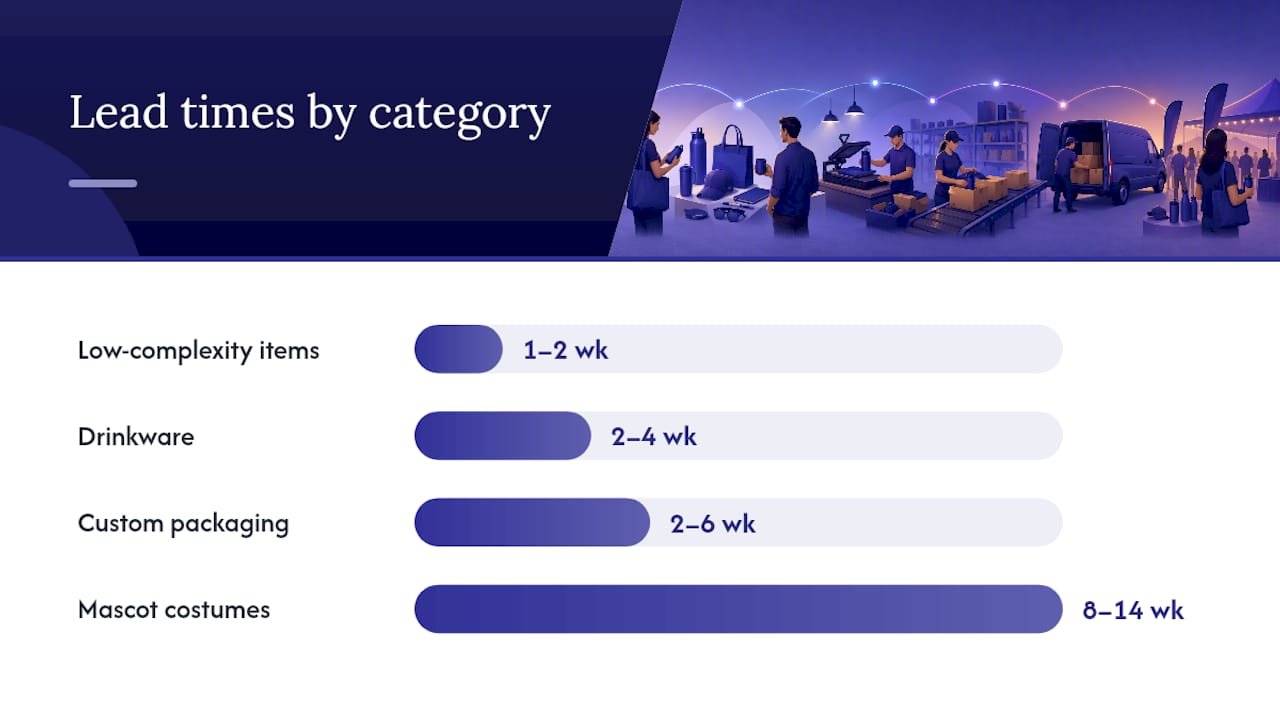
Low-complexity items like pens, stickers, and basic keychains typically clear production in 1 to 2 weeks once art is approved, because decoration methods like pad printing or one-color imprints add minimal time. Decorated apparel runs longer: screen printing adds a few days per color, while embroidery requires digitizing the artwork into a stitch file first, a step that alone can take 2 to 3 business days before a single shirt gets sewn. Drinkware sits in the middle, usually 2 to 4 weeks, depending on whether it needs laser engraving (fast) or full-color wrap printing (slower, more setup).
Molded items like stress balls or custom-shaped stress relievers take longer still, since they often require a new mold if the shape is not already in a supplier’s catalog. Custom packaging follows a similar curve. Standard custom packaging typically takes 2 to 6 weeks including design, proofing, production, and shipping. Mascot costumes and other large custom builds sit at the far end of the spectrum. Custom mascot costumes commonly take 8 to 14 weeks from design approval to delivery, since sculpting, foam work, sewing, and wear testing all happen in sequence, not parallel.
What Factors Actually Change A Custom Product’s Delivery Time?
Customization complexity drives more delay than any other single factor. A new mold, a Pantone-matched color that is not in a supplier’s standard palette, or hardware that has to be sourced separately can each tack on 1 to 3 weeks before regular production even starts. Order quantity matters too, but not in the direction most people assume. Very large orders sometimes take longer because a factory needs multiple production runs, while very small orders can get deprioritized behind bigger clients during busy periods.
Seasonal capacity is the factor procurement teams underestimate most. Every supplier gets slammed in Q4 as companies stock up for the holidays and year-end conferences, and that backlog can push a normally 3-week item to 5 or 6 weeks with zero change to the order itself. Material shortages compound this. If a specific fabric blend or bottle color is backordered, your production clock does not start until the material arrives.
Internal approval cycles are the hidden lead-time killer. Most delays actually happen during design approval, not production. A proof that sits in someone’s inbox for five days adds five days to the calendar just as surely as a factory delay would. Responding to proofs within 24 to 72 hours keeps momentum, and MOQ and lead time depend heavily on how quickly buyers confirm sampling and artwork approvals.
Finally, origin and shipping method set the floor for total time. Overseas production on ocean freight adds 3 to 6 weeks of transit alone, while domestic manufacturing paired with ground or air shipping can cut that to a few days.
Can You Actually Rush A Promotional Product Order?
Sometimes, but not evenly across every product. Rush-eligible categories tend to be digitally printed goods, items already stocked in blank inventory, and anything produced domestically, since there is no ocean transit to compress. Items that require new tooling, custom molds, or handcrafted assembly, like a mascot costume or an injection-molded item in a brand-new shape, generally cannot be rushed at any price, because the physical steps (curing, sculpting, testing) take a fixed amount of time regardless of budget.
Rush premiums are real but predictable. Rush surcharges commonly range from 15% to 60% of the order cost, with the higher end reserved for the tightest timelines and the most complex decoration. Domestic production is your biggest lever here. Since it skips ocean freight entirely, domestic manufacturing paired with expedited shipping can bring total turnaround into a one-week window for items that already have approved art.
To actually get a rush slot: pay for priority scheduling upfront rather than asking after the fact, simplify to fewer imprint colors, and lock final artwork before you ask for expedited handling. Our rush order guide breaks down which categories respond best to this approach.
How Long Do Samples Take Compared To Bulk Production?
A sample and a bulk order run on separate clocks, and confusing the two is one of the most common planning mistakes procurement teams make. Domestic samples typically ship in 3 to 7 business days. International samples add customs clearance and longer transit, often stretching to 2 to 3 weeks before a physical unit lands on your desk.
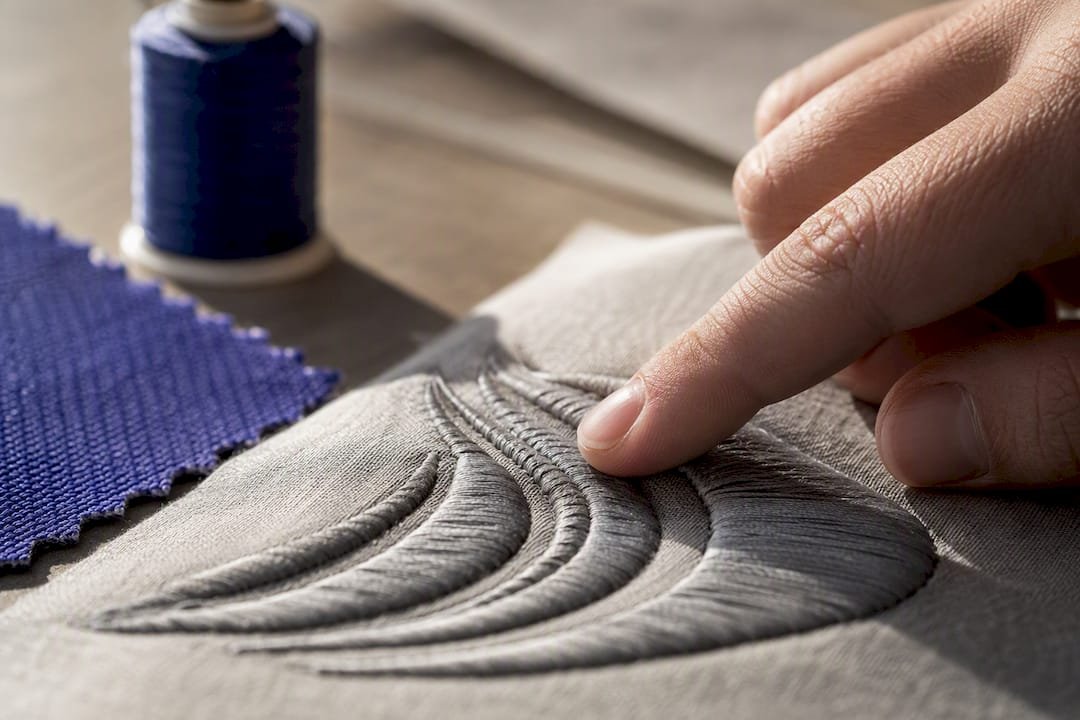
Not every order needs a physical sample. Low-risk items with simple one-color imprints are usually fine with a digital mockup, and a partner like RNK Apparel Co. explains how digital mockup workflows let brands verify placement and color without waiting on a physical unit. Reserve physical samples for anything where color accuracy, material feel, or fit genuinely matters, like embroidered apparel going to executives or drinkware with a wrap print that needs to be checked in hand.
If the calendar is tight, three moves compress sample time without skipping the safeguard entirely: request an expedited sample (many suppliers offer 24 to 48 hour turnaround for a fee), lean on 3D digital renders for low-stakes decisions, or run a small pilot batch of 10 to 20 units that doubles as both your sample and your first shipment. Each approach trades a bit of certainty for speed, so match the method to how much is riding on the item looking right the first time.
How Do You Plan Backward From Your Event Date?
Start from your in-hand date, the day items must physically arrive, and work backward rather than forward from today. That single shift in thinking prevents most last-minute scrambles.
16+ weeks out: Finalize product selection for anything requiring tooling, molds, or mascot builds. This is also when to lock your supplier if the item needs a custom shape or color.
12 weeks out: Submit final artwork for standard custom apparel and packaging. Confirm material availability with your vendor now, before a shortage becomes your problem.
8 weeks out: Order drinkware, bags, and mid-complexity decorated items. This window still allows for one design revision without blowing the schedule.
4 to 6 weeks out: Place orders for standard low-complexity items like pens and basic giveaways. Confirm your in-hand date in writing with the vendor, since locking a specific delivery window prevents the common “shipped on time, arrived late” gap.
2 weeks out: This is rush territory only. Expect premium pricing and a narrower product selection.
Add 2 to 4 weeks to every stage above during Q4 or around major holidays, when factory backlogs stretch even routine orders.
How Can You Avoid Delays In Promotional Product Orders?
A late shipment almost always traces back to one of a handful of preventable gaps, not a factory failure. Run through this before you place an order:
- Prepare print-ready artwork in the correct file format before you request a quote, not after.
- Set an internal SLA of 24 to 48 hours for anyone who needs to approve a proof.
- Confirm minimum order quantity and material availability with the vendor in writing.
- Choose domestic production or air freight when your timeline has no room for ocean transit.
- Assign one single approver for final proofs. Splitting sign-off across three people is a guaranteed delay.
- Require tracking numbers and, for multi-location events, staged delivery confirmations.
- Book quality control and kitting time before the event, not the week of.
Pro Tip: Draft a one-line vendor response template in advance (“Approved as shown” or “Approved with attached changes”) so your team can clear a proof in minutes instead of drafting a reply from scratch every time one lands in the inbox.
Our corporate event merchandise checklist covers the logistics side of this in more depth, including kitting and multi-location staging.
How Discount Swag Helps You Hit Tight Deadlines
Discountswag built its in-hand date guidance around one goal: turning a vague production quote into a firm delivery day you can plan an event around. That starts with vendor selection. Discountswag works with a curated pool of suppliers chosen partly for rush reliability, not just price, and offers rush order options for teams working against a fixed date. For multi-location rollouts, kitting and fulfillment services handle the coordination that usually causes the last-mile delays procurement teams dread most.
What Planners Should Prioritize When Time Is Short
When the date won’t move, prioritize domestically producible, rush-eligible items over anything needing new tooling. Simplify decoration to fewer colors, and put one person in charge of sign-off. If a custom piece can’t be rushed affordably, switch to a stocked equivalent rather than gambling on a factory’s exception schedule.
— Jerry
Ready To Lock In Your Event Date?
Discountswag’s edge isn’t just speed, it’s the combination: rush order capability, a curated supplier pool vetted for reliability, and fulfillment that handles kitting and delivery to single or multiple locations without you chasing three separate vendors.
If your event date is fixed and you’re not sure a product category will make it in time, that’s exactly the kind of question to ask before you place the order, not after. Browse current product categories or start a request for a specific in-hand date to get a straight answer on feasibility before you commit budget.
Sources
- What are the lead times for ordering promotional products? – Promo Bears USA
- How Long Does Custom Packaging Take? Real Timelines (2026)
- Lead time — Wikipedia
FAQ
What Is Product Lead Time?
Product lead time is the total span between placing an order and receiving finished goods, covering design, production, and shipping as a single window rather than production alone. Confusing “production time” with total lead time is the most common scheduling mistake procurement teams make.
What Is A Typical Lead Time For Promotional Products?
Most standard promotional items take 2 to 6 weeks from order confirmation to delivery. Fully custom items needing new tooling or molds often run 8 to 16 weeks or more, so it pays to check which category your product falls into before setting an event date.
Can You Give Examples Of Lead Times For Different Products?
Pens and basic imprinted items typically ship in 1 to 2 weeks, screen-printed apparel in 2 to 3 weeks, and custom packaging in 2 to 6 weeks. At the long end, custom mascot costumes commonly take 8 to 14 weeks due to handcrafted construction stages.
How Fast Can Discountswag Deliver A Rush Order?
Rush-eligible products, generally domestically produced or digitally printed items, can sometimes ship in a matter of days rather than weeks once artwork is finalized. Exact rush windows vary by product, so requesting a feasibility check for your specific event date is the most reliable way to know what’s possible.
Does Shipping Time Count As Part Of The Lead Time?
Yes. Transit time is part of total lead time, not a separate add-on, and skipping it from your planning math is how “on time from the factory” becomes “late to the event.” Domestic shipping via ground or air adds days; overseas ocean freight can add several weeks on top of production time.
 Bottle Carriers
 Mugs
Mugs