


Cut Corporate Gifting Cost for Procurement: Bulk Pricing and 1–3% Rules


Most companies spend $25 to $75 per employee for routine recognition, $50 to $150 per client, and $150 or more for VIP or milestone gifts. Keep in mind the IRS caps the deductible portion of client gifts at $25 per recipient per year, which affects your accounting even if it doesn’t limit what you spend.
TL;DR:
- Most companies spend between $25 and $150 per gift, with larger budgets allocated for VIP or milestone recognition, but IRS deductions are limited to $25 per client annually.
- Gifting budgets usually fall into three tiers: $15 to $40 for routine items, $50 to $150 for standard recognition, and over $150 for executive or milestone gifts, influencing relationship status.
- Bulk procurement and early planning help reduce costs, with customization and shipping logistics accounting for additional lead time and expense considerations across all budget levels.
- Gifting effectiveness depends more on relationship value and timing than on total spend, with targeted, appropriate gifts strengthening retention and renewal chances.
- Using a consistent budgeting method and vendor partnerships like Discount Swag supports efficient, scalable gift programs that align with company size and relationship importance.
Table of Contents
- Typical Corporate Gifting Budget Ranges Explained
- Why There Is No Single Right Amount
- Budgets by Recipient Type: Employees, Clients, and VIPs
- Gift Ideas by Budget Tier That Align With the Ranges
- How to Manage Your Corporate Gifting Budget and Logistics
- Tax, Reporting, and Company Policy Considerations
- Distributor Perspective: Stretching Budget Without Losing Impact
- What Return Do Different Gifting Budgets Actually Produce?
- How Do Gifting Costs Compare Across Industries and Company Sizes?
- Strategies to Optimize Your Gifting Budget Efficiency
- Author Perspective: A Quick Buyer Checklist
- How Discount Swag Helps: Curated Kits, Bulk Pricing, Rush Fulfillment
- Sources
- FAQ
Typical Corporate Gifting Budget Ranges Explained
Corporate gifting budgets tend to cluster into three bands. Each one signals something different about the relationship being recognized.
Entry-level gifts, usually $15 to $40, cover routine employee recognition, low-touch client thank-yous, and high-volume conference swag. Mid-range gifts, $50 to $150, are the workhorse tier: standard client appreciation, new-hire welcome kits, and holiday gifts for staff. Premium gifts, $150 and up, are reserved for executive relationships, major renewals, and career milestones like a 10-year work anniversary.
Industry data backs up these bands closely. Average client gift spend in the U.S. commonly runs $50 to $200, and companies that formalize a dedicated gifting budget report measurably better retention outcomes than those who wing it. Company size shifts the numbers, too:
- Small businesses (under 50 employees) often spend at the lower end of each band because gifting comes out of a general marketing line, not a dedicated budget.
- Mid-market companies (50 to 500 employees) typically formalize tiers, separating employee recognition from client gifting entirely.
- Enterprise organizations frequently run year-round gifting calendars with per-department budgets and negotiated bulk pricing that lowers their effective per-unit cost.
Scale changes the math more than most buyers expect. A 20-person company giving $75 gifts to five key clients spends $375 total. A 2,000-person company doing the same ratio spends tens of thousands, which is exactly why bulk procurement becomes the bigger lever at scale.
Why There Is No Single Right Amount
Five factors push your budget up or down, and treating every gift the same regardless of context is where most programs go wrong.
- Occasion significance. A birthday card and a promotion gift shouldn’t cost the same, even for the same employee.
- Frequency. Gifts given quarterly need a lower per-item cost than a once-a-year holiday gift, or your annual total balloons.
- Recipient level. A junior client contact and the VP who signs the renewal warrant different spend, even at the same company.
- Company size and cash flow. A startup with 15 employees can’t run the same program as a 500-person firm, and shouldn’t try to.
- Company culture. Some organizations favor modest, consistent gifting over occasional lavish gestures, and either approach works if applied evenly.
Two budgeting methods handle most of this. Flat per-head budgeting assigns a fixed dollar amount per person or per gift, simple to plan and easy to audit. Proportional budgeting ties client gifts to 1 to 3% of the account’s annual value, which scales naturally with the relationship’s worth. Whichever you pick, apply it consistently. Nothing damages morale faster than one employee learning a peer got a nicer gift for the same tenure.
Budgets by Recipient Type: Employees, Clients, and VIPs
Breaking spend down by who’s receiving the gift makes budgeting far less abstract.
Employees:
- Routine recognition (birthdays, work anniversaries under five years): $25 to $50
- Milestone recognition (5, 10, 15+ years, promotions): $75 to $150
- Approximate annual per-employee gifting total, including holidays: $100 to $250
Clients:
- Standard client appreciation: $50 to $150 per gift
- Key accounts using the proportional method: 1 to 3% of annual account value, often landing between $150 and $500 for six-figure accounts
- New client welcome gifts: $40 to $75
VIP and executive relationships:
- Escalate spend beyond $150 only for accounts with clear strategic weight, a major renewal on the table, or a long-tenured executive relationship
- Route anything above your standard VIP ceiling through a second approval, not just the requesting manager
- Document the reason for the escalation so next year’s budget planning has a paper trail instead of a guess
Governance matters more at the VIP tier than anywhere else. A $500 gift with no sign-off process invites both budget creep and awkward optics if two similarly ranked clients receive noticeably different treatment.
Gift Ideas by Budget Tier That Align With the Ranges
Matching the gift concept to the price band keeps quality consistent even when the dollar amount changes.
Under $30: Branded drinkware, notebooks, or small tech accessories scale well for large groups without feeling generic. This tier works best for conference giveaways, new-hire kits, or company-wide holiday gifts where volume matters more than individual customization.
$50 to $150: This is where light personalization starts to pay off. Think a curated gift set with a monogram, a quality apparel piece, or a branded tech item paired with a handwritten note. Curated wellness sets and non-consumable items tend to outperform generic branded swag or cash of equal value, since they feel considered rather than transactional.
$150 and up: Executive gifts and career milestones justify higher-end apparel, premium tech, or fully custom branded boxes. These almost always need an approval step before ordering.
Three mistakes account for most gifting complaints: guessing apparel sizes instead of asking, ignoring dietary restrictions on food items, and misspelling a name during personalization. None of these are budget problems. They’re process problems that a good vendor checklist solves regardless of what tier you’re spending in.
How to Manage Your Corporate Gifting Budget and Logistics
Getting the number right matters less than getting the timing right. Companies that lock their gift budget and headcount early avoid nearly every rush fee that catches procurement teams off guard later.
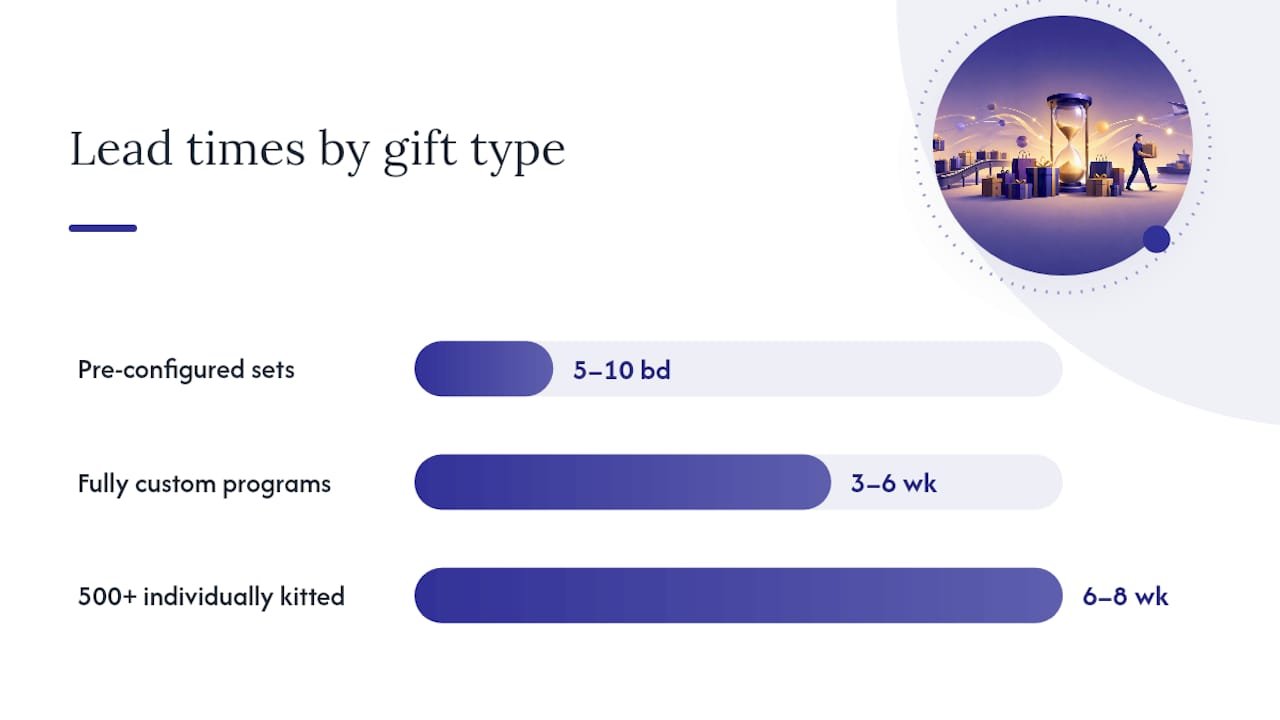
A realistic planning timeline looks like this: lock the budget and recipient count first, finalize shipping addresses next (address collection is the single biggest delay in corporate gifting), then set a ship-by date working backward from the event or holiday. Pre-configured gift sets typically ship in 5 to 10 business days, while fully custom branded programs need 3 to 6 weeks. Orders above roughly 500 units with individual kitting need 6 to 8 weeks.
Customization, packaging, and kitting each add cost layers on top of the base product. Printing method (silk screen, laser engraving, embroidery, UV) changes both per-unit price and turnaround, and minimum order quantities heavily influence your effective cost per gift.
Before placing an order, confirm:
- Recipient count and address list are final
- Customization method is chosen and quoted
- Ship-by date allows buffer for at least one revision round
- Bulk-order discount thresholds have been checked against your quantity
- Someone has budgeted staff time for kitting and distribution, not just the product cost
Address corrections and last-minute additions almost always eat into your buffer, and reordering a small batch later costs far more per unit than padding the original order.*
Tax, Reporting, and Company Policy Considerations
The IRS caps the deductible portion of a client gift at $25 per recipient per year. That’s a deduction limit, not a spending limit. You can give a client a $200 gift; your company just can’t deduct more than $25 of it as a business expense.
Incidental costs like engraving, gift wrapping, and shipping generally don’t count against that $25 cap if they don’t add substantial value on their own. Branded promotional items with your logo have historically received different treatment than personal gifts, so loop in accounting before assuming everything falls under the same rule. Employee gifts carry separate tax considerations around what counts as a taxable benefit versus a de minimis perk.
Internally, keep a simple policy checklist: who approves spend above each tier, what documentation gets filed for tax purposes, and how you enforce consistency so two similar clients don’t receive wildly different treatment.
Distributor Perspective: Stretching Budget Without Losing Impact
Printing method and minimum order quantity are the two levers that move your per-unit cost the most, and they’re the two most procurement teams underuse. Choosing a lower-cost printing method at a slightly higher MOQ often beats a premium method at a small quantity, even after storage costs.
Pre-configured sets are the faster, cheaper path when timelines are tight. Fully custom kits cost more and take longer, but they’re worth it for executive tiers where the packaging itself is part of the message.
Fulfillment strategy matters just as much as the product. Centralized shipping to one office is cheaper per unit; distributed shipping to remote employees or multiple client sites costs more per shipment but avoids the internal labor of redistributing gifts yourself.
- Negotiate pricing tiers before you need them, not during a rush order
- Ask your vendor about bulk discount thresholds before finalizing headcount
- Compare centralized versus distributed shipping costs for your specific recipient spread
Pro Tip: Ask any vendor for their MOQ break points before you finalize quantity. Ordering three units above a discount threshold can lower your entire order’s per-unit cost more than any other single decision.
What Return Do Different Gifting Budgets Actually Produce?
Higher spend doesn’t automatically produce higher returns, but under-investing in key relationships has a measurable cost. Companies that allocate a dedicated gifting budget rather than an ad hoc one report better retention and, in many cases, a return that outweighs the gift’s face value several times over when the relationship renews or expands.
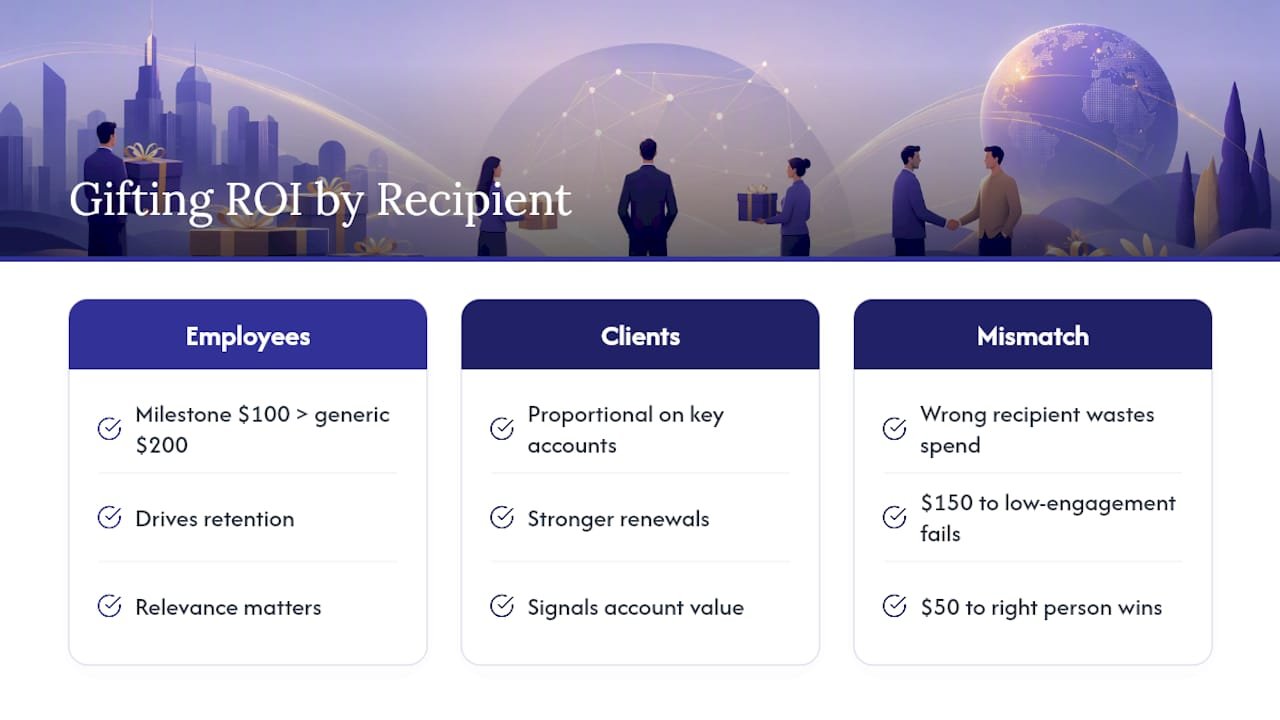
The return shows up differently depending on recipient type. For employees, a well-timed $100 milestone gift tends to do more for retention than a generic $200 holiday gift sent to everyone regardless of tenure. The relevance of the gesture, not just its cost, drives the outcome. For clients, proportional gifting on key accounts correlates with stronger renewal conversations, largely because the gift signals that the account is understood as valuable, not just serviced.
Where budgets underperform is usually a mismatch problem, not a spending problem. A $150 gift sent to a low-engagement client contact rarely moves the needle, while a $50 gift sent to the right person at the right moment often outperforms it. This is why branded items tied to a broader marketing or retention strategy tend to justify their cost more consistently than one-off gestures disconnected from any relationship plan.
The practical takeaway for budget approval conversations: frame the ask around the relationship’s value, not the gift’s price tag. A $300 gift to a client worth $50,000 annually is an easier internal sell than the same number applied uniformly across every account.
How Do Gifting Costs Compare Across Industries and Company Sizes?
Spend patterns vary more by relationship structure than by industry label, but some patterns hold consistently across company size.
Retail and consumer-facing companies more often lean on volume gifting, lower per-unit cost across a much larger recipient list, since their relationships are broader but shallower.
By company size, the pattern is fairly predictable. Small businesses typically spend less per gift but also give fewer gifts overall, keeping total program cost manageable. Mid-market companies formalize tiers and start separating employee and client budgets into distinct line items, which usually raises average per-gift spend since the guesswork gets replaced by policy. Enterprise organizations spend the most in aggregate but often achieve the lowest per-unit cost, because bulk purchasing power offsets the higher total volume.
Benchmarking against industry peers is useful, but only as a sanity check, not a target. A 15-person marketing agency and a 500-person logistics company both giving “client gifts” are solving completely different budgeting problems, even if their per-gift dollar amount looks similar on paper. The more useful comparison is against your own prior year’s spend and outcome, tracking whether retention or engagement improved after a budget change, rather than matching a competitor’s number blindly.
Strategies to Optimize Your Gifting Budget Efficiency
The fastest way to lower your effective cost per gift without cutting quality is consolidating your order volume. Bulk ordering through a single supplier reduces per-unit pricing, simplifies branding consistency, and cuts the administrative overhead of managing multiple vendors for one gifting cycle.
A few tactics consistently move the needle for procurement teams working within a fixed budget:
Negotiate pricing before your busy season, not during it. Vendors have far more flexibility on pricing tiers when you’re not asking for a rush turnaround at the same time. Standardize a small set of go-to gift options rather than sourcing something new for every occasion. This gives you leverage to hit better bulk pricing tiers because you’re buying the same items repeatedly rather than one-off quantities.
Separate your budget by function early. Blending employee recognition, client appreciation, and executive gifting into one undifferentiated pool makes it nearly impossible to tell where your money is actually working. Track cost per gift against outcome, not just against the calendar year’s total spend, so you can shift budget toward what’s actually improving retention.
Programs without this buffer almost always end up paying rush fees that eat into the following quarter’s allocation instead.
Author Perspective: A Quick Buyer Checklist
Match your spend to the relationship, not a template. Before you order: lock your recipient count, assign each group its tier, and set aside a small contingency for rush fixes.
— Jerry
How Discount Swag Helps: Curated Kits, Bulk Pricing, Rush Fulfillment
Discount Swag is the alternative to piecing together corporate gifting from multiple vendors: one distributor for custom branded boxes, bulk pricing, and rush fulfillment, so your budget goes toward the gift itself instead of coordination overhead.
That matters most at the two ends of the budgeting spectrum this guide covers: high-volume employee or conference gifting, where bulk pricing determines your real cost per unit, and executive or milestone gifts, where custom branded boxes need to look intentional, not assembled last minute. Discount Swag also supports rush orders without the stress of a standard vendor’s minimum lead time, and handles fulfillment to single or multiple locations when your recipient list spans offices or remote employees.
Reach out when you’re planning quantities above a few dozen units, need a fully custom executive gift box, or you’re working against a tight ship-by date. Start by browsing Discount Swag’s gifting options and requesting a quote for your headcount.
Sources
- How Much to Spend on Corporate Gifts ($25–$150/Person) – Monsuri
- Corporate Gifting Industry: 2026 Verified Stats
FAQ
How much do companies spend on corporate gifting?
Most U.S. companies spend $25 to $75 per employee for routine recognition and $50 to $150 per client, with VIP and milestone gifts often reaching $150 to $200 or more. Larger organizations and key-account gifting sometimes use a proportional model instead, tying the gift to a percentage of the account’s value.
Can you expense corporate gifts?
Yes, but the IRS limits the deductible portion of a client gift to $25 per recipient per year. You can spend more than $25, you just can’t deduct more than that amount as a business expense, and incidental costs like wrapping usually don’t count against the cap.
What are the guidelines for giving corporate gifts?
Match the gift amount to the significance of the relationship: routine employee recognition in the $25 to $75 range, standard client gifts between $50 and $150, and executive or milestone gifts above $150 with a documented approval step. Apply your chosen method, whether flat per-head or proportional, consistently across similar recipients to avoid uneven treatment.
How does corporate gifting work in practice?
A company sets a budget tier for each recipient group, employees, clients, and VIPs, then selects gifts and vendors that fit those price bands and lead times. Providers like Discount Swag support this by offering bulk pricing, custom branded boxes, and rush fulfillment so the execution matches the planned budget without last-minute surprises.
What is the difference between per-head and proportional gifting budgets?
Per-head budgeting assigns a fixed dollar amount to every recipient in a group, which is simple to plan and audit. Proportional budgeting ties the gift to 1 to 3% of an account’s annual value, which scales the gift with the relationship’s actual worth to the company.
 Bottle Carriers
 Mugs
Mugs