

Lower Landed Cost and Leftovers: Calculate Event Swag Quantities


Order swag using one formula: eligible recipients × expected pickup rate + buffer. Get the pickup rate wrong and the formula still saves you from the two worst outcomes: a warehouse full of unclaimed tote bags or an empty table halfway through day one.
TL;DR:
- Accurate estimation of the expected pickup rate, based on event type and attendee engagement, is crucial to avoid overstock or shortages.
- Distributing premium swag items to targeted segments or through reward-based methods significantly increases the pickup rate compared to open-table giveaways.
- Planning for a buffer of 5% to 15% depends on the certainty of attendance, with higher buffers needed for first-time or uncertain events.
- Knowing the full landed cost, including setup and shipping, helps set realistic budgets and avoid waste caused by underestimating true expenses.
- Using tiered giveaways and coordinating orders with vendors like Discount Swag simplifies fulfillment and enhances value without excess leftovers.
Table of Contents
- How Do You Calculate Event Swag Quantities?
- Planning Quantities by Swag Item Type
- Distribution Method Changes Your Pickup Rate
- Setting Buffers and Working With Vendor Tiers
- What Does Landed Cost Actually Mean for Swag?
- Lead Times That Keep You Out of Rush Pricing
- Tracking Leftovers After the Event
- Building a Repeatable Swag Planning Checklist
- Balancing Visibility and Waste
- How Discount Swag Handles Quantity and Fulfillment
- Sources
- FAQ
How Do You Calculate Event Swag Quantities?
The formula only works if you get the inputs right, and most planners get one of them wrong on the first try.
Eligible recipients is not the same as registrations. Registrations count everyone who signed up; eligible recipients are the people who will actually stand in front of your table or badge scanner. Strip out no-shows, speakers who get gifted separately, and staff. For a 500-person conference, the real eligible recipients will be somewhat lower after accounting for no-shows and excluded groups.
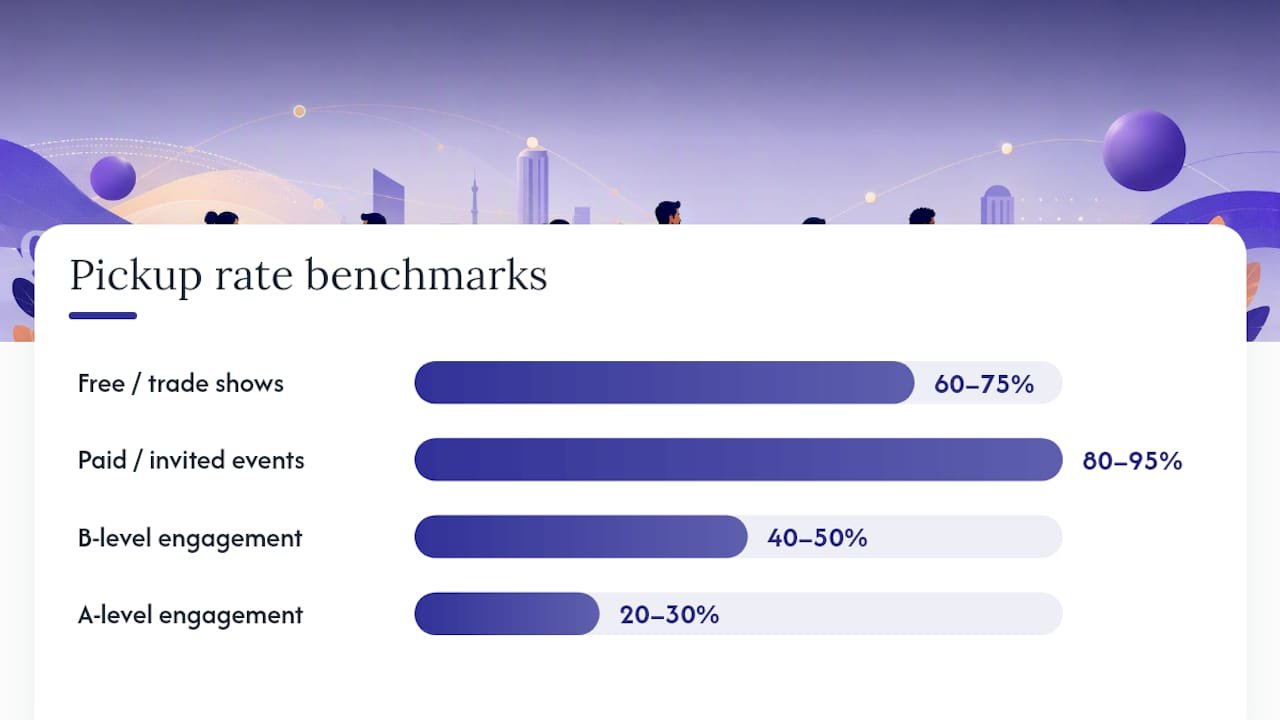
Expected pickup rate varies enormously by event type. Use these as starting benchmarks, then adjust based on your own event history:
- Free public conferences and trade show floors: 60% to 75% pickup among booth visitors.
- Paid or invited events (summits, VIP dinners, client appreciation events): 80% to 95%, since attendees feel entitled to what they paid for.
- Tiered activity rewards (demo completion, badge scans, survey fills): B-level engagement runs around 40% to 50% of booth visitors, with A-level participation closer to 20% to 30%, depending on staffing and demo capacity.
Two quick examples. A 3,000-visitor trade show with open badge-scan pickup is riskier: 3,000 × 65% pickup + 10% buffer puts you near 2,145 units.
For tiered giveaways, run the formula separately per tier. If you expect 2,000 visitors, budget your premium A-level item for 20% to 30% of that (400 to 600 units) and your broader B-level item for 40% to 50% (800 to 1,000 units), based on the tiered engagement benchmarks that trade show veterans use to plan demo-based rewards.
Planning Quantities by Swag Item Type
Apparel, low-cost handouts, and premium rewards each need their own math, not one blanket number.
- Apparel: Size to your actual audience mix, not a generic bell curve. Reserve 5% to 10% extra in the most common sizes (usually M and L) since those run out first, and avoid printing an event date on shirts when possible so leftovers stay useful next year, a point industry guides on avoiding swag waste raise consistently.
- Bags and welcome kits: Give one per registrant only if you have a controlled check-in process; for open-floor events, distribute at badge scan instead so quantities track actual foot traffic.
- Low-cost handouts (pens, stickers, lanyards): One to three per person is the sweet spot. More than that reads as clutter, not generosity.
- Premium items: Reserve these for identified segments, meeting completion, or a specific conversion action, never for general table pickup.
Distribution Method Changes Your Pickup Rate
How you hand items out matters as much as what you’re handing out.
- Open table pickup: Lowest control, widest range, typically 50% to 70% of foot traffic.
- Staffed handout with light qualification (a quick conversation, a badge scan): 65% to 85%, since a person filters who actually takes one.
- Activity or reward-based distribution (demo, survey, spin wheel): Highest yield relative to cost, often 80%+ of participants, because the item is earned rather than grabbed.
- Mailed kits: Order to your confirmed mailing list. Don’t apply a pickup-rate discount here. Every name on the list gets a box; plan production for the list count plus a small damage buffer.
Pro Tip: Move your highest-margin item to the back of the table and put a staffer next to it. Scarcity plus a person asking “are you a returning customer?” filters out grab-and-go traffic and lifts your effective pickup rate without changing the item.
Setting Buffers and Working With Vendor Tiers
Buffer size should track your confidence in the headcount, not habit.
- High-certainty events (RSVP’d internal meetings, paid summits): 5% buffer.
- Moderate-certainty events (open registration with a no-show history): 10% buffer.
- Low-certainty or first-time events: 15% buffer, especially for low-cost items where the marginal unit cost is small.
- Weigh vendor price breaks carefully. If jumping from 400 to 500 units drops your unit price 8%, but you only need 420, the “savings” is really 80 units of dead stock. Reserve rounding-up-to-a-tier for evergreen items you’ll use again, not for anything printed with this year’s event date.
What Does Landed Cost Actually Mean for Swag?
Landed cost is the full price of a usable item in a recipient’s hands, not the unit price on a quote. It includes the base product, setup and artwork fees, kitting labor, and shipping.
The math that actually matters: A swag cost calculator built on Total Budget = (Recipients × Average Cost Per Item × Items Per Recipient) + Fixed Costs shows why. Order 500 units at $4 each ($2,000) plus $300 setup and $400 shipping, and your landed cost is $2,700. If only 385 get distributed, your true cost per usable item is $7.01, not $4.
That gap between quoted unit price and real cost per usable item is exactly why the cost-per-usable-item metric holds up better internally than a raw quote comparison. Budget a 5% to 10% contingency on top for rush fees or last-minute reorders.
Lead Times That Keep You Out of Rush Pricing
Production windows vary by category: apparel generally needs 2 to 3 weeks, drinkware and bags 2 to 4 weeks, and tech accessories 3 to 5 weeks depending on customization complexity.
- Lock artwork at least one full production cycle before your target ship date.
- Approve proofs within 48 hours of receipt to avoid schedule slippage.
- Confirm ship dates for multi-location fulfillment two weeks before the event, not two days.
- Build kitting milestones backward from your event date, since kitting delays are a top cause of expensive rush orders.
Tracking Leftovers After the Event
Record five numbers: ordered, usable received, distributed, leftover, and damaged. That’s the entire reconciliation.
- Compare leftover rate against your assumed pickup rate to see which input was wrong.
- Route surplus to internal use, a discounted employee sale, or donation rather than storage.
- Updating your pickup-rate assumption after every event is the single fastest way to tighten future orders, and it costs nothing but five minutes of bookkeeping.
Building a Repeatable Swag Planning Checklist
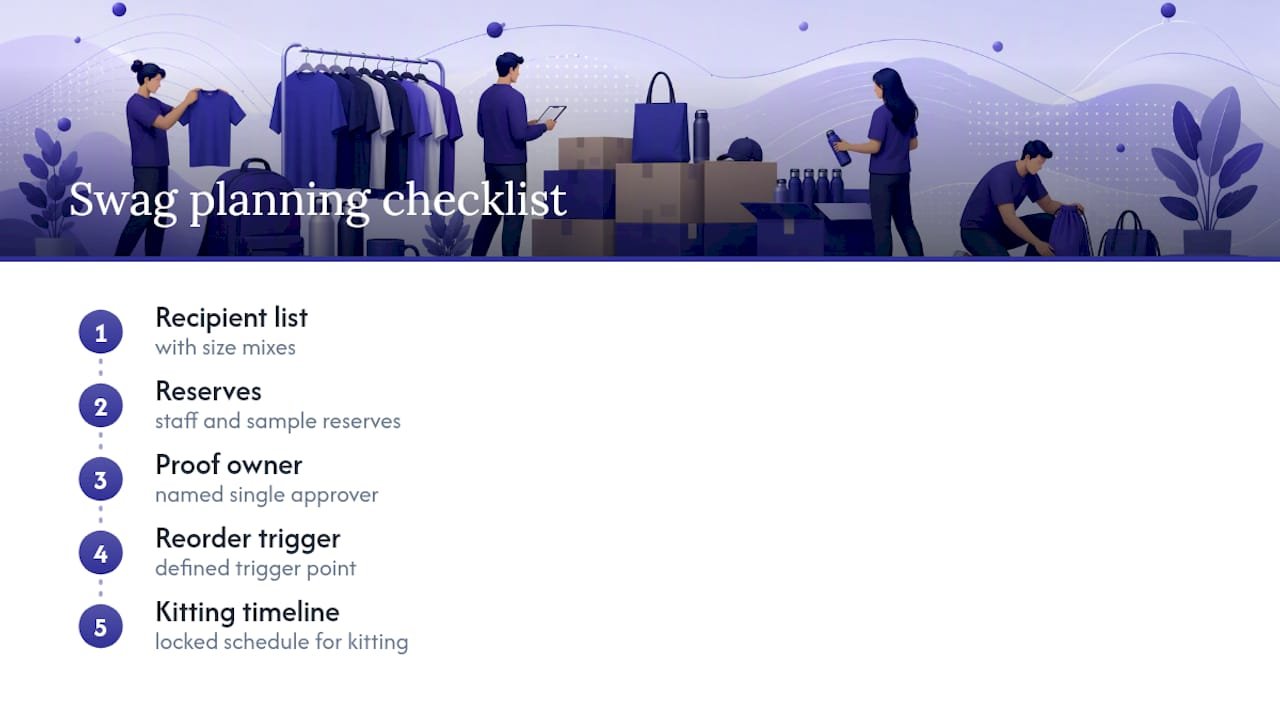
A working checklist covers five things: your recipient list with size mixes, staff and sample reserves, a named proof owner, a defined reorder trigger point, and a locked kitting timeline. Discount Swag’s event merchandise checklist and kitting guide walk through both pieces in more detail, and pairing that with general inventory planning practices helps you carry leftover stock into your next order instead of writing it off.
Balancing Visibility and Waste
Chasing the lowest unit price is how planners end up with a garage full of stress balls nobody wanted. Cost per usable item is the number that matters, and tiered giveaways almost always beat one universal handout for both budget and perceived value. When the math allows it, spend the extra dollar on something reusable. It gets remembered longer than a sticker ever will.
— Jerry
How Discount Swag Handles Quantity and Fulfillment
Getting the formula right solves half the problem. The other half is finding a supplier who can actually execute a tiered order, hit your production window, and kit multi-location shipments without your team chasing four separate vendors. Discount Swag guarantees savings of 10% or more versus any competitor’s online price on the same order, backed by curated suppliers and fulfillment built for exactly this kind of multi-tier, multi-location distribution.
If your event needs apparel in three size runs, a premium tier reserved for qualified leads, and a low-cost handout for general floor traffic, Discount Swag’s fully custom branded boxes and kitting service can build that mix into one coordinated order instead of three separate ones. Rush orders may be available when your headcount firms up later than planned. Request a landed-cost estimate using the budgeting worksheet, reference the checklist ratios above, and get a quote before your next production window closes.
Sources
Useful references for building your own quantity model: the company swag budgeting guide, the free swag cost calculator, the tiered giveaway benchmarks, and Discount Swag’s merch ordering timeline guide.
- Bigprintworld
- Gamescom Merch Strategy: Giveaways and Quantities – Eidetic Marketing
- Calculate Swag Cost & Impact | Free Swag Calculator
FAQ
How Many Items Should Be in a Swag Bag?
Three to five items is the practical range for a general-attendance bag: one apparel or bag item, one or two low-cost handouts, and one useful item like drinkware or tech. Beyond five, perceived value per item actually drops because the bag feels like clutter rather than a curated gift.
What Are Some Good Swag Items for Events?
Drinkware, tech accessories (chargers, cables), and apparel consistently perform well because attendees use them repeatedly after the event, extending brand exposure. Discount Swag’s branded drinkware and tech accessory options both fit this reuse pattern.
What Swag Items Are Most Popular With Attendees?
Practical, everyday items beat novelty items almost every time. Insulated water bottles, phone chargers, and quality tote bags outperform items like stress balls or plastic trinkets because attendees keep using them for months, not days.
What Items Sell Best in a Swag Store?
Apparel and drinkware typically lead internal swag store sales, since employees and fans are willing to pay for items they’d actually wear or use daily. Limited or seasonal designs tend to move faster than year-round staples.
How Do I Handle Walk-Ins and No-Shows in My Quantity Plan?
Build your buffer around your event’s historical no-show rate rather than assuming full registration turnout. A 10% to 15% buffer on top of your calculated pickup number typically covers walk-ins without creating meaningful leftover risk.
 Bottle Carriers
 Mugs
Mugs