

Order 100, Not 25: Procurement Math for Swag Order Quantities


Most promotional items follow tiered pricing, and true no-minimum options exist for products like print-on-demand drinkware, stickers, and short-run apparel. Small orders often carry setup fees or less-than-minimum (LTM) surcharges that inflate your real cost per piece. Ordering up to the next pricing tier is frequently cheaper than staying at a low quantity, and when you need speed or flexibility, distributors like Discountswag can run low-minimum jobs with rush turnaround.
TL;DR:
- Low-minimum options for print-on-demand drinkware, stickers, and apparel allow flexibility for small orders despite typical setup fees or surcharges.
- Decoration method influences minimum order quantities, with screen printing and embroidery requiring larger runs, while direct-to-film and POD can often fulfill single-item orders.
- Effective per-unit costs are best determined by including setup, last-minute (LTM) fees, and shipping fees in calculations before placing an order.
- Buyers should consider combining departments’ orders or ordering slightly above tier thresholds to reduce the overall cost per piece.
- Flexible solutions like low-minimum catalogs, pooling orders, and using POD can help meet small order needs without excessive costs or delays.
Table of Contents
- Why Do Suppliers Set Minimum Swag Order Quantities?
- What Are Typical MOQs by Swag Product Category?
- How Do Setup Fees and LTM Charges Change Your Real Cost?
- What Are Your Options for Small or Flexible Swag Orders?
- How Should You Size Swag Orders for Events and Programs?
- How Discountswag Handles Flexible Quantities and Fast Turnaround
- What Buyers Consistently Get Wrong About Order Quantities
- Get Flexible Swag Quantities Without the Guesswork
- Sources
- FAQ
Why Do Suppliers Set Minimum Swag Order Quantities?
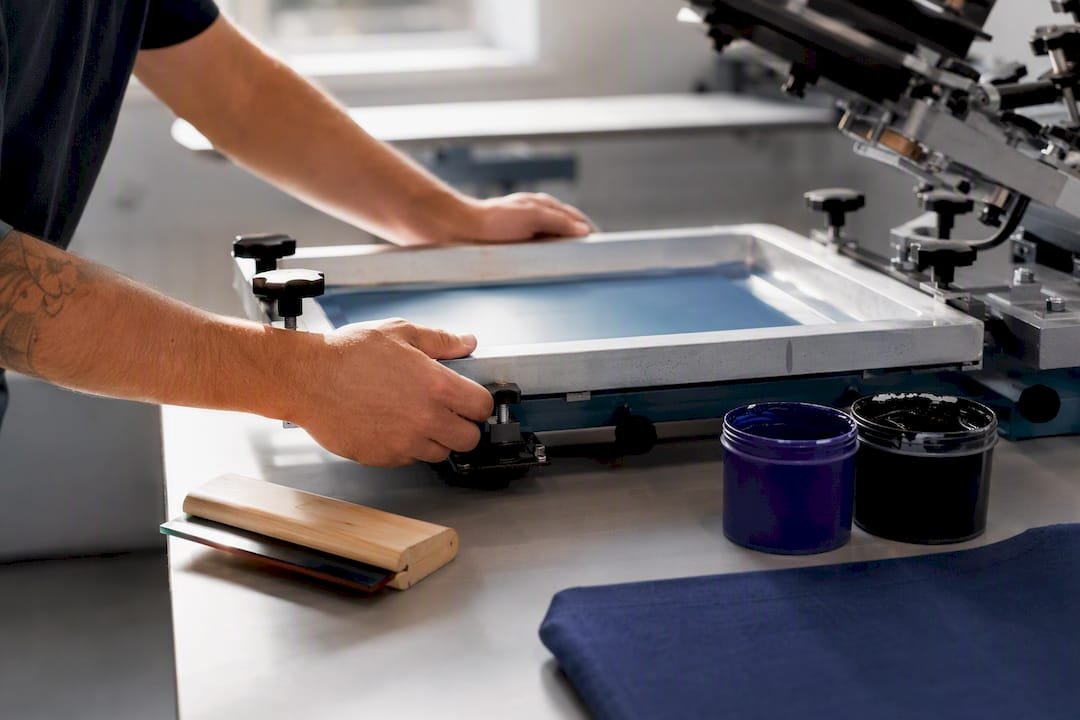
Minimum order quantities exist because decoration equipment has fixed costs regardless of how many units run through it. A screen printer has to burn a screen, mix ink, and set up a press before printing shirt one. That setup cost gets divided across however many units you order, which is why suppliers push you toward larger runs.
Decoration method changes everything. Screen printing and embroidery typically carry the highest minimums, often 24 to 50 units for apparel, because screens and digitized embroidery files require real setup time that only pays off at volume. Direct-to-film (DTF) printing and print-on-demand (POD) methods skip most of that setup, which is how a supplier can sell you a single custom hoodie without blinking.
Here’s how the math typically plays out on a basic $12 embroidered polo with a $50 digitizing fee:
The pricing mechanics behind setup fees and quantity tiers explain why headline unit prices can mislead buyers who don’t factor in fixed charges. A few things to keep in mind when comparing quotes:
- Ask whether setup fees are one-time or charged per color, per location, or per order.
- Confirm whether a fee is waived at a specific quantity threshold.
- Compare effective per-unit cost, not the sticker price on the quote.
What Are Typical MOQs by Swag Product Category?
Minimums vary sharply depending on what you’re buying and how it gets decorated. Knowing the general ranges before you request quotes saves a round of back-and-forth with a sales rep.
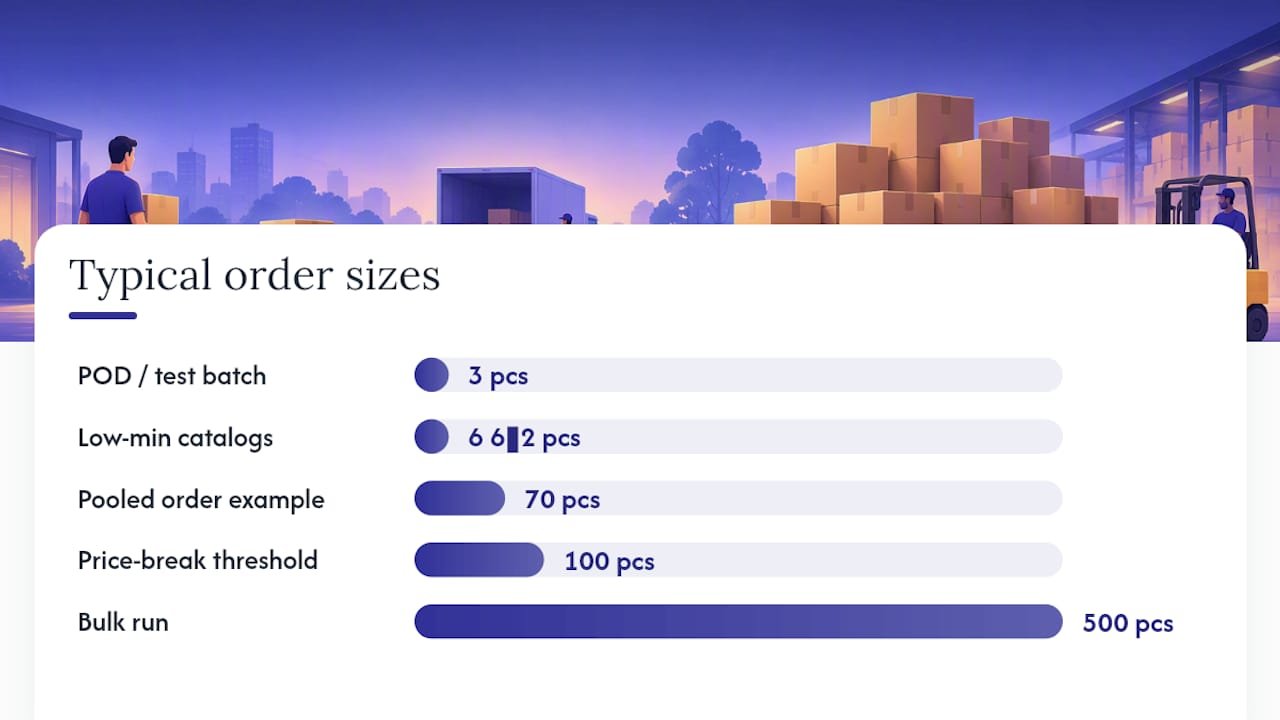
- Apparel: Short runs start around 24 to 50 units for screen printing or embroidery. Common volume tiers sit at 100, 250, and 500, with unit price dropping meaningfully at each step. The custom apparel bulk buying guide walks through how decoration choice shifts these thresholds.
- Drinkware: Many tumblers and water bottles now ship through no-minimum or low-minimum POD programs, especially for single-color logos. Premium double-wall drinkware with pad printing or laser engraving often carries a 25 to 100 unit minimum instead.
- Tech items: Power banks, wireless chargers, and branded tech accessories usually carry the highest minimums in the swag category, frequently 50 to 250 units, because manufacturers batch-produce packaging and components overseas.
- Stickers and pens: These sit at the flexible end of the spectrum, with no-minimum runs common for stickers and low minimums (often under 100) for pens. The tradeoff is limited decoration real estate, so branding impact per item stays modest.
Buyers increasingly weigh durability over sheer volume. Custom Ink’s survey work found corporate buyers now judge campaign success by whether recipients actually keep using an item, not just by how many units went out the door. That’s a real argument for ordering fewer, better drinkware pieces over a mountain of pens nobody keeps past the conference.
How Do Setup Fees and LTM Charges Change Your Real Cost?
The number on the quote sheet is rarely what you actually pay per unit. Setup fees, digitizing charges, and LTM surcharges all get folded into your total, and the smaller your order, the more those fixed costs dominate the math.
LTM fees specifically punish orders that fall below a supplier’s stated minimum. Typical LTM surcharges run $25 to $75 per order, on top of whatever setup fee already applies. Order 15 units when the minimum is 24, and that LTM charge alone can add a dollar or more to every single piece.
Here’s a fuller version of the polo example above, showing how the numbers shift once you factor in an LTM fee at the smallest quantity:
Pro Tip: Before you settle on a quantity, calculate the total delivered cost, including setup, LTM fees, and shipping, then divide by units. Comparing effective per-unit price this way often reveals that bumping from 25 to 100 units costs less per piece even though the total invoice is higher.
That effective per-unit calculation is the single most useful habit a procurement buyer can build. It’s the difference between a supplier’s marketing price and what actually lands on your budget line, and it applies whether you’re ordering 25 mugs or 5,000 lanyards.
What Are Your Options for Small or Flexible Swag Orders?
You don’t have to accept a supplier’s stated minimum as final. A handful of tactical moves can get you real flexibility without blowing your budget on unused inventory.
- Use print-on-demand or short-run DTF/DTG for single-digit needs. These methods skip screen setup entirely, so ordering three shirts for new hires costs more per piece but avoids a 50-unit commitment you don’t need.
- Search out low-minimum specialty catalogs. Certain drinkware, notebook, and accessory lines start as low as 6 to 12 units, which works well for small executive gifts or sales team samples.
- Pool orders across departments. If marketing needs 40 shirts and HR needs 30, combining into one 70-unit order often crosses a price break that neither team would hit alone.
- Order slightly above your break point. If the tier jumps at 100 units and you need 92, ordering the full 100 can cost less overall than paying the lower-tier price for 92.
Each option trades something. POD gives you flexibility but usually costs more per unit and limits decoration to simpler applications. Pooling saves money but requires coordination across teams that may not normally talk to each other about swag.
Pro Tip: Order a small POD batch to test fit, color, and print quality before committing to a bulk run. It costs a little more upfront but catches problems before they show up on 500 units.
How Should You Size Swag Orders for Events and Programs?
A simple formula covers most planning scenarios: expected attendance multiplied by your pick rate, plus a buffer.
Employee welcome kits work differently since distribution is guaranteed rather than optional. Order to headcount plus new-hire pipeline for the next quarter, rather than guessing at a pick rate.
A few planning habits that cut down on waste and warehouse clutter:
- Run a pilot batch for new programs before committing to a full year’s supply.
- Set a reorder cadence (quarterly works for most mid-size programs) instead of one massive annual order.
- Decide upfront whether multi-location fulfillment or centralized storage fits your logistics better. Centralized storage saves per-unit cost but adds shipping and handling work on your end.
Repeat purchasing is common in this category. Buyer data from 2025 shows most promotional product purchases happen through e-commerce channels with strong repeat-order patterns, which supports a cadence-based approach over one-off mega orders.
How Discountswag Handles Flexible Quantities and Fast Turnaround
Some distributors run low-minimum custom branded boxes for buyers who need small, curated kits rather than a single mass-produced item. Rush orders may be available for teams that need swag quickly, and fulfillment can cover distribution to a single office or multiple locations.
Before committing to any fulfillment partner, check four things: pricing transparency on setup and LTM fees, realistic lead times stated upfront, control over which SKUs go into a kit, and a clear sample policy before you commit to volume. The swag fulfillment guide covers these criteria in more depth, and the branded merch ordering checklist is worth running through before you submit a quantity that turns out to be wrong for your timeline.
What Buyers Consistently Get Wrong About Order Quantities
The second is treating distribution as an afterthought, ordering 500 units with no plan for how they physically reach five different offices. The third is underestimating lead time and paying rush fees that would have been avoidable with two extra days of planning.
The fix is almost always the same three moves: run the effective per-unit math before you commit, request a physical sample before scaling to volume, and centralize reorder decisions with one person or team instead of letting quantities get decided ad hoc across departments.
— Jerry
Get Flexible Swag Quantities Without the Guesswork
Some suppliers offer procurement buyers alternatives to rigid supplier minimums, including low-minimum custom branded boxes, rush production services, and fulfillment that can scale from one office to multiple locations without managing separate vendors.
If you’re staring down a quote that assumes you need 500 units when your event only calls for 150, or a launch date that’s closer than your supplier’s standard lead time allows, Discountswag’s distribution and fulfillment services are built for exactly that gap. Request a quote through the custom swag boxes page and get real numbers on quantity, timeline, and effective per-unit cost before you commit to a run size.
Sources
Consult PPAI for industry standards, and review pricing guides from MFGMerch and Print & Promo Marketing when benchmarking quotes.
- Custom Ink Survey Shows Corporate End-Buyers Prioritize High-End, Stylish Promo – Print & Promo Marketing
- How Promotional Product Pricing Works: Setup Fees, Tiers, and Rush Charges Explained
- Promotional product buyer statistics: 2025 in review | Totally Inspired
FAQ
What Items Sell Best in a Swag Store?
Durable apparel and premium drinkware consistently outperform disposable items because recipients keep using them long after an event ends. Buyer survey data shows corporate buyers now measure success by whether people wear or use an item repeatedly, not by unit count alone.
What Are Some Good Examples of Swag?
Common examples include branded apparel like polos and hoodies, insulated drinkware, tech accessories such as power banks and chargers, notebooks, and tote bags. The strongest options tend to be items people would use anyway, since branding sticks around longer on things that stay in daily rotation.
What Are Good Swag Options for Employees?
Welcome kits with apparel, a quality water bottle, and a notebook remain a reliable baseline for new hires. Discountswag’s fully custom branded boxes let you build a kit around your budget and headcount rather than forcing a fixed bundle.
What Are Some Good Bulk Giveaway Items?
Stickers, pens, and drinkware tend to work best for large bulk giveaways because many suppliers offer no-minimum or low-minimum runs on these categories.
Does Discountswag Offer Low-Minimum Custom Swag Orders?
Yes, Discountswag offers fully custom branded boxes and low-minimum runs designed for buyers who don’t need a 500-unit commitment. Current pricing depends on product mix and quantity, and is available directly through the Discountswag site.
 Bottle Carriers
 Mugs
Mugs