


Event Planners: 8 Point Hotel Shipping Checklist Plus Copy Ready Labels

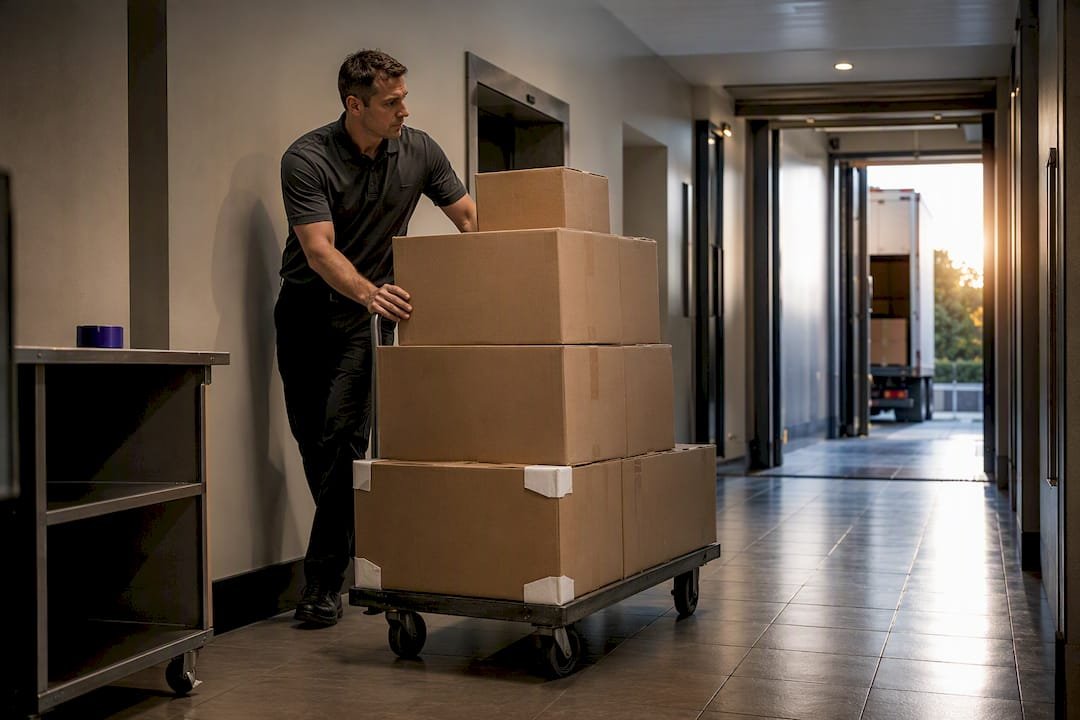
Yes, hotels will accept shipped swag for your event, but every property sets its own rules on timing, fees, and labeling. The first move is always the same: call the hotel’s conference services or receiving contact and get their exact requirements in writing before a single box leaves your warehouse. Skip that call, and you risk a refused pallet, a surprise storage bill, or a stack of tote bags sitting in a loading dock the morning of your event.
TL;DR:
- Confirm the hotel’s exact receiving contact, label format, and arrival window at least 7 days before shipping to avoid misdelivery or storage issues.
- Most hotels prefer swag shipment arrive three to four days before the event, with earlier arrivals risking refused packages or unbudgeted fees.
- Use clear, complete labels with the recipient’s reservation name, confirmation number, arrival date, and specific handling instructions to prevent shipment loss or misrouting.
- Shipping pallet freight or large quantities often requires advance warehouse delivery and involves higher fees, so plan timelines accordingly for trade shows or bulk shipments.
- Outsourcing swag logistics to a fulfillment partner can reduce handling costs, ensure proper labeling, and streamline hotel delivery coordination.
Table of Contents
- How Do You Ship Swag to a Hotel Successfully?
- When Should You Ship Swag to Arrive at a Hotel?
- What’s the Right Way to Label and Pack Swag Boxes?
- Which Shipping Method Fits Your Swag Shipment?
- How Do Packages Move Once They Arrive at the Hotel?
- What Fees Should You Expect When Shipping to a Hotel?
- Final Checklist and Sample Label Templates
- Discount Swag’s Operational Tips for Hotel Deliveries
- What Planners Get Wrong About Shipping Swag to Hotels
- Let Discount Swag Handle the Hotel Coordination
- Sources
- FAQ
How Do You Ship Swag to a Hotel Successfully?
Getting swag delivered to a hotel without drama comes down to confirming six things with the property before you ship anything. Miss one of these, and you’re gambling with your event timeline.
Start with who actually receives the package. Some hotels route everything through the front desk, others have a dedicated package room, a loading dock, or a convention services team that handles group shipments separately from guest mail. At properties hosting trade shows, an exclusive drayage contractor may control all freight, meaning your carrier can’t even drop off at the hotel directly. Get the name, email, and phone number of the actual human who will sign for your boxes.
Next, lock down the exact label format the property wants. Most hotels need the guest name or reservation name, a confirmation number, the arrival date, and the event or group name printed clearly on every box. Marriott’s own guidance makes clear that these requirements are set at the property level, not the brand level, so a policy that worked at one Marriott may not apply at the next one.
The remaining details to confirm:
- Receiving window and earliest acceptable arrival date. Some properties allow boxes to arrive three or four days early; others will refuse anything that shows up before a set date.
- Storage policy and free-hold period. Ask exactly how many days of storage are complimentary and what happens after that window closes.
- Size, weight, and pallet restrictions. Freight over a certain weight often has to go to an advance warehouse rather than the hotel dock, especially for trade show shipments.
- Billing instructions. Find out whether fees land on your group master account, a guest’s room folio, or get billed separately to your company, and get that in writing.
- Handling fee schedule. Sample property shipping instructions show real fee tiers by package weight and pallet count. These vary enough between properties that assuming your last hotel’s rates apply here is a mistake.
Pro Tip: Ask the conference services manager to email you their shipping instructions as a PDF or screenshot. Verbal confirmation over the phone is easy to misremember; a written document is something you can forward to your fulfillment team and point back to if a fee gets disputed later.
When Should You Ship Swag to Arrive at a Hotel?
Many properties prefer swag shipments to arrive a few days before the event starts, allowing time for processing without excessive early arrival. That window gives receiving staff time to log, sort, and stage everything without scrambling, and it gives you a buffer if a box gets misrouted along the way.
Shipping too early causes its own headaches. A box that shows up ten days ahead of a three-day event might get refused outright, get bumped into paid storage, or get handed off to a drayage contractor who charges handling fees your team never budgeted for. Exhibitor manuals are blunt about this: shipments that arrive before the published dates get refused or reassigned to contracted freight handlers, and that reassignment usually comes with a bill.
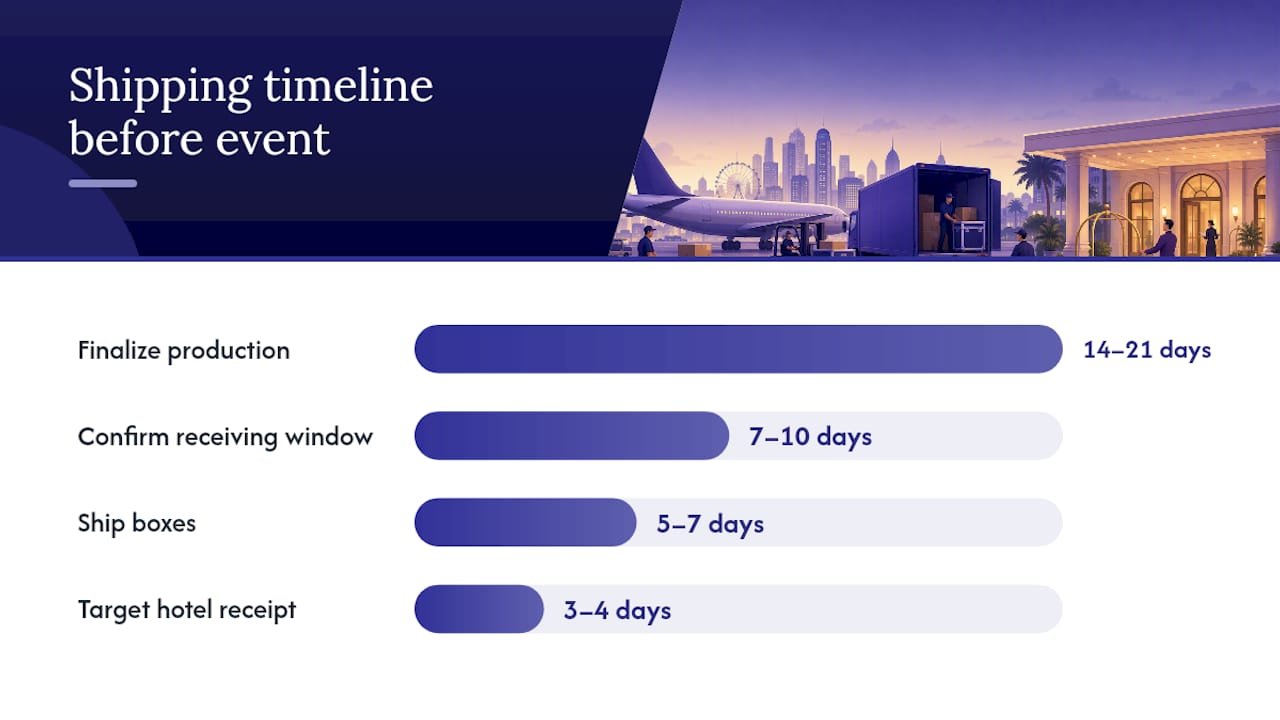
A workable production and shipping timeline looks like this:
- 14 to 21 days before the event: finalize kit production and confirm final quantities with your supplier.
- 7 to 10 days before the event: confirm the hotel’s exact receiving window and label requirements one more time, since staff and policies can shift.
- 5 to 7 days before the event: ship the boxes, building in a cushion for carrier delays, weather, or a missed pickup.
- 3 to 4 days before the event: target hotel receipt, which lines up with most properties’ preferred arrival window.
For trade shows or large freight loads, this timeline shifts. Exclusive drayage arrangements often require shipments to go to an advance warehouse weeks ahead of the show, not to the hotel directly, and the exhibitor kit for your specific event will spell out those deadlines. Read it before you finalize any shipping date.
What’s the Right Way to Label and Pack Swag Boxes?
Address format mistakes are the single most common reason swag shipments get lost, refused, or billed incorrectly. A box addressed only to “the conference” with no reservation number or arrival date is a coin flip for a receiving desk juggling dozens of shipments that week.
Every box needs these fields, printed clearly:
- Recipient name exactly as it appears on the reservation (not a nickname or shortened version)
- Reservation confirmation number or event/group name, whichever the hotel specified
- Arrival date, so staff know when to expect it and when to start the storage clock
- “Hold for guest” or the specific group name, per whatever instruction the hotel gave you
- Onsite contact name and cell number, plus the conference services manager’s contact if the hotel shared one
Before you tape a new label on, strip off any old shipping labels or barcode stickers from reused boxes. A leftover barcode from a previous shipment can trick a scanner or a warehouse worker into routing the box to the wrong place entirely. Pack by destination, too. Boxes meant for individual room drops should be separated from boxes headed to a meeting-room kit table, since they often move through completely different parts of the hotel. Number every box “1 of 12,” “2 of 12,” and so on, and tuck a packing list inside each one so hotel staff or your onsite team can verify contents fast without opening every carton.
Send a sample label to your hotel contact before production wraps and ask for written approval. Archived event shipping guidance backs this up directly: properties can refuse early or improperly addressed shipments outright, and a five minute email exchange up front avoids that entirely.
Which Shipping Method Fits Your Swag Shipment?
The right carrier depends on how much you’re shipping and how much risk you’re willing to carry yourself.
Small parcel carriers work well for boxed kits and room drops, giving you predictable tracking and a delivery flow similar to a residential shipment. LTL and pallet freight make sense once you’re moving bulk quantities of drinkware, apparel, or bags, but pallet shipments require an extra layer of confirmation. Some hotels charge a pallet-break fee just to unpack freight off a pallet, and not every property accepts pallet delivery at all.
A third option worth serious consideration: routing everything through a kitting and fulfillment partner instead of shipping loose boxes yourself. A partner can pre-assemble kits, label every box to the hotel’s exact specs, consolidate multiple shipments into fewer deliveries, and coordinate day-of delivery timing directly with conference services. That consolidation matters more than it sounds. Fewer boxes arriving as one coordinated shipment usually means fewer handling fees than a dozen separate parcels trickling in over a week.
Consider consolidating shipments whenever you’re sending swag from multiple suppliers to the same hotel; combining them under one bill of lading tends to reduce per-package handling charges. Shipping direct from a supplier still works fine for a single small kit run. Once you’re managing multiple item types across multiple vendors, though, routing through one fulfillment point cuts down the coordination load significantly. Whichever method you choose, share every tracking number with the hotel’s receiving contact ahead of arrival so their team can flag your shipment when it lands.
How Do Packages Move Once They Arrive at the Hotel?
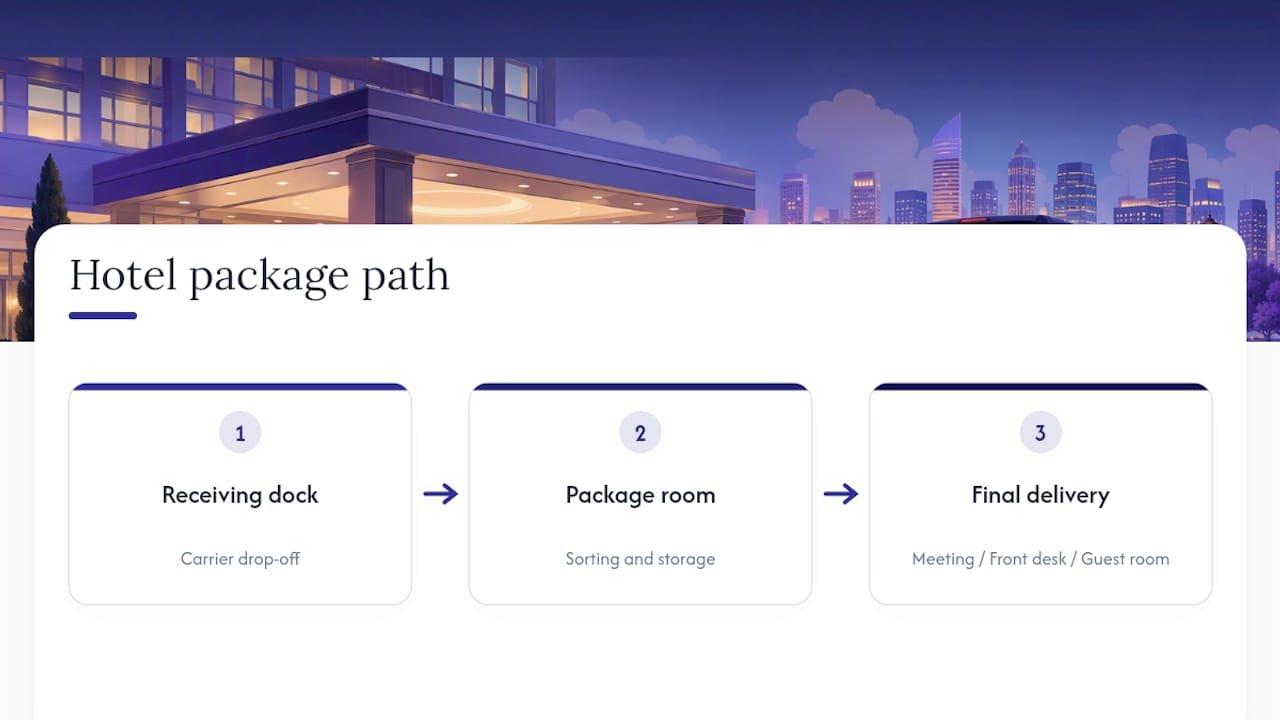
A shipment’s journey inside a hotel typically follows a predictable path: carrier drop-off at the receiving dock, sorting into a package room, then delivery either to a designated meeting space, the front desk, or a guest room, depending on what the hotel allows.
Room delivery isn’t universal. Many properties require a signature and photo ID before releasing a package to a guest, and some skip room delivery altogether in favor of holding everything at the front desk or a designated pickup point. Amazon’s own delivery guidance notes something planners often overlook: once a carrier scans a package as delivered at a hotel’s receiving location, that scan counts as a completed delivery as far as the carrier is concerned, even if the box hasn’t reached the actual guest yet. That gap between “delivered” on a tracking page and “in the guest’s hands” is exactly why confirming the hotel’s internal handoff process matters as much as tracking the shipment itself.
For trade show freight under an exclusive drayage arrangement, packages often route through an advance warehouse rather than the hotel dock directly, following whatever the exhibitor manual specifies. Coordinate timed deliveries with conference services ahead of the event and provide clear labels for whichever meeting space each box belongs to. If room delivery isn’t permitted, plan instead for a staged meeting-room drop with your own onsite team handling final distribution.
What Fees Should You Expect When Shipping to a Hotel?
Handling and storage fees vary a lot by property, and the biggest mistake planners make is assuming last year’s hotel rates apply everywhere.
Sample property fee schedules show per-package handling charges in the range of roughly $5 to $50 per box, with pallet handling frequently running $300 or more, plus additional daily storage fees once a property’s free-hold window expires.
Those charges can land on a guest’s room folio, your group’s master billing account, or get invoiced separately to your company, and which one applies depends entirely on the arrangement you set up in advance. Marriott’s shipping and handling documentation shows how granular these fee structures can get, right down to per-item rates for outbound processing.
A few moves keep costs predictable:
- Confirm the free-hold storage window before you ship, and time arrival to fall inside it.
- Consolidate boxes into fewer, larger shipments rather than a trickle of small parcels.
- Use the hotel’s preferred vendor or advance warehouse whenever one is assigned for your event.
- Put billing instructions in writing, naming the exact account or folio that should absorb the charge.
- Look into transit insurance, since most hotels limit their own liability for items lost or damaged before they reach the receiving desk.
Final Checklist and Sample Label Templates
A clean shipping process comes down to confirming eight things and copying two label formats correctly.
Before you ship anything, verify: the hotel’s receiving contact and their direct line, the exact label format they require, the confirmed arrival window, your chosen carrier and service level, tracking numbers shared with the hotel, billing instructions in writing, transit insurance coverage, and an onsite contact who can field questions the day boxes arrive.
For individual room drops, use this format on every box:
- Guest full name (exactly as it appears on the reservation)
- Reservation confirmation number
- Arrival date
- “Hold for Guest” clearly marked
For group or meeting-room shipments, use this format instead:
- Group or meeting name
- Onsite contact name and phone number
- Arrival date
- Box number and total (“Box 3 of 15”) with a packing list reference
Time your confirmations in three passes: get hotel policy details locked in 14 days before production starts, confirm shipping details again 7 days before you ship, and do a final check with the receiving contact 24 to 72 hours before boxes arrive.
Discount Swag’s Operational Tips for Hotel Deliveries
Sending a sample label to the hotel and waiting for written approval before mass production starts is the single habit that prevents most shipping headaches. It costs a day of back and forth and saves you from a refused shipment two weeks later.
A good fulfillment approach splits shipments by delivery type, sending room drop boxes separately from meeting-space kits, and includes a packing list inside every box so hotel staff can verify contents without opening each one individually. That split matters when you’re coordinating event swag logistics across a property with different receiving rules for guest rooms versus group freight.
Property fee schedules genuinely vary this much: some hotels charge nothing for a small parcel held three days, while others assess handling fees the moment a pallet touches the dock. Confirming property-specific rules before shipping isn’t optional. It’s the step that keeps your swag budget intact.
What Planners Get Wrong About Shipping Swag to Hotels
The mistakes I see most often aren’t complicated ones. Planners ship too early because “early is safer,” skip written billing instructions and get surprised by a folio charge, or leave packing lists out of boxes and end up with a confused hotel staffer opening every carton on event morning.
The fix is one habit, repeated every time: get written confirmation from the hotel on label format and arrival window before production locks in. That single email exchange prevents nearly every failure mode covered here.
— Jerry
Let Discount Swag Handle the Hotel Coordination
Doing all of this yourself, chasing down conference services managers, verifying label formats, tracking six different boxes across three carriers, eats hours you probably don’t have during event crunch. Discount Swag’s distribution and fulfillment services handle that coordination directly: verifying label formats against hotel requirements, splitting shipments into room drops versus meeting kits, and tracking every box through delivery so you’re not the one refreshing a tracking page the morning of your event.
Rush orders are built into the process for planners who confirmed a venue late or added attendees at the last minute, and fully custom branded boxes can be kitted and labeled to a specific hotel’s specs before they ever leave the warehouse. If you’re managing swag across more than one hotel or region, the multi-location shipping guide walks through how to structure those shipments without duplicating fees.
Request a fulfillment quote through Discount Swag’s distribution services page and get your label format and delivery timeline confirmed before you finalize a single order.
Sources
- How do I send a package to a Marriott hotel? (Marriott support article)
- Evermore Orlando Resort shipping and rates instructions (sample property PDF)
- Exhibitor service manual (example exhibitor instructions and advance-warehouse guidance)
- Amazon help: Deliveries to hotels — delivery considered successful once scanned at hotel receiving location
FAQ
Can I Ship Something to a Hotel Before I Arrive?
Yes, most hotels accept packages shipped ahead of a guest’s or group’s arrival, but each property sets its own earliest acceptable arrival date and storage limits. Confirm the receiving window with the hotel’s front desk or conference services team, since Marriott’s own guidance confirms these policies are set at the property level and vary from one hotel to the next.
What Is the 3–4 Day Rule for Hotel Shipping?
Many hotels recommend swag or event shipments arrive three to four days before the event starts, giving receiving staff enough time to log and stage everything without running into storage limits. Sample property instructions reflect this window directly, though it’s not universal, so confirm the exact date with your specific property.
Can You Have Something Mailed to a Hotel for a Guest?
Yes, hotels routinely accept mail and packages addressed to a specific guest, as long as the guest’s name matches their reservation and the hotel is notified ahead of arrival. Include the guest’s full name, arrival date, and a note to hold the package, since unclear labeling is the most common reason a package gets misrouted or delayed at the front desk.
How Do I Ship Something to a Hotel for a Guest?
Address the package with the guest’s full name exactly as it appears on their reservation, the confirmation number if the hotel requests it, and the arrival date, then mark it “Hold for Guest.” Notify the hotel directly that a package is coming, since a scanned “delivered” status from your carrier only confirms it reached the hotel’s receiving area, not that staff have logged it for pickup.
Who Pays Hotel Handling Fees for Shipped Packages?
It depends entirely on the billing arrangement you set up in advance with the hotel: charges can go to a guest’s room folio, a group’s master account, or get invoiced separately to your company. Confirm this in writing before shipping, since hotel fee schedules show handling and storage charges that can add up quickly if billing instructions aren’t clear ahead of time.
 Bottle Carriers
 Mugs
Mugs