

Match Budgets $5–$150 to Funnel Stage: Sales Prospecting Gifts


Yes, prospecting gifts work when they are targeted, relevant, and matched to funnel stage. The one rule that governs everything else: match gift value to the recipient’s role and where they sit in your pipeline, a $10 item for a top-of-funnel lead, a $75 to $150 item for a decision maker you are trying to close. The ideas, budgets, and checklist below show exactly how.
TL;DR:
- Gifts should be matched to the prospect’s role and funnel stage, with low-cost items for top-of-funnel leads and higher-value gifts for decision-makers.
- Relevant, durable, and personalized gifts that align with the recipient’s needs increase response and engagement, especially when sent within a strategic timing window.
- Proper execution involves vetting vendors for quality, lead times, and privacy concerns, as well as tracking gift impact through CRM response and pipeline speed.
- A small-scale pilot of 25 to 50 targeted accounts helps test and optimize the program before expanding to larger segments.
- Gifting is most effective for targeted account-based marketing, executive outreach, and trade-show follow-up, but should not replace strong value propositions or be used broadly.
Table of Contents
- Why prospecting gifts work: psychology and evidence
- Gift ideas mapped to funnel stage, role, and budget
- How to choose and execute prospecting gifts
- Practical examples and operational templates
- When gifting is the right tactic and when to skip it
- How Discount Swag supports a prospecting gift program
- Sources
- FAQ
Why prospecting gifts work: psychology and evidence
Gifting works because it changes how a prospect feels about you before you ever ask for their time. A well-timed, relevant gift triggers reciprocity: the recipient feels a mild social pull to respond, take the call, or at least open the next email. It also buys attention in an inbox that ignores cold pitches, and it gives your brand a physical presence on a desk long after the email thread goes cold.
The clearest evidence for this comes from consumer research, but the mechanism translates directly to B2B. A Journal of Marketing field study found that gift buyers spent about 63% more in the year after a gift purchase than similar customers who bought only for themselves, with gains in both purchase frequency and cross-buying. The takeaway for sales teams is not that a gift causes a sale. It is that a gift purchase, or in this case a gift received, changes the relationship trajectory in a way that outreach alone rarely does.
One field study found that gift buyers spent significantly more the following year than non-gift buyers, a signal that gifting shifts long-term behavior, not just short-term goodwill, according to AMA’s coverage of the research.
Three mechanisms explain why this works in a sales context:
- Attention capture: a physical or unexpected item breaks through inbox fatigue in a way a sixth follow-up email cannot.
- Reciprocity: receiving something of perceived value creates a mild obligation to respond or engage.
- Brand recall: a useful item sits on a desk or in a bag, reinforcing your name long after the pitch is forgotten.
Set realistic expectations. A gift does not replace a value proposition, and practitioner guidance from AMA is explicit that gifting works best as an attention channel paired with a clear reason to meet, not as a substitute for one. Track response rate and meeting-set rate rather than expecting direct revenue attribution from a single gift.
Before you build a program, know the guardrails. The FTC’s Endorsement Guides require clear and conspicuous disclosure whenever a gift or incentive could influence the credibility of an endorsement, which matters if you ask a recipient to post about what you sent. On the tax side, IRS Publication 463 covers what portion of business gift expenses may be deductible and what records you need to keep, worth a look before your finance team asks.
Gift ideas mapped to funnel stage, role, and budget
The right gift depends on two things: how well you know the prospect and how close they are to a decision. Match the two, and the gift feels like insight rather than a transaction.
Top-of-funnel: low-cost attention hooks
These gifts introduce your brand to a cold or lightly warmed list. They need to be cheap enough to send at volume and useful enough to survive a desk purge.
- Branded drinkware. A well-made mug or tumbler from a drinkware line stays visible on a desk for months. Budget: $5 to $15 per unit. Personalize with the company name printed alongside your logo, not just your branding alone.
- Digital gift cards or coupon codes. A small digital incentive removes shipping delays entirely and is easy to send to a list of hundreds. Budget: $5 to $20. Best for outreach where you do not yet have a mailing address.
- Office desk items. Notebooks, pens, or small office accessories work as low-friction icebreakers. Budget: $5 to $12. Send alongside a short, specific note referencing the prospect’s role or a recent company announcement.
Mid-funnel: personalized items that build rapport
Once a prospect has engaged, a slightly higher investment signals that you are paying attention to them specifically, not blasting a list.
- Lumpy mail packages. A small box that arrives with an unusual shape or weight, think a branded tech accessory or snack bundle, gets opened out of curiosity before the recipient even knows who sent it. Budget: $15 to $35. Include a handwritten note referencing a specific pain point from your last conversation.
- Tech accessories. Wireless chargers, phone stands, or a compact technology organizer fit almost any desk setup and get daily use. Budget: $15 to $30. Reference the prospect’s actual workflow in the note, not a generic “thought you’d like this.”
- Local or edible treats. Regional snacks, coffee, or a small gourmet box feel personal without requiring deep research. Budget: $15 to $25. Time delivery to land midweek so it does not sit in a mail room over the weekend.
- Branded apparel. A quality quarter-zip or cap from an apparel line works well for prospects you have had at least one live conversation with. Budget: $20 to $40. Confirm size before shipping, a mismatched size undoes the personalization effort.
Bottom-funnel: premium gifts for decision-maker buy-in
At this stage the gift is less about attention and more about signaling that closing the deal matters to you.
- Curated branded boxes. A fully custom branded box built around the prospect’s industry or interests works well when you are trying to win over a committee, not just one buyer. Budget: $50 to $150. Distribution note: coordinate delivery to land right before a final decision meeting, not weeks in advance.
- Premium drinkware or bag sets. A higher-end bag paired with drinkware from the same collection reads as a matched set rather than a random giveaway. Budget: $40 to $80. Personalization tip: monogram or laser-etch the executive’s initials rather than just the company logo.
- Outdoor or lifestyle gifts. Insulated coolers or gear from an outdoor and sport line suit relationship-heavy sales cycles like real estate, finance, or enterprise services. Budget: $50 to $100. Best sent after a signed letter of intent, as a thank-you rather than a bribe.
Event and trade-show follow-ups
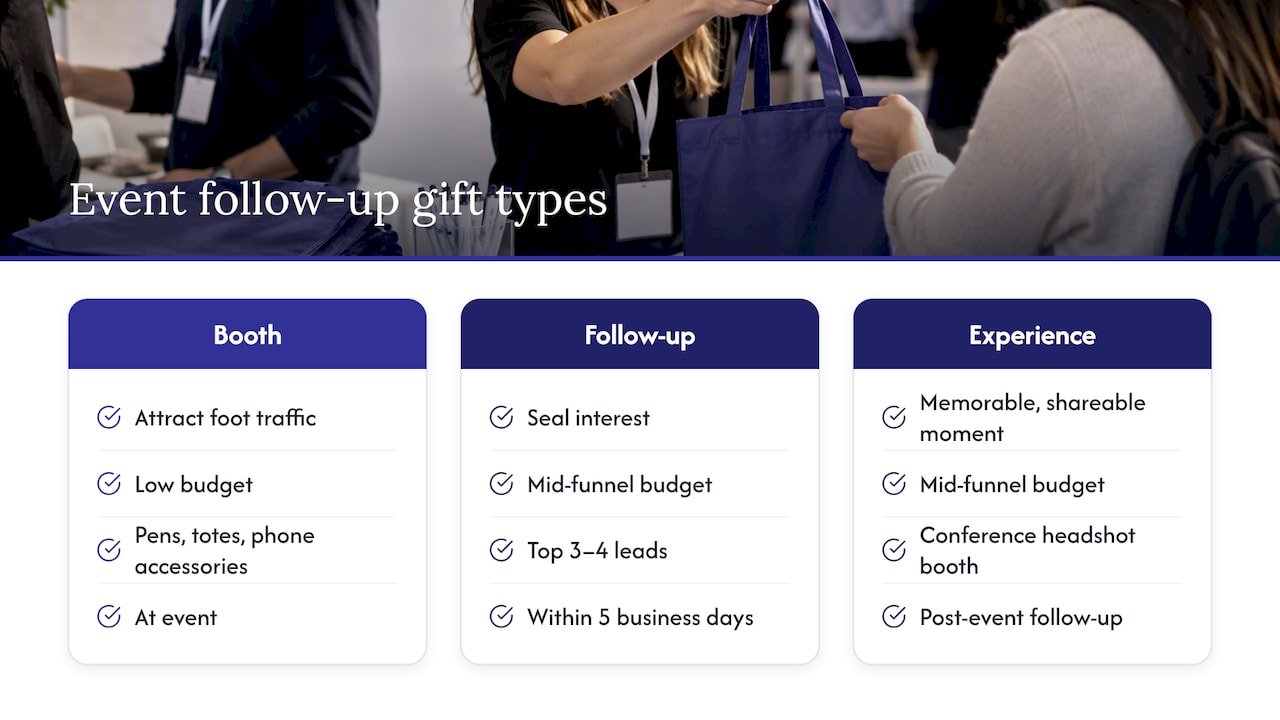
Trade shows create a narrow window where a gift can either seal interest or get lost in a bag of fifty other giveaways. The follow-up gift, sent within a week, does more work than the booth item itself. Booth giveaways should stay cheap and functional (pens, tote bags, phone accessories), while the follow-up gift to your top three or four leads from the show should move into the mid-funnel budget range and reference the specific conversation you had. Our trade show giveaway guide breaks down which items perform best on a crowded floor.
For events where you want a memorable, shareable moment rather than a physical item, an experience-based option like a conference headshot booth from a partner such as Studio2U Headshots gives attendees something they actually want, and gives you a natural reason to follow up with the photo.
Pro Tip: Send the follow-up gift within five business days of the event, while your booth conversation is still fresh in the prospect’s memory.
How to choose and execute prospecting gifts
Picking a gift is the easy part. Executing a program that does not embarrass your brand or waste budget takes a short checklist.
Run every gift idea through these five criteria before you commit:
- Relevance: does the item connect to the prospect’s role, industry, or a specific conversation you had?
- Durability: will it survive shipping and still look good when opened?
- Logistics: can your vendor hit your timeline, including rush orders when a deal moves fast?
- Personalization: can the item carry a name, department, or message beyond your logo alone?
- Price-to-impact ratio: does the budget match the deal size and funnel stage, or are you overspending on a cold lead?
Before signing with any promotional products vendor, ask these questions:
- What is your standard lead time, and what does a rush order cost?
- Can you send a physical sample before we commit to a bulk order?
- Do you support fulfillment to multiple locations if we are sending to several offices at once?
- What imprinting or personalization options are available on this specific item?
Watch for a few red flags. A vendor unwilling to send a sample before a bulk order is a warning sign, as is a supplier who cannot explain how they store or use the mailing addresses you provide, a privacy issue that can create liability beyond a bad gift. Cheap materials that look fine in a product photo but arrive flimsy will undercut the exact brand impression you are trying to create.
Once gifts are shipping, measure what they influence rather than assuming a direct sale. Track response rate (did the prospect reply or engage within a set window), meeting-set rate (did the gift lead to a booked call), and pipeline influence (did gifted accounts move through stages faster than a control group). Tag every gift send in your CRM with the campaign name, cost, and funnel stage so you can pull these numbers later without guesswork. Our ROI guide for promotional products walks through a simple cost-per-impression framework if you want a more formal model.
Practical examples and operational templates
Running a gifting pilot works best as a repeatable sequence rather than a one-off idea. A typical operational flow looks like this: request a sample of the item you are considering, get internal approval on budget and branding, confirm imprinting and labeling details, then coordinate fulfillment if you are shipping to more than one office.
- Sample the item first, always, before committing to a volume order.
- Get sign-off on branding placement and message before production starts.
- Confirm multi-location fulfillment details if your target accounts span several offices.
- Tag the campaign in your CRM before the first item ships, not after.
A useful starting point for testing this at small scale is a curated kit built around a specific account-based marketing list, the kind of approach our guide to customized gifts in campaigns walks through for executive outreach specifically. Run it against 25 to 50 target accounts before scaling further.
Pro Tip: Start with a 30-day pilot on a short, high-value account list before rolling a gifting program out to your full pipeline.
When gifting is the right tactic and when to skip it
Gifting earns its budget in a handful of situations: targeted account-based marketing lists, executive outreach where a generic email will not get past a gatekeeper, and trade-show follow-up while the conversation is still fresh. In those cases, a gift is a signal of effort, not a substitute for one.
Skip it when you are tempted to use gifting to paper over a weak pitch. Sending gifts to a broad, untargeted list because outreach numbers are down usually produces a low response and a wasted budget line, and it trains prospects to expect a transaction rather than a conversation. A gift should support a value proposition that already stands on its own.
One more thing worth respecting: not every prospect wants to be gifted, and some companies have strict policies against employees accepting anything of value. Ask, or build an easy decline option into your outreach, and keep disclosure in mind whenever a gift could be seen as influencing an endorsement or review.
— Jerry
How Discount Swag supports a prospecting gift program
Once you know which gift belongs at which funnel stage, the harder problem is logistics: sourcing quality items, getting them personalized correctly, and shipping to the right desks on time. There are suppliers that build fully custom branded boxes, handle rush orders when a deal timeline shifts overnight, and fulfill to single or multiple locations so a gift meant for several offices does not turn into multiple separate headaches.
A simple way to start:
- Request samples of the items you are considering before committing to a bulk order.
- Run a small pilot, 25 to 50 target accounts, tied to one funnel stage.
- Track response and meeting-set rate in your CRM, then scale what works.
Start by browsing options and requesting a quote at Discount Swag.
Sources
The claims above draw on a small set of primary sources worth bookmarking. The FTC’s Endorsement Guides cover disclosure requirements for gifts tied to endorsements. IRS Publication 463 explains deductibility and recordkeeping for business gift expenses. The AMA’s coverage of the Journal of Marketing field study and its companion piece on winning attention with gifts supply the evidence and practitioner guidance behind the funnel-mapped approach used throughout this article.
- To Get Customers to Buy More in the Future, Help Them Buy a Gift — AMA
- FTC’s Endorsement Guides: What People Are Asking — Consumer FTC
- Publication 463 (Travel, Entertainment, Gift, and Car Expenses) — IRS
FAQ
What are the hottest gifts right now?
Tech accessories, insulated drinkware, and curated branded boxes are seeing strong demand because they combine daily usefulness with easy personalization. Digital gift cards are also gaining ground for top-of-funnel outreach since they remove shipping delays entirely.
What is a good gift for a sales agent?
A practical desk item like a quality tumbler or a compact tech accessory works well because sales agents use them daily and see the sender’s name repeatedly. For higher-value relationships, a personalized branded kit tied to a specific deal or milestone tends to land better than a generic giveaway.
What are some good gifts for a sales team?
Team gifts work best when they are shared or usable at the office, such as branded apparel sets or a curated box of drinkware and snacks. Keep the budget consistent per person and avoid singling out individuals unless the gift marks a specific achievement.
What is the 5 gift rule for adults?
The “5 gift rule” is a personal gift-giving guideline, not a business or sales prospecting standard, and it typically limits gifts to five categories such as something to wear, read, want, need, and do. It does not apply to corporate gifting programs, where budget bands by funnel stage and role are a more useful framework.
 Bottle Carriers
 Mugs