

Lanyard Attachment Types: How to Pick the Right One

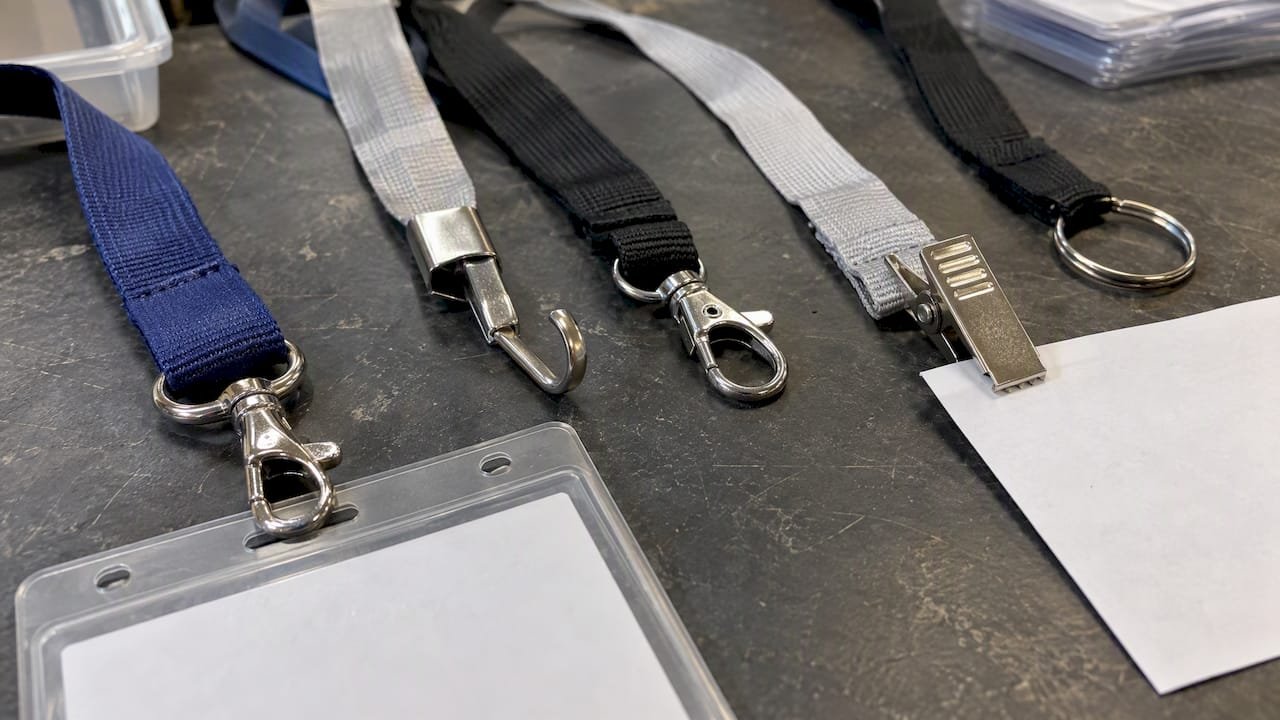
The attachment is the part of a lanyard people touch most. It decides whether a badge hangs straight, whether a key card survives a month of swiping, and whether a lanyard is safe to wear near machinery. The main types are the swivel hook, the lobster clasp, the bulldog clip, the carabiner or key ring, the badge reel, the wrist loop and the breakaway release. Match each one to what the lanyard will carry and where the wearer will be.
This guide is for marketers and buyers ordering branded lanyards in volume for events, onboarding and employee programs. It covers how each attachment behaves, what it suits, and what to check before you approve a proof.
TL;DR
- Swivel hook (J-hook or trigger): the safe default for punched ID badges and event passes. It rotates, so the badge doesn’t flip or twist.
- Bulldog clip: best when badges or cards have no punched slot. Fast to attach, but it grips lightweight items only.
- Lobster clasp, carabiner and split ring: better for keys, access cards and anything heavier or reused daily.
- Breakaway: add a breakaway release wherever a lanyard could catch on equipment or be pulled by a child. Combine it with any clip above.
- Don’t confuse promotional lanyards with fall protection lanyards. OSHA and ANSI govern those, and a badge lanyard is never a substitute.
Table of Contents
- The two parts of every lanyard attachment
- Swivel hooks and J-hooks
- Lobster clasps
- Bulldog clips
- Carabiners, split rings and key rings
- Badge reels, holders and card cases
- Wrist lanyards and device loops
- Breakaway releases: when you need one
- Promotional lanyards are not fall protection lanyards
- How to choose: a quick decision table
- Questions to answer before you order
- Our perspective
- Using lanyards at events
- Order branded lanyards with the right hardware
- FAQ
- Sources
The two parts of every lanyard attachment
People say “attachment” for two different things, and mixing them up causes most ordering mistakes.
- The end fitting is the hardware at the bottom: hook, clasp, clip, ring or reel. It holds the badge, card, key or device.
- The neck release is the connector at the back of the neck. A standard lanyard has none, and the strap is sewn into a closed loop. A breakaway lanyard has a small connector that separates under force.
You choose one of each. A swivel hook with no release is a common event lanyard. A bulldog clip with a breakaway is a common office lanyard. A lobster clasp with a breakaway suits staff who carry keys and move around a building.
Swivel hooks and J-hooks
The swivel hook is a metal or plastic hook on a rotating joint. You slide it through the slot punched in a badge or card holder. The swivel lets the badge turn with the wearer instead of twisting the strap, which matters at a conference where people lean over tables and shake hands for eight hours.
Best for: event badges, conference passes, visitor badges, and any holder with a slot.
Watch for:
- A hook only works if the badge has a slot. If your attendee cards aren’t punched, you need a different fitting or a holder.
- Plastic hooks are light and cheap and suit short events. Metal hooks feel sturdier and look more premium for staff or VIP programs.
- The hook opening should match the slot width. A wide hook in a narrow slot won’t sit properly.
Our Full Color 3/4″ Lanyard w/ Hook and Full Color 1″ Lanyard w/ Hook are the straightforward versions. The Full Color 3/4″ Premium Lanyard w/ Hook suits programs where the lanyard is part of the brand impression.
Lobster clasps
A lobster clasp is a spring-loaded claw that closes on itself. It’s harder to open by accident than a basic hook, and it clips onto rings, loops and bag straps as well as badge holders. Many lobster clasps include a swivel too, so you get the rotation and the closed grip.
Best for: staff lanyards that carry a badge plus keys, a USB drive or a small tool, and any lanyard that gets clipped and unclipped several times a day.
Watch for: the claw needs a ring or loop to grab. On a flat badge with a slot, it works well. On an unpunched card, it doesn’t.
The Breakaway Swivel Lobster Clasp Lanyard combines the clasp, the swivel and a safety release in one build, which makes it a practical default for office teams.
Bulldog clips
The bulldog clip, also called an alligator or crocodile clip, is a spring clamp with a toothed or smooth jaw. It bites onto the edge of a card, a paper pass or a holder without a hole. Staff can swap badges quickly, and visitors can clip a pass on in seconds.
Best for: paper tickets, temporary passes, flat cards with no slot, and programs where the badge changes often while the lanyard stays the same.
Watch for:
- Grip depends on spring tension. A heavy holder with a stack of cards can slip.
- Jaws can mark paper or thin plastic if the badge is pulled out repeatedly.
- They suit light loads. For keys, choose a ring or carabiner instead.
See the Lanyard with Bulldog Clip if your attendee or visitor badges are unpunched.
Carabiners, split rings and key rings
A split ring is a small double-coil key ring. A carabiner is a spring-gated loop. Both turn a lanyard into a key carrier, and a carabiner also lets the wearer clip the lanyard to a bag, belt loop or backpack strap.
Best for: keys, access fobs, outdoor and field teams, campus programs and giveaways that people keep using after the event.
A caution on terminology. Marketers sometimes see “carabiner” and assume it means a climbing or safety piece of equipment. A promotional carabiner or key ring is a convenience item. It isn’t load rated and shouldn’t be used to hold weight or support a person. The Small Carabiner Key Ring is a good example of a handy item for keys and light gear, not a safety device.
Badge reels, holders and card cases
A badge reel is a retractable cord with a clip or strap on the end. It’s usually clipped to a belt, a pocket or a lanyard. The wearer pulls the badge toward a reader and lets it retract. Plenty of teams pair a short lanyard with a reel for staff who badge in often.
Holders are a separate decision. A rigid holder protects the card and gives you a slot for a hook. A soft sleeve is cheaper. A holder with a built-in pocket can carry a second card or a ticket.
Best for: frequent badge-in environments, hospital and lab settings, reception desks and co-working spaces.
If you need a simple branded holder to go with your lanyards, look at the Round Badge Holder.
Wrist lanyards and device loops
Not every lanyard hangs from the neck. A wrist lanyard is a short loop with a clasp or card holder. It’s popular at festivals, gyms, trade show floors and anywhere a neck strap gets in the way. A device loop attaches to a phone case or tracker.
Two options on our site show the range: the Recycled Wrist Lanyard with Card Holder and the Recycled AirTag Lanyard. The first suits a one-card pass. The second suits luggage, keys and gear that tend to get lost.
Breakaway releases: when you need one
A breakaway release is a small plastic or metal connector in the strap that separates when pulled hard enough. If the lanyard catches on a door handle, a machine or a grabbing hand, it comes apart instead of tightening around the neck.
The common-sense rule is to add one when the wearer might be near moving equipment, could be grabbed (schools, healthcare, security and crowd events), or will wear the lanyard for a full workday. Check your own site rules, your insurer’s guidance and any workplace safety policy before you finalize a spec. If you manage a facility, ask your safety officer, not your promotions team, what the standard is for the area.
A breakaway is mostly a safety choice, but it’s also a practical one. Staff don’t lose a badge if it snags, and the strap can be reattached in seconds.
Promotional lanyards are not fall protection lanyards
The word “lanyard” also names a piece of industrial safety equipment, and the two should never be mixed up in a purchase order.
In the United States, fall protection systems are regulated under OSHA 29 CFR 1910.140. The rule covers connectors, anchorages and lanyards used in personal fall arrest and positioning systems. Industrial connectors must be made of drop-forged, pressed or formed steel and proof-tested to a minimum tensile load of 3,600 pounds (16 kN) without permanent deformation. The ANSI/ASSP Z359.3-2019 standard covers safety and positioning lanyards, including their marking, instruction, maintenance and removal from service.
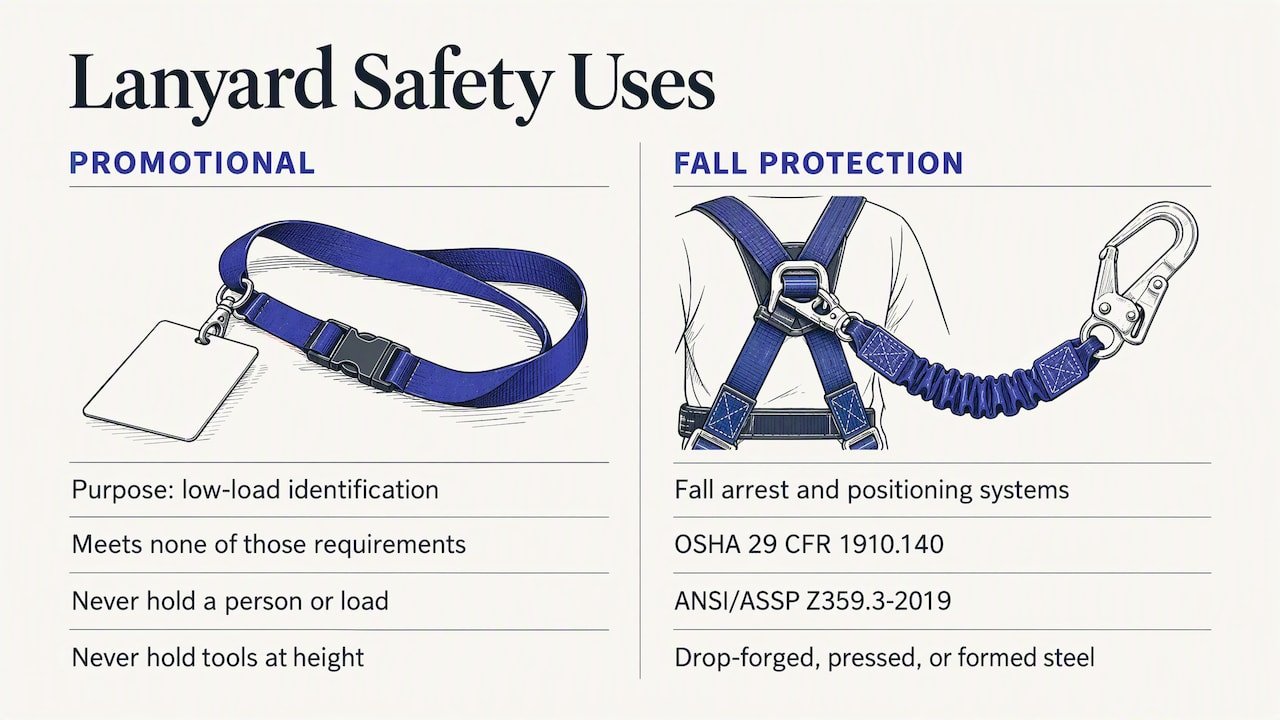
A promotional lanyard meets none of those requirements. It’s made for low-load identification. A branded hook, clip or carabiner must never be used to hold a person, a tool at height or any load that matters. If your team needs fall protection, buy certified equipment from a safety supplier and follow your safety program.
How to choose: a quick decision table
| What the lanyard carries | Recommended end fitting | Add a breakaway? |
|---|---|---|
| Event badge with slot | Swivel hook | Often, for large or public events |
| Paper pass or unpunched card | Bulldog clip | Often |
| Badge plus keys | Lobster clasp or split ring | Yes, for daily wear |
| Keys, fobs, gear | Carabiner or key ring | Optional |
| Staff who scan a card often | Badge reel on a short lanyard | Depends on the site |
| Festival or gym pass | Wrist lanyard | Not applicable |
| Child or school environment | Swivel hook or clip | Yes |
Questions to answer before you order
- What exactly is attached? Card, key, tool, phone or paper? Weight and slot type decide the fitting.
- Is the badge punched? If not, choose a clip or add a holder.
- Who wears it, and for how long? A one-day attendee has different needs than an employee wearing it daily for a year.
- Is there a safety rule? Machinery, healthcare, schools and security teams often require a breakaway.
- Does the wearer share the lanyard? If badges swap often, a clip works better than a fixed hook.
- How should it look? Metal hardware feels premium. Plastic hardware saves budget for large attendee counts.
- Will people reuse it? A lanyard with a key ring or carabiner tends to stay in use after the event, which extends the brand exposure.
Our perspective
Most lanyard problems we see in corporate programs don’t come from the print. They come from the hardware being chosen last. A team designs a beautiful full-color strap, then discovers that the attendee badges have no slot, or that the hook is too wide for the holder, or that the facilities team requires a breakaway.
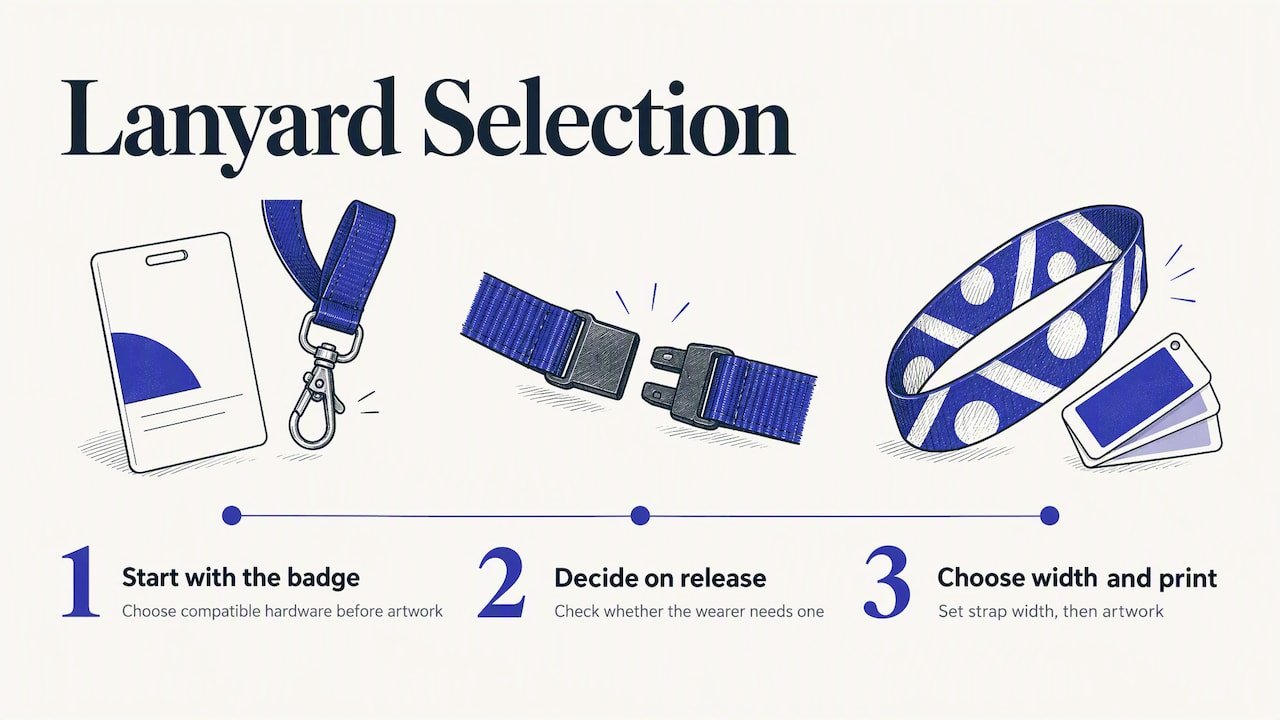
Our advice is to choose the attachment first and the artwork second. Start with the badge or card you actually have. Then decide whether the wearer needs a release. Then pick the strap width and print.
We also push buyers to think about distribution early. Lanyards are rarely used in one place. A company may need them at a headquarters event, a regional office and a trade show booth in the same month. We handle distribution to single or multiple locations and support rush orders, so a late badge change doesn’t have to become a missed event. That’s most useful when the hardware has been settled, because a rush job is much easier when no one has to rethink the spec.
One more point: for a staff program, spend your budget on the hardware people touch. Strap fabric is seen from a distance. A clasp that works smoothly is felt every day.
— Jerry
Using lanyards at events
At trade shows and conferences, lanyards are often the one piece of branding every attendee wears. A few practical points help:
- Match the attachment to your registration process. Badges printed on site often come as unpunched cards, which favors a clip or a holder.
- Order a small buffer of extras. Some will break, some will be swapped, and late registrants always appear.
- Plan the post-event life. A lanyard with a useful clip is more likely to go home with the attendee.
- Make the badge photographable. If you plan to promote the event online, a branded lanyard appears in many attendee photos, so it’s worth thinking through the social side too. This trade show social media plan shows how to organize that content before the show.
If you’re deciding between lanyards and other giveaways, our guide to types of branded promotional products for marketers compares the options, and our corporate swag budgeting guide helps you set a per-unit target.
Order branded lanyards with the right hardware
If you’re ready to specify a program, start from the Discount Swag catalog. We supply customizable lanyards alongside apparel, drinkware, bags and technology items, with branded kits, rush orders and delivery to one or many locations. We guarantee 10% or more savings versus any competitor’s online price, so you can compare the quote against what you’ve been offered elsewhere. Tell us the badge type, the quantity and the delivery dates, and we’ll help you match the attachment to the job.
FAQ
What is the most common lanyard attachment?
The swivel hook, often called a J-hook or trigger hook, is the most widely used for ID badges and event passes. It suits any holder with a slot, and the swivel stops the strap from twisting. For unpunched cards, a bulldog clip is the usual alternative.
What is the difference between a lobster clasp and a carabiner?
A lobster clasp is a spring-loaded claw that hooks onto rings and loops. A carabiner is a closed loop with a spring gate that clips around straps, rings or bag loops. For promotional lanyards, both are convenience hardware for keys and light gear, not load-rated safety equipment.
Do I need a breakaway lanyard?
Use one if the wearer could be near machinery, could be grabbed, or will wear the lanyard all day. Your workplace safety policy or facility rules may require it. Ask your safety officer for the standard that applies to your site.
Can I use a promotional lanyard for fall protection or tool tethering?
No. Fall protection lanyards in the U.S. fall under OSHA 29 CFR 1910.140 and related ANSI/ASSP standards, and they use certified connectors. A promotional lanyard is meant for identification only.
Which attachment is best for keys?
A split ring, key ring or carabiner holds keys better than a hook or clip. Pair it with a breakaway release for daily wear so the lanyard releases if it snags.
 Bottle Carriers
 Mugs