

DTG vs DTF: Which Print Method Fits Your Order?

Choose DTG (direct-to-garment) when the order is cotton apparel and you want a soft, breathable print with fine detail. Choose DTF (direct-to-film) when the order mixes fabrics, includes polyester, nylon or fleece, or needs bold, opaque color on dark garments. Neither is “better” in general. They solve different problems, and a good promotional program often uses both.
This guide is written for marketing managers and buyers who place bulk apparel orders and need to know what to ask for, what to expect on the finished shirt, and where costs really come from.
TL;DR
- DTG sprays ink into the fabric. It feels softest on cotton and handles photographic artwork well.
- DTF prints on a film, then heat-presses it onto the garment. It works on almost any fabric and stays vivid on dark colors.
- Durability depends more on curing, fabric and care than on the label. DTF is often more flexible and stretch-tolerant; DTG shines on quality cotton.
- Cost is close on most runs. Fabric mix, number of colors, garment color and order size move the price more than the method.
- Decision rule: cotton tees and hoodies with detailed art, DTG. Mixed fabrics, performance wear, caps, bags and bold logos, DTF.
Table of Contents
- How the two methods work
- Head-to-head comparison
- Quality: which one looks better?
- Durability: does DTG peel, does DTF crack?
- Cost: what actually changes the price
- Which method for which promotional item
- Why many producers run both
- Our perspective
- Ordering custom apparel through Discount Swag
- A short checklist before you place the order
- FAQ
- Sources
How the two methods work
DTG: ink goes into the fabric
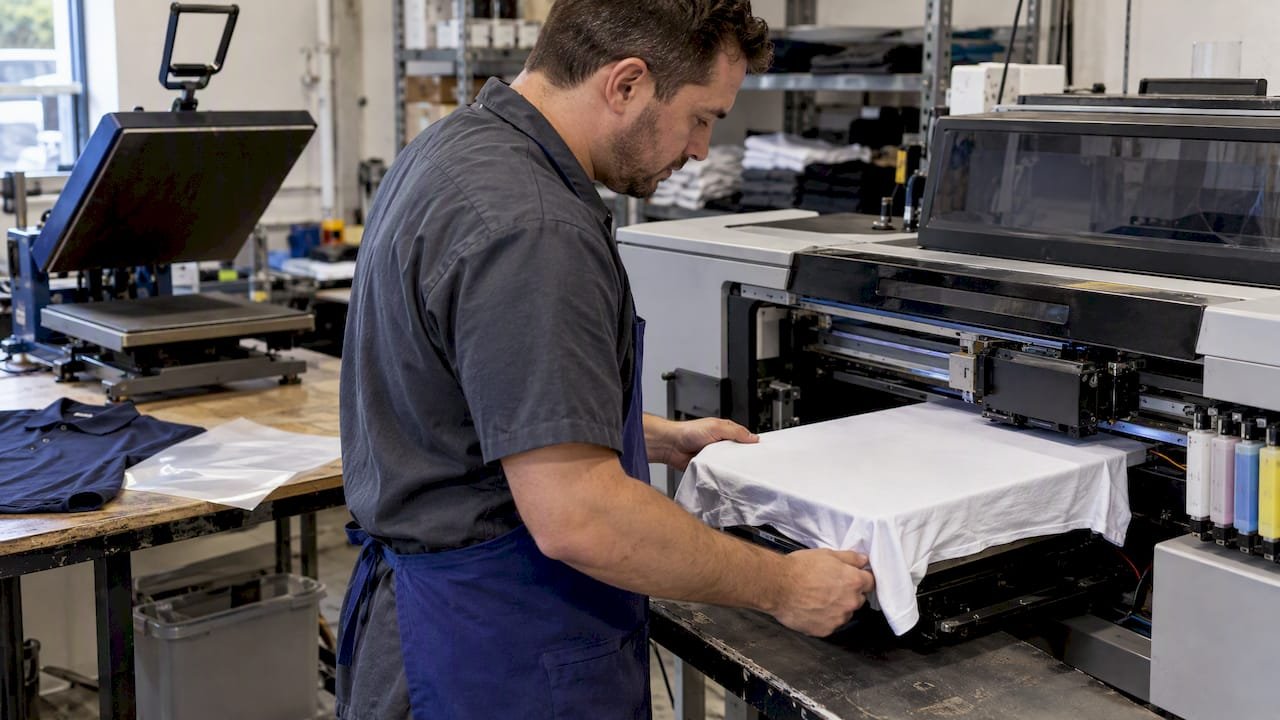
DTG works like a large inkjet printer for textiles. The garment is loaded on a platen, the printer applies water-based ink straight onto the fibers, and the ink is then cured with heat. On dark garments, a white underbase is printed first. Shopify’s comparison notes that the process produces highly detailed designs, including realistic photographs, on both light and dark fabrics.
Because the ink sits in the fibers rather than on top of them, a good DTG print on quality cotton reads as part of the shirt, not a layer stuck onto it.
DTF: print on film, then transfer
With DTF, the artwork is printed onto a transfer film, coated with adhesive powder, cured, and then heat-pressed onto the finished garment. Since the print is made before it meets the garment, the same transfer can go onto cotton, polyester, blends and other substrates. Epson’s overview of DTG and DTFilm printing describes both as ways to print on demand without screens or complicated setup.
The trade-off is that a DTF print sits on the surface as a thin layer. It can feel slightly more noticeable to the touch, especially on large solid areas.
Head-to-head comparison
| Factor | DTG | DTF |
|---|---|---|
| Best fabric | Cotton and high-cotton blends | Cotton, polyester, blends, nylon, fleece and more |
| Hand feel | Softest, ink absorbed into fibers | Thin film layer on top, slightly more noticeable |
| Dark garments | Needs a white underbase, good results on quality cotton | Consistent opaque white base, very vivid |
| Fine detail and gradients | Excellent, especially photos | Very good, strongest on bold artwork |
| Stretch tolerance | Good on cotton | Typically more elastic film layer |
| Breathability | High | Lower over large coverage areas |
| Typical use | Fashion-forward tees, retail-style merch | Promotional runs across mixed products |
The fabric and feel rows come from Shopify’s guide, which says DTG is generally the stronger choice for natural fibers when soft hand feel and breathability matter, while DTF is preferred for synthetics and gives more vibrancy on dark garments through a consistent white ink layer.
Quality: which one looks better?
It depends on the artwork and the shirt.
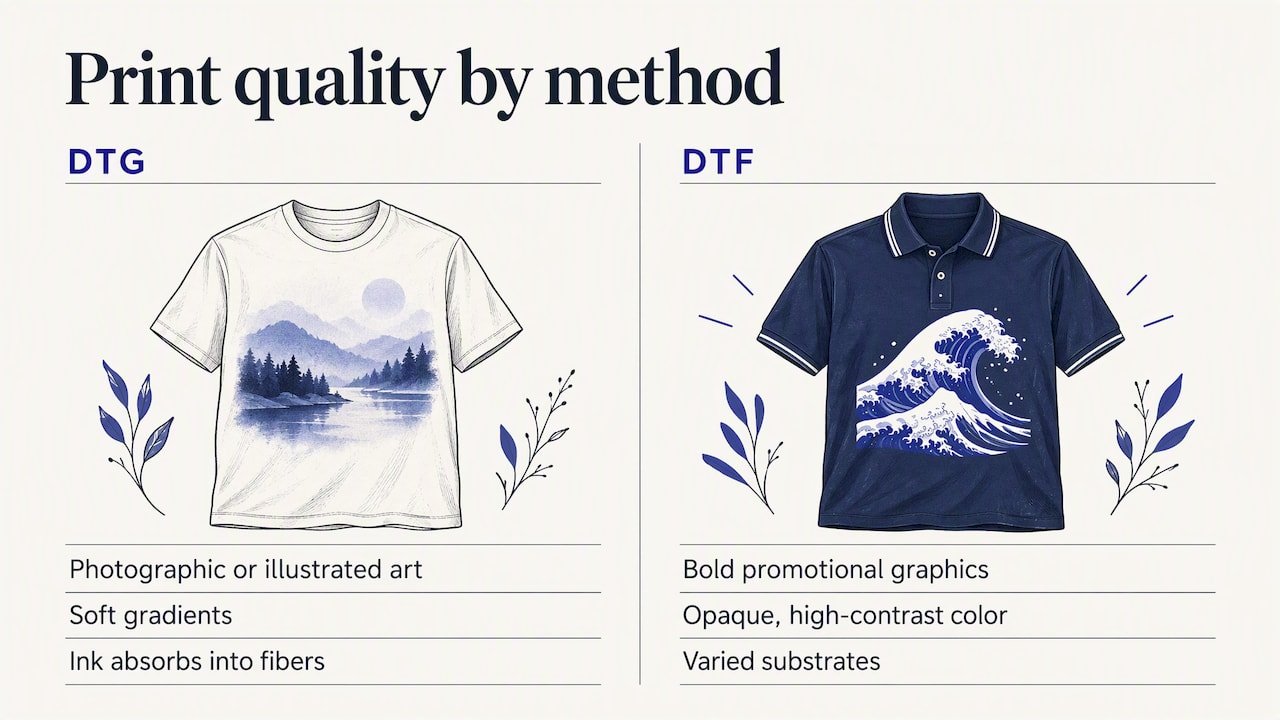
Photographic or illustrated art. DTG is usually favored when a design benefits from ink absorbing into the fibers, as Epson’s announcement of its hybrid DTG and DTFilm printer points out. Think event photography on a commemorative tee, or an illustration with soft gradients.
Bold logos and promotional graphics. The same source describes DTF as widely used where opaque, high-contrast color on varied substrates is the main requirement. A flat, saturated corporate logo on a navy polo or a black quarter-zip is exactly that case.
Fine text. Small type is where artwork preparation matters more than the method. Our guides on shirt logo sizes and pixel specs and why font choice matters on branded products cover the details that prevent reprints, whichever technology prints your order.
Durability: does DTG peel, does DTF crack?
Both can fail, and both can last for years. What separates a print that survives from one that does not is mostly process quality and aftercare.
A few things to know:
- DTF relies on adhesive and heat pressing. If the transfer is under-cured or pressed at the wrong temperature or pressure, edges can lift. Done correctly, wash resistance is strong. A Czech textile study on resistance to washing and abrasion tested DTF prints on cotton and polyester and found no significant damage and only insignificant color loss after 50 wash cycles in the samples it describes.
- DTG is bonded in the fibers, so there is no film to peel. Over many washes on cotton, the main risk is gradual fading, more so with heat and harsh detergent.
- Stretch matters for activewear and fitted items. A thin elastic film layer tends to move with the fabric, which is one reason DTF is chosen for blends and performance fabrics.
Vendor claims of exact wash counts vary widely, and many come from companies selling printers or transfers. Treat any single number as a benchmark for good conditions, not a guarantee. What you can control is the care label. The routine in our post on caring for printed shirts, including waiting before the first wash, applies to both methods: turn garments inside out, wash cool, and avoid high-heat drying.
Cost: what actually changes the price
Both methods are digital, so neither has the screen setup fees of traditional screen printing. That is why they suit smaller and more varied runs. Published per-shirt ranges you will see online differ a lot, and we would not plan a budget around any one of them. These are the factors that really move your quote:
- Fabric mix. If you order tees, polos, hoodies and bags in one program, DTF can avoid the need to split the work across methods.
- Garment color. Dark garments use more ink in DTG because of the white underbase. DTF’s white layer is built into the film.
- Print size and coverage. Larger prints use more ink or more film and adhesive.
- Number of locations. Front chest plus back plus sleeve adds cost either way.
- Order size. Very large single-design runs of the same garment may be cheaper with screen printing. Our comparison of screen printing vs embroidery helps you judge when volume changes the answer.
- Blank garment quality. The shirt often costs more than the decoration. Tight-weave ring-spun cotton prints better with DTG than loose, textured knits.
For a wider look at how to keep apparel spend under control without lowering quality, see our piece on bulk custom apparel and smarter brand spending and the corporate gifting cost guide for procurement.
Which method for which promotional item
| Item | Usually the better fit | Why |
|---|---|---|
| 100% cotton tees for a conference | DTG | Soft feel, breathable, handles detailed art |
| Black or navy tees with a bold logo | DTF or DTG | DTF for punchy opacity; DTG for soft hand |
| Polyester performance shirts | DTF | Works on synthetics |
| Cotton-poly hoodies and fleece | DTF | Handles blends and textured surfaces |
| Totes, caps and bags | DTF | Transfers to varied substrates |
| Photo-style or gradient artwork on light cotton | DTG | Detail without a surface layer |
| Embossed, textured or high-end polos | Consider embroidery | See below |
Sometimes the right answer is neither. For polos and corporate wear that should look premium for years, compare embroidered polos and printed tees or read our matchup of direct embroidery and appliqué. For hard goods such as drinkware and pens, a different process is usually needed; our article on UV printing vs screen printing explains why teams often need both.
Why many producers run both
The either-or question tends to disappear on the production side. Hardware makers now sell hybrid machines, such as the SureColor F2270 in Epson’s launch announcement, which supports both DTG and DTFilm so a shop can switch between premium on-demand cotton orders and durable multi-material promotional runs.
For you as a buyer, that means a single order can be split by product: cotton tees by one method, bags and performance wear by the other, with the same artwork. Doing this smoothly takes disciplined job routing. If you are curious how production teams approach that, this overview of workflow automation in manufacturing gives useful background on coordinating mixed jobs.
Our perspective
We distribute promotional products for marketing and procurement teams, and the same pattern comes up in nearly every apparel program: the method debate matters less than the brief. Teams that send a clear logo file, the garment colors, the fabric and the delivery deadline get better results than teams that ask for “DTG” or “DTF” by name and leave everything else open.
Our advice:
- Start from the garment, not the method. Pick the shirt, jacket or bag for your audience first. Then let the fabric and the artwork decide the print process.
- Match the method to the job. Soft cotton with detailed art points to DTG. Mixed fabrics and bold logos point to DTF.
- Order a sample before a big run. A single printed piece tells you more about feel and color than any spec sheet.
- Plan the distribution early. Printing is only half the work. Shipping to one office or twenty locations, and fitting rush deadlines, usually decides whether an event kit arrives on time. We cover this in how to order branded merch without delays.
- Avoid dead stock. Decorating on demand is attractive because it makes smaller and more varied runs practical. Our post on personalized swag at scale shows how to use that without overbuying sizes.
— Jerry
Ordering custom apparel through Discount Swag
If you are ready to buy rather than research, we sell customizable apparel, bags, drinkware, technology and more for corporate programs, with rush ordering, branded kits and fulfillment to single or multiple locations. We also guarantee 10% or more savings versus any competitor’s online price. Browse the catalog at discountswag.store, or see how we approach bulk custom apparel for brand teams.
A short checklist before you place the order
- List every garment and its fabric content (for example 100% cotton, 50/50, polyester).
- Note garment colors, since dark colors change the ink and prep.
- Send vector or high-resolution artwork, and confirm print size and placement.
- Decide on care expectations and include care cards if the shirts are for employees or customers.
- Ask for a physical sample if the order is large or the design has fine detail.
- Confirm delivery locations, quantities per location and the in-hands date.
FAQ
Which is best, DTG or DTF?
Neither wins everywhere. DTG is the stronger choice for soft, breathable prints on cotton with detailed artwork. DTF is the stronger choice for mixed fabrics, synthetics and bold, opaque logos on dark garments. If your order includes both kinds of items, expect each to be matched to its best method.
Does DTG last longer than DTF?
Not necessarily. Both can last through many washes when properly cured and cared for. DTF often holds up well on stretchy and synthetic fabrics because the film layer is flexible, while DTG performs best on good cotton. Washing inside out in cool water and avoiding high heat extends the life of either.
Is DTG or DTF cheaper?
They are often close in price. DTF tends to be more economical when an order mixes fabrics or uses dark garments with large, full-color art, while DTG can be economical for single-fabric cotton runs. Print size, number of locations, and the blank garment affect the total more than the method.
Does DTG printing peel off?
It is uncommon, because DTG ink is absorbed into the fibers rather than sitting as a film. The more typical wear pattern is gradual fading after repeated hot washes. Peeling is more associated with transfers that were cured or pressed incorrectly, which is why process quality matters.
Sources
- DTG vs. DTF Printing: How To Choose for Your Business (Shopify)
- Epson introduces hybrid DTG and DTFilm garment print solution (Epson US)
- DTG & DTFilm Printing Made Simple (Epson blog)
- Investigation of the resistance of different textile prints to washing and abrasion
 Bottle Carriers
 Mugs