

Eco Swag Certifications: What They Verify and Which to Ask For


For eco-friendly promotional products, the certifications worth asking for are the ones that match the material in your hand: Global Recycled Standard (GRS) for recycled content, FSC for paper, GOTS for organic textiles, UL ECOLOGO and Cradle to Cradle for broader product performance, and USDA Certified Biobased for biobased content. Each verifies one defined thing. A logo on a tag does not prove a finished item, and a certificate does not let you call a product “eco-friendly”. This guide shows what each label covers, how to check a certificate, and how to describe the result in US marketing copy.
TL;DR
- Match the label to the material: GRS for recycled fabric, FSC for paper, GOTS for organic textiles, USDA Certified Biobased for biobased content, UL ECOLOGO and Cradle to Cradle for multi-attribute performance.
- A certification verifies a process or a defined attribute. It is not proof of a perfect outcome and does not guarantee fair labor on its own.
- Ask for the certificate number, issuer, scope and validity dates, then verify them with the issuing body. For chain-of-custody claims, ask for the paperwork covering your actual shipment.
- In US marketing, follow the FTC Green Guides. Say exactly what is certified (product, packaging or one component) and never imply government endorsement.
- Buying fewer, better-documented items beats a long list of vaguely green ones.
Table of Contents
- Why certifications matter more than the word “eco”
- The certifications you will actually meet on swag
- What certification does not tell you
- How to confirm a certificate is current and covers your item
- Writing certified swag claims that hold up in the US
- Putting it into a swag program
- Where to start with certified-looking items
- Promo: sourcing swag with fewer moving parts
- Perspective
- FAQ
- Sources
Why certifications matter more than the word “eco”
Most swag buyers have seen the problem: a supplier’s catalog shows a leaf icon, a “sustainable” banner and no detail. The U.S. Federal Trade Commission has warned that unqualified claims such as “eco-friendly” are likely to suggest far-reaching benefits that few products, if any, have, and that may be impossible to substantiate. That is the marketing risk. Your name is on the item, so the claim becomes yours.
Third-party certification is the practical answer. The promotional products industry’s responsible-sourcing guide defines it as an independent organization assessing conformity against specified standards, and it adds that programs differ a lot in testing, inspection and quality-control review. So the useful question is never “is it certified?” but “certified by whom, for what, and does it cover this exact item?”
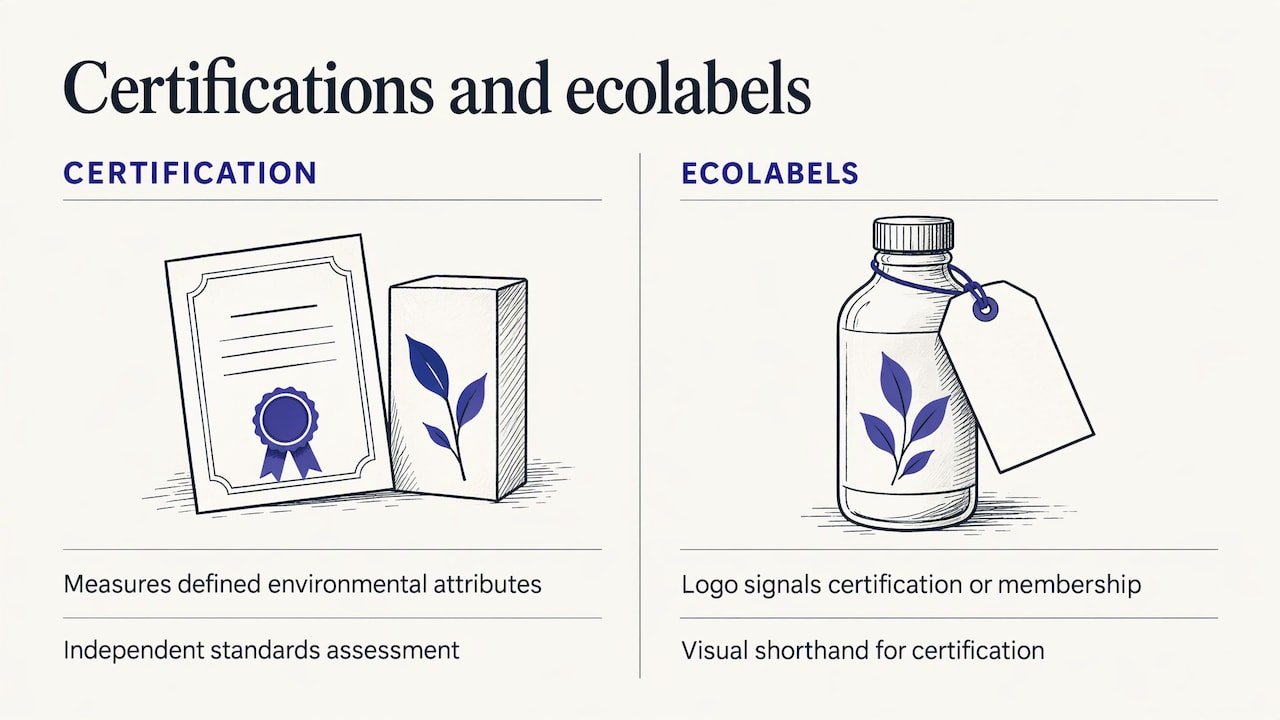
PPAI makes a helpful distinction in its 2024 US guide: certifications measure defined environmental attributes, while ecolabels are logos that communicate a certification or membership. The logo is the shorthand. The certificate is the evidence. It names Cradle to Cradle, UL ECOLOGO, Global Recycled Standard and EPA Safer Choice among the examples.
The EPA gives buyers a short test for choosing among them. It says to prefer standards or ecolabels that cover the product’s key impact areas, are issued or supported by respected organizations, are managed by government agencies, or appear in EPA’s federal-purchasing recommendations. Use that as your first filter.
The certifications you will actually meet on swag
Promotional products are mostly textiles, paper, plastics and metals. That narrows the field. Here is what each major label verifies and where it applies.
| Certification | What it verifies | Typical swag it fits |
|---|---|---|
| Global Recycled Standard (GRS) | Recycled content and chain of custody, plus social, environmental and chemical requirements | Recycled polyester totes, backpacks, messenger bags, apparel |
| FSC Chain of Custody | Certified wood or paper is identified, tracked and separated from non-certified material | Notebooks, portfolios, packaging, printed inserts |
| GOTS | Organic textile requirements across material, processing, environmental, social and labeling criteria | Organic cotton tees, totes, hoodies |
| UL ECOLOGO | Multi-attribute, life-cycle-based criteria set by product standard | Office products, packaging, some consumer goods |
| Cradle to Cradle Certified | Product assessment across defined sustainability categories | Select apparel, bags and materials |
| USDA Certified Biobased | Verified biobased content | Biobased pens, drinkware accessories, packaging |
| EPA Safer Choice | Safer chemical ingredients in chemical-based products | Cleaners and similar kits, not textiles |
Global Recycled Standard
The GRS is the label you will see most on bags and apparel made from recycled plastic bottles. Textile Exchange, which owns it, says the standard sets criteria for third-party certification of recycled materials and chain of custody. It sets a 50% minimum recycled-content threshold for consumer-facing labeling (20% for business-to-business use), and it adds social, environmental, processing and chemical requirements.
That threshold matters for swag. A tote that carries a GRS label for consumers must meet the higher bar. Ask which one the certificate reflects, and write your copy to match.
FSC Chain of Custody
For anything made of paper or wood, FSC is the standard reference. FSC says certifiers check that certified products come from certified suppliers and are identifiable, separated from non-certified products, traceable and recorded by volume, with a management system behind it. Certificates last five years with annual surveillance audits.
The detail buyers miss is that FSC certification belongs to a company holding a certificate, not to the paper in general. If you print a portfolio or notebook, the claim depends on the supplier and printer chain being covered.
GOTS for organic textiles
Global Standards develops and runs GOTS, which publishes material, processing, environmental, social, traceability and labelling requirements for activities within the certified scope. It is the label to look for on organic cotton tees and totes. One note on cost, because it explains why smaller suppliers sometimes skip it: one industry write-up puts fees at $1,200 to $3,000 per facility annually, plus a $180 annual GOTS fee per inspected location.
UL ECOLOGO and Cradle to Cradle
UL describes ECOLOGO as a voluntary, multi-attribute, life-cycle-based program. Depending on the product standard, criteria can cover materials, recycled or biobased content, packaging, energy, supply-chain impacts, waste, water, safer chemicals and performance. That breadth is why it is respected for office and packaged goods. Cradle to Cradle sits in the same multi-attribute family and is also on PPAI’s list of examples.
USDA Certified Biobased and EPA Safer Choice
The USDA label assures that a product or package contains a certified amount of biobased content. It speaks about content, not about the whole product’s footprint. EPA Safer Choice is narrower still: it applies to chemical-based products such as cleaners, laundry detergents and carpet and floor care products. Do not expect it on a tumbler or a tee.
What certification does not tell you
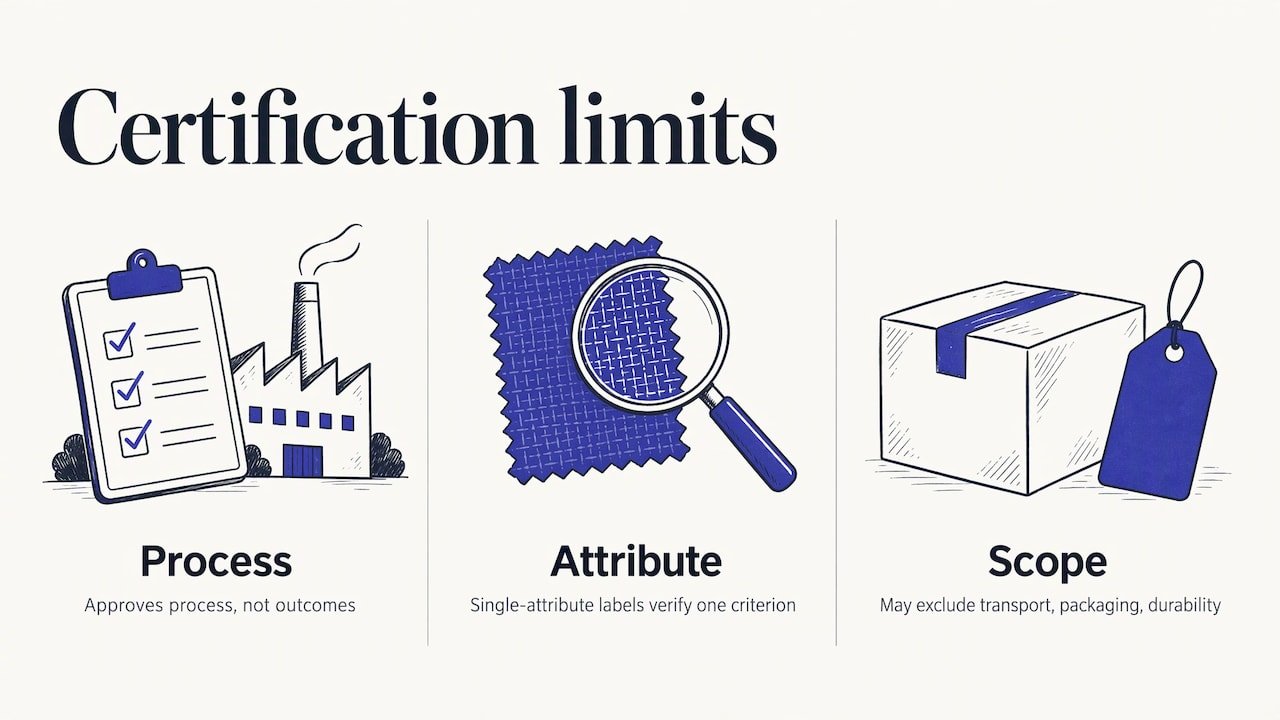
A certificate is strong evidence for what it covers and silent on everything else. Three limits are worth building into your buying brief.
Process, not outcome. The U.S. Department of Labor puts it plainly: certification approves the process, not the outcomes, and should not be used to claim that no child labor or forced labor was involved in producing a good. Human Rights Watch makes the related point that audits can miss forced labor, child labor and other violations, and that remediation depends on what suppliers and brands do afterward. So write “made with GRS-certified recycled content”, not “ethically made”.
One attribute at a time. A recycled-content label says nothing about fair wages, and a social-compliance label says nothing about recycled content. The Ecology Center’s factsheet notes that labels vary in strength and thoroughness, and single-attribute certifications verify only one criterion. If a particular outcome matters to your brand, name it in the brief and ask which standard covers it.
Scope. A label has a defined boundary. It may leave out transport, packaging, durability or end-of-life. That is not a flaw to hide. It is the reason your copy should name the part that is certified.
How to confirm a certificate is current and covers your item
This is the step that separates a defensible claim from a decorative one. The checks below follow commonly published verification guidance. Because the most detailed versions come from certification service providers, confirm each point against the issuer’s own database or contact page.
- Get the full certificate, not a logo. Record the certificate number, the issuing body, the issue and expiry dates, status, scope and exclusions, as supplier-certificate guidance recommends.
- Verify with the issuer. Use the certifier’s official database or label-check tool, or contact the issuer through contact details you found independently, not those printed on the document you were handed.
- Match the legal entity and site. The certificate holder and the manufacturing site should be the ones making your order. A certificate for a component, a product family or an unrelated scope does not prove your finished item.
- Match the product. Compare the exact model, variant and materials to your purchase specification.
- For chain-of-custody claims, ask for the transaction certificate. Verification guidance explains that a facility-level Scope Certificate is not enough by itself: match the transaction certificate to the actual shipment, quantities and invoice. A logo or an affiliate’s certificate is not proof.
- Check validity dates against your production window. Textile Exchange notes that a certification contract is typically valid for one year, so an expired certificate on file is a real risk on repeat orders.
- File it. Keep the certificate with the order record. If a claim is ever questioned, the document trail is your substantiation.
The discipline is the same one used to review any claim against its source: a product description audit compares what a page says with what the record supports, line by line. Apply that to every eco line in your swag copy.
For teams buying at volume, this checklist is the hidden cost of sustainable swag. Doing it for ten suppliers and forty SKUs is a project. That is a good reason to consolidate orders with a distributor that works from curated, trusted suppliers.
Writing certified swag claims that hold up in the US
Certification protects you only if your wording stays inside it. Three rules cover most cases.
Follow the Green Guides. The EPA states that environmental claims should meet the FTC Green Guides, which apply to advertising, labels, package inserts, promotional materials and electronic media. It also says EPA cannot endorse products or services, so never imply that it has. Using “EPA Safer Choice” is fine where the product holds the label. Saying “EPA approved” is not.
Say what is certified. The industry guide advises that environmental claims should identify whether they apply to the product, the packaging, the service or only a component, with qualifications that are clear, prominent and understandable. The FTC’s proposed revised Guides likewise advise that qualifications make clear a certification or seal refers only to specific and limited benefits.
Keep records. USDA’s brand guide requires environmental and other product claims to be truthful, evidence-based and supported by records. The same habit protects any marketing team.
Here is how that looks in practice:
| Instead of | Write |
|---|---|
| “Our eco-friendly tote” | “Tote made with GRS-certified recycled content” (once you hold the certificate for that item) |
| “Sustainable notebook” | “Notebook with FSC-certified paper cover” (if the certificate covers the cover only, say so) |
| “Ethically made” | Name the specific social standard and the facility it covers |
| “Green gift kit” | List which items in the kit carry which certification |
If your legal team reviews marketing copy, hand them the certificate file along with the draft. Review goes faster when the evidence is attached.
Putting it into a swag program
A few practical choices make certified swag easier to run.
- Start from the material. Pick the items first (bags, drinkware, notebooks, apparel), then ask which certification fits that material. Asking for GOTS on a ceramic mug wastes everyone’s time.
- Choose fewer, more durable items. Certifications rarely measure whether anyone keeps the item. A bag people carry for years does more than a long list of labeled one-offs.
- Decide which attribute your brand cares about. Recycled content, responsibly sourced paper, organic fiber and safer chemistry are separate goals. Name one or two per campaign.
- Plan certification lead time. Paperwork requests take time. Build them into the schedule before a rush date, not after.
- Keep the QR option in mind. If a recipient wants the detail, a code can lead to a page explaining what is certified. Our guide to QR codes on swag covers size, placement and tracking.
- Think about the audience. Early-career recipients often ask about materials. If you hand out gear at career fairs, see our guide to campus recruiting swag.
Where to start with certified-looking items
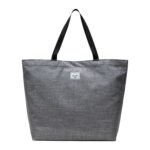
Several items in our catalog are built around recycled or responsibly sourced materials. The Classic Recycled Messenger Bag and the Case Logic Invigo Recycled 16" Messenger Bag are recycled-material bags. The Merchant & Craft Revive Recycled 9 Can Tote Cooler belongs to the same recycled line as the Revive backpack cooler, and the Windsor Impressions Presentation Portfolio is listed with FSC Mix paper. Before you describe any of them as certified in your own materials, request the certificate that covers the exact item and follow the checks above.
Promo: sourcing swag with fewer moving parts
Discount Swag is an online distributor of customizable corporate promotional products across apparel, bags, drinkware, technology, office, outdoor and more. We work with curated, trusted suppliers, and we handle rush orders, branded kits and fulfillment to single or multiple locations, so one order can cover a whole program. We also guarantee 10% or more savings versus any competitor’s online price.
If you are building a recycled-material bag, a branded kit or a larger event order, start on the Discount Swag site and tell us which attribute matters most to your brand.
Perspective
Buyers often ask us for “the eco option” as if it were one product. It never is. It is a decision about which attribute you want to stand behind: recycled content, responsible paper, organic fiber or something else.
Our view is that the best sustainable swag program is a short one. Pick a few durable items, from trusted suppliers, with a certificate you can put in a folder. A recycled messenger bag or a recycled cooler that someone carries for years says more about your brand than a pile of labeled one-offs.
That is also why we built our service around curated suppliers, branded kits and fulfillment to one or many locations. A program with fewer suppliers and one ordering point is easier to document, easier to describe accurately and easier to repeat next year.
Jerry
FAQ
Which certification is best for eco-friendly swag?
There is no single best one, because each verifies a different attribute. GRS fits recycled-content bags and apparel, FSC fits paper items, GOTS fits organic textiles, and UL ECOLOGO or Cradle to Cradle fit broader product performance. Choose by material and by the claim you want to make.
Can I call a certified product “eco-friendly”?
It is safer not to. The FTC has said unqualified eco-friendly claims are likely to convey broad benefits that may be impossible to substantiate. Name the certification and what it covers, such as “made with GRS-certified recycled content”.
Does a certification prove no forced or child labor was involved?
No. The Department of Labor says certification should not be used to claim that no child or forced labor was involved. Describe the process standard the product meets, and name the specific social standard if you cite one.
How do I check that a certificate is real and applies to my order?
Get the full certificate, then verify its number, issuer, scope and dates with the issuing body. Match the certificate holder, site and exact product to your order. For chain-of-custody claims, ask for the transaction certificate covering your shipment.
Does the EPA certify or endorse promotional products?
No. The EPA says it cannot endorse products or services, and it points marketers to the FTC Green Guides for environmental claims. EPA Safer Choice is a label for chemical-based products and appears only where a product has earned it.
Sources
- FTC proposed revisions to the Green Guides, Federal Register 2010
- PPAI: Guide to Responsible Sourcing in the Promotional Products Industry
- PPAI: Using Ecolabels To Find Sustainable Products
- EPA: Frequent Questions about Sustainable Marketplace and Green Products
- Textile Exchange: Recycled Claim Standard and Global Recycled Standard
- Forest Stewardship Council US: Chain of Custody Certification
- Global Standards: GOTS
- Cotton Gins: GOTS Certification 2026
- UL Solutions: ECOLOGO Certification Program
- USDA BioPreferred: About the label
- USDA BioPreferred Brand and Marketing Guidelines
- U.S. Department of Labor: Independent verification in fashion supply chains
- Human Rights Watch: Why Social Audits Can’t Fix Labor Rights Abuses
- Ecology Center: Third-Party Certifications and Eco-Labels
- How to check a supplier’s certificates
- How to Verify a Textile Certificate
- Textile Exchange: Get Certified
- Product Description Audit: A 7-Step Guide
 Bottle Carriers
 Mugs