


Custom Challenge Coins for Companies: How to Order Them Right

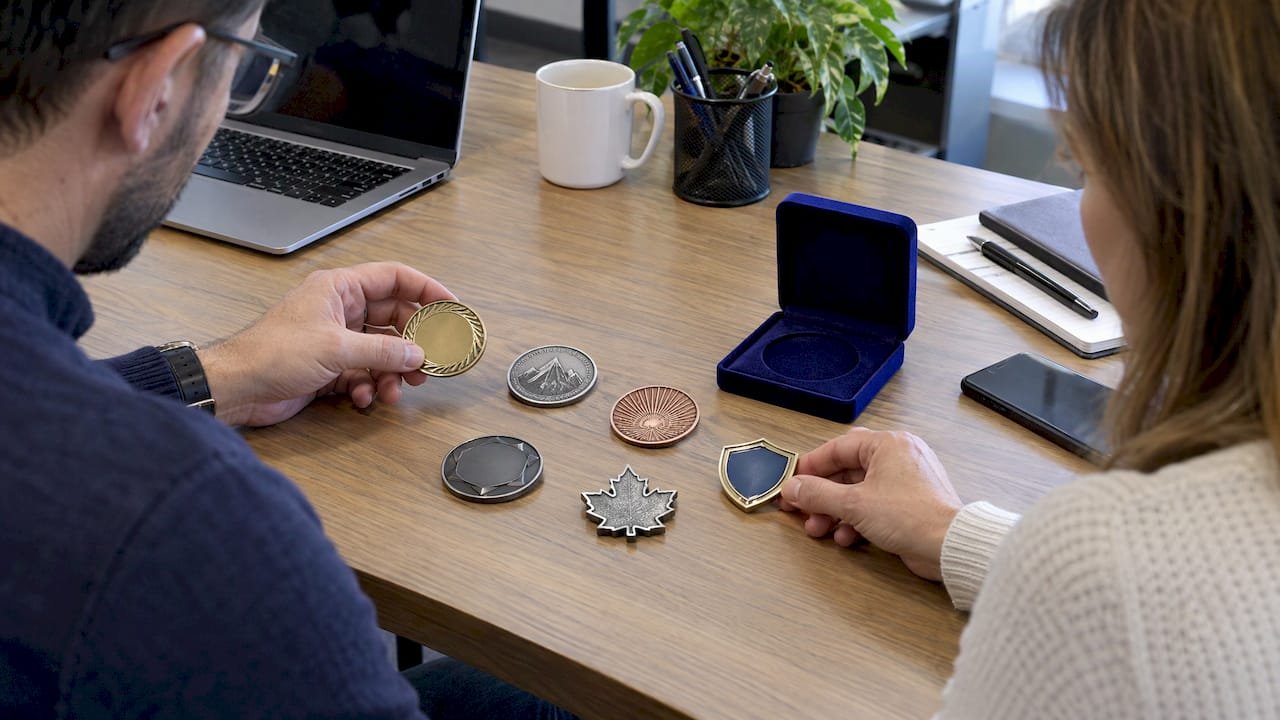
A corporate challenge coin works when it is specified well, ordered early and handed over in a way people remember. The coin is a small metal medallion carrying your logo or emblem, given for recognition, milestones, launches or team identity. The metal is the easy part. Most of the effort goes into the brief, the proof approval, the timeline and getting the finished coins to people in several offices. Below is the buying routine for a marketing or procurement team, and how we at Discount Swag handle the program around the coin: kits, boxes, rush timing and distribution.
TL;DR
- Decide the purpose first (recognition, onboarding, event, anniversary). It sets the quantity, the design and the budget.
- Specify five things in writing: size, shape, finish, color method and edge or back details. Approve a digital proof before production.
- Plan the calendar backward from the handout date. Custom minting runs in weeks, not days, and artwork revisions are what usually cause delays.
- A coin feels like an award only when it is presented well. A branded kit or custom box does that job.
- If coins must reach several offices, decide the distribution plan before you place the order, not after the cartons arrive.
Table of Contents
- What a corporate challenge coin is, and why companies use them
- Start with the brief: purpose, audience, quantity
- Specifying the coin: the decisions that matter
- Designing for your brand, not for a template
- Reading a quote: what to compare
- The calendar: work backward from the handout date
- Presentation turns a coin into recognition
- Distribution: the part that goes wrong at scale
- Where Discount Swag fits
- Our perspective
- Common mistakes to avoid
- FAQ
- Sources
What a corporate challenge coin is, and why companies use them
A challenge coin is a custom-struck or cast metal coin that marks membership or achievement. The tradition is old: coins awarded to soldiers for exceptional performance trace back to the Roman Empire, and in the modern U.S. armed forces they became a symbol of unit identity. Companies borrowed the idea because it answers a real marketing problem: a coin is small, durable and personal, so people keep it on a desk or in a drawer for years instead of throwing it out.
Common corporate uses:
- Employee recognition: service anniversaries, top performer awards, project completions.
- Onboarding: a coin in the welcome kit for a new hire or a new team.
- Sales and customer programs: a closed deal, a partner milestone, a key account gift.
- Events: conferences, offsites, product launches, internal summits.
- Brand moments: a company anniversary, an acquisition, a rebrand.
If you are buying for a company, you are not shopping for a single novelty piece. You need a consistent run, on-brand artwork, a schedule and delivery to the people who will hand the coins out. That changes how you should buy.
Start with the brief: purpose, audience, quantity
Before you contact anyone who makes coins, write a one-page brief. It saves rounds of revisions, and revisions are where schedules slip.
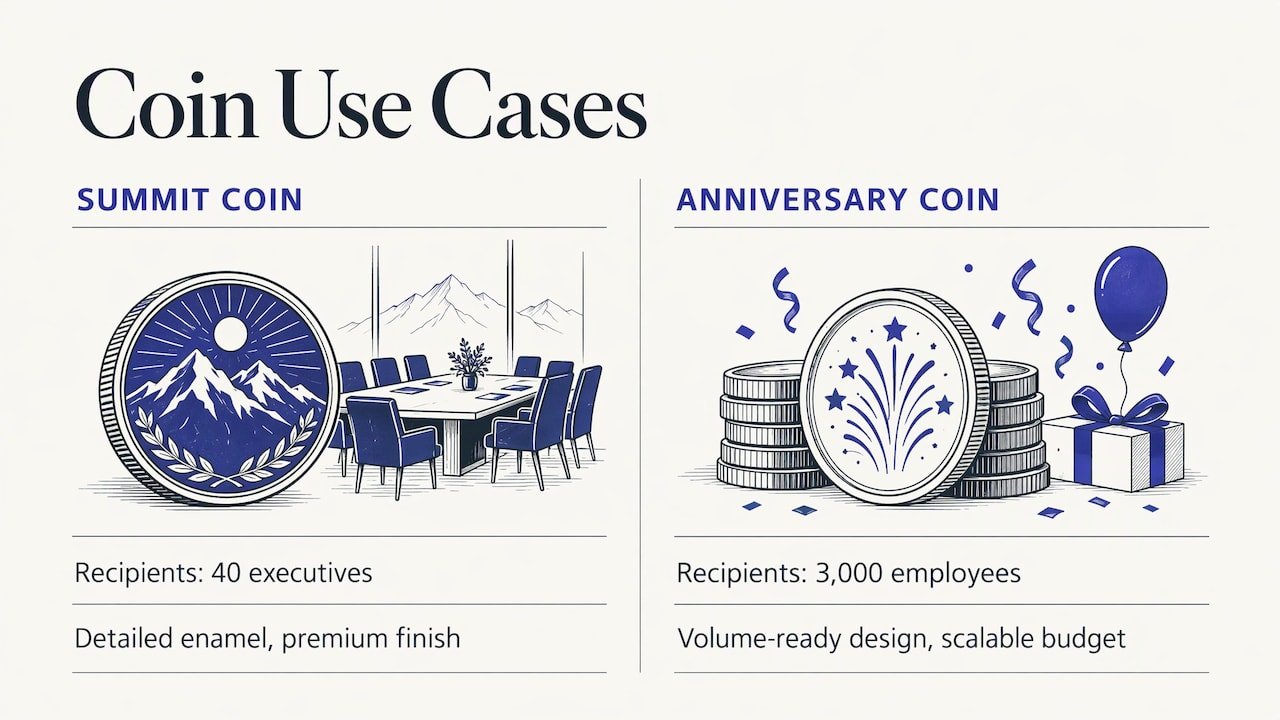
Purpose. A coin for 40 executives at a leadership summit and a coin for 3,000 employees at a company anniversary are different products. The first can carry detailed enamel work and a premium finish. The second needs a design that holds up in volume and a budget that scales.
Audience. Who receives it, and what will they do with it? A coin given to a field technician may live in a pocket or truck. A coin given to a client may sit in a presentation box on a shelf. Pocket coins need durable plating and no sharp edges. Display coins can afford finer detail.
Quantity. Count recipients, then add a buffer for late hires, replacements and spare coins held by managers. Custom coins are priced per piece with unit cost falling as volume rises, so a second small run later usually costs more per coin than a larger first run. Estimate honestly for the full year, not only the first event.
Handout date. Everything else is scheduled backward from this. More on that below.
Specifying the coin: the decisions that matter
Every coin order comes down to the same handful of choices. Put them in your brief so any manufacturer quotes the same thing and you can compare quotes fairly.
Size and thickness
Most challenge coins are sized around the diameter of a standard coin you would hold in your palm, commonly in the range of roughly 1.5 to 2 inches. Larger sizes show more detail but cost more and feel heavy in a pocket. Thickness changes the heft: a thicker coin feels more substantial, which matters for an award.
Shape
Round is the traditional choice and the cheapest to produce. Custom cutout shapes (the outline of your logo, a product silhouette, a state) stand out but add cost and need a clean, simple outline. Thin protruding elements can snag or bend, so keep the shape compact.
Production method: die struck or cast
The two main methods are die struck and cast. Die striking presses the design into metal with steel dies, giving crisp lines and a classic coin feel. Casting pours metal into a mold and suits more complex three-dimensional shapes. For a logo-led corporate coin, die struck is the usual starting point. Ask each manufacturer to state which method the quote assumes.
Finish and plating
The finish is the color of the metal: gold, silver, antique brass, antique silver, copper and others. Antique finishes darken the recessed areas so the raised design reads clearly. Polished finishes look bright and formal. Match the finish to your brand colors: a gold coin beside a navy logo looks very different from a silver one.
Color method
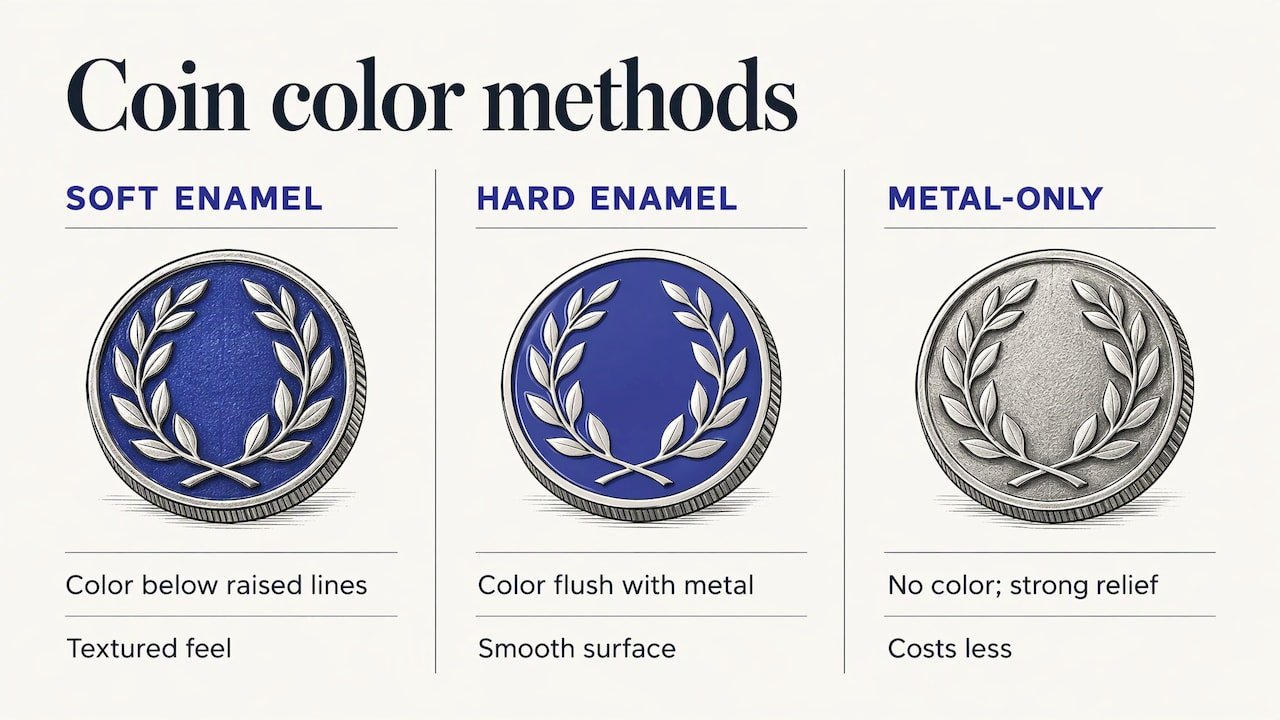
Color fills the recessed areas of the design. Soft enamel leaves the color slightly below the raised metal lines, giving a textured feel. Hard enamel is polished flush with the metal for a smooth surface. Where your brand has an exact color, give the Pantone number and ask for the manufacturer to match it. If you want no color at all, a metal-only coin with strong relief can look premium and costs less.
Edge, back and extras
The edge can be plain, or cut with a pattern. The back can repeat your logo, carry a motto, a year, or be left blank for engraving or serial numbering. Numbered coins add a sense of scarcity for award programs. Extras such as cutouts, a spinning center or glow-in-the-dark color raise the price, so choose one feature that matters and skip the rest.
Designing for your brand, not for a template
A good corporate coin looks like it belongs to your company. Use these rules:
- Send vector artwork. Logos should be supplied as vector files so lines stay sharp when scaled onto metal.
- Simplify. Fine gradients and tiny type do not survive striking. Thin lines under a minimum thickness blur. Ask the manufacturer for its minimum line width and type size.
- Limit the colors. Fewer colors means lower cost and cleaner results. Metal plating counts as a design element on its own.
- Say something on the back. The front is your logo. The back can hold what makes it a coin worth keeping: a values statement, the name of the project, the year.
- Follow your brand guidelines. Colors, clear space and logo versions apply here too. Have brand, legal and the program owner approve before submission, so the proof stage is not a surprise review.
If your program has a theme, such as a milestone, a launch name or a team motto, let it drive the design. A coin that references a real moment is kept; one that only repeats the logo is easy to forget.
Reading a quote: what to compare
Quotes for custom coins look similar at first glance and differ in the details. Compare them line by line.
| Item | What to confirm |
|---|---|
| Unit price at your quantity | Is it the price for your exact size, shape, finish and color count? |
| Setup, mold or die fee | Is it one-time, waived at volume or charged on every reorder? |
| Artwork and proof | Is design support included, and how many revisions are allowed? |
| Production time | Is it counted from proof approval or from order date? |
| Shipping | Is freight included, and to how many addresses? |
| Packaging | Are coins bagged loosely, individually wrapped or boxed? |
| Overrun and shortage | What variance in the final count is allowed? |
Two habits prevent surprises. First, request the quote in writing with the specification you wrote in the brief. Second, ask what is charged if you change the artwork after the proof is approved. Many delays and extra charges begin there.
The calendar: work backward from the handout date
Custom coins are made to order, so the timeline has several stages, and each can slip.
- Brief and quotes: a few days to collect and compare.
- Artwork and digital proof: the stage most prone to delay, because stakeholders change their minds. Name one approver.
- Production: typically a matter of weeks after proof approval, depending on the manufacturer, method and quantity. Confirm the number in writing.
- Shipping: from the manufacturer to you, then from you to recipients.
- Packaging and kitting: often forgotten, yet it needs its own time.
Build in a buffer of at least a week or two before the date coins must be in hand. If you are working to a fixed event, such as a conference keynote or an anniversary dinner, order the coin first and plan the rest of the program around its arrival date.
Presentation turns a coin into recognition
A loose coin in an envelope reads as an afterthought. The same coin in a branded box, with a card explaining why the person is receiving it, reads as an honor. Because coins are small, the packaging does a lot of the work.
Ideas that fit corporate programs:
- A presentation box with a foam or fabric insert so the coin sits face up when opened.
- A recognition kit: the coin together with a notebook, a drinkware piece or a tech accessory, all carrying consistent branding.
- A welcome kit for new hires that includes the coin along with the daily-use items people will carry around.
- A card insert with a short note, and where you want to measure response, a QR code. Our guide to QR codes on swag covers size, placement and tracking.
This is where an everyday-items distributor helps most. We offer fully custom branded boxes and branded kits, so the coin you source arrives in something that matches the rest of the program.
Distribution: the part that goes wrong at scale
Ordering 500 coins is one task. Getting the right coin to the right person in eight offices, before the right meeting, is another. Plan these points early:
- Who receives what. Build a simple list with recipient name, office address and quantity. Names and addresses from HR or sales operations are cleaner than a list assembled at the last minute.
- One shipment or many. Shipping everything to one location and re-shipping adds days and doubles the handling. Shipping directly to each location from the start is faster.
- Reserve stock. Keep a small reserve for late additions and replacements, held somewhere central.
- Tracking. Someone should own the tracking numbers and confirm delivery before the handout date.
- Handout script. Give managers a short note on how to present the coin and what it means, so the moment is consistent from office to office.
Distribution to single or multiple locations is something we do for corporate programs, with operational workflows built for large-scale rollouts. If the coin is one piece of a larger kit, we can ship the finished kits to each location, rather than leaving your team to repack and re-ship.
Where Discount Swag fits
A challenge coin is rarely the only item in a program. The same recognition moment or onboarding usually needs a bag, a bottle, a tech item or a layer of apparel. Our catalog covers bags, apparel, technology, drinkware, office, outdoor and sport, home, and health and beauty items, all customizable with your logo. For presentation, we offer fully custom branded boxes and branded kits.
Timing is a common worry, and we support rush orders for the pieces around your coin. We also guarantee 10% or more savings versus any competitor’s online price, and our products come from trusted suppliers chosen for quality. Your marketing or procurement team can see the full range and start an order at discountswag.store.
If you are building a recognition or welcome kit around a coin, these are natural companions from the catalog:
- Stanley Quencher 30 oz tumbler for a premium drinkware piece
- Bellroy tech kit for a tidy desk and travel accessory
- Windsor Impressions presentation portfolio for documents, a card and a note
- Reclaim wireless charging writing pad for an everyday item with a recycled build
Our perspective
We look at challenge coins the way a buyer of a whole program does. The coin is a small, lasting symbol, and the people who receive it judge the company by how the moment is handled: how the coin is presented, whether it arrives on time and whether everyone in every office gets the same experience.
That is why we think of coins as one part of a kit, not a standalone purchase. A coin in a plain bag is a trinket. The same coin in a custom branded box, next to a quality bag or tumbler from a supplier you trust, is recognition. Our job is the rest of the program: curated products, branded kits, rush orders when a date moves, and fulfillment to one location or many.
Our advice to marketing and procurement teams is simple. Fix the date, name one approver for artwork, build the recipient list early and decide how the coins will be packed and shipped before they are made. Do that, and the order runs without stress.
Jerry
Common mistakes to avoid
- Starting design before the brief. Without a purpose, size and quantity, the design gets reworked.
- Too many approvers. Each extra opinion adds a revision. Name one decision maker.
- Over-detailed artwork. Tiny text and fine lines turn muddy in metal.
- Ignoring packaging. The unboxing is part of the gift.
- Late distribution planning. Finished coins in one office, recipients in six, and a date in a week is a preventable problem.
- Ordering too few. A small reorder later usually costs more per coin and may not match the first batch exactly.
For a related program, see our guide to campus recruiting swag, which shows how to choose items by audience and budget in the same way.
FAQ
How many custom challenge coins should a company order?
Count every planned recipient, then add a reserve for late hires, replacements and spare coins held by managers. Unit price falls as quantity rises, so ordering for a full year is usually more economical than reordering in small batches. Confirm the allowed overrun or shortage on the final count with the manufacturer.
How long does it take to get custom challenge coins?
Custom coins are made to order, so allow for artwork, proof approval, production and shipping. Production usually takes weeks after the proof is approved, and the exact time depends on the manufacturer and the quantity. Ask for the schedule in writing, and add a buffer before your handout date.
What is the difference between soft and hard enamel?
Soft enamel leaves the color slightly recessed below the raised metal lines, so the coin has a textured feel. Hard enamel is polished smooth and level with the metal. Both can match a brand color when you supply a Pantone number, so choose by the look and feel you want.
How should we present coins to employees or clients?
Present them in a branded box or kit with a short note about why the person is receiving it. Pair the coin with a useful item such as drinkware, a bag or a tech accessory so the gift is used every day. Our branded kits and fully custom branded boxes are made for this.
Can coins be shipped to several offices?
Yes, if you plan it before the order. Prepare a recipient list with addresses and quantities, decide whether kits will ship directly to each location, and assign someone to confirm delivery before the event. We fulfill to single or multiple locations for corporate programs.
 Bottle Carriers
 Mugs