

Campus Recruiting Swag: What to Hand Out in 2026

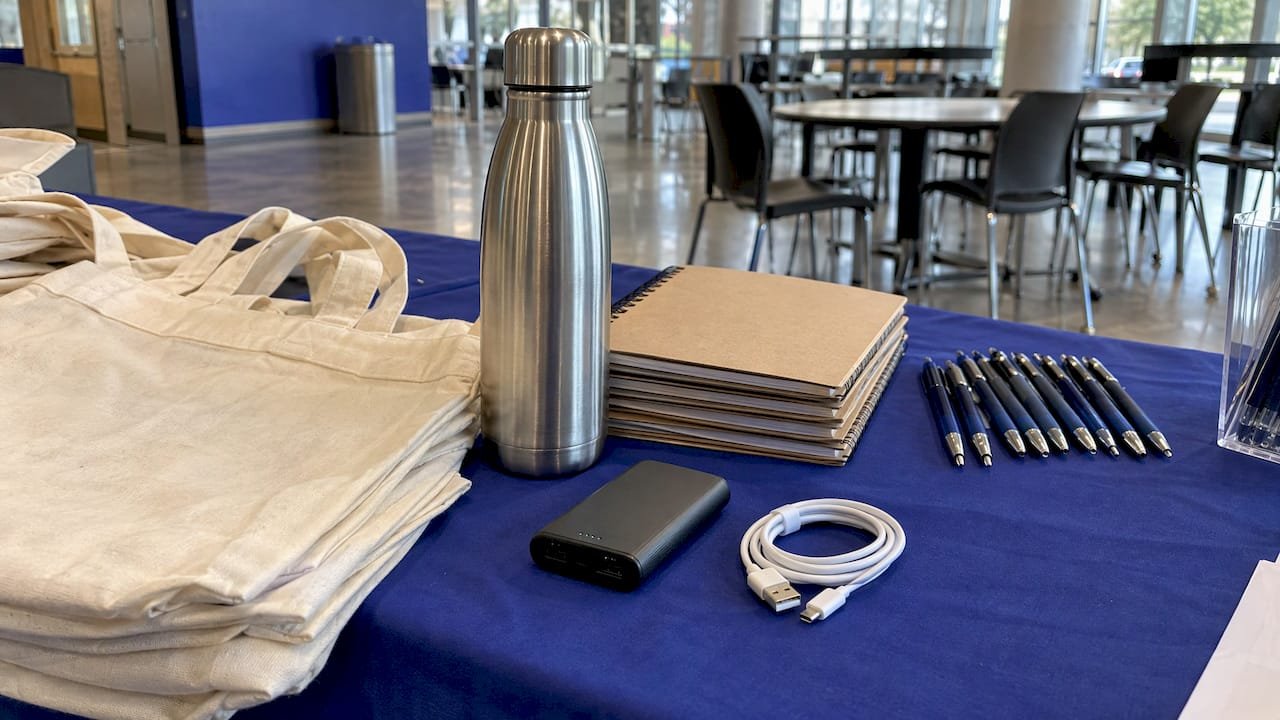
The best campus recruiting swag is something a student will use every week for a semester or more: a power bank, a sturdy water bottle, a tote, a good notebook. Choose it by the daily routine of a student, brand it simply, and use it to open conversations at your booth instead of letting it sit in a bowl. This guide covers what to pick, how to fit it to your event and budget, and how to hand it out so it helps your recruiters.
TL;DR
- Pick items students use daily: tech accessories, drinkware, bags and quality stationery beat novelty items.
- Durable, reusable swag cuts event waste, and students and campus career centers notice it.
- Match the item to the event: a career fair, an info session and an on-campus interview each call for a different piece.
- Hand swag out as part of the conversation, for example after a question or a résumé review, not from a pile at the table edge.
- Order early, plan shipping to every campus, and keep a rush option ready for late-added events.
Table of Contents
- What students actually keep using
- Campus recruiting swag ideas by category
- How to choose swag that fits your audience, event, brand and budget
- Make it sustainable so it does not end up in the trash
- Use swag to start conversations
- Perspective
- Order and logistics for multi-campus programs
- Promo: build your campus program with Discount Swag
- FAQ
- Sources
What students actually keep using
Start from the student’s bag, not from your brand guide. A Town & Country Magazine survey from August 2024 found that pens, notebooks, planners and highlighters ranked as the school supplies students said matter most, with 100% of surveyed students naming pens and 81% naming notebooks. The same piece lists AirPods and reusable water bottles among the items students commonly carry.
That tells you where the shelf space is. Students carry writing tools, something to hold water, something to charge a phone, and a bag to hold it all. If your item fits one of those slots, it earns a place in their routine, and your logo goes with it into lecture halls, libraries and, later, the first office.
SAGE’s 2026 back-to-college guide points the same way. It names power banks, charging cables, multi-chargers, Bluetooth trackers, webcam covers, tech organizers and tote bags as leading categories for student promotions, and it describes power banks as combining high perceived value, daily exposure and a good branding area.
Campus recruiting swag ideas by category
The ideas below are grouped by the way students use them. Each group lines up with a product category we carry, so a single program can mix several.
Tech that earns daily use
- Power banks. The most-cited student-friendly item. A slim one fits a pocket and gets used between classes.
- Charging cables and multi-chargers. Useful in a library, where outlets are scarce. Cables are small, light and easy to ship to a campus.
- Webcam covers and tech organizers. Low cost per unit and well suited to students doing virtual interviews.
- Bluetooth trackers. A strong fit for keys, laptop bags and ID wallets.
- Phone stands and wireless chargers. Good for dorm desks, and they keep your logo in view during study sessions.
Drinkware
Reusable bottles and tumblers sit at the top of most lists because they replace a daily purchase. Choose insulated stainless steel over thin plastic. Pick a size that fits a standard backpack pocket and a dorm cup holder. A matte finish with a small one-color logo looks more like something a student would choose themselves.
Bags
A canvas or recycled-fabric tote does double duty at a career fair: students use it to carry the materials they collect at every booth. If your tote is the sturdy one, it becomes the bag they keep using. Drawstring packs and small zip pouches for cables also work well.
Apparel and wearables
Apparel works when it looks like something a student would wear without your name on it. Think quarter-zips, soft tees, beanies and caps with a subtle mark. Sizing is the hard part at an event, so plan unisex fits and a spread of sizes, or use a caps-and-beanies approach where sizing does not matter.
Office and professional tools
These tools suit a student getting ready for interviews: a padded notebook or journal, a quality pen, a portfolio for résumés, a laptop sleeve. They connect your brand to the moment a student is taking the next career step.
Outdoor, wellness and home items
For events on a campus quad or during orientation week, consider picnic blankets, sunglasses, sunscreen sticks, lip balm, first-aid pouches or small dorm organizers. They show up at the moments students are relaxing, which makes the association with your brand a friendly one.
Fun extras
Stickers, enamel pins, phone grips and laptop decals cost little and give students something to personalize. Use them as add-ons beside a core item, not as the main offering.
How to choose swag that fits your audience, event, brand and budget
A short checklist keeps the decision from becoming a debate about taste.
1. Audience

Who are you trying to meet? Engineering majors often appreciate tech accessories. Business and communications students often respond to portfolios, notebooks and polished apparel. First-year students attending an orientation event want dorm and campus-life items, while seniors are focused on interviews. If your hiring spans several majors, pick one universal core item and one or two niche extras.
2. Event
| Event | Best-fit swag | Why it fits |
|---|---|---|
| Large career fair | Compact item: pen, cable, sticker, lip balm | Students visit dozens of booths and carry little |
| Info session | Notebook, tote, bottle | Students sit for an hour and take notes |
| Workshop or résumé review | Portfolio, premium pen, tech organizer | Matches the career-readiness theme |
| Interview day | Branded kit with a notebook, pen and bottle | Makes a good last impression on finalists |
| Offer or welcome stage | Full branded kit | Builds excitement before a start date |
3. Brand
Pick a color, a logo size and a tone that feel like your company. A recruiter should be able to say why this item represents the company. If your culture is outdoorsy, lean toward bottles and packs. If it is analytical, lean toward notebooks and tech.
4. Budget
Split your spend into tiers rather than giving everyone the same item. A common approach is a low-cost item for the many students who stop by, a mid-tier item for those who join a conversation or a sign-up, and a premium kit for finalists and offer-stage candidates. This focuses your spend on the people who matter most. Remember to count more than the unit price: decoration setup, shipping to each campus, and a buffer for late events all affect the total.

Make it sustainable so it does not end up in the trash
Campus career centers pay attention to waste. MIT’s career center tells employers that swag is useful for building a brand beyond the career fair, and that the best items are useful or unique. It also encourages more durable items over disposable ones to reduce the waste an event creates.
Indiana University’s Office of Sustainability goes further with a Sustainable Swag Guide. It ranks options from giving nothing, to an experience or consumable, to functional, long-lasting, ethical, eco-friendly or local swag, with low-quality or wasteful swag last. It asks you to weigh necessity, added value, reusability, waste reduction and ethical practices, and to minimize packaging and consider recycled, organic or sustainable materials.
In practice, that points to a few simple rules:
- Pick one durable item over three small throwaways.
- Skip individual plastic wrapping where you can.
- Choose recycled or organic materials for totes and apparel when the option exists.
- Keep leftover inventory for the next event instead of discarding it, which is easier when the design avoids a year or a specific event date.
- Ask suppliers about the materials in the products you shortlist.
The UK’s Institute of Student Employers has reported on this too. A 2025 employer roundtable found 57% of employers still offer merchandise at campus events, many with a sharper focus on usefulness, and one participant put the principle as useful over gimmicky, thoughtful over throwaway. A 2023 ISE report on a survey of almost 2,400 students and graduates found nine in ten believe employers should act on environmental sustainability. Both studies are from the UK, but the direction of travel is clear for any campus program: quality and purpose matter.
Use swag to start conversations
Swag works best when a recruiter hands it over as part of a real exchange. A few habits help:
- Give it after a question. Ask what a student is studying or what they hope to do, then offer the item. The gift becomes a thank-you for talking.
- Tie the item to the pitch. A notebook goes with a note about interview prep. A power bank goes with a line about your hybrid work culture. A recruiter can then explain why the item is on the table.
- Add a clear next step. Place a small card or QR code in the tote or on the packaging that links to your careers page or event sign-up.
- Tier the handout. Keep a core item for everyone and a better item for students who sign up, book an interview or attend a workshop.
- Train the booth team. Give recruiters a short script and a plan for how many items go out per hour, so supplies last the whole event.
When the best swag is not a product
The ISE roundtable also reported that some employers now replace freebies with prize draws, access to resources, or experiences such as masterclasses, CV workshops and live project briefs. These can sit alongside a physical item. A student who joins a résumé clinic and leaves with a branded portfolio gets both value and a keepsake. Your online presence matters here as well: students will look you up after meeting you, so a digital footprint guide for businesses is a helpful reference for making sure what they find matches the booth experience.
Perspective
We handle promotional programs for marketing and procurement teams, and campus recruiting is one of the most coordinated ones. The same event can involve a booth at one university, shipments to three other campuses, and a recruiter who adds a fair two weeks before it happens.
Our view is simple: choose fewer, better items and make them easy to deliver. A single well-chosen piece of drinkware, a tech accessory or a tote carries your brand further than a table of small items, and a branded kit makes finalists feel considered.
That is why we focus on curated products from trusted suppliers, distribution to a single location or many, rush ordering for the events that appear late, and operational workflows for large programs. We also guarantee 10% or more savings versus any competitor’s online price, so a recruiting budget can go toward quality instead of volume.
Jerry
Order and logistics for multi-campus programs
The swag decision is half the work. The other half is getting boxes to the right place on time.
- Build a calendar. List every fair, info session and interview day for the semester, with the ship-to address and contact for each.
- Work backward. Allow time for artwork approval, production and transit, and add a cushion for campus mailroom delays.
- Split shipments. Send quantities to each campus or recruiter instead of routing everything through one office.
- Keep a reserve. Hold a small inventory at headquarters for added events.
- Standardize the look. Use the same logo placement and colors across items so different pieces look like one program.
- Consider kits. Bundling a notebook, pen and bottle in a branded box makes interview and offer stage gifts easier to prepare and ship.
Promo: build your campus program with Discount Swag
If you buy promotional products in bulk for recruiting, we can handle the full program: apparel, drinkware, bags, technology, office items, outdoor and sport products and more, customized with your logo. We offer fully custom branded boxes for interview and offer kits, distribution to single or multiple locations, and rush orders for events that come up late.
Browse the catalog and start your order at Discount Swag.
FAQ
What is the best campus recruiting swag?
The best choice is a useful item students will keep using, such as a power bank, an insulated water bottle, a tote or a quality notebook. Pick something that matches the event and the majors you want to reach. Keep the branding simple so students are comfortable using it in public.
How much swag should I bring to a career fair?
Plan from your expected booth traffic and the length of the event, then add a reserve. Use tiers so a low-cost item goes to most visitors and a better item goes to students who have a real conversation or sign up. Keeping leftover stock for the next event avoids waste.
How can I make campus swag more sustainable?
Choose durable, reusable items, reduce packaging, and look for recycled, organic or ethically produced materials. Indiana University’s Sustainable Swag Guide and MIT’s employer advice both favor lasting items over disposable ones. A single useful item is usually better than several small ones.
When should I order swag for a recruiting season?
Order as soon as your event calendar is set, because production, artwork approval and shipping to several campuses all take time. Late additions happen often, so keep a rush option and a small reserve ready. Check lead times with your supplier for the current schedule.
What can I give students besides physical products?
Consider prize draws, résumé reviews, workshops, masterclasses or live project briefs, as some employers in the ISE roundtable now do. Many teams pair one of these with a durable item, so the student leaves with both a skill and a keepsake.
Sources
- College Essentials: Everything You Need According to Students, Town & Country Magazine
- Top Back-to-College Promotional Products for 2026, SAGE
- Career Fair Advice for Employers, MIT Career Advising & Professional Development
- Sustainable Swag Guide, Indiana University Office of Sustainability
- Campus engagement: what’s working and what’s not, ISE
- Students reject corporate swag, ISE
- Digital footprint guide for businesses
 Bottle Carriers
 Mugs