
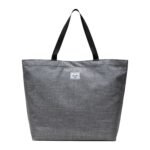

Conference Swag Bag Essentials That Attendees Keep


The seven items worth your budget are a high-quality reusable bag, a notebook and pen, one useful tech item, reusable drinkware, a hygiene item, a snack or small gift card, and a lanyard or badge holder. Everything else is optional flair. Skip the stress spiral of trying to fill a bag with 15 items and instead lock in these essentials, then decide your per-attendee budget and place your order at least four to six weeks out.
Here’s the full essentials list to start planning against today:
- Reusable bag — the container that carries (and advertises) everything else
- Notebook and pen — still the highest-use item at any conference, digital agenda or not
- One useful tech item — a portable charger, charging cable, or phone stand
- Reusable drinkware — a water bottle or insulated tumbler
- Hygiene item — hand sanitizer or lip balm, especially for winter or travel-heavy events
- Snack or small gift card — a low-cost trust builder attendees notice immediately
- Lanyard or badge holder — functional, branded, and worn all day long
Key Takeaways
The most effective conference swag bag pairs one high-quality bag with a handful of genuinely useful items, matched to a clear budget tier and ordered with enough lead time to catch mistakes before the event.
| Point | Details |
|---|---|
| Prioritize seven essentials | Bag, notebook and pen, one tech item, drinkware, hygiene item, snack or gift card, and lanyard. |
| Match budget to attendee type | Economy runs $3 to $6, mid runs $10 to $25, premium runs $30 and up per bag. |
| Order lead time matters most | Apparel needs three to four weeks; tech items often need three to five weeks before rush fees apply. |
| Build in a damage buffer | Reserve 2 to 5 percent of your item budget for broken, mislabeled, or missing pieces. |
| Use curated kits to save time | Discount Swag’s custom swag boxes bundle essentials by budget tier with rush ordering and fulfillment built in. |
Table of Contents
- What Are the Real Conference Swag Bag Essentials?
- How Many Items and What Should You Budget?
- Choosing the Bag and Presenting Contents Attendees Keep
- How Do You Choose Swag That Fits Your Audience?
- Making Swag Bags Sustainable and Accessible
- Lead Times, Samples, and Fulfillment That Won’t Blow Your Deadline
- Three Sample Swag Bundles by Audience
- Lessons From Packing Thousands of Conference Bags
- How Discount Swag Simplifies Your Swag Bag Planning
- Frequently Asked Questions
- Sources
What Are the Real Conference Swag Bag Essentials?
Every item on that list earns its spot for one reason: attendees actually use it after the event ends. That’s the filter that matters more than novelty or cost. Research on swag retention backs this up directly. Skift’s roundup of swag bags people won’t throw away found that curated, higher-quality sets consistently beat long lists of cheap filler, and GoGather’s swag bag guide makes the same point about quality reusable bags, notebooks, and small practical items outperforming novelty giveaways.
That’s the standard industry term for this whole category, by the way: conference giveaway items or promotional bag contents. “Swag” is the shorthand everyone uses, but when you’re briefing a vendor or writing a purchase order, you’ll see both terms used interchangeably.
Why the bag itself is a decision, not an afterthought
A flimsy plastic bag signals cheap before an attendee even looks inside. A well-made tote, backpack, or drawstring bag becomes free advertising on the walk back to the hotel, on the flight home, and at the grocery store six months later. This is the single highest-leverage decision in your whole swag plan, and it belongs at the top of your checklist, not the bottom.
Notebook and pen: still not obsolete
Despite a decade of predictions that paper note-taking would disappear, notebooks remain one of the most-used swag items at any conference. Pair a slim, quality notebook with a pen that actually writes smoothly (test one before you order 500), and you’ve covered a habit that never went away.

Useful tech: pick one, pick it well
A portable charger, a braided charging cable, or a simple phone stand solves a real problem: dead batteries by 3 p.m. on day two. Anker’s guide to conference giveaways that work makes the case that perceived value, not raw unit cost, drives whether attendees keep tech items. A charger with a premium finish and useful capacity gets carried home. A generic one gets left in the hotel room.
Reusable drinkware attendees actually grab
Insulated tumblers and branded water bottles show up on nearly every “best swag” list for a reason: attendees use them at the event and long after. Look for a spill-resistant lid and a size that fits standard cup holders, since that’s the detail that decides whether it becomes a desk staple or a donation pile candidate.

Hygiene items for the realities of travel
Hand sanitizer and lip balm cost almost nothing per unit and solve a problem every attendee has, especially at winter conferences or in dry convention center air. These are cheap trust builders. Nobody remembers a conference for its hand sanitizer, but they’ll use it three times a day without thinking twice.
Small gift cards and snacks build goodwill fast
A $5 coffee gift card or a branded snack solves an immediate need (long registration lines, early morning sessions, no breakfast) and creates goodwill disproportionate to its cost. A psychological study on gift giving found that small gifts tend to increase positive attitudes toward the giver in controlled settings, which lines up with what event planners see anecdotally: a thoughtful $3 item often outperforms a forgettable $15 one.
Wearables, where they fit
A lightweight T-shirt, cap, or branded quarter-zip works well for multi-day conferences, company retreats, or events where attendees expect apparel. Skip it for short, one-day industry events where a shirt feels like overkill; nobody wants a T-shirt they’ll never wear for a two-hour breakfast seminar.
Lanyards and small accessories
Lanyards and badge holders are functional necessities that double as branding real estate worn all day. A cable organizer or small pouch rounds out the bag without adding real cost, and it keeps loose items from rattling around and getting lost before attendees even reach their hotel room.
Pro Tip: A $2 upgrade on your charger or tumbler (matte finish, better lid, slightly higher capacity) often moves an item from “left behind” to “carried home and used for a year.” Perceived value beats unit cost almost every time attendees decide what to keep.
How Many Items and What Should You Budget?
The right count depends on attendee type, not personal preference. General attendees do well with a compact set of 3 to 5 items. VIPs and speakers warrant a fuller kit of 6 to 10 items, since the goal shifts from “useful” to “memorable.”
Three budget tiers cover most events:
- Economy tier ($3 to $6 per bag): notebook, pen, hand sanitizer, lanyard, and a basic tote.
- Mid tier ($10 to $25 per bag): everything in economy plus a branded tumbler or charging cable and a small gift card.
- Premium tier ($30 and up per bag): a premium tech item (power bank or wireless charger), a quality apparel piece, upgraded drinkware, and a curated presentation.
Here’s a quick calculation to make this concrete. Say you’re ordering for hundreds of attendees at the mid tier with a moderate per-bag cost. Add customization and shipping costs based on your event specifics. Overall, mid-tier orders for large groups generally range in the low to mid five figures once all factors are included.
- Match the tier to the attendee, not the whole event uniformly (VIPs get premium, general registration gets economy or mid).
- Round up your item count estimate by 5 to 10 percent to cover damaged, defective, or extra on-site registrations.
- Lock your budget tier before you start browsing catalogs, or scope creep will eat your margin fast.
Choosing the Bag and Presenting Contents Attendees Keep
The container shapes how attendees experience everything inside it, and the three most common formats each serve a different event profile. A reusable tote works for single-day, local events where attendees aren’t flying home with luggage constraints. A drawstring bag fits multi-day conferences where attendees need something compressible for a suitcase. A backpack makes sense for tech and business conferences where attendees appreciate a genuinely useful piece of gear, not just a giveaway.
Presentation matters almost as much as content. A well-organized bag reads as a gift; a jumbled one reads as clutter.
- Group items by category (tech together, hygiene together) rather than tossing everything in loose.
- Use a tissue insert or thin divider so the first thing attendees see is your standout item, not a tangle of cables.
- Add a printed insert with a QR code linking to your event app, discount page, or thank-you message.
- Label VIP bags distinctly (a different ribbon color or tag) so distribution staff don’t mix them up with general registration.
- Seal any food items individually and note allergen information, since tamper-evident packaging matters for anything edible.
Pro Tip: Unboxing psychology is real even at scale: attendees form an impression in the first three seconds of opening a bag. Put your single best item on top, visible immediately, instead of burying it under the notebook and lanyard.
How Do You Choose Swag That Fits Your Audience?
Run through this checklist before you finalize an order, not after:
- Attendee demographics — age range, industry, and seniority shift what feels useful versus juvenile.
- Session length and format — a half-day event needs less than a three-day summit.
- Travel profile — are attendees flying in, or driving from nearby? Airline carry-on limits rule out bulky items.
- Security and airline considerations — liquids over 3.4 ounces, sharp objects, and lithium battery items need TSA-compliant packaging if attendees fly home.
- Brand fit — does the item visually and functionally match your company’s identity, or does it feel like a mismatch?
- Sustainability goals — does this item align with any public commitments your organization has made?
- Usable-size constraints — apparel sizing, bag dimensions, and drinkware capacity all affect whether an item gets used.
Before you sign off with a vendor, ask these questions directly:
- What’s your standard lead time for this quantity, and what’s the rush-order surcharge?
- What’s your minimum order quantity per item?
- Can I get a physical sample before committing to the full order?
- What customization methods do you support (screen print, embroidery, laser engrave), and do costs vary by method?
- Do you handle fulfillment and drop-shipping to multiple locations, or is delivery a single drop?
- What’s your proof approval process, and how many rounds are included before extra fees apply?
Watch for red flags: vendors who won’t quote a firm lead time, who bury setup fees until the final invoice, who refuse to send a sample, or who make vague material certification claims without documentation to back them up.
Making Swag Bags Sustainable and Accessible
Sustainability and accessibility aren’t separate checkboxes bolted onto the end of a swag order. They’re design decisions that affect whether items get used at all.
On the sustainability side, look for recycled-content fabrics in totes and apparel, FSC-certified paper for notebooks and inserts, and refillable containers instead of single-use hygiene packets where the budget allows. Swap edible swag for a single higher-quality item when possible, since perishables generate more waste than almost anything else in a typical bag. Ask vendors directly for recycled content certification documentation rather than taking a marketing claim at face value; legitimate suppliers can produce it without hesitation.
On accessibility, a few small choices broaden who actually benefits from your swag:
- Use readable type sizes (at least 10 point) on any printed inserts or instructions.
- Choose drinkware with non-slip grip texture, which helps attendees with limited hand strength or dexterity.
- Offer apparel in an inclusive size range rather than defaulting to standard S through XL only.
- Provide a digital alternative, like a discount code or app download link, for attendees who’d rather skip physical items entirely.
Lead Times, Samples, and Fulfillment That Won’t Blow Your Deadline
Customized apparel typically needs three to four weeks for standard production; printed drinkware runs two to three weeks; tech items with imprint or laser engraving often need three to five weeks depending on complexity. Rush fees generally apply inside those windows, and they can add 15 to 30 percent to your total order cost, so building in buffer time upfront pays for itself.
Before placing a bulk order, work through this checklist:
- Request a digital mockup and confirm exact imprint placement before final approval.
- Order physical samples early enough to catch color or sizing issues while there’s still time to adjust.
- Verify packaging dimensions against your shipping method and expo booth setup space.
- Confirm whether your vendor supports staged deliveries if you’re distributing to multiple locations or event dates.
For fulfillment strategy, a single drop to the venue works fine for one-location events with straightforward logistics. Distributed shipping makes more sense for multi-city roadshows or hybrid events where remote attendees need kits mailed directly to their homes. A partner fulfillment service that handles both scenarios saves you from coordinating separate shipping accounts and tracking numbers manually.
Three Sample Swag Bundles by Audience
Different attendees need different kits. Here’s how three common audience types break down, with realistic per-bag cost ranges as planning estimates rather than fixed quotes.
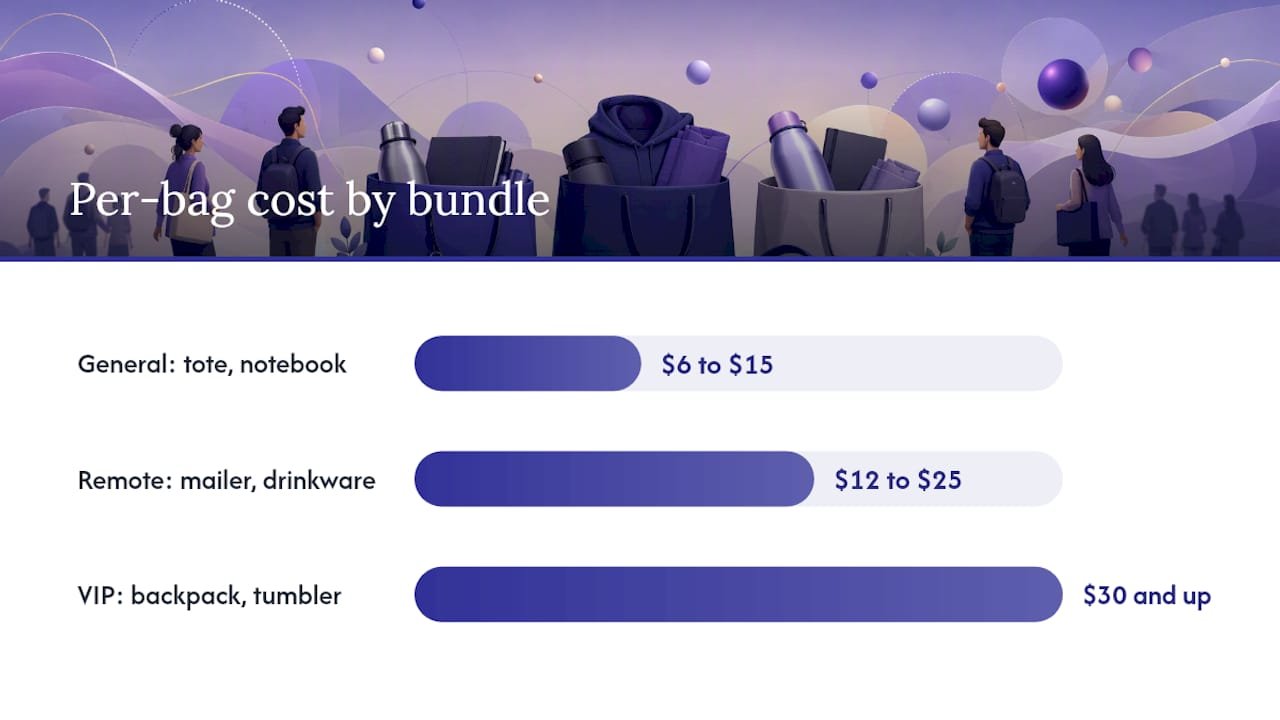
| Bundle | Contents | Per-Bag Cost Range |
|---|---|---|
| General attendee | Tote bag, notebook and pen, hand sanitizer, lanyard, small snack | $6 to $15 |
| VIP or speaker | Backpack, premium charging cable or power bank, insulated tumbler, branded apparel, gift card | $30 and up |
| Remote or hybrid attendee | Mailer box, drinkware, notebook, digital discount code insert, small snack | $12 to $25 |
The general attendee bundle covers the baseline every registration should receive, no exceptions. The VIP bundle earns its higher cost through better materials and one memorable item, not just more items. The remote bundle swaps volume for a mailer-friendly footprint and leans on a digital component, since a QR code insert linking to an app download or discount code fills the gap left by items you can’t easily ship.
To move any bundle up a tier, upgrade one item rather than adding three cheap ones. Swapping a basic tumbler for an insulated one, or a plain charging cable for a compact power bank, shifts perception more than padding the bag with extra low-value pieces. Variable-data printing lets you personalize name or title on badge holders and notebooks at volume, which adds a VIP feel without a VIP price tag.
Lessons From Packing Thousands of Conference Bags
. After years of watching orders come together and fall apart at the last minute, one pattern shows up again and again: planners underestimate how much can go wrong between “order placed” and “bags stuffed on-site.” Wrong sizes arrive. A batch of printed cables shows up with a smudged logo. A shipment gets delayed two days past the event.
The single most useful habit I’ve seen separate smooth events from chaotic ones is simple. Reserve an extra 2 to 5 percent of your total item budget specifically for broken, mislabeled, or missing pieces. It feels like padding when you’re building the budget, and it feels like a lifesaver the morning you’re short 12 tumblers with registration opening in an hour.
How Discount Swag Simplifies Your Swag Bag Planning
Discount Swag turns everything above into a single order instead of a dozen separate vendor conversations. Rather than sourcing a bag from one supplier, drinkware from another, and tech items from a third, you get curated kits built around the exact tiers this article covers, economy through premium, with bulk pricing that scales as your attendee count grows.
Rush ordering and multi-location fulfillment mean you’re not stuck if your event lands in six weeks instead of six months, and you’re not manually coordinating separate shipments if attendees are split across venues or shipping to home offices for a hybrid event. Discount Swag’s guide to promotional items for brand awareness walks through how item selection ties directly to long-term visibility, which matters more than most planners realize once the conference badge comes off.
If you’re ready to move from planning to ordering, start by requesting a sample pack and confirming lead times against your event date. That single step catches sizing, color, and quality issues before you commit to 500 units.
Frequently Asked Questions
What are the true conference swag bag essentials?
A high-quality reusable bag, a notebook and pen, one useful tech item, reusable drinkware, a hygiene item, a snack or small gift card, and a lanyard or badge holder cover the core essentials most attendees actually use.
How much should I budget per swag bag?
Economy bags run $3 to $6 per attendee, mid-tier bags run $10 to $25, and premium VIP bags run $30 and up, depending on item quality and customization.
How many items should go in a conference swag bag?
General attendees do well with 3 to 5 compact essentials, while VIPs and speakers warrant fuller kits of 6 to 10 items.
How far in advance should I order conference swag?
Plan on three to four weeks for customized apparel and three to five weeks for tech items with imprint or engraving, plus buffer time for sample approval and potential reorders.
What swag items should I avoid?
Skip low-value novelty items, anything oversized for travel, and edible items without proper sealing and allergen labeling, since these are the most common categories attendees discard immediately.
Sources
- Conference Giveaways That Work: Ideas & Tips for 2026 – Anker US
- 30 Ideas for Swag Bags That Won’t Get Thrown Out
- Frontiersin
- 10 Conference Swag Bag Ideas for 2026 | GoGather
 Bottle Carriers
 Mugs
Mugs