

CPSIA Compliant Promotional Products: A Buyer’s Guide


Most promotional products are not covered by the CPSIA’s children’s product rules. The ones that are include anything designed or intended primarily for children 12 and younger. That includes a general-use item that your decoration turns into a kids’ item. For those products, federal law requires testing by a CPSC-accepted lab and a Children’s Product Certificate. Adults-only swag such as polos, tumblers and tote bags usually needs a different certificate or none at all. This guide shows you how to tell which case you’re in and what to ask your supplier before you order.
TL;DR
- The CPSIA’s strictest rules apply to children’s products, meaning items designed or intended primarily for kids 12 and under.
- Children’s products need third-party testing at a CPSC-accepted lab, a Children’s Product Certificate (CPC) and permanent tracking information.
- Your decoration can change an item’s category. A logo with cartoon characters on a basic item can make it a children’s product.
- Never rely on the blank item’s paperwork alone. Ask for documentation on the finished, decorated item.
- Sort every item into a category before you approve artwork, not after the order ships.
Table of Contents
- What the CPSIA is and why marketers should care
- Which promotional products count as children’s products
- How decoration can turn a general item into a children’s product
- Testing: what a CPSC-accepted lab does
- CPC or GCC: choosing the right certificate
- Tracking labels, and what they do not require
- Who is responsible when a distributor decorates the item
- The eFiling change for imports
- A note on batteries
- Our perspective
- A pre-order checklist for marketing teams
- Why recall readiness belongs in your plan
- Ordering with Discount Swag
- FAQ
- Sources
What the CPSIA is and why marketers should care
The Consumer Product Safety Improvement Act (CPSIA) amended the Consumer Product Safety Act in 2008. It gave the Consumer Product Safety Commission (CPSC) new regulatory and enforcement tools. In everyday talk, “CPSIA compliant” means a product meets the children’s product rules the law created or strengthened.
People often confuse the two names. The CPSC is the agency. The CPSIA is the law that gave it more power over children’s products. So “CPSC certification” and “CPSIA compliance” overlap, but they are not the same thing.
The CPSC also has guidance written for suppliers and distributors of promotional products. It says those businesses must understand and follow federal product safety laws, especially when they decorate products in a way that makes them appeal to children.
If you’re a marketing manager or buyer, you are rarely the legal manufacturer or importer. But you pick the product, approve the artwork and set the audience. Those choices decide which rules apply, so the work starts with you.
Which promotional products count as children’s products
The CPSC defines a children’s product as any consumer product designed or intended primarily for children 12 years of age or younger. It looks at several factors:
- What the manufacturer says about the intended use
- How the product is packaged and advertised
- Whether consumers commonly see it as appropriate for kids
- The agency’s Age Determination Guidelines, last updated in January 2020
That means the label on the box is not the whole answer. Intent and appearance both count.
Items that usually land in the children’s category
- Toys, figurines, games and plush items
- Youth-sized apparel, especially with playful designs
- Kids’ backpacks, lunch bags and water bottles marketed to children
- Craft kits, coloring sets and school supplies aimed at young children
- Novelty items meant to amuse kids at a school or family event
Items that are usually general-use
- Adult-sized apparel, polos, quarter-zips and caps
- Insulated tumblers, travel mugs and desk accessories
- Tote bags, laptop sleeves and backpacks in adult styling
- Power banks, cables and other tech accessories
- Notebooks, pens and office items
General-use does not mean unregulated. Other federal and state rules can apply, such as flammability standards for some apparel, battery rules, or California’s Prop 65 warnings. These sit outside the CPSIA’s children’s rules, but they still affect your order. For the California side, see our guide on shifting Prop 65 liability to suppliers.
How decoration can turn a general item into a children’s product
This is the most common pitfall. The CPSC’s promotional products guidance warns that adding decoration that appeals to children under 12 can convert a general-use product into a children’s product. Once that happens, the whole compliance burden moves to whoever directs that final decoration.
Here are three realistic scenarios.
- A plain adult tote with a corporate logo. General use. No kids’ appeal. Normal checks apply.
- The same tote with a cartoon mascot, bright colors and a “Family Fun Day” theme. Now the item looks aimed at children. Treat it as a possible children’s product and get a ruling from your supplier or compliance advisor before you print.
- A branded stuffed animal for a pediatric clinic’s open house. This is clearly a children’s product. It needs the full testing and certificate package.
The lesson for marketers is to treat creative choices as compliance choices. Theme, color palette, character art and the event audience all feed into the age determination.
Testing: what a CPSC-accepted lab does
Federal law requires that every children’s product be tested by a third-party, CPSC-accepted laboratory for the applicable children’s product safety requirements. The tests depend on the product. They can include:
- Lead content or lead in surface coatings
- Phthalate content in certain plasticized components
- Flammability for wearing apparel
- Toy safety standards for toys
- Small parts rules for items intended for children under 3
The CPSC says there are over 600 accepted laboratories worldwide. Testing is required for the first production batch. After that, periodic retesting is generally required, at least annually, or within three years if specific controls are in place. Confirm the cadence with your supplier’s compliance contact.
A few practical points follow from that:
- Testing a sample is not enough. The test must cover the product as it will be sold, with its inks, coatings and materials.
- Changing a material or a decoration process can require retesting. If you switch from screen printing to a different ink or substrate, ask whether the old report still applies.
- The lab must be on the CPSC’s accepted list. A test from a non-accepted lab does not satisfy the requirement. The CPSC publishes answers about accepted and firewalled laboratories.
The CPSC does not approve products before they’re sold. Its Regulated Products Handbook states that the agency has no premarket authority to approve a product. Manufacturers and importers must make sure their products meet the mandatory standards. So there is no “CPSC approved” badge to look for, and a supplier who claims one deserves a follow-up question.
CPC or GCC: choosing the right certificate
Two certificates matter here. A Children’s Product Certificate (CPC) covers products designed for kids 12 and under. A General Certificate of Conformity (GCC) covers general-use products that are subject to a safety rule or ban. The CPSC’s overview of the framework says certificates of conformity are required for products subject to a consumer product safety rule that are imported or distributed in commerce.
| Children’s Product Certificate (CPC) | General Certificate of Conformity (GCC) | |
|---|---|---|
| Applies to | Products designed or intended primarily for children 12 and under | General-use products subject to a safety rule or ban |
| Third-party lab testing | Required, at a CPSC-accepted lab | Generally not required by the certificate itself |
| Issued by | The U.S. manufacturer or the importer | The U.S. manufacturer or the importer |
| Tracking label | Required on product and packaging where practicable | Not required |
Using the wrong certificate type is a basic compliance failure, so categorize each item at the start of the project. If your team can’t decide whether an item is for children, treat that as a flag to ask a compliance professional, not a reason to guess.
The CPSC states that the importer must issue the CPC for products made overseas, and the U.S. manufacturer must issue it for products made domestically. An importer cannot simply pass along a foreign manufacturer’s certificate. Distributors and retailers must be given a reasonable way to access the certificate, such as a hard copy or a dedicated web address.
Teams that run printed or scannable assets in their programs sometimes keep certificate links on a web page tied to the batch. If you already work with scannable items, NFC cards and yard signs show how physical items can point people to a web page. Whatever you use, the certificate itself must meet the CPSC’s rules.
Tracking labels, and what they do not require
Children’s products and their packaging must carry permanent tracking information, to the extent practicable. It must let the manufacturer identify the production date and location and cohort details such as a batch or run number. The requirement comes from Section 103 of the CPSIA, and the CPSC’s own Regulatory Robot notes the tracking requirement for products and packaging. Many distributors meet it with a short code or a URL on the item.
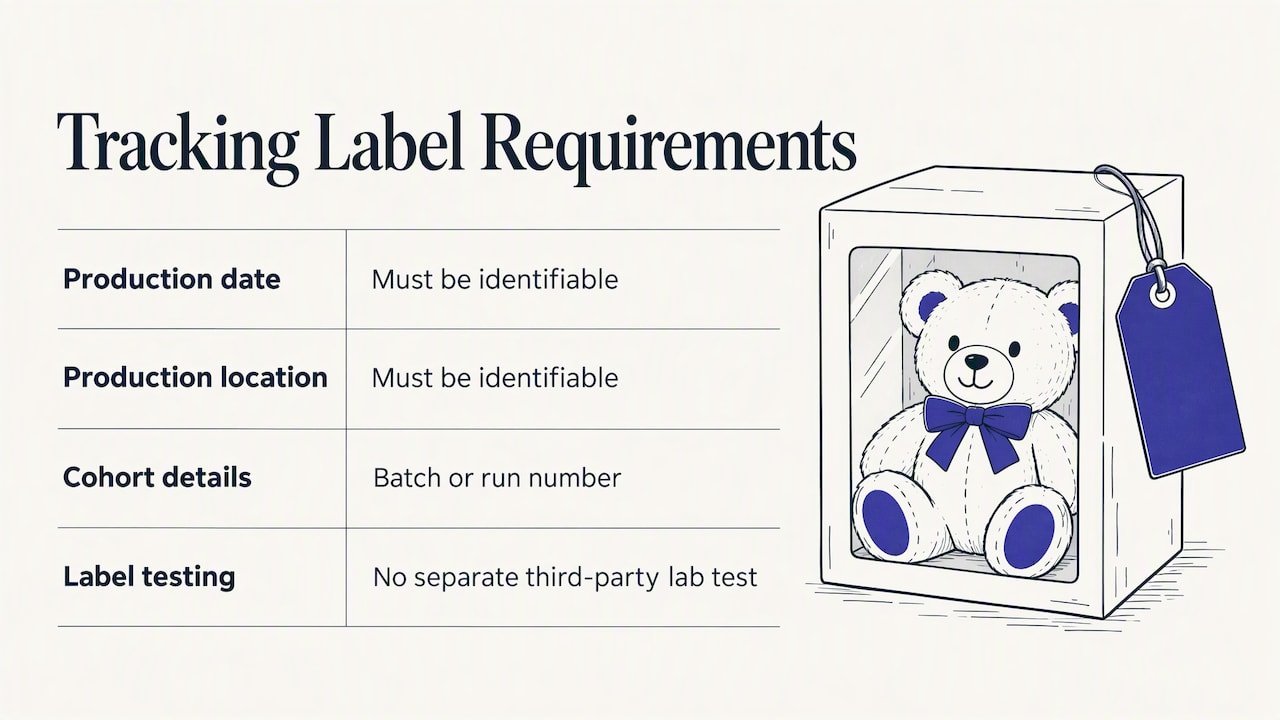
There is a common misunderstanding here. The CPSC does not require the tracking label itself to be certified or to be tested by a third-party lab. The finished product is tested against the applicable rules. The label only has to do its job. You don’t need to send the label to a lab.
Who is responsible when a distributor decorates the item
A base product’s manufacturer may supply a clean test report. That does not automatically cover the decorated product. The CPSC’s guidance explains that a distributor can become the responsible party when it directs the final production or decoration of the item. You can’t simply rely on the blank product’s claims. You need confirmation that the finished item meets the rules.
For a corporate buyer, this turns into a short list of questions for every supplier:
- Is this item a children’s product, a general-use product, or something else? Who made that determination, and on what basis?
- Who is the issuing manufacturer or importer for the certificate?
- For children’s items, can I see the CPC and the underlying test reports for the finished, decorated version?
- Which accepted lab ran the tests, and when?
- How is tracking information applied to the product and packaging?
- What happens if I change artwork, colors or the decoration method?
A supplier that can’t answer these quickly is telling you something.
The eFiling change for imports
Imports of promotional products are affected by a new filing process. The CPSC states that beginning July 8, 2026, importers of most regulated consumer products must electronically file certificate data with U.S. Customs and Border Protection. A law firm’s summary of the rollout adds that products entering through Foreign Trade Zones follow on January 8, 2027. Before this, certificates were generally kept on file and shown on request.
That shifts the burden onto importers. For your team, the practical effect is simple: expect suppliers to ask for product details earlier, and expect clean certificate data to matter more for imported goods. Leave extra time for items made overseas, particularly for rush orders.
A note on batteries
Tech giveaways can bring their own safety rules. The CPSC’s button cell and coin battery rules require specific packaging for button cell or coin batteries. They apply to products made or imported after February 12, 2023. If an item includes a coin battery, such as a blinking lanyard light or a small gadget, ask the supplier how it complies. Keep these items away from kids’ events entirely unless you’ve confirmed compliance.
Our perspective
We sell corporate promotional products to marketing teams and buyers, and we see the same mistake again and again. The compliance question comes up at the end, after artwork is approved and the budget is committed. By then, a change costs time you don’t have.
So we suggest a different order of operations. Decide the audience first. If the audience is employees, customers or partners who are adults, choose from general-use items and keep the artwork adult. If the audience includes children, say so at the start, so the item can be handled as a children’s product from the beginning.

We also think “buy the cheapest blank” is the wrong frame for any item that might touch the CPSIA. A trusted supplier with documentation is worth more than a few cents saved on a unit. That is the reason we focus on curated quality from trusted suppliers, and why our guide on what makes a retail-quality promotional product starts with the supplier, not the price.
One more habit that pays off: write the intended audience into the order brief. Our promotional product campaign brief has room for it, and it gives everyone, including your compliance contact, the same facts.
— Jerry
A pre-order checklist for marketing teams
Use this before approving any promotional order that might reach children.
- Define the audience. Who will use or receive the item? Is any part of that audience 12 or younger?
- Check the item and the art together. Look at size, theme, characters, colors and packaging as a child’s parent would see them.
- Classify it. General-use or children’s product? Write down the reasoning.
- Request documents early. For children’s items, ask for the CPC and the test reports covering the finished product. For general-use items, ask what rules apply and who holds the certificate.
- Confirm tracking information. Ask where it appears on the product and packaging.
- Lock the specification. Any change to material, ink or decoration method needs a fresh check.
- Keep records. Store certificates, order details and supplier contacts together in case a question comes up later.
Your order process matters here too. Our guide on how to order promotional products right walks through the steps around proofs and approvals, where these checks fit naturally.
Why recall readiness belongs in your plan
CPSC research on recall effectiveness suggests many consumers don’t know the agency or how its recall process works. For a brand, that means that if an issue ever arises with giveaway merchandise, clear and plain communication matters. Keep a list of who received what, and use a batch or order reference so you can reach them.
Ordering with Discount Swag
If you buy promotional products in bulk for your company, we can help you build a program around the categories we carry, including apparel, drinkware, bags, technology, office and outdoor items. We also offer rush orders, branded kits and fulfillment to single or multiple locations. For documentation questions on a specific item, raise them when you request a quote, before artwork is final. Browse the full range at discountswag.store.
FAQ
What is a CPSIA regulated item?
A CPSIA regulated item is usually a children’s product, meaning one designed or intended primarily for children 12 and younger. These products must follow children’s product safety rules, be tested by a CPSC-accepted lab and carry a Children’s Product Certificate. General-use items face other rules but not the children’s product testing regime.
What is the difference between CPSC and CPSIA?
The CPSC is the federal agency that oversees consumer product safety. The CPSIA is the 2008 law that amended the Consumer Product Safety Act and gave the agency stronger tools, particularly for children’s products. The agency enforces the law.
Do I need a Children’s Product Certificate for adult corporate swag?
No, not when an item is designed for adults and not made to appeal to children under 12. Those items may still need a General Certificate of Conformity if they are subject to a safety rule or ban. If you’re unsure about a specific item, ask your supplier and a compliance professional before ordering.
Who has to issue the certificate for imported promotional items?
The importer issues the Children’s Product Certificate for products made overseas, and a U.S. manufacturer issues it for products made domestically. An importer cannot just pass along a foreign manufacturer’s certificate. Distributors and retailers must be given reasonable access to it.
How often does a children’s product need retesting?
The first production batch must be tested, and periodic retesting is generally required at least annually. It can be within three years if specific controls are in place, according to the CPSC. Material or process changes can trigger new testing, so confirm the schedule with whoever holds your certificate.
Sources
- Buying Promotional Products: A Guide to Federal Safety Laws (CPSC)
- Children’s Products (CPSC)
- The Consumer Product Safety Improvement Act (CPSC)
- Initial Certification Testing (CPSC)
- CPSC-Accepted Laboratories FAQ
- The Regulated Product Handbook (CPSC)
- Overview of U.S. Consumer Product Safety Framework (CPSC)
- Children’s Product Certificate FAQ (CPSC)
- Regulatory Robot: tracking label requirement (CPSC)
- Rules Requiring Third-Party Testing and a Children’s Product Certificate (CPSC)
- CPSC eFiling Is Here (Buchalter)
- Button Cell and Coin Battery FAQs (CPSC)
- CPSC Product Safety and Recall Report
 Bottle Carriers
 Mugs