

How Employee Swag Stores Work: 2026 HR Guide


An employee swag store is a private, branded online storefront where employees self-order approved company merchandise through on-demand production and automated fulfillment. Unlike a one-time bulk purchase, these stores function as permanent internal programs that connect HR systems, budget controls, and print-on-demand logistics into a single managed experience. Understanding how employee swag stores work gives HR and corporate culture managers a clear path to replacing ad hoc merchandise requests with a scalable, brand-consistent system. The operational model eliminates dead inventory, reduces administrative overhead, and puts employees in control of their own branded gear.
How do employee swag stores work from setup to fulfillment?
The employee swag store process follows a defined sequence from asset preparation through live ordering. Getting that sequence right determines whether your store launches in days or drags on for months.
Here is how a well-run setup unfolds:
- Gather core brand assets. Collect finalized logo files, brand color codes, and any usage guidelines your marketing team has approved. These assets feed directly into product decoration templates, so errors here create errors on every item produced.
- Select and configure your product catalog. Choose items that align with your culture and use cases, such as new hire kits, recognition rewards, or remote employee gear. A focused catalog of 10 to 20 products outperforms a sprawling one every time.
- Set budget rules and shipping policies. Decide whether employees receive a credit allowance, pay out of pocket, or use a combination. Define which shipping carriers and regions are supported before the store goes live.
- Configure employee access. Connect the store to your HRIS or SSO system so employees are provisioned automatically. Manual onboarding at this stage creates the exact administrative burden the store is designed to eliminate.
- Run a pilot with a small team. Test ordering, fulfillment routing, and budget tracking with one department before opening access company-wide.
- Launch and monitor. Open the store to all eligible employees and track order data, budget consumption, and fulfillment performance from day one.
A store can launch in 24 hours when brand assets and budget rules are prepared in advance. Full rollouts typically move from kickoff to pilot in one to two weeks and reach company-wide access within two to four weeks. That timeline is fast enough to align with a new fiscal year, a rebrand, or a major hiring push.
Once an employee places an order, the store routes it to a fulfillment partner for on-demand production. Production and shipping typically complete within seven to ten business days after order placement. The item ships directly to the employee’s address, whether that is a corporate office or a home office in another state.

Pro Tip: Prepare your logo files in vector format (.AI or .EPS) before your first platform conversation. Raster files cause decoration quality issues that delay your launch and require rework.
On-demand vs. bulk ordering: which model fits your program?
The shift from bulk procurement to on-demand production is the single biggest structural change in how swag programs function today. Each model has a distinct operational profile, and choosing the wrong one for your use case creates real costs.
| Factor | Bulk ordering | On-demand store |
|---|---|---|
| Upfront cost | High (large minimum orders) | Low (no minimum required) |
| Inventory risk | High (dead stock is common) | None (items produced after order) |
| Storage requirement | Warehouse or office space needed | No storage required |
| Size flexibility | Fixed at time of order | Employee selects size at checkout |
| Lead time per item | Fast once stock exists | 7 to 10 business days per order |
| Best use case | Large events, uniform programs | New hires, recognition, remote teams |
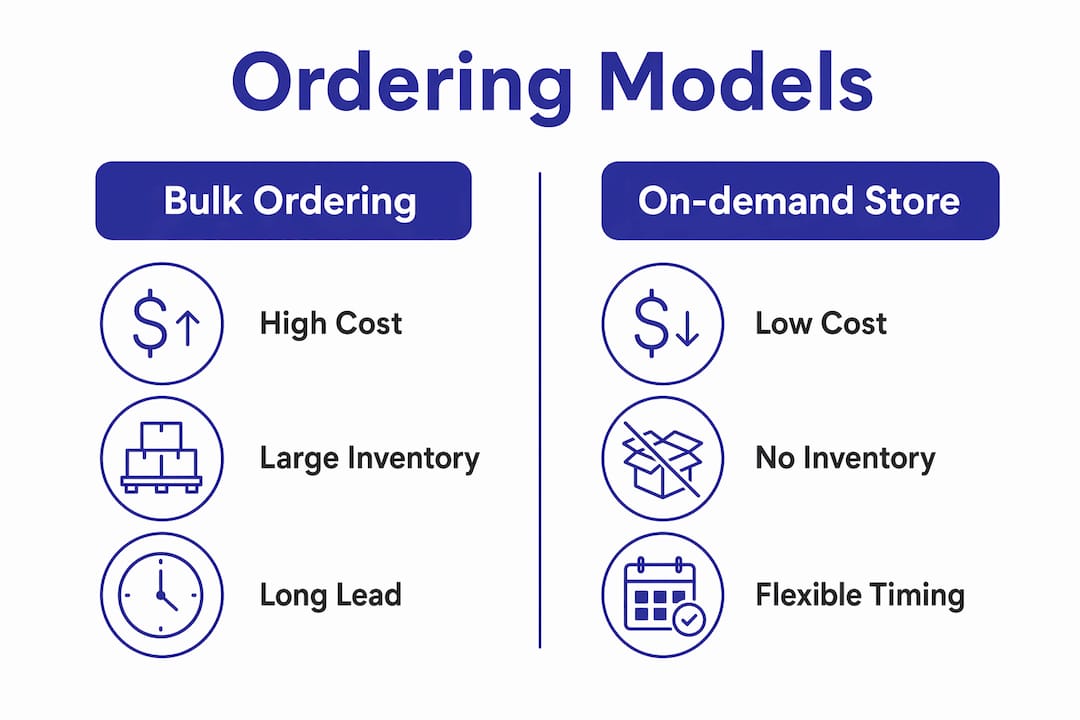
Bulk ordering still makes sense for large-scale events where every attendee receives the same item on the same day. For ongoing employee merchandise programs, on-demand stores reduce dead inventory and give employees size and style flexibility that bulk orders cannot provide.
The operational advantages of on-demand go beyond cost. Consider what bulk ordering actually requires: someone forecasts quantities, places a large order, receives a shipment, stores it, tracks what is left, and manually distributes items on request. Every one of those steps is a coordination task that falls on HR or office management. On-demand production removes all of them.
The one genuine tradeoff is lead time. An employee who needs a hoodie for a client meeting next Tuesday will not get it from an on-demand store. For time-sensitive needs, maintaining a small stock of high-velocity items alongside your on-demand store is a practical solution.
What automation features power efficient swag store management?
Automation is what separates a functional swag store from a genuinely efficient one. Without it, you are still doing manual work. With it, the store runs itself for routine transactions.
The core automation capabilities that matter most for HR teams include:
- HRIS and SSO integration. Employee eligibility, access levels, and shipping addresses are provisioned automatically when someone joins or changes roles. HRIS and SSO automation can save up to 40 hours per week compared to manual order management. That figure represents real headcount capacity returned to strategic work.
- Budget credits and spend caps. The store can load a fixed credit to each employee’s account on a schedule, such as quarterly or on their hire anniversary, without any manual action from HR or finance.
- Role-based permissions. Catalog managers, approvers, and standard employees each see a different version of the store. A department head can approve orders above a spend threshold without involving HR in every transaction.
- Address validation and carrier routing. The system checks shipping addresses at checkout and routes orders to the correct fulfillment center automatically. This prevents the most common fulfillment failure: items shipped to wrong or incomplete addresses.
- Reporting and audit logs. Every order, credit redemption, and approval action is logged. Finance can pull spend reports by department, and HR can audit who received what for compliance purposes.
Governance controls including role permissions, audit logs, and brand kit enforcement are what make a swag store function like an internal supply chain rather than an honor system. Without these controls, catalog drift and budget overruns become predictable outcomes.
Pro Tip: Connect your swag store to your HRIS before launch day, not after. Retroactively migrating employee records and correcting access errors is significantly more time-consuming than a clean integration from the start.
What are the best practices for managing an employee swag store?
Operational success in managing employee merchandise comes down to governance and discipline, not platform features. The most common failures trace back to internal misalignment, not technology.
The biggest launch delays come from internal disagreements on approvals, product selection, and budget rules. Resolving those decisions before you touch the platform is the single most valuable thing you can do for your timeline.
Follow these practices to build a program that holds up over time:
- Start with a phased rollout. A phased approach starting with two to three teams lets you refine budget rules, permissions, and catalog choices before opening access to the full company. Errors caught at the pilot stage cost far less than errors discovered after 500 employees have placed orders.
- Curate, do not accumulate. A catalog of 10 to 15 well-chosen items with consistent branding outperforms a 60-item catalog with inconsistent quality. Brand standards and approval workflows define store success more than merchandise variety does.
- Assign clear ownership. Designate one person in HR or marketing as the program owner. Without a named owner, catalog updates stall, budget rules go unenforced, and the store degrades over time.
- Align stakeholders before launch. HR, marketing, finance, and operations each have a stake in how the store runs. Marketing owns brand standards. Finance owns budget policy. HR owns employee eligibility. Operations owns fulfillment logistics. Get written agreement from each group before configuration begins.
- Treat it as an ongoing program. Most companies fail when they treat swag as a one-off event rather than a continuous program with clear rules and ownership. Schedule quarterly catalog reviews and annual budget assessments as recurring calendar items from day one.
The role of branded merchandise in employee engagement is not decorative. It signals belonging, communicates culture, and reinforces brand identity every time an employee wears or uses a company item. A well-governed store protects that signal. A poorly managed one dilutes it.
Key takeaways
Employee swag stores work because they combine on-demand production, HRIS automation, and brand governance into a single self-service system that scales without adding administrative headcount.
| Point | Details |
|---|---|
| On-demand production is the foundation | Items are produced after each order, eliminating inventory risk and storage costs entirely. |
| Automation drives efficiency | HRIS and SSO integration can save up to 40 hours per week versus manual order management. |
| Governance defines success | Brand controls, role permissions, and audit logs matter more than catalog size. |
| Phased rollouts reduce risk | Piloting with two to three teams before full launch catches budget and permission errors early. |
| Program ownership is non-negotiable | A named program owner in HR or marketing prevents catalog drift and policy gaps over time. |
Why swag stores are the infrastructure HR has been missing
I have spent years watching HR teams manage branded merchandise through spreadsheets, email chains, and shared closets full of mismatched polos. The swag store model does not just make that process faster. It reframes the entire category from a logistics problem into a cultural asset.
What strikes me most is how much of the resistance to swag stores comes from HR teams who have been burned by one-off bulk orders. They ordered 500 hoodies for a company retreat, ended up with 200 left over in a storage room, and concluded that swag programs do not work. That conclusion is wrong. The bulk model does not work. The store model is a fundamentally different operation.
The shift I predict for 2026 and beyond is that swag stores will become standard infrastructure in HR tech stacks, sitting alongside payroll, benefits, and performance management tools. Vertically integrated production that reduces delays and improves quality control is already pushing fulfillment timelines down. As those timelines compress further, the last remaining argument for bulk ordering, which is speed, weakens considerably.
The HR teams I respect most treat their swag store the way a good marketing team treats a brand style guide: as a living document with an owner, a review cycle, and real consequences for going off-brand. That discipline is what separates programs that build culture from programs that just burn budget.
— Jerry
How Discountswag makes your swag store program work
Discountswag specializes in corporate promotional products built for exactly the kind of on-demand, brand-governed programs described in this guide. Whether you are setting up your first employee store or replacing a bulk ordering model that has outgrown your team’s capacity, Discountswag provides the product selection and fulfillment infrastructure to support it.
From curated branded promotional products suited to new hire kits and recognition programs to corporate gift sets that complement your store catalog, Discountswag gives HR teams a single source for quality-controlled merchandise. You get consistent branding across every item, direct-to-employee shipping, and a product range designed to hold up in real use. Explore the full catalog and see which products fit your program’s use cases and budget structure.
FAQ
How long does it take to set up an employee swag store?
A store with prepared brand assets and defined budget rules can go live in 24 hours. Full company-wide rollouts typically take two to four weeks from kickoff.
What is the difference between a swag store and bulk ordering?
A swag store produces items on demand after each employee order, eliminating inventory and storage. Bulk ordering requires upfront quantity commitments, carries dead-stock risk, and demands manual distribution.
How do employees access a company swag store?
Employees are provisioned automatically through HRIS or SSO integration, which grants access based on role, department, or hire date without any manual setup by HR.
How long does fulfillment take for on-demand swag orders?
Production and delivery typically complete within seven to ten business days after an employee places an order, with items shipped directly to their address.
What is the most common reason swag store programs fail?
Most programs fail because companies treat swag as a one-time event rather than an ongoing program with a named owner, defined budget rules, and regular catalog reviews.
 Bottle Carriers
 Mugs
Mugs