


Event Planners: Lock In-Hand Dates With 3–10 Business Day Timelines


An in-hand date is the exact day your branded promotional products must physically arrive at their destination, not the day you place the order. To know if it’s achievable, run one calculation: add production time (counted from proof approval, not order date), shipping transit, and a safety buffer, then check if that total fits inside your window. If it doesn’t, you need a rush plan or a different decoration method. A distributor can quote rush-capable fulfillment once you know which side of that line you’re on.
TL;DR:
- Confirm the supplier’s stock availability for the exact SKU, color, and quantity before setting a firm in-hands delivery date.
- Count production time from proof approval, not order placement, adding extra days for peak seasons or revisions to avoid delays.
- Lock in specific proof and approval deadlines with documented consequences to prevent schedule slippage caused by slow client sign-offs.
- Verify the decorator’s actual production slot and stock status early, and document these confirmations with timestamps for accountability.
- Build rush quotes around surcharges, freight, overtime, and SKU swaps, ensuring they are contingent on proof approval deadlines to avoid unexpected costs.
Table of Contents
- What Should You Confirm the Moment an Order Comes In?
- How Do You Calculate a Delivery Schedule Backward From Your Event Date?
- Why Does the Proof Approval Step Control Your Whole Timeline?
- What Three Confirmations Turn a Quote Into a Real Date?
- What Can Actually Be Rushed, and What Can’t?
- What Communication Checkpoints Prevent Last-Minute Surprises?
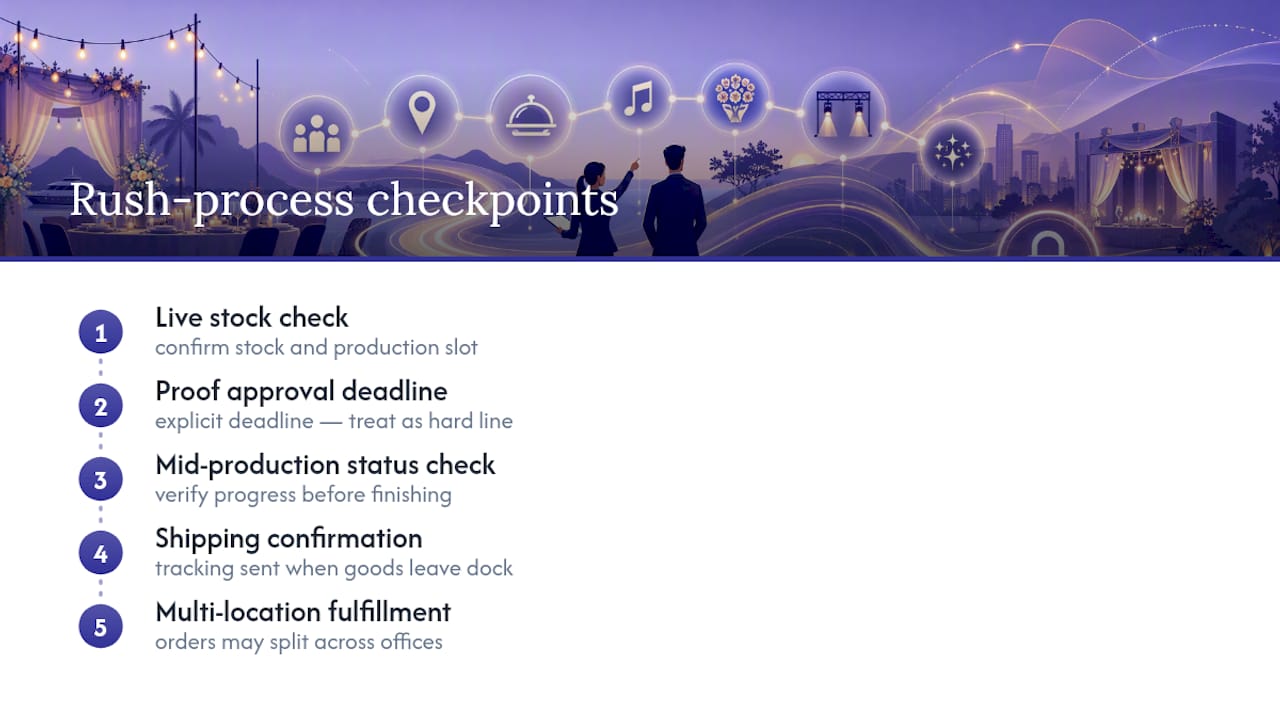
- Some distributors build their rush process around the same checkpoints outlined above: live stock checks before quoting, an explicit proof-approval deadline attached to every rush order, a mid-production status check, and shipping confirmation with tracking passed along the moment goods leave the dock. Multi-location fulfillment means a single order can split across offices without splitting the timeline math you already ran.
- Ready to Lock In Your Delivery Date?
- Sources
What Should You Confirm the Moment an Order Comes In?
Time-sensitive orders die from small gaps, not big mistakes. Before you quote anyone a date, work through this sequence on the first call or email:
- Lock the event date, delivery address, and required time of day. “Sometime that week” is not a delivery window a decorator can plan around.
- Ask if artwork is print-ready, then set an exact proof-deadline (date and time, not “soon”).
- Confirm the SKU variant and quantity so the supplier can check blank-goods stock against your actual order, not a similar one.
- Ask the decorator directly about their earliest open production slot. A general lead time and an actual slot are two different things.
- Decide whether your quote language is provisional or confirmed, based on how solid the supplier’s answer was.
Skipping any one of these is how a “confirmed” date turns into an apology email three weeks later. For a longer walkthrough of this intake process, Discount Swag’s guide to ordering branded merch without delays breaks down each step further.
How Do You Calculate a Delivery Schedule Backward From Your Event Date?
Start at the finish line and work backward. Say your event is on October 15. Ship-ready goods need to leave the warehouse with enough transit time to arrive by October 13, giving you a two-day cushion. If ground shipping takes 3 business days, the order needs to ship by October 8. If production takes 7 business days (say, for embroidery), your proof needs to be approved by September 29. Work backward one more step, and you have your order cut-off date.
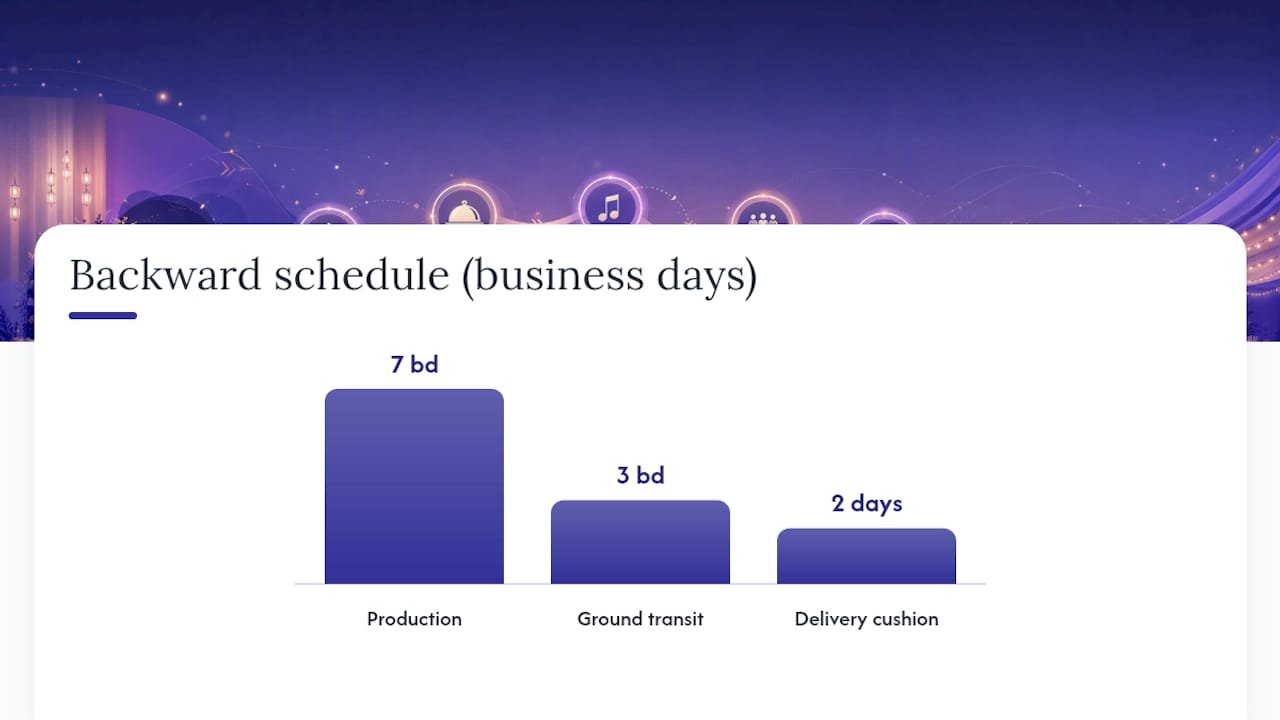
That math only holds if you count production days from the moment the proof is approved, not the moment the PO lands. This is the single most common source of missed dates, because production lead time is measured from proof approval, not order placement, and any delay in sign-off eats directly into your buffer.
Decoration method drives most of the variation in that timeline:
| Decoration method | Typical production time |
|---|---|
| One-color screen print | 3 to 5 business days |
| Multi-color screen print | 5 to 7 business days |
| Embroidery | 7 business days |
| Digital transfer or dye-sublimation | 10 business days |
These ranges hold under normal conditions, but peak seasons (Q4 holidays, back-to-school, major conference months) push suppliers toward the top of each range or past it. Industry guidance recommends adding 5 to 7 business days on top of quoted production and shipping windows, specifically to absorb one revision round or a short supplier delay.
Pro Tip: Always count your production window starting the day the proof gets a written “approved,” not the day you submit the order. If a client sits on a proof for four days, your entire timeline shifts four days, even if nobody touches the file.
For help mapping this against a specific event date, Discount Swag’s event swag logistics guide walks through scheduling from order to onsite delivery.
Why Does the Proof Approval Step Control Your Whole Timeline?
Nothing moves in production until someone signs off on the proof. Every revision round doesn’t just delay approval, it resets or adds an entirely new proof cycle, which compresses whatever buffer you built into your schedule.
Getting a clean proof approved on the first pass depends on what you hand the decorator up front. A complete quote request should include these assets before anyone starts artwork:
- A vector logo file (not a screenshot or low-resolution JPEG)
- Exact PMS or hex color codes, not “our blue”
- Placement specs (left chest, full back, centered on barrel)
- Size and bleed notes for the specific product
Set the proof-approval deadline in writing, in the order confirmation itself, with a stated consequence. Something like: “Proof approval required by 5:00 PM on September 29. Approvals received after this time will move your in-hands date and may require expedited freight at your cost.” Best-practice rush guidance backs this up: explicit proof-approval deadlines with documented consequences prevent disputes when a client’s slow sign-off blows the schedule.
Pro Tip: Send the proof-deadline language in the same email as the quote, not buried in fine print later. Clients respect a deadline they saw upfront far more than one that surfaces after they’ve already missed it.
What Three Confirmations Turn a Quote Into a Real Date?
A quoted lead time is not a promise. Most missed deadlines trace back to one of three things nobody actually confirmed: blank-goods stock, the decorator’s production slot, or artwork readiness. Confirming these three elements before you commit to a firm date is the difference between a date you can defend and one you’re guessing at.
- Blank goods: Verify the exact variant, color, and quantity is in stock, not just that the product line generally exists.
- Production slot: Get the decorator to confirm an actual queue position, not a generic “5 to 7 days” estimate that assumes an empty schedule.
- Written commitment: Log both confirmations in the job record with names, dates, and timestamps.
If a supplier hasn’t confirmed yet, don’t quote a hard date. Use provisional phrasing instead: state the timeline as approximate, subject to stock confirmation, something like “approximately 8 working days, pending supplier stock confirmation.” Upgrade to a confirmed date only once both checks clear.
If confirmation fails, you have three fallback paths: switch to an in-stock alternate SKU, pay for expedited decoration, or upgrade to express freight. Each costs more and only works within a shrinking window, so decide fast rather than waiting on a supplier that’s gone quiet.
What Can Actually Be Rushed, and What Can’t?
Rush services speed up decoration and freight. They cannot conjure blank inventory that’s on backorder, which is the most common reason a “rush order” still misses its date. Confirm stock before you promise anything can be expedited.
Build every rush quote around four cost categories so nothing gets disputed later:
- Rush surcharge: A flat or percentage fee for jumping the production queue.
- Express freight: Overnight or two-day shipping instead of ground.
- Overtime decoration: Weekend or after-hours labor charges at the decorator.
- SKU replacement: Cost difference if you switch to an in-stock alternate.
Tie your rush guarantee directly to the proof-approval deadline. If that deadline slips, the guarantee should too, or you’ll end up eating freight upgrades that were the client’s delay, not yours. It’s worth keeping two rush-capable suppliers vetted per major product category (apparel, drinkware, tech) so a backorder on one doesn’t strand your entire timeline.
What Communication Checkpoints Prevent Last-Minute Surprises?
Distributors that consistently hit dates treat the weeks after the quote as carefully as the quote itself. That means confirming lead times, logging supplier acknowledgements, and automating three specific touchpoints rather than assuming silence means everything’s on track.
- Order entered and proof sent. Confirms the job is live and the clock on approval has started.
- Proof approved and production started. Confirms the real production window has now officially begun.
- Goods shipped with tracking. Confirms a carrier has the package and gives you a number to watch.
For long production runs or especially tight timelines, add a check at roughly the halfway mark. Ask directly: is the ship-ready date still confirmed, and is anything at risk of slipping? Require these fields in every confirmation: exact ship date, carrier, tracking number, and an escalation contact who answers the phone. Document each one in the job record. If a date slips later, that record is what settles who’s responsible. Discount Swag’s shipping guide for swag kits covers carrier selection for both single-site and multi-location deliveries.
Some distributors build their rush process around the same checkpoints outlined above: live stock checks before quoting, an explicit proof-approval deadline attached to every rush order, a mid-production status check, and shipping confirmation with tracking passed along the moment goods leave the dock. Multi-location fulfillment means a single order can split across offices without splitting the timeline math you already ran.
None of this replaces the backward calculation. It just gives you a supplier that confirms stock and slots instead of quoting generic lead times and hoping they hold. The order forms and proof-approval requests should reflect that discipline every time, not just when a deadline is tight.
The gap between “quoted lead time” and “confirmed in-hands date” is where most promotional product orders quietly fail, and it’s rarely the decoration method’s fault. It’s a supplier who never confirmed stock, a proof that sat in someone’s inbox for five days, or a rush guarantee with no teeth behind it. Buyers who protect their timeline treat the proof deadline as a hard line, not a suggestion, and they get a written slot confirmation instead of a verbal “should be fine.” That discipline costs nothing and saves the one thing you can’t buy back once an event date passes: time.
— Jerry
Ready to Lock In Your Delivery Date?
If your event date isn’t moving, your supplier process needs to be airtight, not hopeful. Certain suppliers run live stock checks before quoting, manage proof deadlines with explicit consequences built into the confirmation, and offer rush lanes with multi-location fulfillment when a single order needs to land in multiple offices.
That means fewer surprises between the quote and the truck showing up. If you’re deciding between apparel, drinkware, or tech items for an upcoming event and need a real production estimate instead of a rough guess, Discount Swag’s guide to promotional items for brand awareness can help you narrow the field before you request pricing. When you’re ready, request an expedited quote with a confirmed in-hands date and a stated proof-approval deadline so both sides know exactly what has to happen, and by when, to make your event.
Sources
For deeper detail on the lead-time ranges and confirmation process referenced above, see Zigaflow’s reporting on why promotional merchandise orders go late and its rush order management guide, along with the promotional products glossary from DealStream.
- After the Quote: Why Promotional Merchandise Orders Go Late – Zigaflow Insights | Zigaflow
- What Information Do You Need for a Promotional Product Quote? – SourcingXpro
 Bottle Carriers
 Mugs
Mugs