

Promotional Merchandise Brand Consistency Guide


Promotional merchandise brand consistency is defined as presenting your brand uniformly across every promotional product you distribute, from logo placement and color to product quality and messaging. 84% of consumers remember the advertiser on a promotional product, and recipients keep those items for an average of seven months. That kind of sustained exposure only pays off when every item looks like it came from the same brand. The industry term for this practice is promotional branding, and it sits at the intersection of visual identity management and physical marketing. Marketing professionals who treat promotional products as an extension of their brand standards, not an afterthought, build recognition that compounds over time.
What does promotional merchandise brand consistency require?
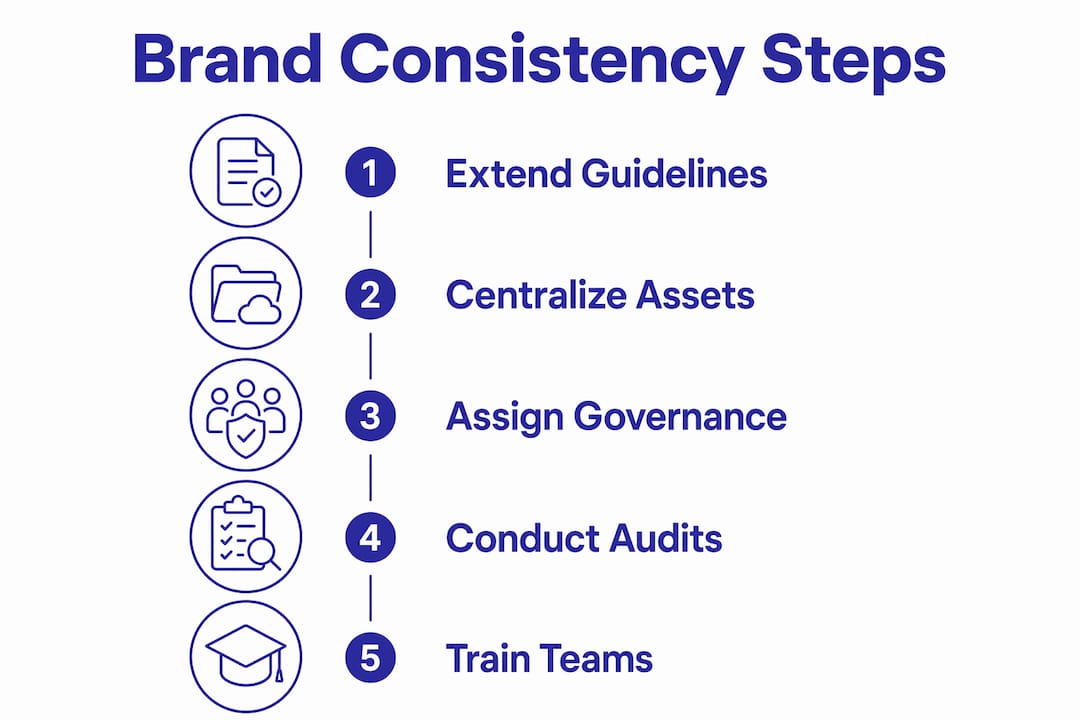
Promotional merchandise brand consistency starts with a single document: your brand guidelines, extended specifically to cover physical products. Most brand style guides cover digital and print applications. Few go far enough to specify decoration standards for embroidery, screen printing, or laser engraving. Clear brand guidelines including logo usage, color palettes, typography, and decoration standards are the non-negotiable foundation for any consistent merchandise program.
The tools that support those guidelines matter just as much as the guidelines themselves. A central asset repository, such as a shared drive or a digital asset management platform like Bynder or Brandfolder, prevents teams from pulling outdated logo files. A centralized system prevents usage of outdated or incorrect logos and eliminates the visual confusion that comes from decentralized file storage. Without it, you will find five versions of your logo circulating across five different offices.

The table below outlines the core prerequisites every marketing team needs before placing a single promotional order.
| Prerequisite | What it covers |
|---|---|
| Brand guidelines for merchandise | Logo placement rules, approved color codes (Pantone, CMYK, RGB), typography, and decoration method specs |
| Central asset repository | Single source of truth for approved logo files, artwork, and product templates |
| Approved product catalog | Pre-vetted items that meet quality and brand positioning standards |
| Centralized ordering platform | Company store or portal with built-in artwork approval and order tracking |
| Brand governance owner | A brand manager or procurement lead responsible for enforcing standards |
Governance is the piece most teams skip. Assigning a named owner, whether a brand manager, a marketing operations lead, or a procurement contact, creates accountability. Without a designated decision-maker, inconsistencies accumulate quietly until a trade show or client meeting makes them impossible to ignore.
How do you select and design products that reinforce brand identity?
Product selection is where brand consistency in merchandise either holds together or falls apart. The product itself carries a message before anyone reads the logo. A premium leather notebook signals something different than a flimsy spiral pad, even if both carry the same wordmark. Quality of promotional merchandise signals brand positioning, and low-quality items actively undermine premium brands. Choose products that match the perception you want to create, not just the budget line you want to hit.
Once you have the right product, design execution determines whether the item looks intentional or accidental. Matching promotional products to brand guidelines creates a professional, considered look that inspires trust and reinforces brand identity. The following principles govern effective design application across custom merchandise branding.
- Logo placement: Use a fixed placement zone for each product category. On apparel, the left chest is the standard. On drinkware, center the logo on the front face. Consistency in placement trains the eye to find your brand instantly.
- Color accuracy: Always specify Pantone colors for physical production. RGB and hex codes are for screens. Pantone Matching System (PMS) codes give your decorator an exact target and eliminate the guesswork that causes color drift between orders.
- Size and proportion: A logo that works on a business card does not automatically scale to a tote bag. Define minimum and maximum logo sizes for each product type in your guidelines.
- Design restraint: One logo, one tagline, one color story per item. Overloaded designs dilute the brand message and look unprofessional. The most recalled promotional items tend to be the cleanest ones.
- Cohesion across a collection: If you are ordering pens, notebooks, and tote bags for the same event, treat them as a set. Matching color, logo version, and finish across the collection creates a unified brand identity that individual items cannot achieve alone.
Pro Tip: Request a physical pre-production sample before approving any large run. Digital mockups do not accurately represent embroidery thread color, screen print opacity, or material texture. One sample prevents thousands of off-brand units.
The role of product quality in reinforcing brand positioning cannot be separated from design. A perfectly placed logo on a cheap product still communicates the wrong message.
How do you coordinate branding across teams and locations?
Scaling consistent branding strategies across multiple departments or offices is the hardest operational challenge in promotional products marketing. The instinct is to lock everything down. The smarter approach is to build guardrails, not walls. Brand consistency is not about excessive restriction but about providing guardrails so teams can stay agile yet aligned.
A practical framework for multi-location coordination follows four steps.
- Define what must never change. Logo version, Pantone colors, and approved product quality tier are non-negotiable across every location. Document these as hard rules in your merchandise guidelines.
- Define what can flex. Regional teams may need to add a location name or a local event tagline. Pre-approve the format for those additions so the core brand stays intact while local relevance is preserved.
- Build a curated, pre-approved product assortment. Curating a pre-approved assortment gives teams flexibility while ensuring consistent visual branding across different use cases. Organize the assortment by use case: recruiting kits, client gifts, trade show giveaways, and employee onboarding packs each need different products.
- Deploy a centralized ordering portal. Centralized ordering platforms with approved product catalogs and artwork ensure brand consistency across locations and teams. A company store with built-in approval workflows removes the need for every team to negotiate with vendors independently.
Pro Tip: Schedule a quarterly merchandise audit. Pull samples from recent orders across all locations and compare them side by side against your brand guidelines. Inconsistencies that seem minor in isolation become obvious at scale.
Regular reviews and audits help maintain merchandise consistency and keep your program aligned with evolving brand standards. Brands refresh their visual identity over time, and your merchandise program needs to keep pace.
What are the most common brand consistency problems in merchandise?
The most common failure in promotional branding is not intentional. It is the slow accumulation of small errors that no single person owns. Recognizing the patterns is the first step to fixing them.
- Outdated logo files: A team member downloads a logo from an old email attachment and sends it to a vendor. The vendor prints it. Three months later, you have branded items in circulation with a logo your company retired two years ago. A central asset repository with access controls eliminates this entirely.
- Color drift between orders: Different vendors interpret the same hex code differently. Without a Pantone specification, your navy blue becomes royal blue on one order and slate on the next. Always supply PMS codes and request color-matched proofs.
- Quality mismatches across departments: Marketing orders premium drinkware for client events. HR orders budget pens for a job fair. Both carry the same logo, but the quality gap sends contradictory signals about what your brand stands for. A tiered product catalog with approved quality levels for each use case solves this.
- Decentralized ordering without oversight: When individual teams order directly from any vendor they find, you lose control of artwork, quality, and pricing. Approval workflows within a centralized portal catch errors before production begins.
- No training on brand guidelines: Brand guidelines only work if the people placing orders have read them. A one-page merchandise quick reference card, shared with every team that orders promotional products, closes the knowledge gap faster than a 40-page brand book.
“Promotional branding is a two-sided exchange where the quality and relevance of the item reinforce brand positioning and message.” — ASI
Effective promotional materials require both a strong system and educated users. Technology handles the process. Training handles the people. Both are necessary.
Key Takeaways
Promotional merchandise brand consistency requires clear guidelines, centralized tools, and regular audits to build lasting brand recognition across every product your company distributes.
| Point | Details |
|---|---|
| Start with extended brand guidelines | Document logo placement, Pantone colors, and decoration specs specifically for physical products. |
| Centralize assets and ordering | Use a single platform for approved files and orders to prevent outdated artwork from reaching vendors. |
| Match product quality to brand positioning | Low-quality items undermine premium brands regardless of how well the logo is applied. |
| Build guardrails, not walls | Pre-approved product assortments give teams flexibility while keeping visual branding consistent. |
| Audit regularly | Quarterly reviews catch color drift, outdated logos, and quality mismatches before they compound. |
Why I think most merchandise programs fail before they start
Most promotional merchandise programs fail at the governance step, not the design step. Marketing teams spend hours selecting the right products and perfecting the artwork, then hand the ordering process to whoever has budget authority that quarter. Without a named owner and a centralized system, the program drifts within two ordering cycles.
The insight that changed how I think about this: promotional branding is a two-sided exchange. The item has to be good enough that the recipient wants to keep it. A branded hoodie, for example, can generate up to 6,100 lifetime impressions. That number only materializes if the hoodie is quality enough to wear repeatedly. Cheap items get thrown away. Expensive-feeling items become walking billboards.
The other thing most guides skip is the emotional dimension of physical branding. A well-made, well-designed promotional item communicates that your company pays attention to details. A flimsy, off-color item communicates the opposite, regardless of what your website or sales deck says. Physical objects carry brand signals that digital touchpoints cannot replicate.
My practical recommendation: treat your merchandise program the same way you treat your paid media program. Assign ownership, set standards, measure results, and review performance on a fixed schedule. The types of branded promotional products you choose matter, but the system behind the choices matters more.
— Jerry
Discountswag makes brand-consistent merchandise ordering straightforward
Discountswag gives marketing professionals a single place to source corporate promotional products that meet brand standards from the first order to the hundredth. Every product in the catalog is vetted for quality, and the ordering process includes artwork review to catch color mismatches and logo errors before production begins.
Whether you are building a recruiting kit, a client gift program, or a trade show collection, Discountswag offers curated product selections organized by use case. The goal is to remove the guesswork from vendor selection and artwork approval so your team can focus on strategy, not logistics. Explore the full range of promotional items for brand awareness and find products that fit your brand standards and your budget.
FAQ
What is promotional merchandise brand consistency?
Promotional merchandise brand consistency means presenting your brand uniformly across all promotional products through consistent logo placement, color accuracy, typography, and product quality. It is the physical extension of your visual identity standards.
How does brand consistency affect consumer recall?
84% of consumers remember the advertiser on a promotional product, and recipients keep items for an average of seven months. Consistent branding across those items multiplies recognition with every use.
What tools help maintain consistent branding across teams?
Centralized ordering portals with pre-approved product catalogs and artwork libraries are the most effective tools. Digital asset management platforms like Bynder or Brandfolder support consistent file use across locations.
How often should you audit your promotional merchandise program?
A quarterly audit is the standard recommended practice. Comparing physical samples from recent orders against your brand guidelines catches color drift, outdated logos, and quality inconsistencies before they scale.
Why does product quality matter for brand consistency?
Product quality is a direct signal of brand positioning. Low-quality items undermine premium brands even when the logo is applied correctly, because the physical experience of the product shapes how recipients perceive the brand.
 Bottle Carriers
 Mugs
Mugs