

Promotional Product Categories: A Marketer’s 2026 Guide


A promotional product category is an industry classification that groups branded merchandise by product type, such as apparel, drinkware, or bags, to help marketers compare items by use-case, decoration method, and campaign fit. The formal industry term for these items is “ad specialties,” a label that emphasizes free distribution for goodwill and brand promotion rather than direct revenue. Understanding what is a promotional product category gives marketing professionals a structured way to evaluate options against campaign objectives, budget constraints, and audience expectations. According to ASI and PPAI research, the top-performing categories by sales volume in 2024 were apparel, drinkware, bags, writing instruments, and tech accessories. Choosing the right category is not a cosmetic decision. It directly affects cost-per-impression, recipient retention, and measurable brand recall.
What is a promotional product category?
A promotional product category is a sorting label used industry-wide to group branded merchandise by type, enabling marketers to browse, compare, and source items that share similar decoration methods, price ranges, and marketing applications. The Advertising Specialty Institute (ASI) and the Promotional Products Association International (PPAI) both organize their product databases this way, which means the category framework you use internally mirrors how your distributor and vendor catalogs are structured.
Promotional products themselves are defined by three criteria: they carry an advertising message, they are given without a purchase requirement, and their purpose is to generate goodwill and brand awareness. Categories simply organize these items into logical groups so a marketing team can quickly narrow from thousands of SKUs to a shortlist that fits a specific campaign. A trade show team looking for high-visibility items will search apparel and bags. A client retention team focused on desk presence will look at writing instruments and tech accessories.

The distinction between categories matters operationally, not just aesthetically. Apparel requires screen printing or embroidery, which carries setup fees and size-run minimums. Drinkware uses laser engraving or pad printing with different lead times. Tech accessories often involve electronic compliance certifications. Each category brings its own production logic, and that logic affects your timeline, your vendor negotiations, and your per-unit cost.
| Category | Common examples | Primary decoration method |
|---|---|---|
| Apparel | T-shirts, polos, caps | Screen print, embroidery |
| Drinkware | Tumblers, mugs, water bottles | Laser engrave, pad print |
| Bags | Totes, backpacks, drawstring bags | Screen print, heat transfer |
| Writing instruments | Pens, styluses, markers | Pad print, laser engrave |
| Tech accessories | USB drives, phone stands, earbuds | Pad print, digital print |
| Food and gifts | Snack sets, gift boxes, candy | Full-color label, foil stamp |
Why category selection drives marketing ROI
Category choice is one of the highest-leverage decisions in a promotional campaign because it determines how often recipients use the item, how many people see the brand, and how long the impression lasts. A $6 branded tote bag generates roughly 5,000 impressions over its lifetime, which works out to approximately $0.001 per impression. That figure outperforms television, digital display, and print advertising on a cost-per-impression basis. The implication is direct: a category that produces a useful, frequently used item will consistently outperform a category chosen for novelty alone.
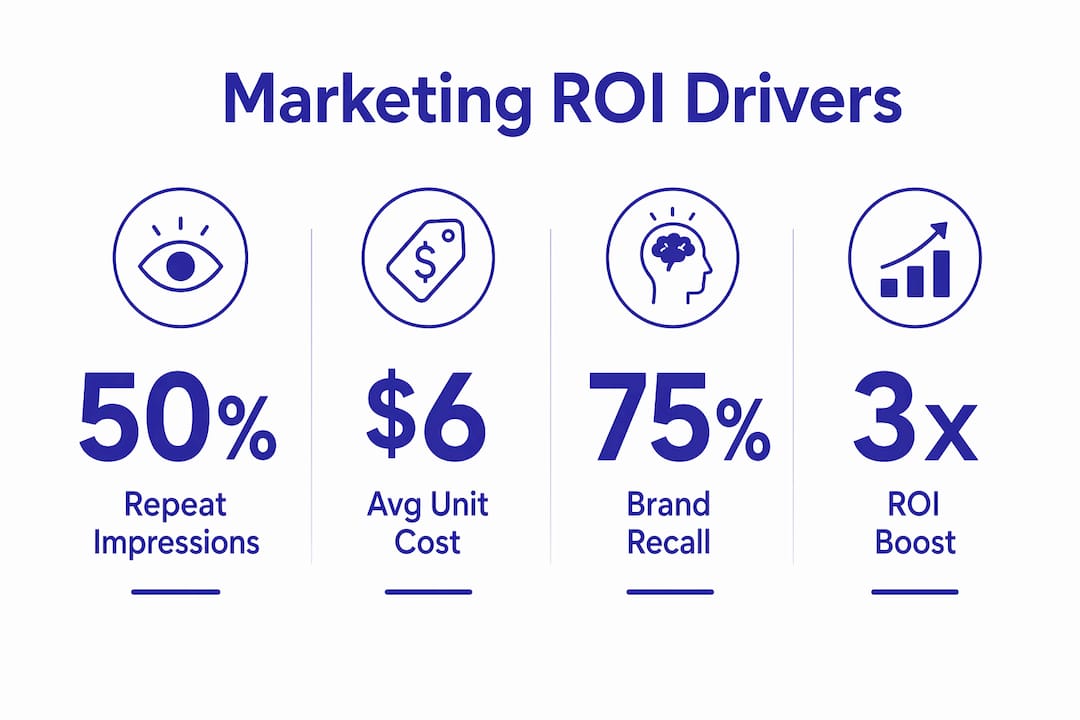
Consumer behavior research reinforces this point with specificity. 78% of consumers keep promotional products because they find them useful, and 85% can recall the advertiser who gave them a logoed item. Usefulness is the single strongest predictor of retention, which means category selection is fundamentally a question of audience utility, not brand preference.
Different categories also align with different campaign objectives:
- Brand awareness campaigns benefit from high-visibility categories like apparel and bags, which generate impressions in public settings and reach audiences beyond the original recipient.
- Lead generation and trade show programs favor writing instruments and tech accessories, which are compact, budget-friendly, and have immediate desk utility that keeps the brand in view.
- Client retention and executive gifting call for premium drinkware, gift sets, or corporate gift sets that signal quality and reinforce relationship value.
- Employee recognition programs work well with apparel and branded kits, which build internal culture and create visible brand advocates.
Pro Tip: Map each category to a measurable outcome before ordering. If your goal is brand recall at a trade show, choose a category with daily use potential like a tumbler or a tote, not a category that recipients will store in a drawer.
Understanding promotional products ROI at the category level lets you justify budget allocations with data rather than intuition. That matters when presenting to a CFO or a skeptical CMO who wants to see promotional spend treated as media spend.
How to choose the right promotional product category
Selecting the right category requires matching four variables: your audience, your campaign objective, your budget, and the operational realities of production. Most marketers get the first two right and underestimate the last two. Here is a structured approach that accounts for all four.
-
Define the campaign objective first. Awareness, lead generation, retention, and employee engagement each favor different categories. Awareness campaigns need reach, which means wearable or portable items. Retention campaigns need perceived value, which means quality drinkware or gift sets.
-
Profile your recipient. Age, profession, lifestyle, and daily environment all affect which category will generate the most use. A tech-forward audience responds to wireless chargers and phone accessories. An outdoor-oriented audience gravitates toward performance apparel and insulated bottles.
-
Set a realistic per-unit budget. Categories vary significantly in cost structure. Writing instruments can be sourced for under $1 per unit at volume. Premium drinkware from brands like YETI or Hydro Flask runs $25 to $50 per unit. The category you choose must fit the budget without forcing a quality compromise that undermines the brand impression.
-
Check decoration compatibility. Decoration methods differ by category and affect how well your logo reproduces. A complex multi-color logo may not translate well to laser engraving on metal drinkware. Confirm decoration options before committing to a category.
-
Factor in lead time. Apparel with custom embroidery typically requires 10 to 15 business days. Tech accessories with electronic compliance testing can take longer. If your campaign has a hard deadline, lead time eliminates certain categories before price even enters the conversation.
-
Evaluate usefulness against quality. PPAI research shows that 55% of recipients value daily usefulness and 21% specifically note high quality as a reason they keep a promotional item. Poor quality within any category reduces retention and damages brand perception rather than building it.
Pro Tip: Before finalizing a category, ask your distributor for usage data or category performance benchmarks from similar campaigns. Discountswag can provide category-level guidance based on campaign type and audience profile, which removes guesswork from the selection process.
Trends shaping promotional product categories in 2025 and 2026
The top five promotional product categories by sales volume have remained stable year over year, with T-shirts, drinkware, polos, caps, and bags holding their positions through 2024 into 2025. That stability is useful for planning because it confirms that core categories carry predictable demand, reliable vendor supply chains, and well-established decoration infrastructure. For most campaigns, starting with these categories is a lower-risk decision than chasing emerging product types.
That said, the 2025 ASI State of the Industry report flagged a notable shift: drinkware’s growth rate has slowed due to tariff pressures and changing import dynamics. Categories like bags and food gifts are gaining ground as alternatives, particularly for campaigns where the brand wants to signal thoughtfulness rather than utility alone. Food and gift sets are especially effective for client appreciation programs because they create a moment of experience rather than a passive brand impression.
Sustainability is reshaping category decisions at the premium end of the market. Recycled material totes, organic cotton apparel, and bamboo writing instruments are no longer niche requests. They are standard options in most distributor catalogs, and recipients increasingly judge branded merchandise on environmental credentials alongside quality. Brands that align their category choices with sustainability values generate stronger favorability among millennial and Gen Z audiences.
Consumer preferences also reflect a clear shift toward fewer, better items. The research is direct: branded merchandise judged on usefulness and quality outperforms high-volume, low-quality giveaways in every retention and recall metric. The practical implication for 2026 planning is to reduce SKU count per campaign, increase per-unit investment, and concentrate budget in one or two categories that align tightly with audience behavior.
Key takeaways
Promotional product categories are the structural foundation of any effective branded merchandise strategy, and selecting the right one requires aligning audience utility, campaign objectives, and production realities.
| Point | Details |
|---|---|
| Category definition | A promotional product category groups branded items by type to aid comparison and sourcing decisions. |
| Top categories by sales | Apparel, drinkware, bags, writing instruments, and tech accessories lead industry sales year over year. |
| ROI driver | Usefulness determines retention; 78% of consumers keep items they find useful, maximizing impressions. |
| Selection framework | Match category to campaign objective, audience profile, budget, and decoration compatibility before ordering. |
| Trend watch | Drinkware growth is slowing; bags, food gifts, and sustainable options are gaining share in 2025 and 2026. |
Why most marketers pick the wrong category
Most promotional product decisions I see are made backwards. The team picks a product they like, then tries to justify it with a campaign objective. That is the wrong sequence, and it consistently produces mediocre results.
The categories that generate the strongest brand recall are almost never the most visually exciting. A well-chosen tote bag or a quality tumbler will outperform a clever gadget every time, because the tote goes to the grocery store and the tumbler sits on the desk. Frequency of use is the variable that drives impressions, and impressions are what justify the spend.
I have also seen brands underinvest in category research and overspend on decoration. A $3 pen with a four-color logo is still a $3 pen. The category sets the ceiling on perceived quality, and no amount of decoration upgrades that ceiling. Choosing a category one tier above your instinct, and simplifying the decoration, almost always produces a better result.
The other mistake is treating all campaigns as if they need the same category. A trade show giveaway and an executive gift are solving different problems for different audiences. The category framework exists precisely to help you make that distinction systematically rather than intuitively. Use it that way.
— Jerry
Explore branded promotional product categories with Discountswag
Discountswag organizes its entire product offering by category, so you can move directly from campaign objective to product selection without sorting through irrelevant SKUs. Whether you are building a trade show kit around apparel and bags or sourcing premium drinkware for a client retention program, the catalog is structured to match the way marketing teams actually plan campaigns.
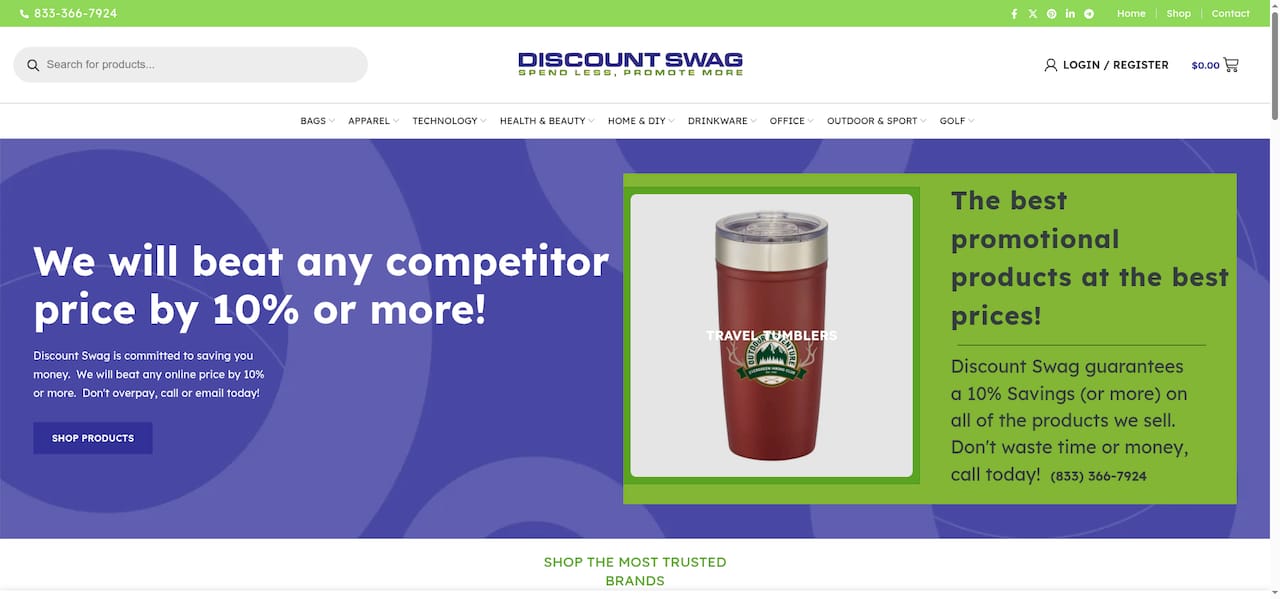
Browse branded promotional products by category to find options across apparel, drinkware, tech accessories, writing instruments, and more, each with decoration specs and volume pricing. If you are evaluating apparel specifically, the promotional apparel guide covers decoration methods, sizing considerations, and campaign fit in detail. Discountswag works with marketing teams and procurement leads to match category selection to campaign goals, not just product availability.
FAQ
What is a promotional product category?
A promotional product category is an industry classification that groups branded merchandise by product type, such as apparel, drinkware, or bags, to help marketers compare items by use-case and decoration method. Categories are used by distributors like Discountswag and industry bodies like ASI and PPAI to organize product catalogs for efficient sourcing.
What are the top promotional product categories by sales?
The top five categories by sales in 2024 were T-shirts, drinkware, polos, caps, and bags, in that order. This ranking has remained stable year over year, making these categories reliable starting points for most campaign types.
How do I choose the right promotional product category?
Start by defining your campaign objective, then profile your recipient audience, set a per-unit budget, and confirm decoration compatibility and lead time. Categories that produce useful, frequently used items generate the highest impressions and the strongest brand recall.
Why does category choice affect marketing ROI?
Category choice determines how often recipients use the item and how many impressions the brand receives over time. A $6 tote bag generates approximately 5,000 impressions at roughly $0.001 per impression, which outperforms most paid media channels on a cost-per-impression basis.
What is the difference between promotional products and branded merchandise?
Promotional products and branded merchandise refer to the same class of items: logoed goods given freely to promote a brand. The term “ad specialties” is the formal industry label, emphasizing that these items are distributed without purchase requirements solely to build goodwill and brand awareness.
 Bottle Carriers
 Mugs
Mugs