

Branded Swag Campaign Strategy: A 2026 Marketer’s Guide


A branded swag campaign strategy is a focused plan for selecting, distributing, and measuring promotional merchandise to maximize brand impact and customer connection. Unlike ad hoc giveaways, a structured promotional merchandise strategy treats every item as a marketing asset with a defined goal, audience, and measurable outcome. According to ASI’s 2026 Ad Impressions Study, 78% of consumers keep promotional products because they find them useful, and 76% are more likely to do business with a brand that gave them branded merch. Those numbers make one thing clear: swag works when it is planned, not improvised. This guide walks marketing professionals and brand managers through every stage of building an effective swag campaign, from goal setting to ROI measurement.
What makes a branded swag campaign strategy work?
A successful branded swag campaign strategy rests on six components. Miss one and the campaign loses efficiency. Get all six right and you have a repeatable system that builds brand equity with every item distributed.
- Strategic goal setting. Define what the campaign must achieve before ordering a single item. Goals might include lead generation at a trade show, client retention, or employee brand advocacy. Every product choice flows from this goal.
- Audience research. The best swag fits into a recipient’s daily routine. A campaign targeting software developers calls for different products than one targeting C-suite executives. Survey your audience or review past campaign data to identify what they actually use.
- Brand alignment. Every item must carry your brand colors, logo, and messaging in a way that feels intentional, not slapped on. A mismatched color or a logo printed too small undermines the impression you paid for.
- Product selection. Prioritize usefulness and quality. PPAI research confirms that consumers keep swag primarily because it is useful (55%) and high-quality (21%). Cheap, generic items end up in the trash and take your brand impression with them.
- Distribution planning. Decide whether items ship via direct mail, get handed out at events, or arrive as part of a welcome kit. The distribution method affects perceived value and the likelihood of retention.
- Measurement and optimization. Build tracking into the campaign from day one. Promo codes, campaign URLs, and CRM tagging all create data you can act on after the campaign ends.
Pro Tip: Set a cost-per-impression target before you finalize your product selection. That single number forces every product decision to be grounded in ROI, not aesthetics.
How do you select promotional products that maximize retention?
Product selection is where most campaigns either win or waste budget. The core principle is simple: useful items get kept, and kept items generate impressions for months or years. A product that sits on a desk or rides in a bag every day is a billboard you paid for once.

The product categories with the strongest daily use rates are tech accessories, apparel, drinkware, and bags. A branded insulated tumbler goes to the office, the gym, and the coffee shop. A quality tote bag appears at grocery stores, airports, and client meetings. These items generate passive impressions far beyond the original recipient.
| Product category | Daily use potential | Cost-per-impression | Sustainability options |
|---|---|---|---|
| Drinkware (tumblers, mugs) | Very high | Very low | Yes (recycled materials) |
| Tote bags | High | Very low | Yes (organic cotton, recycled) |
| Tech accessories | High | Low | Moderate |
| Apparel (T-shirts, hats) | Moderate | Low | Yes (sustainable fabrics) |
| Pens / notepads | Low | Moderate | Moderate |
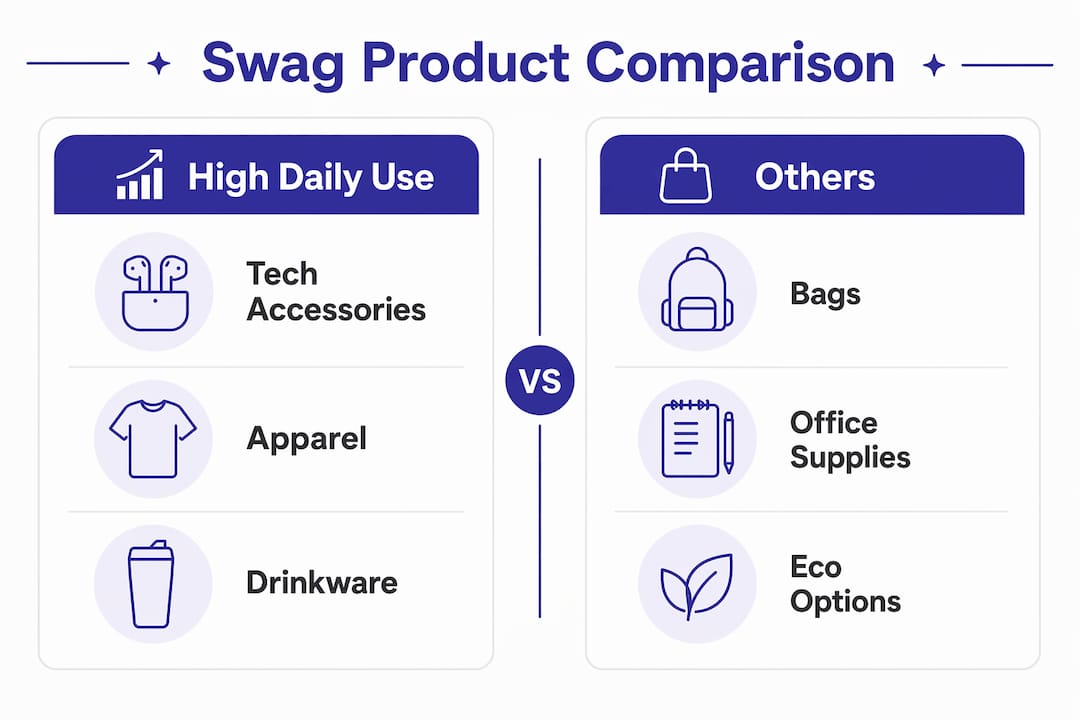
ASI research shows that promotional products deliver impressions at an average cost of $0.006, outperforming TV and digital advertising on a per-impression basis. A $6 tote bag alone generates nearly 5,000 impressions over its lifetime at roughly 0.1 cent per impression. That math makes the case for investing in fewer, better items rather than flooding recipients with cheap giveaways.
Sustainable and Made-in-USA items also carry a perception premium. Consumers view brands more favorably when their swag reflects environmental responsibility. For brand managers building long-term loyalty, that perception lift is worth the modest price increase. You can review current product trends to identify which categories are gaining traction with specific audiences in 2026.
Pro Tip: When comparing two products at different price points, calculate cost-per-impression for each, not just unit cost. A $15 item used daily for two years almost always beats a $3 item discarded in a week.
What are effective swag marketing tactics for engagement and loyalty?
Product selection gets you in the door. Tactics determine whether the campaign actually moves the needle on engagement and brand loyalty. The most effective swag marketing tactics combine personalization, channel integration, and precise timing.
Personalization
Personalized swag, items printed with a recipient’s name or initials, yields about 30% higher ROI than generic giveaways. The reason is psychological: a product with your name on it feels like a gift, not a handout. That emotional response translates directly into stronger brand association and unaided recall.
Multi-channel integration
Swag works harder when it is part of a coordinated campaign. Integrating swag with direct mail and digital channels enhances perceived value and creates more tracking opportunities. A direct mail piece that arrives alongside a branded item gets opened. A follow-up email referencing the item gets read. The combination outperforms either channel alone.
Campaign timing and sequencing
The four tactics below have the strongest track record for boosting engagement:
- Pre-event kits. Ship branded items before a conference or webinar. Recipients arrive already connected to your brand and are more likely to engage with your booth or session.
- Milestone gifts. Send swag at contract anniversaries, onboarding completions, or purchase milestones. Timing tied to a meaningful moment amplifies the emotional impact.
- Incentive-based giveaways. Tie swag to a specific action, such as completing a survey, attending a demo, or referring a contact. This creates measurable attribution and motivates participation.
- Welcome kits. New clients and new employees who receive a curated branded kit on day one report stronger brand affinity from the start.
Tracking and data collection
Every campaign needs a mechanism for attribution. Promo codes printed on packaging, QR codes linking to campaign landing pages, and CRM tags on swag recipients all create data trails. Without these, you cannot distinguish which items drove pipeline and which ones simply got used without generating a business outcome.
How do you measure swag campaign performance and ROI?
Measurement transforms swag from a cost center into a defensible marketing investment. The metrics that matter most are cost-per-impression, brand recall lift, lead attribution, and retention rates.
Cost-per-impression is the most universal benchmark. Divide the total campaign cost by the estimated number of impressions generated over the item’s useful life. ASI data puts the industry average at $0.006 per impression. Use that as your baseline and aim to beat it with product and distribution choices.
Brand recall lift requires pre- and post-survey measurement. Survey a sample of recipients before the campaign and again 60–90 days after distribution. A well-executed campaign targeting the right audience with useful items should produce a measurable increase in unaided brand recall.
Lead attribution tracks whether swag recipients converted to leads or customers at a higher rate than non-recipients. CRM tagging makes this possible. Tag every contact who received swag and compare their conversion rate to your control group over the following quarter.
Pro Tip: Use unique promo codes on each swag item type, not just each campaign. That granularity tells you whether the tote bag or the tumbler drove more conversions, so you can cut the underperformer next time.
Branded merchandise is one of the most cost-efficient advertising channels available, and tracking methods like promo codes and landing pages enable clear attribution. The brands that treat measurement as optional are the ones that cut swag budgets during downturns. The ones that track rigorously defend and grow those budgets because the data supports them.
Common challenges in branded swag campaigns and how to avoid them
Even well-intentioned campaigns fail when execution misses on a few critical points. These are the most common pitfalls and the fixes that work.
- Generic, low-quality items. A cheap pen with a smudged logo does more brand damage than no swag at all. PPAI data confirms that quality drives retention. Spend more per unit and order fewer items if budget is tight.
- Focusing on unit price instead of cost-per-impression. A $1 item that gets thrown away immediately has an infinite cost-per-impression. A $12 item used for 18 months has a cost-per-impression of fractions of a cent. The math always favors quality.
- Misalignment with brand values. Distributing single-use plastic items while your brand publicly champions sustainability creates cognitive dissonance. Audiences notice. Choose products that reflect what your brand actually stands for.
- No personalization or audience segmentation. Sending the same item to every segment of your audience ignores what you know about them. Segment by role, industry, or relationship stage and match the product accordingly.
- Skipping measurement entirely. Campaigns without tracking produce anecdotes, not data. Without data, you cannot justify the budget, refine the approach, or prove that swag contributed to pipeline. Build tracking in before you place the order, not after.
- Poor distribution timing. Swag that arrives after an event, or too early to feel relevant, loses its impact. Coordinate logistics so items land at the moment of highest engagement.
Key takeaways
A branded swag campaign strategy succeeds when useful, quality products are matched to the right audience, distributed at the right moment, and tracked with clear metrics from the start.
| Point | Details |
|---|---|
| Usefulness drives retention | Select items recipients use daily to maximize impressions and brand exposure over time. |
| Cost-per-impression beats unit price | Evaluate every product by impressions generated per dollar, not sticker price alone. |
| Personalization lifts ROI | Adding recipient names or initials produces roughly 30% higher ROI than generic items. |
| Multi-channel integration amplifies results | Pairing swag with direct mail or digital campaigns increases engagement and attribution accuracy. |
| Measurement is non-negotiable | Use promo codes, CRM tags, and pre- and post-surveys to track recall lift and lead conversion. |
Why most swag campaigns underperform (and what I’ve learned from the ones that don’t)
The uncomfortable truth about most branded swag campaigns is that they are planned backward. Marketers pick a product they like, slap a logo on it, and figure out the goal later. I have seen this pattern repeat across industries, and the result is always the same: a storage room full of branded stress balls and no data to show for the spend.
The campaigns that actually work start with a single question: what does this recipient do every day, and how does our product fit into that routine? ASI’s 2026 data reinforces what experienced practitioners already know. 85% of consumers remember the advertiser after receiving a promotional product, and 75% hold a positive opinion of the brand. Those numbers only materialize when the item is useful and well-made.
The other shift I have seen make a real difference is treating swag as a channel, not a category. When you integrate swag with your broader campaigns and measure it with the same rigor you apply to paid search or email, the ROI becomes defensible. That defensibility is what gets swag budgets protected when finance starts asking questions. Stop ordering swag. Start planning swag campaigns.
— Jerry
Discountswag can support your next swag campaign
Building a campaign that performs requires more than a good idea. It requires the right products, reliable sourcing, and a partner who understands what brand managers actually need.
Discountswag carries a wide selection of promotional items for brand awareness across every major category, from drinkware and tech accessories to apparel and bags. Every product is available with custom branding, and the catalog reflects the quality and usefulness standards that ASI research consistently links to higher retention and stronger impressions. If you are ready to move from ad hoc giveaways to a campaign that generates measurable results, Discountswag has the product range and expertise to help you get there. You can also review the full guide to choosing corporate swag to sharpen your product selection before you place your next order.
FAQ
What is a branded swag campaign strategy?
A branded swag campaign strategy is a structured plan for selecting, distributing, and measuring promotional merchandise to achieve specific marketing goals. It differs from a simple giveaway by tying every product decision to audience research, brand alignment, and measurable outcomes.
Why do promotional products outperform digital ads on cost-per-impression?
Promotional products deliver impressions at an average cost of $0.006, compared to significantly higher rates for TV and digital placements. A single item used daily for months or years generates thousands of impressions from one fixed production cost.
How do I track ROI from a swag campaign?
Use unique promo codes, campaign-specific landing page URLs, and CRM tags to attribute leads and conversions to swag recipients. Pre- and post-surveys measure brand recall lift among the same audience group over a 60–90 day window.
What types of swag generate the most impressions?
Drinkware, tote bags, tech accessories, and apparel generate the highest daily use rates and, by extension, the most impressions per dollar spent. Items that fit naturally into a recipient’s daily routine outperform novelty items every time.
Does personalized swag really perform better than generic items?
Yes. Personalized promotional products, those printed with a recipient’s name or initials, yield approximately 30% higher ROI than generic equivalents. The personal connection strengthens brand association and increases the likelihood the item is kept and used.
 Bottle Carriers
 Mugs
Mugs