


Promotional Products vs Digital Ads: 2026 Guide


Promotional products are tangible branded items, such as tote bags, apparel, mugs, and pens, distributed to consumers to build brand awareness and loyalty. Digital ads encompass search engine marketing on Google Ads, social media advertising on Facebook and Instagram, display banners, and video placements. The debate around promotional products vs digital ads is not about choosing one or the other. It is about understanding where each channel delivers the most value. According to the Advertising Specialty Institute (ASI), promotional products achieve an 85% consumer recall rate compared to just 9–10% for digital display ads. That gap defines the entire strategic conversation.
How do promotional products compare to digital ads in brand recall and ROI?
Promotional products deliver brand impressions at an average cost of $0.006 per view, making them one of the most cost-efficient advertising formats available. A single $6 branded tote bag generates between 3,300 and 5,700 impressions over its lifespan. That works out to a fraction of a cent per view, a figure no digital platform consistently matches.
The owned media versus rented media distinction is critical here. A quality branded fleece generates impressions at $0.004 per view for years after purchase. Digital ads stop working the moment you stop paying. That structural difference has major implications for long-term marketing budget allocation and campaign planning.

| Metric | Promotional products | Digital display ads |
|---|---|---|
| Brand recall rate | 85% | 9–10% |
| Average cost per impression | $0.004–$0.006 | Varies; often higher at scale |
| Consumer favorability | 78% view brands more favorably | Lower, ad fatigue is common |
| Impression lifespan | Months to years | Seconds to days |
| Media ownership | Owned (one-time cost) | Rented (ongoing spend required) |
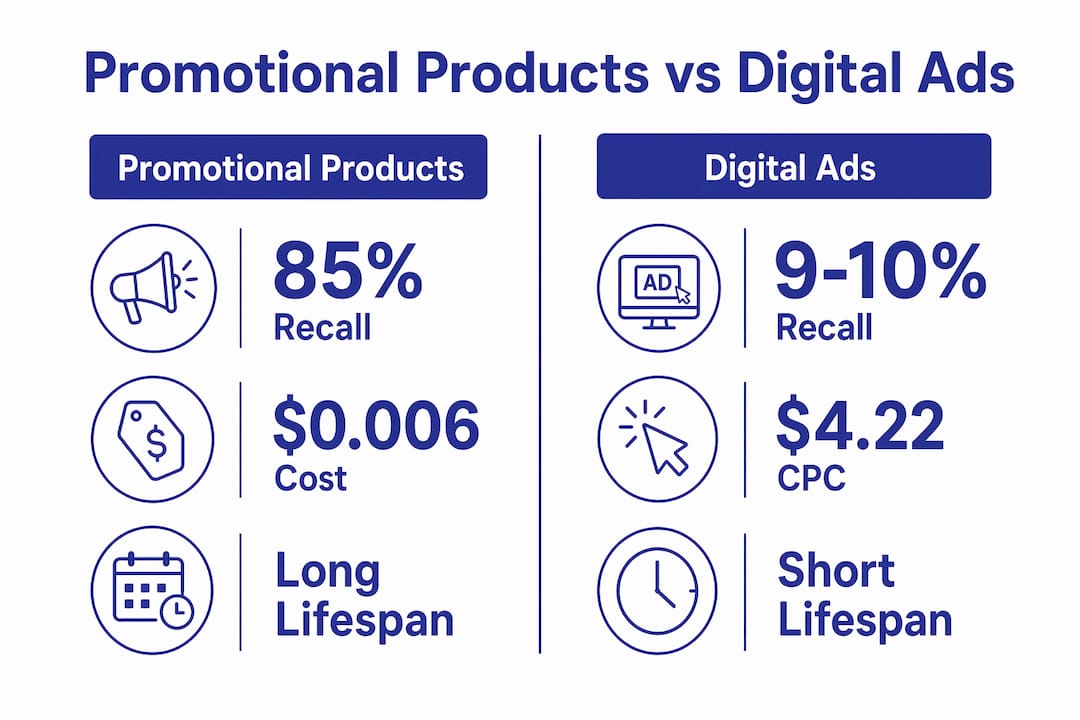
Consumer favorability data reinforces the recall advantage. 78% of consumers view brands more favorably after receiving a promotional item, a rating higher than TV, social media, radio, and print. That is not a marginal edge. It is a structural advantage that compounds over time as recipients continue using the item.
Pro Tip: When evaluating campaign ROI, calculate the total lifetime impressions of a promo item, not just the unit cost. A $10 branded water bottle used daily for two years delivers far more value than its sticker price suggests.
What are the advantages and challenges of digital advertising strategies?
Digital advertising strategies offer targeting precision that promotional merchandise cannot match. Google Ads, Facebook, Instagram, and LinkedIn allow marketers to reach specific demographics, behaviors, and purchase intent signals in real time. That capability makes digital channels ideal for the discovery and conversion stages of a marketing funnel.
The cost structure, however, is unforgiving. Google Ads averages $4.22 CPC across industries, while social media platforms range from $0.50 to $2.80 per click. Those numbers climb fast in competitive verticals like finance, legal, and software. Budget exhaustion is a real risk when campaigns are not tightly managed.
Personalization does improve performance. 75% of consumers are more likely to purchase from brands that use retargeting and personalized ad experiences. That statistic explains why retargeting campaigns on Facebook and Google Display Network remain standard practice. The challenge is that personalization requires data infrastructure, ongoing creative refresh, and budget continuity.
Ad fatigue and banner blindness erode digital ad effectiveness over time. Users develop selective attention to ad placements, particularly on platforms where ad density is high. Marketers running digital campaigns should apply these practices to reduce fatigue:
- Rotate creative assets every 2–3 weeks to prevent audience burnout
- Use frequency caps to limit how often one user sees the same ad
- Segment audiences tightly so messaging stays relevant
- Test video formats, which hold attention longer than static display banners
- Layer retargeting with exclusion lists to avoid over-targeting recent converters
Digital ads suit immediate awareness and lead generation. They are less effective at building the kind of durable brand memory that promotional merchandise creates through repeated physical contact.
How do promotional products create emotional engagement and long-term brand loyalty?
Promotional merchandise triggers what behavioral economists call the reciprocity effect. When a consumer receives a useful, quality item for free, they feel a psychological obligation to view the brand favorably. That response is not manufactured. It is a well-documented human behavior that promo items activate consistently.
78% of consumers keep promotional products because they find them useful, and 76% say they are more likely to buy from a brand that gave them promotional merchandise. Those two statistics together describe a loyalty loop. Usefulness drives retention. Retention drives repeated brand exposure. Repeated exposure drives purchase intent.
Digital ads operate on an interruption model. A pre-roll video on YouTube or a sponsored post on LinkedIn appears between the content a user actually wants. The brand association formed in that moment is often neutral or negative. Promotional items, by contrast, are welcomed into daily routines. A branded mug used every morning creates a positive brand association hundreds of times per year.
The slow-burn nature of promo products is their defining advantage for brand loyalty. A digital ad impression lasts seconds. A branded notebook used throughout a workday delivers brand exposure for months. That sustained presence is what builds the kind of top-of-mind awareness that converts to long-term customer relationships.
Pro Tip: Select promo items that recipients will use in professional or social settings. A high-quality branded pen or insulated tumbler travels beyond the original recipient, generating secondary impressions you never paid for.
What are the sustainability considerations in promotional products vs digital ads?
Sustainability has become a measurable factor in channel selection, not just a brand value statement. A landmark study found that promotional products generate up to 8x less carbon impact per memorized impression compared to digital advertising. That finding challenges the assumption that physical goods are inherently less sustainable than digital channels.
Digital advertising carries a significant energy footprint. Data centers powering Google, Meta, and programmatic ad networks run continuously. AI-driven targeting, real-time bidding, and repeated ad delivery across millions of devices accumulate substantial energy consumption. Each digital impression requires server processing, data transmission, and device rendering. Those costs multiply at scale.
Promotional products, by contrast, generate a single production event followed by years of passive impressions. Eco-friendly materials, such as recycled cotton totes, bamboo pens, and biodegradable packaging, reduce that production footprint further. Marketers who source from suppliers with verified sustainability credentials can make a credible environmental case for promo merchandise.
| Channel | Carbon impact per memorized impression | Impression lifespan | Eco-friendly options |
|---|---|---|---|
| Promotional products | Up to 8x lower | Months to years | Recycled, organic, biodegradable materials |
| Digital advertising | Higher due to data infrastructure | Seconds to days | Limited; tied to energy grid sourcing |
Responsible marketers now factor carbon efficiency alongside cost per impression when planning campaigns. The data supports promo products as the more sustainable choice at the impression level, particularly when items are made from certified eco-friendly materials.
How can marketers effectively integrate promotional products and digital advertising?
The strongest campaigns do not choose between promotional merchandise and digital ads. They use digital channels to generate awareness and promo items to cement loyalty. Experts recommend treating these as complementary channels within a single funnel, not competing budget line items.
A practical integration model works like this. Digital ads on Google or Facebook drive initial discovery and capture leads. Those leads then receive a branded promo item, a welcome kit, a conference giveaway, or a direct mail package. The physical item reinforces the digital message and creates a tangible brand touchpoint that the screen cannot replicate. Adding a QR code to the promo item then connects physical gifts back to digital content, closing the loop and enabling attribution tracking.
Structured digital funnels work best when promo products handle the retention layer. Digital ads are expensive at the retention stage because re-engaging existing customers through paid media costs nearly as much as acquiring new ones. A well-chosen promo item does that retention work at a fraction of the cost.
Practical steps for building an integrated campaign:
- Map your funnel stages: awareness, consideration, conversion, and retention
- Assign digital ads to awareness and consideration; assign promo items to conversion and retention
- Use QR codes or custom URLs on promo items to track engagement and attribute conversions
- Personalize promo items by audience segment, just as you would personalize ad creative
- Set a combined budget that allocates spend based on funnel stage, not channel preference
- Measure success using lifetime customer value, not just immediate click-through or open rates
- Review the data-driven case for promo products before finalizing budget splits
Timing matters. Promo items delivered immediately after a digital ad campaign peaks reinforce the message while brand awareness is still high. That sequencing amplifies recall and increases the probability of conversion.
Key takeaways
Promotional products outperform digital ads in brand recall, cost per impression, consumer favorability, and sustainability, while digital ads lead in targeting precision and real-time reach.
| Point | Details |
|---|---|
| Recall advantage is decisive | Promotional products achieve 85% recall vs 9–10% for digital display ads. |
| Cost efficiency favors promo items | A branded item delivers impressions at $0.004–$0.006 each, often beating digital CPCs. |
| Emotional engagement drives loyalty | 76% of consumers are more likely to buy from brands that gave them promo merchandise. |
| Sustainability supports promo products | Promo items generate up to 8x less carbon per memorized impression than digital ads. |
| Integration outperforms either channel alone | Use digital ads for discovery and promo items for retention to maximize campaign impact. |
What I’ve learned from watching promo products outperform digital year after year
I have watched marketing teams pour budget into Google Ads and Facebook campaigns, hit their click targets, and then struggle to explain why brand recall surveys came back flat six months later. The clicks were real. The memory was not.
The most common mistake I see is treating promotional merchandise as a line item to cut when digital CPCs rise. That logic is backwards. When paid media gets expensive, owned media becomes more valuable, not less. A branded item that generates impressions for two years does not get more expensive when Google raises its auction floor.
The second mistake is buying cheap promo items to hit a unit count. A flimsy pen that breaks in a week does not create a positive reciprocity effect. It creates a negative one. Quality matters enormously in this channel because the item’s perceived value directly shapes the brand perception it creates. Discountswag’s quality-focused approach to merchandise selection reflects exactly this principle.
My honest advice: stop treating digital and promo as competing channels and start treating them as different tools for different funnel stages. Measure both on lifetime customer value, not short-term metrics. And when you are evaluating sustainability as a brand priority, the carbon data on promo products will surprise you.
— Jerry
Branded promotional products for your next campaign
Discountswag works with marketing teams that need physical brand touchpoints to complement their digital advertising strategies. Whether you are planning a trade show giveaway, a client welcome kit, or a retention campaign, the right product makes the difference between a forgotten impression and a lasting brand memory.
Browse the full range of branded promotional products for marketers at Discountswag, from eco-friendly totes and premium drinkware to tech accessories and custom apparel. Every category is built for marketers who need quality, variety, and budget flexibility in one place. If you are ready to build a campaign that combines digital reach with physical brand presence, Discountswag has the merchandise to make it work.
FAQ
What is the recall rate for promotional products vs digital ads?
Promotional products achieve an 85% consumer recall rate, compared to just 9–10% for digital display ads, according to ASI’s 2026 Ad Impressions Study. That gap makes promo items the strongest channel for long-term brand memory.
How much do promotional products cost per impression?
A branded promotional item delivers impressions at an average of $0.004 to $0.006 each, with a single $6 tote bag generating up to 5,700 impressions over its lifespan. Digital platforms like Google Ads average $4.22 per click, making promo items significantly more cost-efficient at the impression level.
Are promotional products more sustainable than digital ads?
A landmark study found that promotional products generate up to 8x less carbon impact per memorized impression than digital advertising. Digital ad delivery relies on energy-intensive data centers and repeated server processing, while a promo item creates a single production event followed by years of passive impressions.
How do promotional products and digital ads work together?
Digital ads drive initial awareness and lead generation, while promotional merchandise reinforces brand loyalty at the conversion and retention stages. Adding QR codes to promo items connects physical touchpoints back to digital campaigns, enabling attribution tracking across both channels.
Which marketing channel works better for brand loyalty?
Promotional products outperform digital ads for brand loyalty. Research shows 76% of consumers are more likely to buy from brands that gave them promo merchandise, driven by the reciprocity effect that tangible gifts create.
 Bottle Carriers
 Mugs
Mugs