


How Promotional Budgets Work: A 2026 Marketer’s Guide


A promotional budget is the planned allocation of financial resources toward marketing activities, with the goal of driving specific, measurable business outcomes. Understanding how promotional budgets work separates campaigns that generate real returns from those that simply spend money. The Gartner CMO Spend Survey 2025 puts average marketing spend at 7.7% of revenue across industries, with wide variation by sector. That number means nothing without a clear system for deciding where every dollar goes and how performance gets measured.
How promotional budgets work: the core framework
A promotional budget is not just a spending cap. It is a financial plan that connects every marketing dollar to a defined objective, whether that is brand awareness, lead generation, or customer retention. Budget decisions directly shape messaging strategy, reach frequency, and competitive positioning. A well-built budget forces clarity on what success looks like before a single dollar is spent.
The industry term for this discipline is promotional budget management, and it sits within the broader practice of integrated marketing communications (IMC) planning. Marketing professionals use it to coordinate spending across channels, time periods, and campaign types. The goal is not to spend less. The goal is to spend in a way that produces a predictable, repeatable return.
B2B companies typically allocate 2–5% of annual revenue to marketing, while B2C companies range from 5–10%, with consumer packaged goods sometimes exceeding 20–25%. Growth-mode companies often push that figure to 10–20%. These benchmarks give marketing teams a starting point, but they are not a substitute for a method-driven approach.

What are the main methods for setting a promotional budget?
Marketing teams use four primary methods to set total promotional budgets. Each has a distinct logic, and the right choice depends on your data maturity, competitive environment, and planning timeline.
- Percentage-of-sales: The team sets the budget as a fixed percentage of projected or past revenue. This method is fast and easy to defend in budget reviews, but it creates a circular problem. Sales drive the budget, which drives sales. If revenue dips, the budget shrinks exactly when spending may need to increase.
- Competitive parity: The budget mirrors what competitors spend, often estimated through industry reports or media monitoring tools. This method prevents underspending in competitive markets but ignores the fact that your objectives may differ entirely from a competitor’s.
- Affordable method: Leadership sets a budget based on what the business can afford after covering fixed costs. This is common in early-stage companies but produces inconsistent results because it disconnects spending from goals.
- Zero-based budgeting (ZBB): Every line item is justified from scratch each cycle, with no carryover assumptions. ZBB takes more time but eliminates legacy spending that no longer serves current objectives.
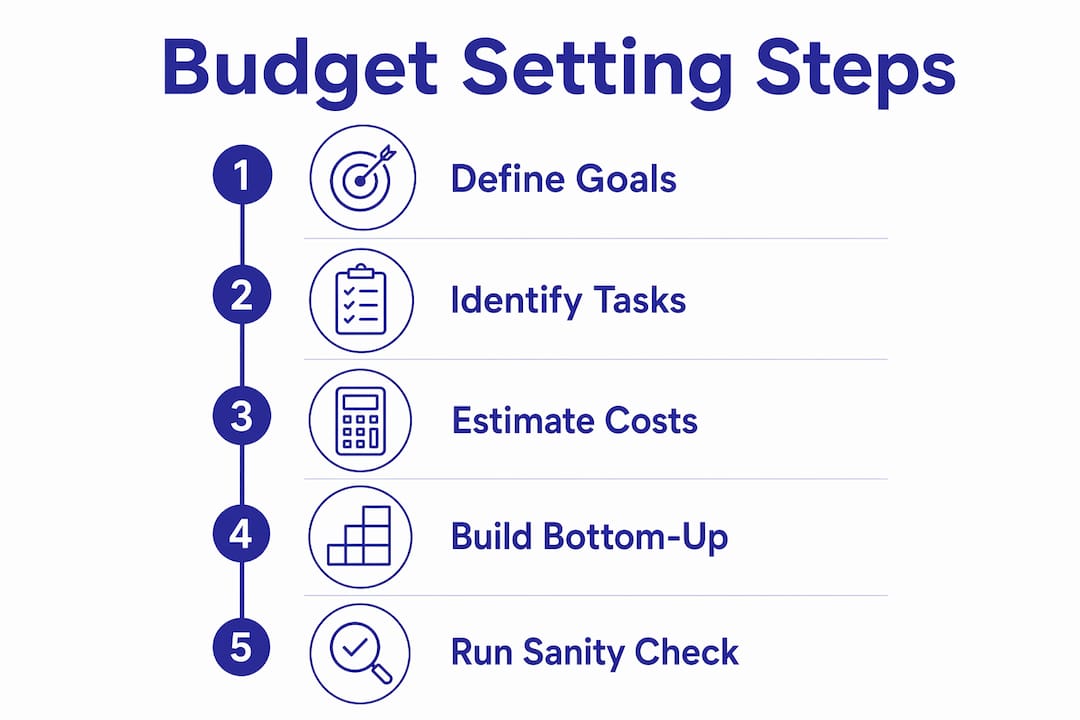
The objective-and-task method is the most effective of all approaches. It starts with a defined goal, identifies the specific tasks required to reach it, and prices each task precisely. This bottom-up logic ensures spending ties directly to strategic outcomes rather than arbitrary percentages.
Bottom-up budgeting delivers 15–30% better cost estimation accuracy than top-down methods. The tradeoff is time and data. Teams that lack historical campaign data often start with a top-down method and migrate to objective-and-task as their measurement systems mature.
Pro Tip: Run a “sanity check” after building a bottom-up budget. Benchmark your total against industry averages and competitive parity figures. If your number is wildly out of range, revisit your objectives rather than cutting execution arbitrarily.
How do you allocate a promotional budget across channels?
Setting the total budget is only half the work. Allocating it across channels and activities determines whether the money actually reaches the right audience. The first step is separating working spend from non-working spend.
Working spend covers direct consumer reach: paid media, sponsorships, branded merchandise, and event placements. Non-working spend covers agency fees, creative production, and campaign management. Mixing the two without tracking them separately creates invisible waste. A campaign can appear to be fully funded while most of the budget never reaches a single customer.
Once you have that separation clear, allocate across channels using this sequence:
- Audit past performance. Pull cost per acquisition (CPA) and return on ad spend (ROAS) by channel from your last two or three campaigns. Channels with strong historical performance earn the largest share of proven budget.
- Apply the 70/20 rule. Allocate 70% of your budget to proven tactics and 20% to newer or experimental strategies. The remaining 10% covers production and management costs. This split balances efficiency with the need to find your next high-performing channel.
- Reserve a testing budget. Monte Carlo simulations suggest campaign returns peak when testing consumes roughly 20% of the overall budget. That figure shifts based on customer acquisition cost and audience size, but the principle holds: underfunding tests means you never find what works at scale.
- Adjust for audience demographics. A B2B audience concentrated on LinkedIn requires a different channel mix than a consumer audience reachable through connected TV or retail activations. Match channel weight to where your audience actually spends attention.
Pro Tip: When planning event giveaway budgets, treat branded merchandise as working spend. It reaches the customer directly and generates measurable impressions, making it a trackable media channel, not an overhead cost.
How do you monitor and control promotional budget performance?
Budget monitoring is not a post-campaign activity. It is a continuous process that runs from the first day of spend to the final audit. Three metrics anchor effective budget control.
- ROAS (return on ad spend): Total revenue generated divided by total promotional spend. A ROAS of 4:1 means every dollar spent returned four in revenue. Track this by channel, not just in aggregate, to identify where spend is working hardest.
- Cost per acquisition (CPA): Total spend divided by the number of new customers or conversions. CPA tells you how efficiently the budget converts attention into action. Rising CPA mid-campaign signals a need to reallocate, not simply spend more.
- Variance analysis: Compare planned spend against actual spend weekly. A 10% overage in week two compounds quickly across a 12-week campaign. Tracking KPIs like ROAS and variance enables mid-campaign adjustments that protect total budget integrity.
Post-campaign audits are equally important. A promotional product audit after each campaign reveals which items generated the most impressions per dollar, which events produced the strongest CPA, and where non-working spend crept above acceptable levels. Teams that skip this step repeat the same inefficiencies in the next cycle.
The most common pitfall in budget control is treating a shortfall as a reason to cut execution. Experts advise scaling objectives to match the available budget rather than delivering a diluted version of the original plan. A campaign that reaches 60% of its target audience with full creative impact outperforms one that reaches 100% with a compromised message.
What are the advanced challenges in promotional budget management?
Experienced marketing teams face a set of challenges that basic budgeting frameworks do not fully address. The most persistent is balancing growth budgets against efficiency budgets within the same fiscal year.
Growth budgets prioritize customer acquisition and market share. They accept higher CPA in exchange for volume. Efficiency budgets prioritize margin and retention. They reduce spend on acquisition and invest in loyalty and reactivation. Most organizations need both simultaneously, which requires ring-fencing each budget type and measuring them against separate KPIs.
Market conditions shift budgets in ways that no annual plan fully anticipates. A competitor’s aggressive campaign, a supply chain disruption, or a sudden shift in consumer behavior can make a carefully built budget obsolete within weeks. Teams that build scenario models, including best-case, base-case, and stress-case spending plans, respond faster and with less internal friction.
New product launches add another layer of complexity. Payout planning for a launch requires modeling the time it takes for promotional spend to generate enough revenue to cover its own cost. This is not the same as standard ROAS tracking. It requires a longer time horizon and a willingness to run at a loss in early periods.
“The biggest mistake in promotional budgeting is treating the number as a constraint rather than a tool. When the budget tightens, the right move is to narrow your objectives, not water down your execution. A focused campaign with a smaller reach almost always outperforms a broad campaign with a compromised message.”
Key Takeaways
Effective promotional budget management connects every dollar to a defined objective, tracks performance continuously, and adjusts based on data rather than instinct.
| Point | Details |
|---|---|
| Use objective-and-task budgeting | Link every dollar to a specific goal and task cost for the most accurate and defensible budget. |
| Separate working from non-working spend | Track media buys and branded merchandise separately from agency fees to measure true ROI. |
| Apply the 70/20 allocation rule | Put 70% toward proven channels and 20% toward testing to balance efficiency with growth. |
| Monitor ROAS and CPA mid-campaign | Weekly variance tracking prevents small overages from compounding into budget failures. |
| Scale objectives, not just spend | When budgets tighten, narrow your campaign focus rather than diluting execution across all channels. |
Why I think most teams budget promotions backwards
Most marketing teams I have worked with build their promotional budget by starting with a number from finance and then figuring out what they can do with it. That is backwards. The number should come from the objectives, not the other way around.
The objective-and-task method feels like more work upfront because it is. You have to define success precisely before you can price it. But that discipline pays off every time a budget review comes around. When you can show exactly what each dollar is buying and what outcome it is tied to, budget conversations become straightforward rather than political.
The other thing I have learned is that the teams with the best results are not the ones with the biggest budgets. They are the ones who treat their budget as a living document. They check variance weekly, run post-campaign audits without fail, and carry those findings into the next planning cycle. The cost per impression data from branded merchandise, for example, consistently surprises teams who assumed digital was always the most efficient channel.
Avoid spreading budget thin across every possible channel to appear comprehensive. Pick fewer channels, fund them properly, and measure them rigorously. That discipline produces results that compound over time.
— Jerry
How Discountswag helps you get more from your promotional spend
Branded merchandise is one of the most underused tools in a well-structured promotional budget. When treated as working spend rather than a miscellaneous line item, it delivers measurable impressions at a cost that often outperforms paid digital channels.

Discountswag works with marketing teams to match branded merchandise to specific campaign goals, whether that is trade show activation, product launches, or employee engagement programs. The catalog covers everything from budget-friendly promotional items for high-volume distribution to premium branded products for key accounts. For teams building their 2026 campaign plans, the 2026 brand awareness guide is a practical starting point for aligning product selection with budget tiers and audience goals.
FAQ
What is a promotional budget?
A promotional budget is the planned allocation of financial resources toward marketing and advertising activities to achieve defined business goals. It covers all forms of paid promotion, including media, events, and branded merchandise.
How do you calculate a promotional budget?
The most accurate method is objective-and-task budgeting: define your campaign goals, list the specific tasks required, and price each task. This bottom-up approach produces more accurate cost estimates than percentage-of-sales or competitive parity methods.
What percentage of revenue should go to promotional spending?
B2B companies typically allocate 2–5% of revenue to marketing, while B2C companies range from 5–10%. The Gartner CMO Spend Survey 2025 reports an average of 7.7% across industries, with significant variation by sector and growth stage.
What is the difference between working and non-working spend?
Working spend reaches consumers directly through media buys, sponsorships, and branded merchandise. Non-working spend covers agency fees, creative production, and campaign management. Tracking both separately is the only way to measure true promotional ROI.
How do you know if a promotional budget is performing well?
Track ROAS, cost per acquisition, and weekly spend variance against your plan. Effective budget monitoring requires mid-campaign adjustments, not just a post-campaign review, to protect ROI across the full spend period.
 Bottle Carriers
 Mugs
Mugs