

Bulk Order Promotional Product Checklist for Teams

A one-page checklist beats a scattered email thread every time you place a bulk promo order. Before you open a vendor’s order form, collect six fields: campaign goal, total quantity, exact SKU, approved artwork file, hard deadline, and a named owner. Each field ties back to what most university procurement checklists require before a purchase order even gets routed for approval.
Three things to do right now, before anything else:
- Confirm who has final sign-off authority on budget and artwork, and get that in writing.
- Attach the exact final artwork file names to the order, not “final_v2_REAL” sitting in someone’s downloads folder.
- Lock the delivery deadline, then subtract at least five business days as a shipping buffer.
Print this page. Hand it to procurement, your vendor rep, or whoever inherits the order if you’re out sick. It’s your source of truth until the boxes arrive.
Key Takeaways
A bulk promo order stays on budget and on time when the team locks specs, approvals, and proof sign-off in writing before production starts.
| Point | Details |
|---|---|
| Collect six fields upfront | Campaign goal, quantity, SKU, approved artwork, deadline, and owner before opening any order form. |
| Budget beyond unit cost | Include setup fees, packaging, shipping, tax, and a contingency line in every quote request. |
| Treat proofs as final | Compare proofs against original files carefully since approved errors are often not reimbursed. |
| Inspect immediately on arrival | Document defects with photos within the vendor’s seven to fourteen day claim window. |
| Discountswag maps to each step | Sample requests, tracked proofing, and multi-location fulfillment align directly with this checklist. |
Table of Contents
- Planning Your Campaign Objectives, Scope, and Budget
- What Specs Do You Need Before Requesting a Quote?
- How Do You Handle Artwork Files and Proof Sign-off?
- Setting a Production Schedule and Payment Terms
- Planning Packaging, Kitting, and Fulfillment
- Confirming Shipping Terms and Receiving Procedures
- Running Quality Control and Handling Returns
- Launch-Day Checklist and Escalation Contacts
- How Discountswag Maps to Every Step of This Checklist
- What Buyers Get Wrong Most Often on Bulk Orders
- Ready to Put This Checklist Into Action?
- Templates and Guidance Worth Bookmarking
- Frequently Asked Questions
- Sources
Planning Your Campaign Objectives, Scope, and Budget
Start with the objective, not the product. A trade show giveaway, an onboarding kit, and a client thank-you gift call for different price points, quantities, and quality bars. Write down the audience segment, the target metric (impressions, redemption rate, headcount served), and the total quantity that metric implies before you request a single quote.
Your budget template needs more than a per-unit price. Bulk orders carry setup and tooling fees, packaging, freight, tax, and a contingency line that often gets left out of the first draft budget, then shows up as a surprise on the invoice.
| Budget line | What to capture |
|---|---|
| Unit cost | Base price per item at your target quantity tier |
| Customization/setup fee | One-time or per-run, confirm which |
| Packaging | Poly bag, box, kit assembly |
| Shipping | Freight class, expedited surcharge if rushed |
| Tax and contingency | Sales tax plus 5% buffer for overruns |
Approval matters just as much as arithmetic. Establish who signs off on the budget, what cost-center or P.O. number the order draws from, and a one-line escalation path (name, email, response window) if the vendor needs a fast answer mid-production.
What Specs Do You Need Before Requesting a Quote?
Vague product descriptions cause more reorders than bad artwork does. A promotional product buying guide worth using pushes you to lock exact specs before you request pricing, not after.
Your item spec sheet needs these fields filled in for every product on the order:
- SKU or catalog number and vendor item code
- Size breakdown (by quantity, not just “assorted”)
- Material and color, with PMS reference for brand-critical colors
- Imprint location and maximum imprint dimensions
- MOQ and tiered pricing at each quantity break
Setup, mold, and tooling fees deserve their own line, and you need to know upfront whether they’re charged once or on every reorder. Vendor systems route orders by SKU, so a wrong item number is one of the most common reasons buyers get the wrong product entirely.
Decide early which items are disposable-volume plays and which are relationship gifts. That single decision drives MOQ negotiation and how much quality scrutiny each item gets.
How Do You Handle Artwork Files and Proof Sign-off?
Send vector files only: .AI, .EPS, or a print-ready .PDF with all fonts outlined. Raster logos pulled from a website almost always print blurry at scale, and that mistake shows up on every single unit in a 500-piece run.
Every color needs a PMS or hex value attached, not “brand blue.” Your proof template should record who reviewed it (name and email), the proof version number, and where the final signed approval lives, ideally a shared drive folder, not someone’s inbox. Vendors treat an approved proof as final, and reprints for errors visible on that proof are frequently not covered.
Set a placement tolerance and a minimum readable text size before you approve anything. For complex multi-color or oddly shaped items, request a physical sample, not just a digital mockup.
Pro Tip: Compare the proof side-by-side with your original file at full size, not thumbnail size. Small text and thin lines that look fine zoomed out can disappear entirely once printed.
Setting a Production Schedule and Payment Terms
Work backward from your delivery date. Build a timeline with named owners at each milestone:
- Artwork approval, confirmed and dated in writing.
- Prototype or pre-production sample, reviewed and signed off.
- Production start, confirmed by the vendor in writing.
- Mid-run quality checkpoint.
- Ship date, with tracking number issued.
- Delivery, confirmed by the receiving contact.
Lead times swing widely by product complexity. Stock items with simple one-color imprints can ship in a week or two; custom-molded or multi-component kits often need four to six weeks, longer if any component crosses a border and clears customs.
Payment terms need to be in writing before production starts:
- Deposit percentage and what triggers it (order confirmation vs. artwork approval)
- Balance due date, tied to a milestone, not a calendar guess
- Accepted payment methods: purchase order, credit card, or wire transfer
- Invoicing contact and expected turnaround for invoice delivery
Planning Packaging, Kitting, and Fulfillment
Packaging decisions belong on the checklist just as much as product selection does. Bulk pallet shipping, retail-ready packaging, and individual poly bagging each carry different costs and different labor requirements on the receiving end.

If you’re assembling kits, your bill of materials needs every component listed with exact quantities per kit, any personalization rules (name tags, department-specific colors), and the packing sequence, so the fifth kit assembled looks identical to the five hundredth.
| Fulfillment model | Best fit |
|---|---|
| Vendor-managed fulfillment | Single-item bulk orders shipping to one address |
| Third-party logistics | Multi-location kits needing staged inventory |
| In-house distribution | Small-batch, high-touch client gifts |
Decide who owns returns and undelivered packages before the first box ships. A missing owner here is how damaged shipments sit in a warehouse for three weeks.
Confirming Shipping Terms and Receiving Procedures
Get shipping terms in writing: who owns freight cost, which carrier handles the shipment, and whether the load is insured. Ask for tracking updates at pickup and at each major transit point, not just a single number at the end.
When boxes arrive, inspect immediately. Count against the packing list, check print quality and color on a sample from each carton, and photograph anything questionable. Claim windows are typically within a limited period after delivery, and that clock starts at delivery, not at whenever someone gets around to opening the boxes.
| Receiving step | Action |
|---|---|
| Count check | Match units received to packing list |
| Visual QC | Sample-check print, color, and finish |
| Documentation | Photograph any defect before touching more units |
Your distribution plan needs a finalized address list, a decision on single versus multi-location drop-offs, and a communication protocol so recipients know when to expect their items.
Running Quality Control and Handling Returns
Log every sample approval with a sample ID, the approval date, and the name of whoever signed off, plus any exceptions noted at the time. That record is your defense if a batch comes back different from what you approved.
| QC checkpoint | Acceptance criteria |
|---|---|
| Sample approval | Matches proof for color, size, imprint clarity |
| Mid-run inspection | Dimensional tolerance and color consistency hold |
| Final inspection | Full carton count matches order, no visible defects |
Set a nonconformance template with fields for defect description, photo evidence, unit count affected, and the vendor’s claim window. Name who signs off on any remediation plan before a replacement order goes out.
Launch-Day Checklist and Escalation Contacts
On delivery day, confirm arrival against your tracking number, spot-check a handful of units for quality, and verify counts for any priority recipients (executives, VIP clients) first.
- Confirm shipment arrival and match to tracking.
- Spot-check item quality on a small sample.
- Verify priority-recipient counts before general distribution.
Keep a short contacts list on hand: fulfillment owner, vendor rep, and event logistics lead, each with a phone number and a backup. Once distribution starts, update inventory records, log delivery confirmations, and open your post-campaign report.
How Discountswag Maps to Every Step of This Checklist
Discountswag’s ordering flow mirrors this checklist directly: sample requests before commitment, a documented proofing process with version tracking, and kitting plus multi-location fulfillment for teams shipping to more than one office or event.
Rush requests are common, and getting an accurate rush quote depends on having your specs ready: final artwork, target quantity, and ship-by date, submitted together rather than in follow-up emails.
Pro Tip: Request your physical sample the same week you lock artwork, not after. It’s the single fastest way to catch a color or size problem before it multiplies across a thousand units.
What Buyers Get Wrong Most Often on Bulk Orders
The most expensive mistakes are the boring ones: skipping the prototype on a complex item, assuming a reorder costs the same as last time, or letting approved artwork live in someone’s inbox instead of a shared folder. Reorder pricing and setup fees shift more often than buyers expect, and skipping that check is where margin quietly disappears.
Every one of those failures traces back to a step on this checklist that got skipped under deadline pressure. The fix isn’t more urgency. It’s fewer shortcuts.
Ready to Put This Checklist Into Action?
You’ve got the framework. Discountswag runs the execution, with proofing, kitting, and multi-location fulfillment built into the ordering process instead of bolted on after the fact.
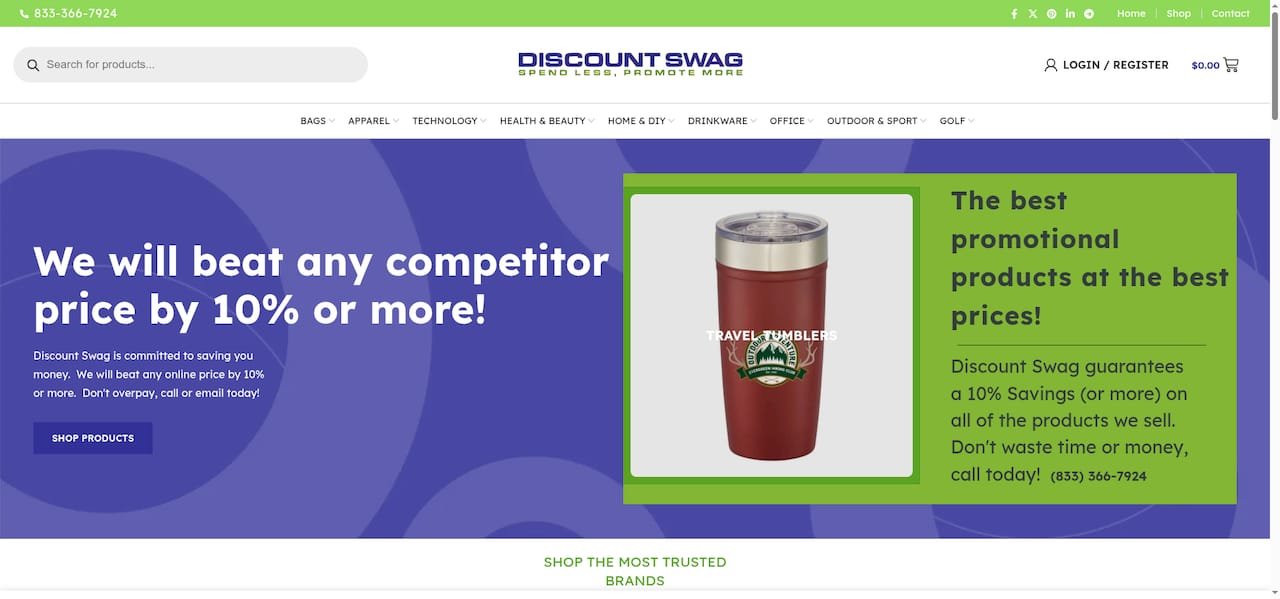
Before you request a quote, have these ready: final artwork file names, target quantities per item, delivery addresses (single or multiple), your desired ship-by date, and a rough budget range so the quote lands close to reality on the first pass. Most requests get a response within one business day, and rush production is available for teams working against a tight launch window.
Start with the promotional items for brand awareness guide if you’re still narrowing down product categories, or go straight to a quote request if your specs are locked and you’re ready to move.
Templates and Guidance Worth Bookmarking
- Promotional items ordering checklist: standard required fields for procurement routing.
- Order form field guide: SKU accuracy and proof sign-off practices.
- Reorder discipline guidance: pricing checks for repeat orders.
- Custom corporate apparel bulk buying guide: size breakdowns and setup fee specifics.
Frequently Asked Questions
What’s the minimum lead time for a bulk promotional product order?
Simple, single-color items can ship in one to two weeks. Custom-molded products or multi-component kits typically need four to six weeks, plus extra time if components ship internationally.
How many samples should I request before approving a large run?
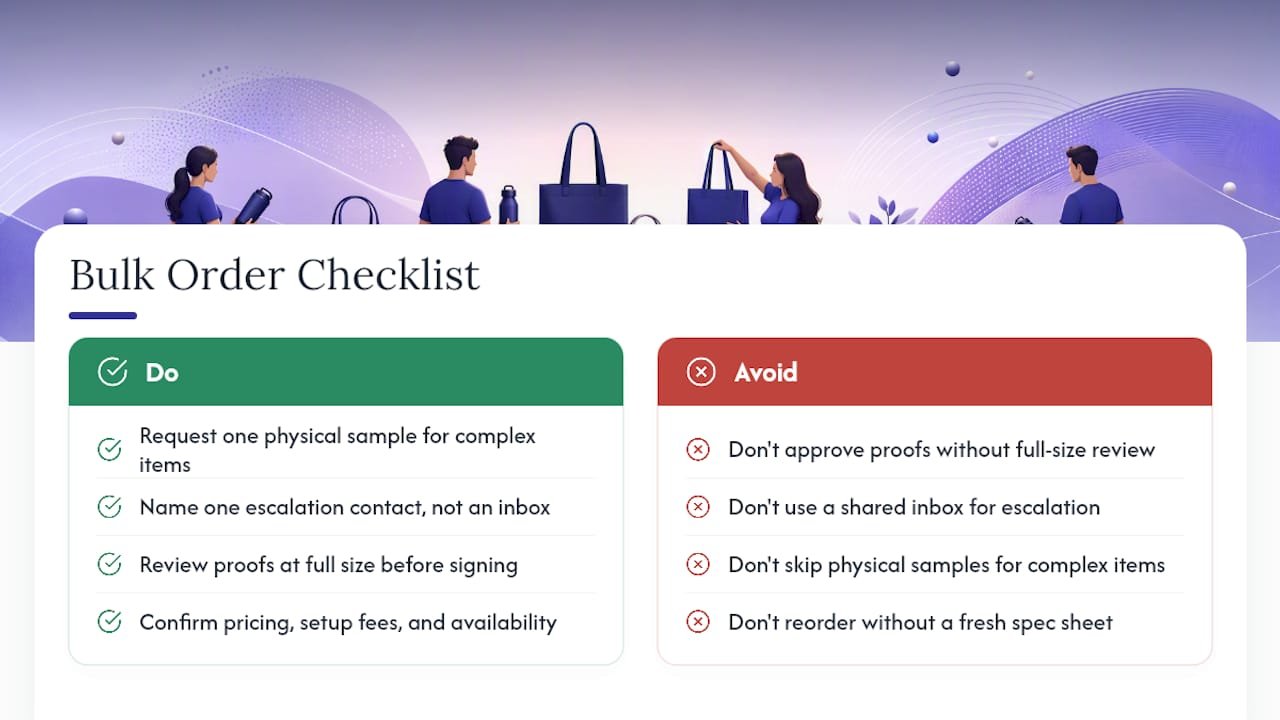
Request at least one physical sample for any complex or high-value item before signing off on production. It’s a small step that catches color and sizing problems before they repeat across the full order.
Who should own the escalation contact on a bulk order?
Name one person, not a shared inbox. That person should have direct contact information for the vendor’s account manager and authority to approve minor changes without waiting on a full committee.
What happens if I approve a proof and then find an error?
Most vendors treat an approved proof as final, and reprints for errors visible on that proof are often billed separately. Review proofs at full size against your original files before signing off.
Do reorders need a fresh spec sheet?
Yes. Confirm current pricing, setup fees, and product availability every time, since supplier costs and product lines change between orders.
Sources
- Promotional Items Ordering Checklist
- How to Fill Out and Submit a Promotional Material Order Form – LegalClarity
- Reorder Discipline for Promo Merchandise Distributors
 Bottle Carriers
 Mugs
Mugs