


Marketers: How a $100 Promotional Setup Fee Drops to $0.20 Per Unit

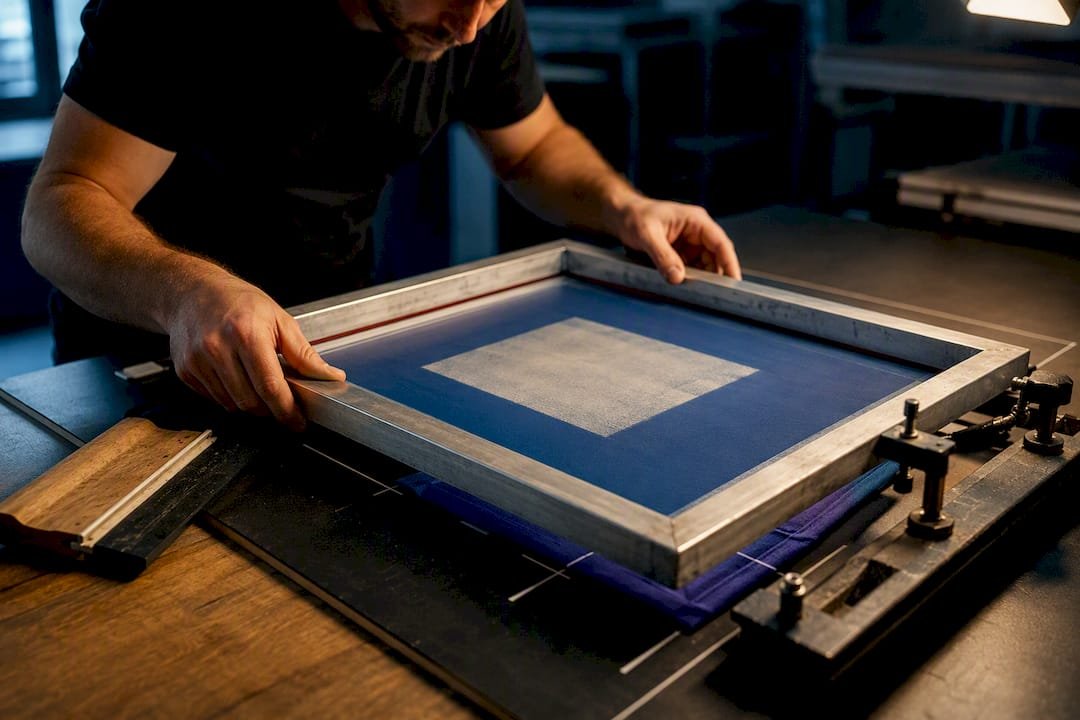
Setup fees are one-time charges that cover the machine work needed before your logo touches a single item, and most buyers pay somewhere between $0 and $150 depending on the decoration method. Screen printing typically runs $25 to $75 per color, embroidery digitizing lands at $50 to $150, and digital methods often skip the fee entirely. A setup fee is a one-time charge. A run charge repeats on every unit.
TL;DR:
- Setup fees vary widely by decoration method, with screen printing costing $25–$75 per color and embroidery digitizing around $50–$150, often waived for reorders.
- The fixed setup cost is spread over order quantity, meaning small runs have higher per-unit costs, while larger orders significantly lower the effective price.
- Reorders typically reduce setup fees by 50 to 75 percent or waive them altogether if files are retained, but temporary file storage lasts six months to a year.
- Minimizing artwork complexity and selecting digital or laser methods for small orders can drastically cut upfront costs before negotiations.
- Always clarify if setup fees are per color, location, or design, and request written policies on reorders and storage to avoid unexpected charges.
Table of Contents
- What Promotional Product Setup Fees Actually Cover
- Setup Fees by Decoration Method: What’s Normal, What’s a Red Flag
- Why Order Quantity Changes Your Real Cost Per Unit
- When Suppliers Waive Setup Fees (and What Reorders Really Cost)
- How to Cut Your Setup Costs Without Cutting Corners
- Questions to Ask Before You Approve Any Quote
- A Sample Quote: Reading the Real Numbers
- What Buyers Consistently Get Wrong About Setup Fees
- How Discount Swag Keeps Your Setup Costs Predictable
- Sources
What Promotional Product Setup Fees Actually Cover
A setup fee pays for the labor and equipment work needed to prepare a job before production starts. It is not padding. Accountants classify it as a fixed, batch-level cost that gets allocated across whatever quantity you order, which is exactly why ordering more units makes each one cheaper.
Here’s what’s actually happening behind that line item on your quote:
- Screen or plate creation — burning a mesh screen for each ink color or engraving a metal plate for pad printing.
- Embroidery digitizing — converting your logo into a stitch file the embroidery machine can read, color by color.
- Die or mold tooling — cutting a custom shape for molded items like stress balls or hard plastic pieces.
- Machine programming and calibration — dialing in a laser engraver or digital press to the exact size and placement your artwork needs.
- Test prints and scrap — running a sample piece (sometimes several) to check color match and registration before the real run starts.
- Quality-assurance time — a technician sign-off confirming the setup matches your approved proof.
- Artwork repro work — cleaning up a blurry logo or converting a file into a usable format.
Some of these costs blur together on a supplier’s invoice, and that is where negotiation room lives — see how to review supplier quotes and pricing packages for best results with pricing and packages. Basic artwork cleanup is often folded into the base price at no charge, while physical tooling almost always carries its own fee because it consumes machine time regardless of order size. Molded items are the extreme case: a custom mold for injection-molded plastic can cost far more than a screen or embroidery file, which is why suppliers treat packaging and mold tooling as an entirely different cost category from standard decoration setup.
Setup Fees by Decoration Method: What’s Normal, What’s a Red Flag
Setup costs are not standardized across the industry, but each decoration method has a predictable range. Knowing that range lets you catch a quote that’s padded before you sign off on it.
| Decoration method | Typical setup fee | What drives the cost |
|---|---|---|
| Screen printing | $25–$75 per color, per location | Each ink color needs its own screen |
| Embroidery | $50–$150 (digitizing) | One-time stitch file creation, reusable on reorders |
| Pad printing | $25–$75 per color | Similar to screen printing, but for curved or small surfaces |
| Laser engraving | $0–$50 | Mostly programming time, no physical tooling |
| Digital print (DTG/DTF) or sublimation | $0–$25 | No screens or plates required |
Screen printing and pad printing charge per color because each color genuinely requires a separate physical screen or plate. A three-color logo on a two-location tee (front and sleeve) can rack up six separate setup charges before a single shirt gets printed. That’s the single most common surprise on a printed-apparel quote, and it’s worth asking about before you approve any multi-color, multi-location design.
Embroidery digitizing works differently. You pay once to create the stitch file, and that file gets reused on every reorder, which is why many suppliers waive the fee entirely on repeat business. Digital decoration methods generally skip tooling altogether, since the printer reads your artwork file directly, and that’s why suppliers can advertise low or no setup on drinkware, tech accessories, and full-color items.
Laser engraving sits in the middle. There’s no physical tool to make, but a technician still has to program the machine for your specific artwork and item placement, so a modest fee is common even without hard tooling.
Why Order Quantity Changes Your Real Cost Per Unit
Setup fees don’t scale with quantity. They’re fixed, so the math is simple: divide the total setup cost by how many units you order, and that’s the setup contribution baked into each item’s price.
- Small run: A $200 setup fee spread across 20 units adds $10 to the cost of every single item.
- Medium run: The same $200 spread across 200 units adds just $1 per unit.
- Large run: Spread across 2,000 units, that same fee adds only $0.10 per unit.
Pro Tip: Before approving a small order, ask your supplier to show setup cost as a per-unit line, not just a flat total. It reframes the real math instantly.
That tenfold and hundredfold drop in per-unit setup cost is why suppliers hit you with less-than-minimum (LTM) fees on tiny orders. If a product’s minimum order is 100 units and you only need 30, the supplier still has to run the same setup, so they tack on an LTM surcharge to cover the fixed cost they can’t spread across enough pieces. Consolidating two small departmental orders into one run is often the cheapest fix available, and it costs nothing but a phone call.
When Suppliers Waive Setup Fees (and What Reorders Really Cost)
Setup fees aren’t fixed in stone once you’re a repeat customer. Most suppliers reduce or waive them entirely on reorders, since the screen, digitizing file, or program from your last run is usually still on file.
- Reorder discounts: Expect setup fees cut by roughly 50 to 75% on reorders using the same artwork, assuming the supplier still has your file.
- Volume waivers: Many suppliers waive setup entirely above a certain quantity threshold, though that number varies widely by method and vendor.
- File retention windows: Screens and digitizing files typically get stored for six months to a year before a supplier purges them and charges a fresh setup fee.
- Get it in writing: A verbal “we’ll waive that next time” is worth exactly nothing on your next invoice. Ask for the waiver policy in an email you can point back to.
- Payment fees are separate: Some suppliers now pass along credit-card processing surcharges of 3 to 5%, which has nothing to do with setup but shows up on the same invoice, so ask about it independently.
How to Cut Your Setup Costs Without Cutting Corners
The cheapest setup fee is the one you never pay. A few practical moves consistently lower the total on your quote.
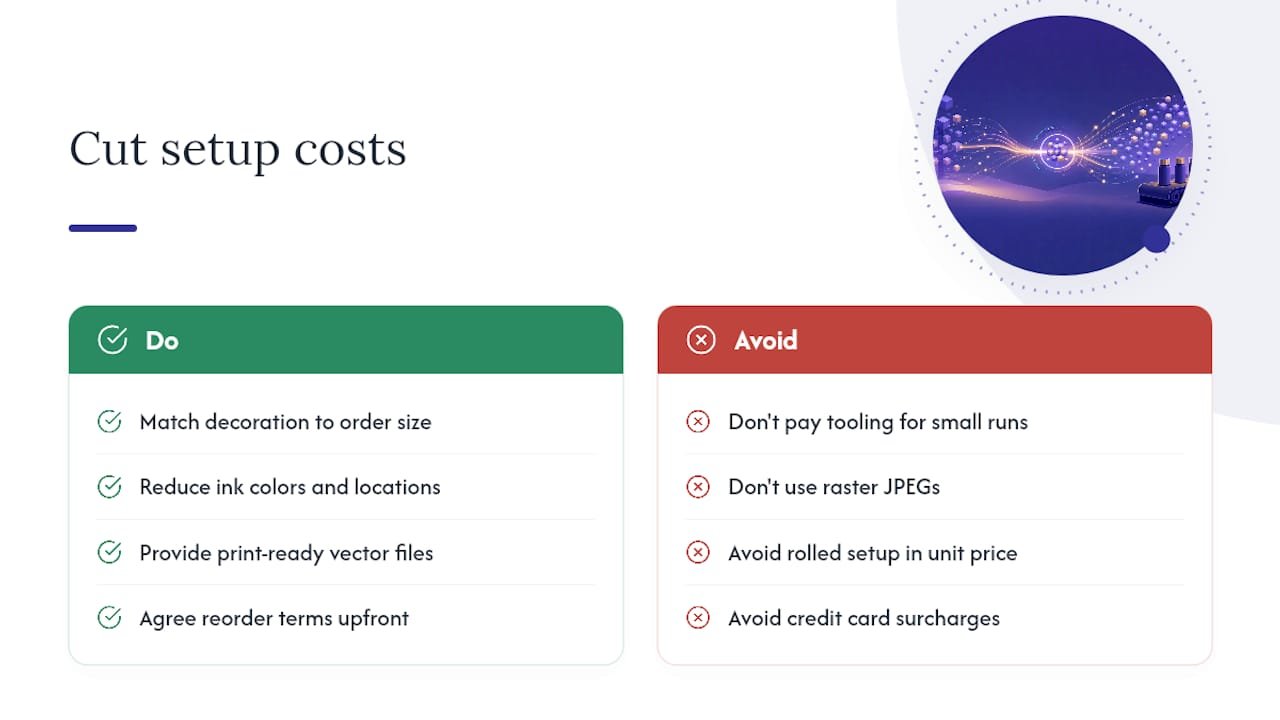
Match your decoration method to your order size. Small runs almost always do better with digital printing, laser engraving, or embroidery (once digitized) than with screen or pad printing, since those methods carry little to no tooling cost. If you’re ordering 40 tote bags for a one-off event, digital print beats screen printing on total cost even if the per-unit price looks slightly higher.
Simplify your artwork. Every extra ink color on a screen-printed item is another setup charge. Dropping a three-color logo to a two-color version, or picking one location instead of two, can shave $50 to $150 off a quote before you even negotiate. Supplying a clean, print-ready vector file (Adobe Illustrator or EPS format, not a JPEG pulled off your website) also avoids artwork-prep fees that some suppliers quietly add for raster files that need to be redrawn. Our guide on ordering branded merch without delays covers file prep in more detail.
Negotiate storage and reorder terms up front, especially if you know you’ll reorder the same design quarterly or annually. Committing to a rough annual volume, even informally, gives you leverage to ask for waived setup on every reorder within that window. And confirm your payment method before you’re staring at a final invoice. Paying by ACH or wire instead of credit card sidesteps processing surcharges that can quietly add hundreds to a large order.
One more decision worth understanding: some suppliers roll setup into a higher per-unit price instead of charging it separately. That’s not free setup, it’s disguised setup. It can simplify your budgeting on a single order, but it usually costs more if you plan to reorder, since you’re paying the setup premium every single time rather than once. For more cost-cutting angles, see how to reduce swag costs without cutting quality.
Questions to Ask Before You Approve Any Quote
Run through these before you sign off, ideally on a call rather than over email, so you get direct answers instead of a copy-pasted rate sheet.
- Is the setup fee charged per color, per location, or per design?
- What’s your reorder policy, and is any part of the setup fee waived or reduced?
- How long do you store my screens, digitizing files, or artwork on file?
- Are there separate artwork-prep or file-conversion fees if I don’t supply a vector file?
- Do you charge a credit-card processing fee, and does paying by ACH avoid it?
- What’s the rush fee if I need this sooner than your standard turnaround?
- Can you confirm the waiver and storage terms in writing, by email?
Before you approve the final invoice, check that every fee listed matches what was verbally quoted. Itemized quotes protect you; vague ones cost you later. Our step-by-step ordering guide walks through what a clean quote should look like line by line.
A Sample Quote: Reading the Real Numbers
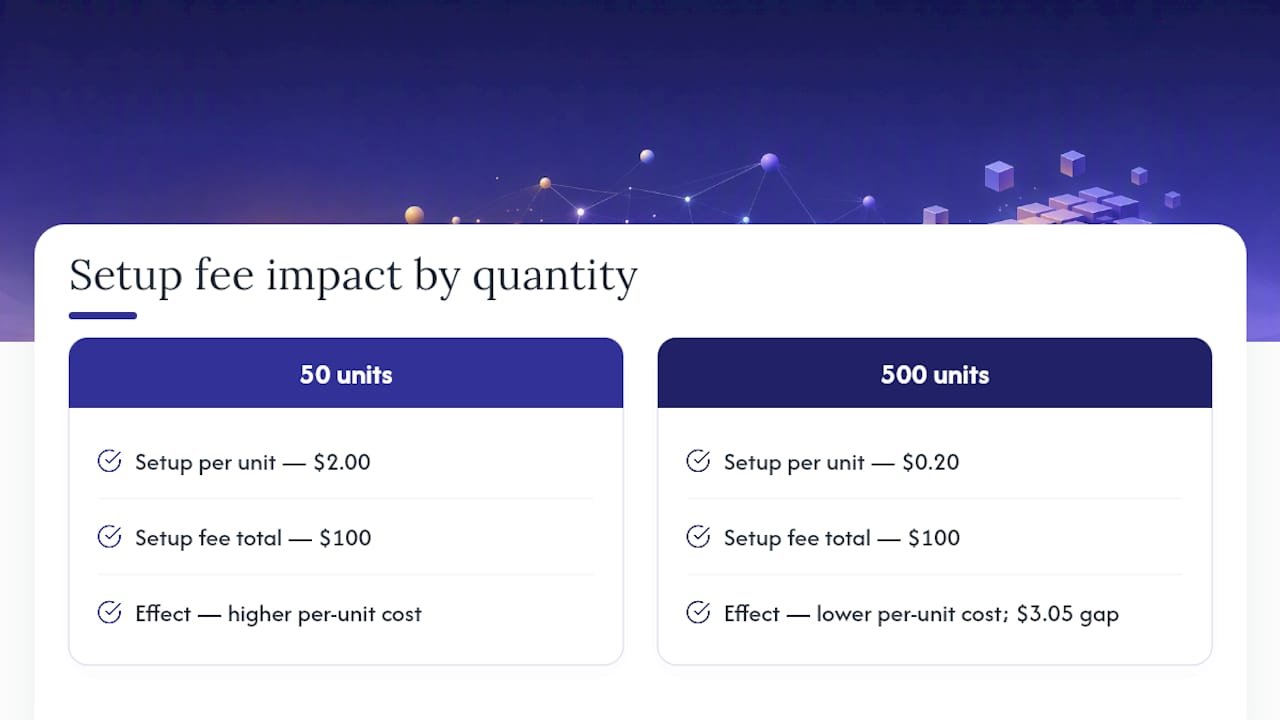
A typical quote for a screen-printed item breaks down into blank cost, decoration setup, run charge per unit, and extras like shipping or rush service. Here’s how the same design plays out at two different quantities.
The setup fee stays flat at $100 in both scenarios, but its contribution per unit drops from $2.00 at 50 units to just $0.20 at 500 units. That $3.05 gap in effective per-unit cost between the two runs comes almost entirely from that one fixed line spreading across a bigger batch, plus a better per-unit blank price at volume. If your event only needs 50 units, switching to a digital or laser method with little to no setup fee often closes that per-unit gap without forcing you to order 450 extra items you don’t need.
What Buyers Consistently Get Wrong About Setup Fees
Most procurement teams treat setup fees as a fixed tax they can’t influence. That’s the wrong mental model. A setup fee is a negotiated cost tied to a specific job, and the number on your first quote is rarely the final number.
The mistake I see most often is buyers fixating on the setup line item while ignoring the run charge and less-than-minimum fee sitting right next to it. A supplier can waive your $75 setup fee and still make it back through a slightly inflated per-unit run charge. Read the whole quote, not just the fee that has a name you recognize.
The other blind spot is artwork. Marketing teams hand over a logo pulled from a PowerPoint deck, get hit with a $35 “artwork prep fee,” and assume it’s just another cost of doing business. It’s not. A clean vector file, prepared once and reused across every future order, eliminates that charge permanently. It’s the cheapest investment a marketing department can make in its own swag budget.
Setup fees reward buyers who plan ahead and punish buyers who order reactively. If your company runs the same event kit every year, the fix isn’t complaining about setup costs. It’s locking in storage and waiver terms in writing so next year’s order starts at a lower baseline than this year’s did.
— Jerry
How Discount Swag Keeps Your Setup Costs Predictable
Artwork files are often stored after the first order, so reorders may skip the digitizing and screen-prep charges that catch most buyers off guard. That’s the real advantage here: no re-quoting the same setup fee every quarter, no guessing whether your logo file still exists on some vendor’s server.
A team may walk through your quote line by line before you approve anything, flagging per-color charges, artwork-prep fees, and rush surcharges up front instead of burying them at checkout. Rush ordering and fulfillment to multiple locations can be part of the process, so a last-minute event kit may not mean a last-minute markup. If you’re planning a recurring program rather than a one-off order, the guide to promotional items for brand awareness walks through how to structure a yearly swag budget around exactly the amortization math covered above.
Start by requesting an itemized quote for your next order and ask the supplier directly what your reorder rate looks like with stored artwork on file. It’s the fastest way to see your real cost per unit before you commit.
Sources
- Setup cost definition — AccountingTools
- How Promotional Product Pricing Works: Setup Fees, Tiers, and Rush Charges Explained
- Setup Time Cost Calculator | Free Manufacturing Tool
- Credit Card Fees Causing Friction Between Promo Products Suppliers & Distributors — ASI
 Bottle Carriers
 Mugs
Mugs