

Beat Promotional Product Minimums: 7 Supplier Questions Marketers Use

A minimum order quantity, or MOQ, is the smallest batch a supplier will run for a custom item, and it exists mostly to cover fixed setup costs like screens, molds, or embroidery digitizing. Expect ranges from small dozens of units on decorated apparel to high minimums on injection-molded goods, though stock items often carry no minimum at all. Check your product category and ask the supplier directly before you build a budget around a guess.
TL;DR:
- Minimum order quantities vary by decoration method, ranging from as low as 50 units for simple printed items to over 500 for molded products.
- Fully custom, molded, or handmade items often require larger orders, while stock items generally have no minimum but offer less customization.
- No minimum orders typically apply to stock items, which come with limited design options and higher per-unit costs compared to bulk custom orders.
- Building supplier questions into your RFQ about MOQ per decoration method helps avoid overordering and surprises during procurement.
- Small-batch testing through low-minimum or no-minimum options enables validation of designs before committing to larger, more cost-effective runs.
Table of Contents
- Why Suppliers Set Minimum Order Quantities
- Typical Minimums by Category (What to Budget For)
- What “No Minimum” Actually Means for Your Order
- The Pricing and Lead Time Math Behind Every Quote
- How to Lower or Avoid Minimums Without Overbuying
- Questions to Ask Every Supplier Before You Order
- Why This Guide Reflects Real Procurement Practice
- The Real Problem Isn’t the Minimum, It’s the Guessing
- Get a Straight Answer on MOQ Before You Commit to a Design
- Sources
Why Suppliers Set Minimum Order Quantities
Every custom order starts with a cost the supplier eats before producing a single unit: burning a screen, digitizing a logo for embroidery, or cutting a steel mold for an injection-molded item. Spread that fixed cost over 25 units and your per-piece price looks brutal. Spread it over 500 and it barely registers. That’s the entire logic behind an MOQ, and it’s why the number moves depending on decoration method rather than the product itself.
Some methods force higher floors than others:
- Screen printing needs a new screen per color, so multi-color designs push minimums up fast.
- Embroidery requires digitizing the logo into a stitch file, a one-time cost suppliers recoup through volume.
- Pad printing (common on pens and small tech items) has lower setup costs, which is why pens often carry lighter minimums.
- Injection molding demands a physical tool or mold, the single most expensive setup cost in the industry, and the reason custom 3D items rarely dip below 500 units.
Typical Minimums by Category (What to Budget For)
MOQs swing widely by product type, and treating every category the same way is the fastest route to a blown budget. Printed items like pens and notebooks typically start around 50 to 250 units, while custom 3D-molded goods routinely require 500 or more because of tooling costs.
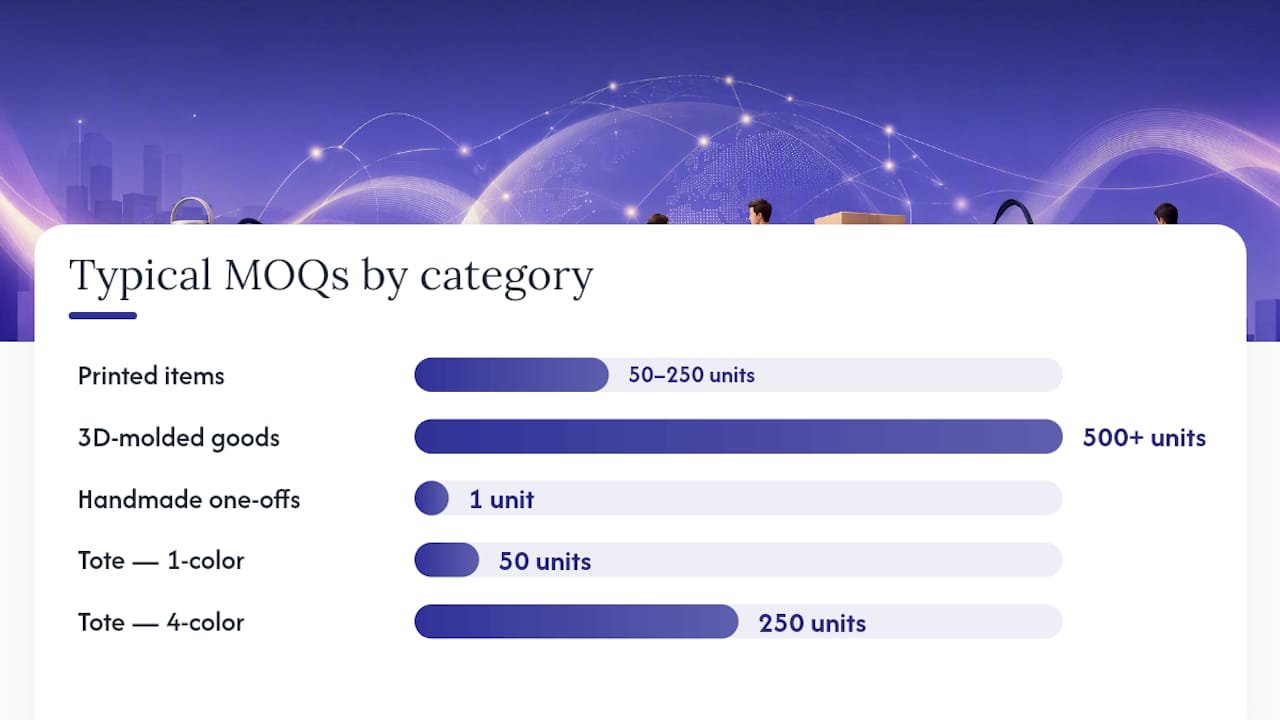
Fully custom, handcrafted items sometimes break the pattern entirely. Mascot costumes and one-off builds can be ordered as single units since they’re made by hand rather than tooled. That’s the exception worth remembering: the more a product resembles a mold-made part, the higher the floor climbs, and the more it resembles a handmade piece, the lower it drops.
Pro Tip: Ask your supplier for their MOQ by decoration method, not just by product. The same tote bag can have a 50-unit minimum for one-color print and a 250-unit minimum for a four-color design.
What “No Minimum” Actually Means for Your Order
“No minimum” almost always means a stock item, not a fully custom one, and it comes with a real tradeoff. You’re trading customization depth and per-unit price for order flexibility. A no-min mug might only offer one imprint location and a higher price per piece than the same mug ordered at 250 units.
That tradeoff makes no-min options a smart fit for specific situations:
- Testing a new campaign message before committing to volume
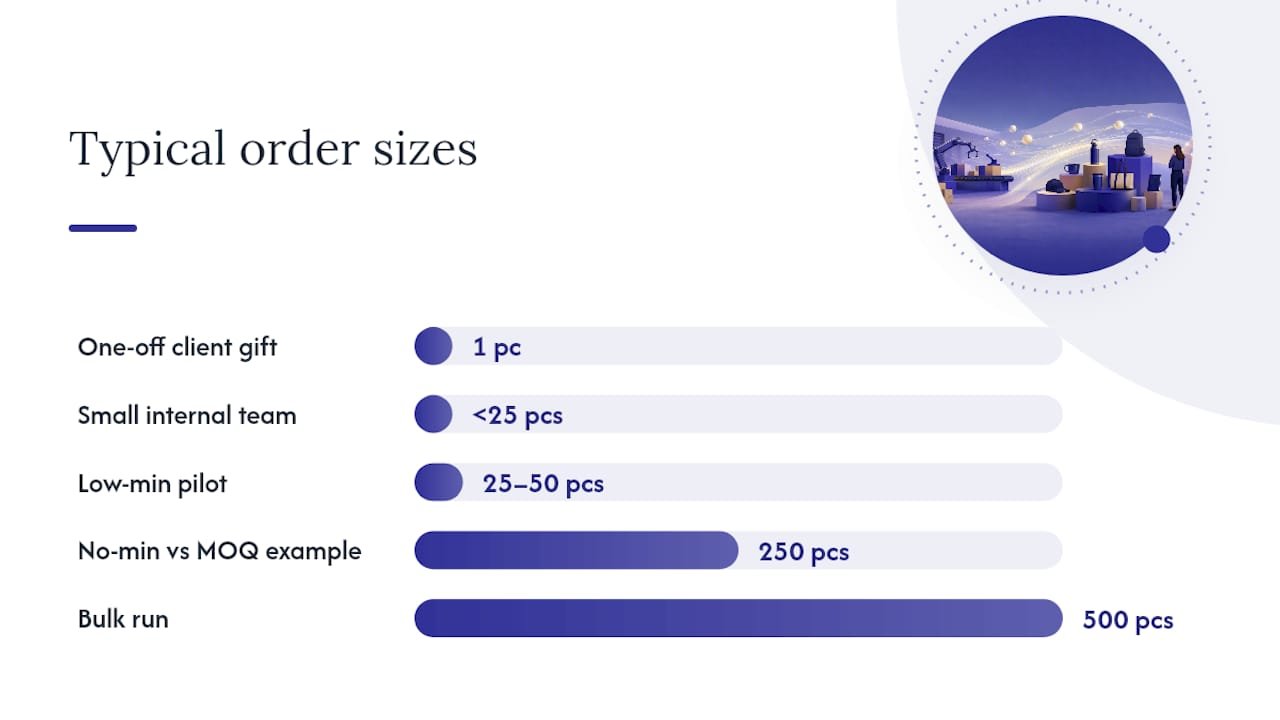
- Small internal teams or department gifts under 25 people
- Segmented giveaways where different groups get different items
- One-off client gifts that don’t need to match a larger order
No-min listings tend to be marketing-led. In practice, buyers are still paying for flexibility, just in a different place on the invoice than a setup fee.
Pro Tip: Run a low-min pilot of 25 to 50 units before committing to a 500-piece order. If the item performs well at a trade show or new-hire kit, you’ve validated the design before locking in a bigger, cheaper-per-unit run.
The Pricing and Lead Time Math Behind Every Quote
Setup costs get divided across your total quantity, so the math is simple: a $150 screen fee spread across 50 units adds $3 per piece, but spread across 500 units it adds just $0.30. That’s the entire reason quantity discounts exist, and it’s worth running the numbers yourself before accepting a quote at face value.
Lead time follows a similar but separate logic:
- Stock and no-min items typically ship fastest since there’s no tooling or digitizing step.
- Custom decorated items add production time for setup, proofing, and the actual run.
- Fully molded or tooled items carry the longest lead times, sometimes weeks, because the mold itself has to be built first.
- Rush fees can compress any of these timelines, but they rarely eliminate the setup step entirely.
If your deadline is tight, ask about rush options early rather than after you’ve already committed to a design. Our guide on ordering branded merch without delays covers the timing mistakes that catch most first-time buyers off guard.
How to Lower or Avoid Minimums Without Overbuying
Procurement teams have more leverage against MOQs than most buyers realize. A few tactics show up again and again in real orders:
- Mix SKUs or colors to hit a supplier’s cumulative minimum instead of ordering one exact configuration.
- Combine campaigns. If marketing and HR both need branded pens this quarter, one combined order clears the minimum faster than two separate small ones.
- Choose stock configurations over fully custom builds when the design doesn’t require a unique shape or mold.
- Negotiate a split run or staged production, paying a slightly higher per-sample fee in exchange for a smaller upfront commitment.
- Use fulfillment or drop-ship options so you’re not warehousing 500 units in a supply closet you don’t have.
A bulk buying guide for outdoor products walks through how quantity tiers affect cost specifically for items that are bulky to store, which makes tactic five worth reading before you order anything oversized.
Pro Tip: If a supplier won’t budge on their MOQ, ask whether they’ll split the run into two ship dates instead. You get the volume discount without needing storage space for the full order at once.
Questions to Ask Every Supplier Before You Order
A vague answer to any of these questions is a red flag worth pushing back on. Copy this list into your next RFQ email:
- What’s your MOQ for each decoration method, not just the product overall?
- What are the price breaks at each quantity tier?
- What’s the lead time at each tier, and what does rush production cost?
- Do you charge for samples, and how much?
- What does the setup fee actually cover, and is it waived on reorders?
- What happens if I need a color change on a reorder, does that trigger a new setup fee?
- What’s your policy on defects or damaged goods on arrival?
Suppliers who dodge the setup-fee question or won’t quote a sample cost upfront tend to be the same ones who surprise you with charges later. Industry groups like PPAI document standard trade practices buyers can reference when a quote doesn’t match category norms. For a full copy-paste version of this list, Discountswag’s bulk order checklist covers the same ground with space to fill in supplier answers side by side.
Why This Guide Reflects Real Procurement Practice
This guide draws on category norms tracked by suppliers and industry groups, plus small-business procurement guidance from the SBA on budgeting for pilot orders versus bulk runs. It’s written by Jerry for Discountswag, a distributor that works with marketing teams on customization, rush timelines, and multi-location fulfillment daily.
For deeper planning, pair this with Discountswag’s bulk promotional products guide or request a quote directly to compare MOQ terms against what’s outlined here.
The Real Problem Isn’t the Minimum, It’s the Guessing
Most of the frustration buyers feel around MOQs doesn’t come from the minimums themselves. It comes from not knowing them until three emails into a quote request. The conventional advice tells you to “shop around,” which is technically true and practically useless if you don’t know what questions separate a fair quote from a padded one.
The tactic that actually moves the needle is asking for MOQ by decoration method before you fall in love with a design. A four-color logo on a tote bag and a one-color version of the same bag can sit 200 units apart in minimum requirements. Buyers who ask that question upfront negotiate from a position of knowledge. Buyers who don’t end up either overordering to hit a minimum they didn’t expect, or downgrading their design mid-process to squeeze under one.
If there’s one thing worth prioritizing first, it’s building the supplier question list into your RFQ process permanently, not just pulling it out when a quote feels off. MOQs aren’t going away, and they aren’t arbitrary. They’re a predictable function of tooling and setup costs, which means they’re also predictable enough to plan around, if you ask the right questions before the invoice, not after.
— Jerry
Get a Straight Answer on MOQ Before You Commit to a Design
Customization, rush timelines, kitting, and multi-location fulfillment can make MOQ-sensitive orders manageable instead of stressful. Rather than guessing at a supplier’s minimum after you’ve already picked a design, you get clear tiered pricing and lead-time answers upfront, from one point of contact who handles the whole order start to finish.
That matters most when you’re choosing between product categories with very different minimum thresholds. A guide on promotional products versus corporate gifts breaks down which category fits your goal before you get locked into a quantity you didn’t plan for. If you’re ready to test a design or need a quote across a few quantity tiers, reach out through Discountswag and get the numbers in writing before you commit.
Sources
- PromoBears USA — ‘What is the minimum order quantity for promotional products?’
- U.S. Small Business Administration (SBA)
- PPAI (Promotional Products Association International)
 Bottle Carriers
 Mugs
Mugs