


Setup Charge vs. Run Charge: What You Pay For on Custom Orders

A setup charge is a one-time fee to prepare a product for decoration: a screen, a plate, an embroidery file. A run charge is a per-unit fee that applies to each additional color, imprint location or personalization. The first is paid once per order. The second grows with every piece you buy. Read both lines on a quote, and you can predict your true cost per item before you approve anything.
This guide is written for marketing managers, buyers and event coordinators who order branded merchandise in volume. It explains what each charge covers, how they interact with quantity, colors and locations, and what to confirm before you sign off.
TL;DR
- Setup charge: a one-time cost to get equipment ready to apply your design, usually applied per imprint method or location.
- Run charge: a per-unit cost for decoration beyond what is built into the base price, such as extra colors or locations. It multiplies by your quantity.
- Quantity changes the math: a fixed setup fee spreads across more units, so cost per piece falls as orders grow, while run charges stay constant per piece.
- Compare on total landed cost: ask for the product price, setup, run charges, artwork fees and shipping on one line-item quote, then divide by quantity.
- Check reorder terms: confirm whether setup applies again on a repeat order and what artwork is kept on file.
Table of Contents
- What a setup charge is
- What a run charge is
- Setup charge vs. run charge at a glance
- How quantity, method and artwork change the numbers
- A worked example
- How to compare quotes before you approve
- Ways to keep setup and run charges down
- Our perspective
- Get an itemized quote for your next order
- FAQ
- Sources
What a setup charge is
Before a logo can go on a mug, a tote or a polo, the decorator has to prepare the production tools. For screen printing that means making a screen for each ink color. For embroidery it means converting your artwork into a stitch file. For other methods it can mean a plate, a die or a mold. The setup charge pays for that preparation.
The industry’s own terminology guide describes it as a one-time fee to prepare a product for decoration, such as creating a screen, mold or embroidery tape, and notes that it is usually applied per imprint method or location. Two practical points follow from that definition:
- It is tied to the tooling, not to your quantity. Ordering 100 pieces or 1,000 pieces, the screen still has to be made once.
- It multiplies by the number of setups, not units. A two-color logo printed on screens needs two screens. A logo on the front and the sleeve is two locations.
There is no universal price. Setup fees vary by supplier, product and method. For orientation, a trade article on how distributors price jobs says setup and decoration costs are often a one-time fee in the range of $40 to $80 plus per-unit decoration costs. Treat that as a general range, not a quote: your actual number depends on the item and the decoration method.
What setup usually covers
On most quotes, the setup line pays for some combination of these tasks:
- Preparing your artwork for the decoration method, for example converting a logo file into a format the embroidery machines can read
- Creating the physical tool: a screen, a plate or a die
- Mounting and aligning the item on the press or machine
- Producing a proof so you can approve placement and colors
Because the work is front-loaded, it is charged once, up front, whether you order a small run or a large one.
What a run charge is
A run charge is a per-unit charge. It pays for the extra pass through the machine when your design asks for more than the base price includes. Typical triggers are an additional ink color, an additional imprint location (front and back, say) or per-item personalization such as individual names.
A decoration glossary from a business-software company defines run charges as a per-unit charge applied for each additional color or imprint location, and points out that they accumulate across every unit in the order. That last part is what catches buyers out: a few cents per piece looks trivial on one unit and becomes real money across a few thousand.
The “first color, first location” phrase
Most supplier price lists use wording such as “includes a one color, one location imprint.” It is easy to read that as “decoration is free.” It is not. It means the first color in the first location is built into the unit price, so there is no run charge for it. The setup charge is still billed on top. Additional colors or locations then add run charges per unit, as the same glossary entry explains.
Setup charge vs. run charge at a glance
| Setup charge | Run charge | |
|---|---|---|
| What it pays for | Preparing tools and files for your design | Extra decoration passes per item |
| How often it is billed | Once per setup (per color, method or location) | On every unit in the order |
| What drives it | Number of colors, locations and decoration methods | Number of extra colors, locations or personalized items |
| Effect of ordering more | Spread over more pieces, so cost per piece falls | Stays the same per piece, total rises with quantity |
| Where it shows up | A one-time line on the quote | Added to or folded into the per-unit price |
How quantity, method and artwork change the numbers
Quantity
The setup fee is fixed overhead, so a larger order dilutes it. Run charges do the opposite: they scale in a straight line. That is why a design with several colors gets expensive faster at high volume than a one-color design does.
Decoration method
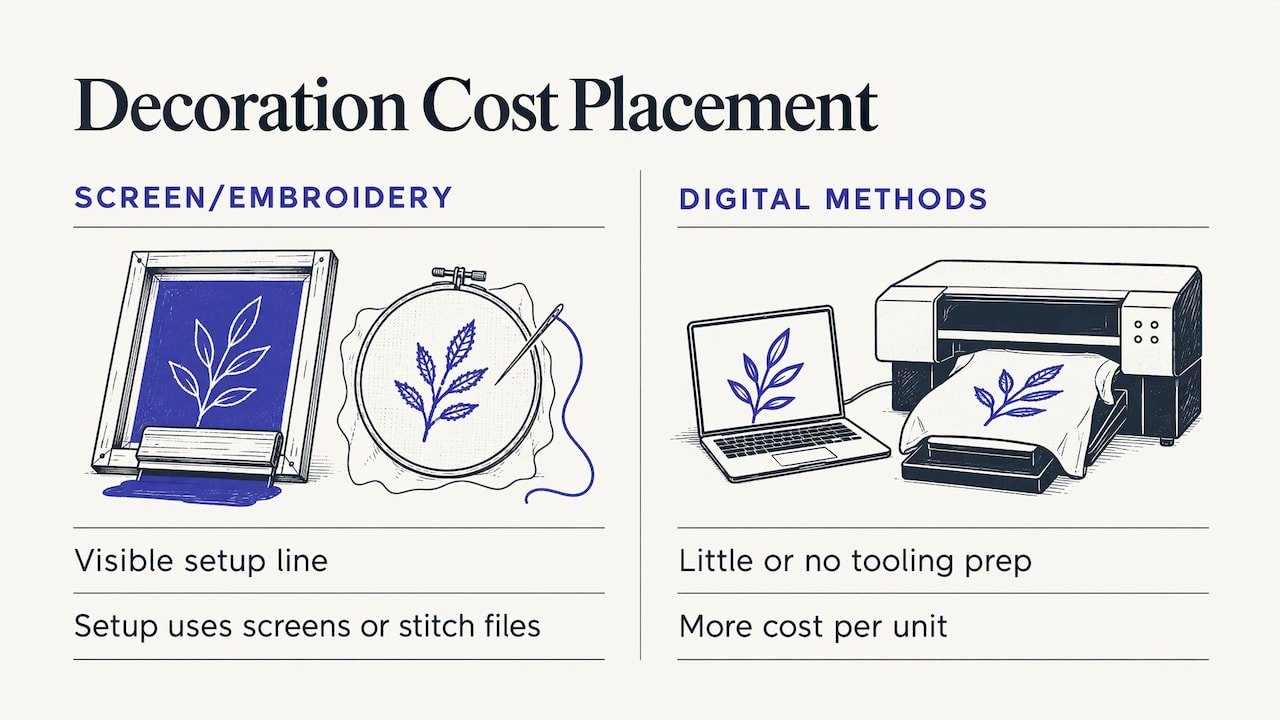
Different methods put the cost in different places. Screen printing and embroidery tend to carry a visible setup line because of screens or stitch files. Digital methods that print directly from a file generally have little or no tooling to prepare, so more of the cost sits in the per-unit price. If your logo has gradients or many colors, ask your account rep which method keeps the all-in cost lowest, not just the setup fee.
Colors and locations
Every added color can mean another screen (setup) and another pass (run charge). Every added location can mean the same. A two-color logo on the chest and a one-color mark on the sleeve is three setups in a screen-print job. Ask for a quote on a simplified version of the artwork too, because dropping one color often saves on both lines.
Special inks and color matching
If your brand guide specifies an exact Pantone shade, ask how the supplier handles it. Matching a specific color can carry its own charge, and it is worth knowing whether it repeats on every reorder.
A worked example
The numbers below are illustrative, not Discount Swag prices, since the cost of each item depends on the product and decoration method. They show the mechanics.
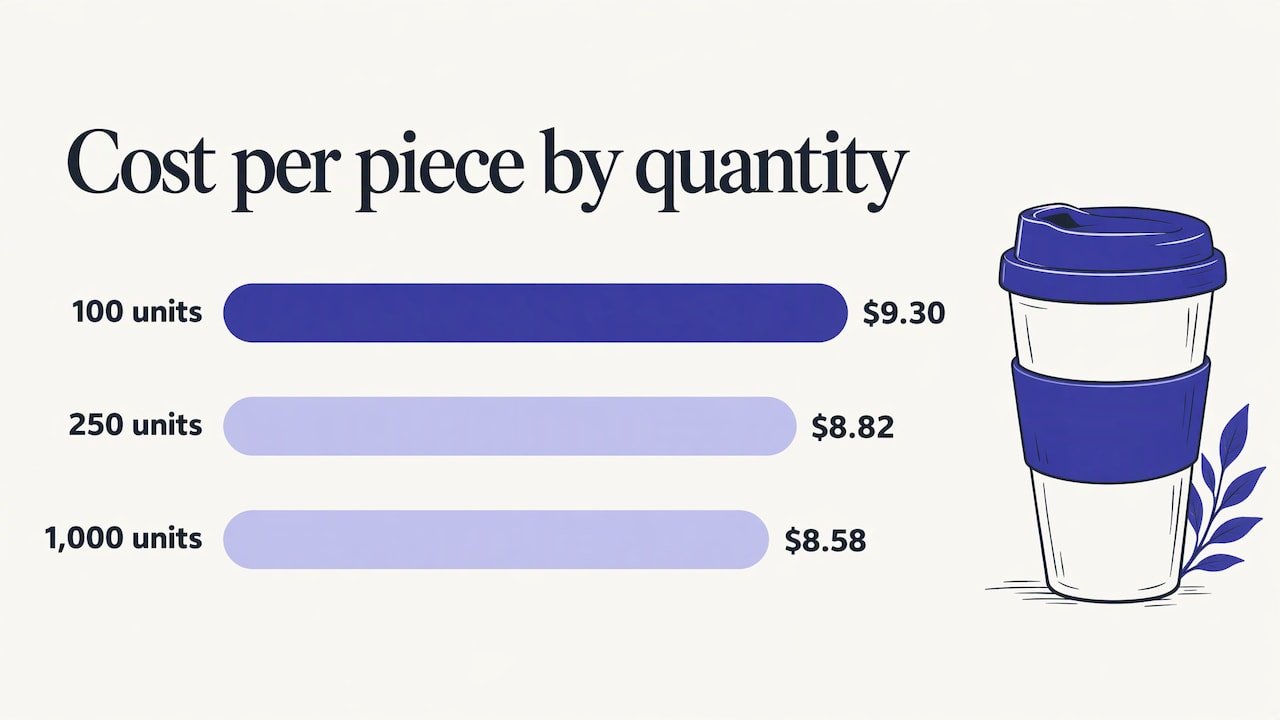
Assume a drinkware item with a base price of $8.00 that includes a one-color, one-location imprint. Your logo has two colors on screen-printed one location. Assume a setup fee of $40 per color and a run charge of $0.50 per unit for the second color.
| Quantity | Product cost | Setup (2 colors) | Run charge (2nd color) | Total | Cost per piece |
|---|---|---|---|---|---|
| 100 | $800 | $80 | $50 | $930 | $9.30 |
| 250 | $2,000 | $80 | $125 | $2,205 | $8.82 |
| 1,000 | $8,000 | $80 | $500 | $8,580 | $8.58 |
Notice what moves. The setup fee is $80 at every volume, so its share of each piece shrinks from $0.80 at 100 units to $0.08 at 1,000. The run charge is $0.50 on every piece. Per-piece cost falls with volume, but it never drops below the base price plus the run charge.
That is also why the per-piece number, not the setup number, is the right figure for budgeting a large program.
How to compare quotes before you approve
The same trade article that gives the $40 to $80 setup range warns that failing to account for setup fees can lead to mispriced orders. For a buyer, the fix is a consistent comparison routine:
- Ask for itemized quotes. Product, setup, run charges, artwork or proofing fees, and shipping each on their own line.
- Hold the specs constant. Same item, same quantity, same number of colors and locations, same ship-to addresses.
- Divide by quantity. Total landed cost divided by units gives you the number that matters.
- Check what is included. “One color, one location included” means different things depending on how many colors your logo has.
- Run it at two quantities. Asking for a price at your target quantity and at a higher tier shows how much of the quote is fixed cost.
What to confirm about artwork, reorders and minimums
These details cause most surprises after the quote. Ask them before you place the order:
- Artwork format. Vector files such as .ai, .eps or .svg are generally the easiest to work with. If your logo is only a low-resolution image, ask whether there is a recreation fee.
- Is setup charged again on a reorder? Setup is a one-time charge for the order it was created for. Whether the same tooling carries over to a repeat order, and for how long, depends on the supplier, so get the answer in writing.
- Is artwork kept on file? If your stitch file or screens are stored, a repeat order is simpler to price and faster to produce.
- Minimum quantities. Some decoration methods have minimums per color or per location.
- Other add-ons. Rush production, special packaging and per-address shipping can sit outside both setup and run charges.
If you run recurring programs such as onboarding kits, it is worth asking your rep to confirm the reorder terms for each item up front. Our swag fulfillment guide covers how shipping to one or many locations fits into the total cost of a program.
Ways to keep setup and run charges down
- Standardize the logo. Use one approved artwork version, with the fewest colors your brand guidelines allow, across the whole product range.
- Consolidate orders. One larger order spreads setup better than several small ones of the same item.
- Choose one imprint location. A strong single placement often looks cleaner than two, and it avoids a second setup and a second run charge.
- Pick products that suit your artwork. A detailed multicolor mark may suit a different decoration method than a simple one-color mark.
- Plan reorders. Reusing identical artwork and specs makes the reorder terms easier to confirm and price.
- Plan ahead for QR codes. If you add a scannable code, size and placement affect how it is decorated. See our guide to QR codes on swag before you finalize artwork.
Our perspective
Most of the confusion we see comes from one thing: buyers compare a unit price against a unit price and forget that the setup line sits somewhere else on the quote. A $7.50 item with a long list of add-ons can cost more than an $8.00 item that includes what you need.
That is why we think about promotional orders as a total cost per piece, delivered. Setup, run charges, rush options and shipping to one address or fifty all belong in the same picture. Our model is built for programs where marketing needs the products decorated correctly and procurement needs a number it can approve.
We stand behind a guarantee of 10% or more in savings versus any competitor’s online price, and we source curated quality from trusted suppliers. When you send us your artwork, quantity and ship-to list, we can lay out the setup and per-unit costs so you see exactly where the money goes before checkout.
Jerry
Get an itemized quote for your next order
If you are planning an order of apparel, drinkware, bags or tech, we can help you price it on a total-cost basis. Discount Swag offers customizable corporate promotional products, rush orders, branded kits and fulfillment to single or multiple locations. Browse the catalog at Discount Swag and send us your logo, quantity and delivery plan to see the full cost per piece.
If you need a popular drinkware option, a branded Stanley Quencher tumbler is a good example of an item to price at several quantities and imprint choices.
FAQ
Is a setup charge always one-time?
It is one-time for the order it is created for. A setup fee pays for preparing the tools and files for your design. Whether it applies again on a repeat order depends on the supplier and on how the artwork is stored, so confirm reorder terms before you buy.
What is the difference between a setup fee and a run charge?
A setup fee is a flat cost to prepare for decoration, such as a screen or an embroidery file. A run charge is billed per unit for extra colors, locations or personalization beyond what the unit price includes. One is fixed for the job, the other grows with quantity.
Does “one color, one location included” mean there is no setup fee?
No. That phrase means the first color in the first location carries no run charge. The setup fee is still billed on top, and additional colors or locations add run charges per unit.
How do I find the real cost per item?
Add the product cost, all setup fees, all run charges, artwork or proofing fees and shipping. Divide that total by the number of units. Do the same for each quote, with the same specifications, so you can compare them fairly.
Sources
- Your Guide to Promo Terminology (ASI)
- What Is Coded Pricing and How Do Distributors Calculate Profit (ASI)
- Run Charge: what it is and how it works (Zigaflow)
 Bottle Carriers
 Mugs