

Healthcare Swag Ideas That Staff, Patients and Visitors Will Use

The best healthcare swag is useful in a shift, a waiting room or a conference hall: drinkware, practical bags, tech accessories, comfortable apparel and simple wellness kits. Pick by audience first (staff, patients, visitors, event attendees), then check your organization’s gift rules and accessibility needs before you order. This guide covers ideas for each group, what to screen for, and how to order in bulk without surprises.
TL;DR
- Staff respond to items that make a long shift easier: insulated drinkware, lunch coolers, tech accessories and comfortable apparel.
- Patient and visitor items need extra screening: gift-value limits, clinical appropriateness, allergies, materials and readable information.
- Events and recruiting work best with a small branded kit, not a pile of single trinkets.
- Check your compliance team’s vendor and gift policy before you finalize a list, and order early enough that rush shipping is the exception.
- Add a QR code to link to current information instead of printing everything on the item.
Table of Contents
- Start with who receives the swag
- Swag ideas for healthcare staff
- Swag ideas for patients and visitors
- Check the rules before you order
- Swag for events, recruiting and conferences
- How to order healthcare swag without stress
- Plan your healthcare swag order with us
- Common questions
- Sources
Start with who receives the swag
Healthcare marketing teams usually buy swag for four different audiences, and the same item rarely works for all of them. A tumbler that delights a nurse on a twelve-hour shift is a fine staff gift. Handed to a patient, it may raise questions about value limits. A pen that works at a health fair table may be wrong for a pediatric ward.
Sort your list before you browse:
| Audience | What they need | Strong categories |
|---|---|---|
| Clinical and support staff | Comfort, hydration, convenience on long shifts | Drinkware, lunch coolers, apparel, tech accessories |
| New hires and recruits | A welcome that signals pride in the organization | Branded kits, bags, notebooks, power accessories |
| Patients and families | Low-risk, easy-to-use, easy-to-read items | Simple stationery, totes, comfort items (after policy review) |
| Event and conference attendees | Things worth carrying home | Totes, portfolios, tech items, drinkware |
The rest of this guide follows those groups.
Swag ideas for healthcare staff
Staff swag is where most healthcare programs start, because it supports retention and culture as well as brand. The strongest items solve a daily problem.
Drinkware that survives a shift
Hydration is the obvious need on a unit where a break may be short and a sink may be far away. A large insulated tumbler fits a car cup holder and a work cart. A smaller travel mug suits a commute or a coffee run.
Options we carry that fit this use include the Stanley Quencher H2.O FlowState 40 oz tumbler, the 30 oz version, the CamelBak Straw Tumbler 30oz, and the Stanley Café-To-Go Travel Mug in 20 oz or 16 oz. Each can carry your logo. A single-color logo on a recognizable bottle often looks better than a busy design.
Lunch coolers and bags
Staff who eat at odd hours carry food in and out. A cooler makes a quiet, daily reminder of who gave it. The Recycled Boxy 9 Can Lunch Cooler and the Merchant & Craft Revive Recycled Backpack Cooler both take a logo. For administrators, residents and traveling clinicians, a Topo Designs Global Briefcase or an Excel Sport 18" Club Duffle Bag covers commuting, gym and overnight needs.
Apparel and accessories
Apparel is the category readers expect to see on every list: branded scrubs and lab coats, t-shirts, quarter-zips, caps, lanyards and badge reels. Two practical rules apply.
- Check the dress code first. Many facilities specify scrub colors by role, and uniform vendors may be contracted. Branded layers, fleece, caps and tees for off-unit use avoid the conflict.
- Keep sizing simple. Collect sizes in the order form, or choose unisex styles in a wide size range, so you are not reordering later.
Badge reels, lanyards and pens remain popular because they are used every day. They are also the items most likely to have been given out before, so a better material or a cleaner design makes yours stand out.
Tech accessories
Power and organization items are practical in settings where staff move between units. Think of a charging pad, a power bank, a cable kit or a tech organizer. The Bellroy Tech Kit keeps cables and small devices together. The Reclaim RPET Wireless Charging Writing Pad puts a notepad and a charger on one desk surface, which suits administrators, educators and managers.
Wellness and appreciation kits
For Nurses Week, a service anniversary or a hard quarter, a small kit says more than a single item. Common ingredients are a tumbler, a notebook, a pen, a self-care item and a thank-you card. Our Custom Ambassador Power Gift Set is an example of a ready-to-brand set. If you want something fully tailored, we also build fully custom branded boxes.
If your kit includes food or drink, ask staff first. Preferences and allergies vary, and a short survey about coffee versus tea, snacks and dietary needs prevents a gift from excluding people. A quick pulse poll takes a day and saves a lot of leftover boxes. If you are also planning how the program reaches your community online, resources on digital marketing for doctors can help you connect the physical gift with your wider outreach.
Swag ideas for patients and visitors
Patient-facing swag is different from staff swag. The goal is comfort and goodwill, but the rules are tighter, and the items must be safe and easy to use for people who may be unwell, elderly or anxious.
Keep it small, simple and inexpensive
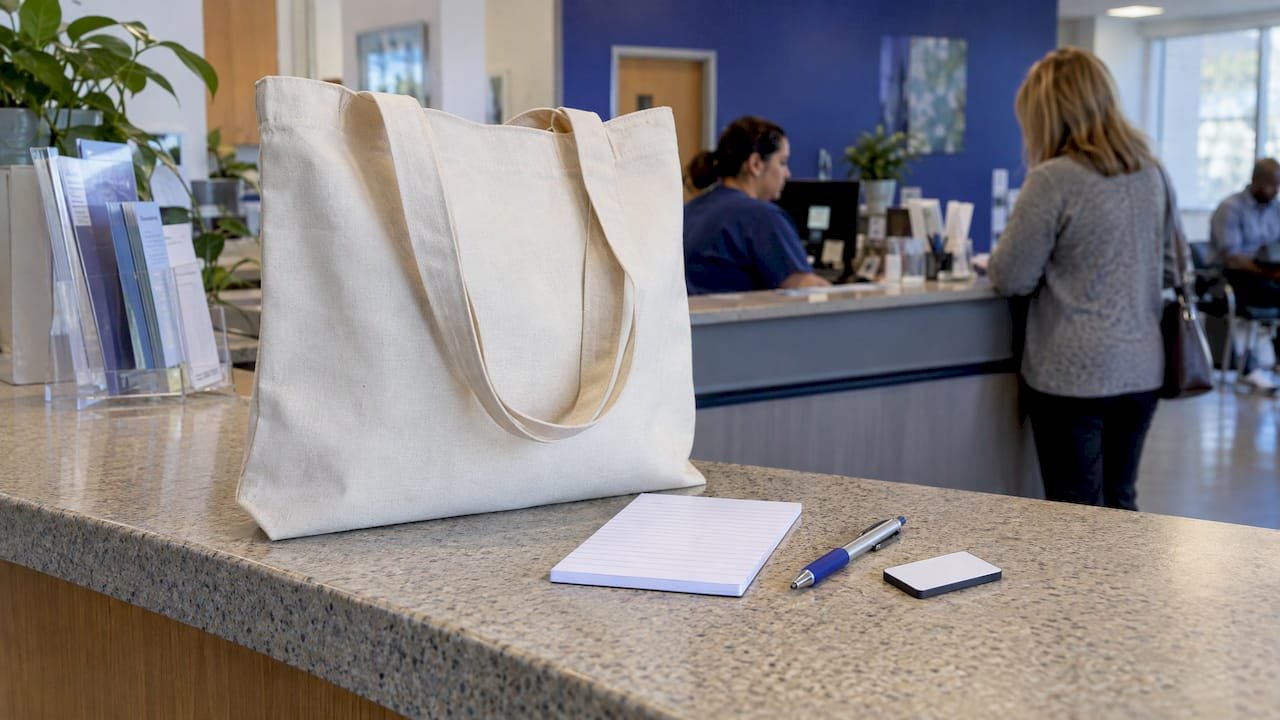
Good candidates include tote bags for carrying paperwork and medications, notepads and pens for appointment notes, and simple magnets with a phone number. Choose neutral designs and readable type. Avoid anything with small parts that could be a hazard for children or older adults, and avoid scented or ingestible items unless your clinical team approves them.
Hand sanitizer: useful, but know its limits
Sanitizer is a classic healthcare giveaway, and the CDC’s guidance gives you a baseline. It says to use hand sanitizer with at least 60% alcohol when soap and water are not available, and to wash visibly dirty hands with soap and water. That tells you two things for your purchase: confirm the alcohol content of any sanitizer you brand, and avoid printed messaging that suggests sanitizer replaces handwashing in every case.
Health fairs and community events
At a community health fair, the item should connect to the conversation at your table. A tote that holds screening forms, a pen for completing them and a card with your appointment line works better than a random trinket. Add a QR code that links to your scheduling page or patient resources, and you can see which tables drove traffic. We cover size, placement and tracking in our guide to QR codes on swag.
Check the rules before you order
This is the section that separates a healthcare swag plan from a generic promotional products list. The items are the easy part. The rules decide what you can give to whom.
Gifts to Medicare and Medicaid patients
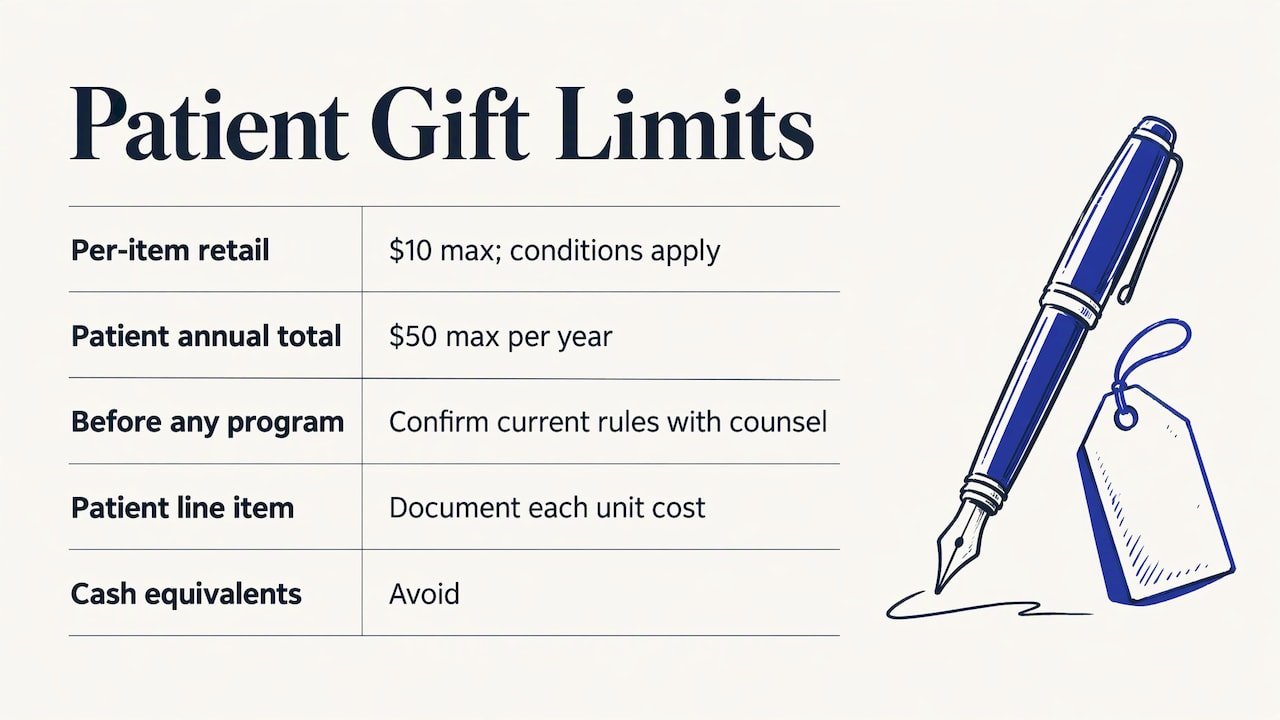
Federal rules limit what providers may give to patients covered by federal programs. The HHS Office of Inspector General’s Special Advisory Bulletin on gifts and inducements, published in August 2002, describes inexpensive gifts as permitted when the retail value is no more than $10 per item and no more than $50 in total per patient per year, subject to the bulletin’s conditions. Because this guidance can be updated, your compliance officer or health-care counsel should confirm the current thresholds and how they apply to your organization before any patient-facing program begins. Treat the figures above as the starting point for that conversation, not the last word.
In practice this means a patient-facing line item such as a pen or tote needs a documented per-unit cost, and you should avoid cash or cash equivalents. Staff gifts and event giveaways to non-patients are a separate question, which your policy should also address.
Vendor and gift policies inside hospitals
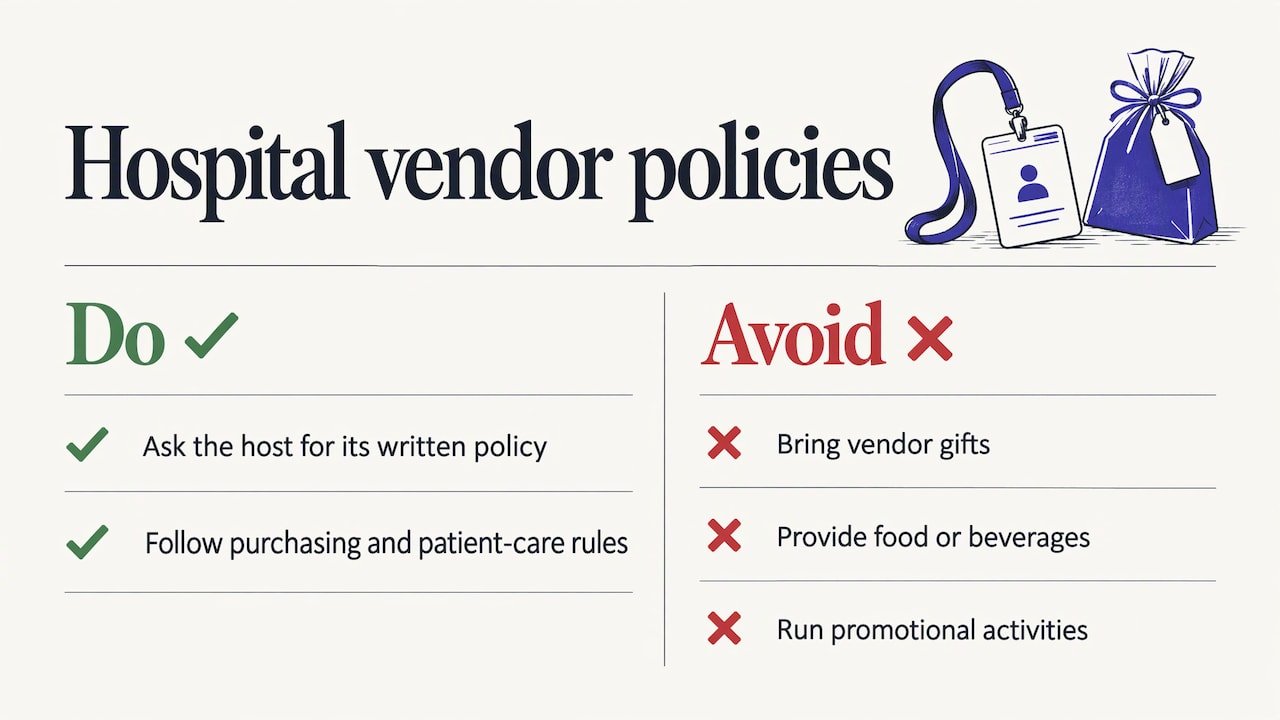
Many health systems restrict what vendors may bring onto the premises. Gundersen Health System’s vendor policy, dated March 14, 2019, is one example: it restricts vendor gifts, vendor-provided food and beverages, and promotional activities, and it requires vendors to follow purchasing, confidentiality, safety and patient-care-area rules. If you plan to distribute swag in a clinic you do not operate, such as a partner hospital or a conference at a medical center, ask the host for its policy in writing. Your hand-out may be fine at a booth outside the building and not allowed on a unit.
Accessibility
Patients, visitors and guests with disabilities must have equal access, and healthcare organizations must communicate effectively with them. Lee Health’s 2024 education guide states both points. For swag, that translates into a few concrete checks:
- Use high-contrast, large type on any printed card or insert.
- Do not rely on color alone to carry meaning.
- Offer information in more than one form, such as a QR code that opens a page designed for screen readers, plus a phone number.
- Choose items that can be used one-handed or without fine grip.
If you are building digital content to go with a kit, the examples of interactive brochures for marketers show how to keep materials current without reprinting.
A short pre-order checklist
The sources above point to the same screening steps for patient-facing swag:
- Does the item fit the gift-value limits that apply to the recipient?
- Is it appropriate clinically, with no allergens, scents or small parts you have not reviewed?
- Are the materials safe for the setting (for example, easy to wipe down)?
- Can people with disabilities use the item and read the information?
- Does the host facility’s vendor policy allow distribution where you plan to hand it out?
Swag for events, recruiting and conferences
Event swag has a different job: be memorable, be carryable and make the follow-up easy. A tote or portfolio is the anchor. The Windsor Impressions Presentation Portfolio with FSC Mix paper suits a physician-recruitment day or a continuing-education session, because attendees can hold a program, a notepad and a business card in one place.
For recruiting nurses, residents and allied health students, think in kits rather than items. A drinkware piece, a notebook and a charging accessory tell a candidate you plan for their daily life. We outline how to build those for students in campus recruiting swag, and much of it carries over to nursing schools and residency fairs.
Matching budget to purpose
A workable way to set a budget is to work backward from the audience size and the purpose:
| Purpose | Pattern that tends to work |
|---|---|
| Broad awareness at a fair | A low-cost, useful item for everyone, with a QR code |
| Staff appreciation | One better item or a kit per person, sized to your recognition budget |
| Recruiting | A kit for finalists, a lighter item for walk-ups |
| VIP, donors and speakers | A single premium item or gift set with a personal note |
Spreading one budget across a premium item for the few people who matter and a simple item for everyone else usually gets more value than a middling item for all.
How to order healthcare swag without stress
Most problems in a swag program come from timing and logistics, not product choice.
- Decide the audience and the rules first. Get compliance sign-off on a short list before you request quotes.
- Pick two or three items. More choices slow approvals and complicate reorders.
- Approve a logo proof. Use vector artwork and confirm color matches with your brand guidelines.
- Plan your distribution. Healthcare systems often have several campuses. We ship to a single location or to multiple locations, so each site can receive its own kit instead of one pallet being re-split by hand.
- Build in lead time. If a date moves, we support rush orders, but a plan with a margin is calmer.
Our site shows pricing as you build an order, and bulk discounts and customization fees apply to custom orders.
Perspective
We see the same pattern whenever a healthcare organization asks us for swag. The first list is a long one, full of items that look fine in a catalog. The final order is short, and it works because someone asked who will hold the item and where.
Our view is that a healthcare program should be built around the daily routine of the person receiving it. A nurse carries a bottle. An administrator keeps a charger on a desk. A visitor needs a bag for paperwork. When the item fits the routine, your logo travels with it for months, and the gift feels like thought rather than overhead.
That is why we focus on curated quality from trusted suppliers, branded kits and distribution to one site or many. Healthcare teams have approval steps, multiple campuses and tight windows around events, and a distributor should absorb that complexity. We back our pricing with a guarantee of 10% or more savings versus any competitor’s online price, so your team can spend the budget on better items rather than more volume.
Start with the rules, choose a small set of items you are proud to put your name on, and let us handle the logistics.
Jerry
Plan your healthcare swag order with us
Discount Swag is an online distributor of customizable corporate promotional products: apparel, drinkware, bags, technology, office items, outdoor and sport gear, health and beauty items and more. For healthcare marketing and HR teams, that means one place to assemble a staff appreciation kit, a recruiting package or an event giveaway, with branded kits, rush orders and fulfillment to single or multiple locations.
Browse the full range on discountswag.store, choose the items that fit your audience and your compliance rules, and send your logo. If you need something unique, ask about fully custom branded boxes.
Common questions
What are the best healthcare swag ideas for staff?
Insulated drinkware, lunch coolers, comfortable apparel, practical bags and tech accessories are the safest bets, because staff use them on every shift. A small kit that combines two or three of them, plus a thank-you card, works well for appreciation weeks and anniversaries.
Can a healthcare organization give swag to patients?
Often yes, but with limits. Federal guidance on gifts to Medicare and Medicaid beneficiaries sets value caps, and many health systems have their own vendor and gift policies. Have your compliance officer approve the item list and per-unit cost before you order.
Is hand sanitizer a good healthcare giveaway?
It can be, if the product contains at least 60% alcohol, which is the CDC’s guidance for use when soap and water are unavailable. Pair it with a message that supports handwashing instead of replacing it, and confirm the formulation with your supplier.
How do I make swag accessible to people with disabilities?
Use large, high-contrast type, avoid conveying meaning through color alone, and offer information in more than one format, such as a QR code to an accessible page plus a phone number. Choose items that are easy to grip and use with one hand.
How far ahead should I order?
Plan for approvals, proofs and production before your event or appreciation week. If dates tighten, we offer rush orders, but the calmest programs finish the approval step early.
Sources
- HHS OIG Special Advisory Bulletin: Offering Gifts and Other Inducements to Beneficiaries
- CDC: Returning to Work
- Lee Health: 2024 Education Guide
- Gundersen Health System vendor policy
 Bottle Carriers
 Mugs