

Die Cut vs Kiss Cut: Which Cut Fits Your Promo Program

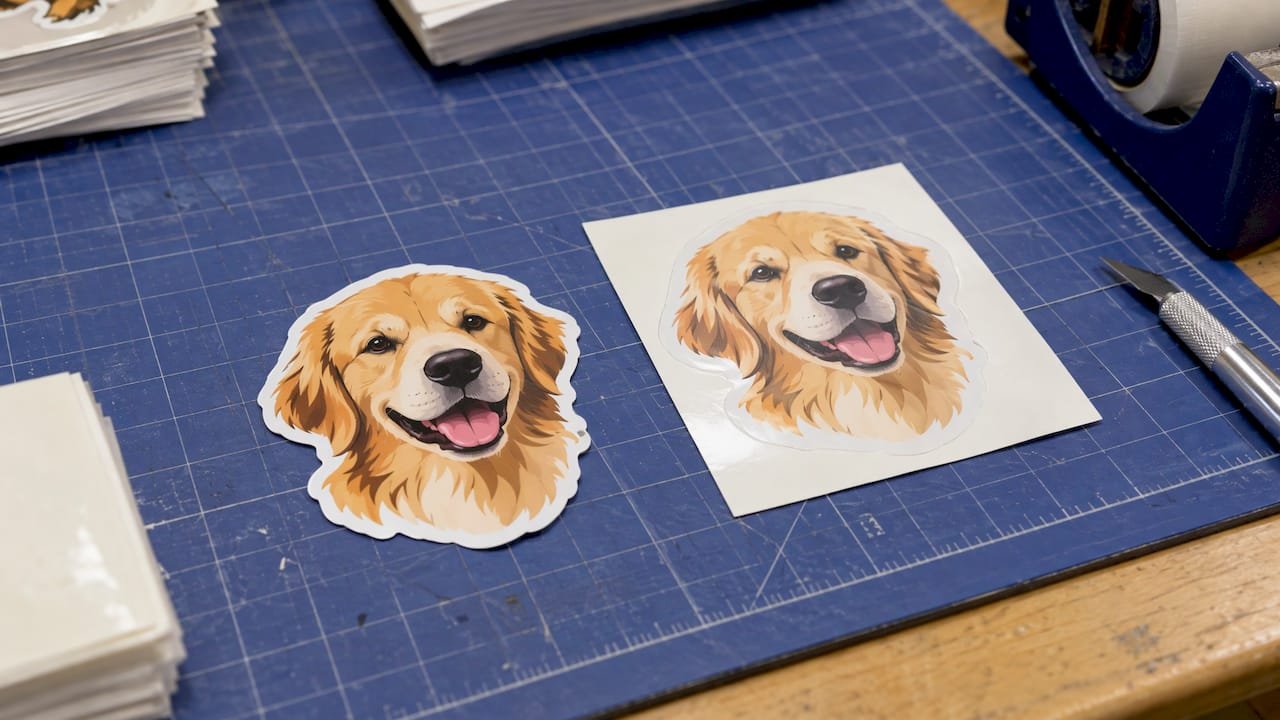
A die-cut sticker is cut through both the sticker and its backing, so it ships as a single piece in the exact shape of the artwork. A kiss-cut sticker is cut only through the sticker layer, so it sits on a larger backing that you peel it from. For a marketing team, the short answer is this: choose die cut when each sticker is a standalone item that has to look premium, and choose kiss cut when stickers go out in sheets, kits or bundles, or when you want printed space around the design for a message.
The difference is small on paper and large in practice. It changes how a sticker looks when it arrives, how easy it is to apply, how much room you have for a URL or QR code, how it packs, and what the order costs. This guide explains both cuts in plain terms, then walks through the decision the way a buyer makes it: by campaign, by quantity and by how the item reaches people.
TL;DR
- Die cut: the blade goes through the sticker and the backing, so the backing matches the sticker’s outline. It reads as a finished, premium single item.
- Kiss cut: the blade goes through the sticker only. The backing stays whole, which makes peeling easy and leaves a border for extra branding.
- Cost: the cut itself is not the only driver. Quantity, setup, material, finish and shape complexity all move the price, and a complex die-cut shape usually needs more setup.
- Best fit: die cut for individual giveaways and hero pieces; kiss cut for sheets, kit inserts, event packs and mailed bundles.
- Before you order: settle the shape, the quantity per location, the finish and the delivery plan together, not one at a time.
Table of Contents
- What die cut means
- What kiss cut means
- Die cut vs kiss cut at a glance
- The other sticker cut types you will see
- Why die cut can cost more
- Which one fits your campaign
- Using the border: QR codes and brand messages
- Surfaces and application
- A quick buying checklist
- A worked example
- Our perspective
- Plan your kit with us
- FAQ
- Sources
What die cut means
Die cutting works like a cookie cutter. A steel die or a cutting blade follows the outline of the artwork and passes through the printed vinyl and the paper backing beneath it. Shopify’s guide to the two cuts describes the result: the backing is cut to the exact shape of the sticker, with no extra border.
What that means in your hands:
- The sticker is one object. There is no sheet to tear and no leftover frame.
- The outline can be almost anything: a logo silhouette, a product shape, a mascot, a state.
- Because there is no border, the artwork itself carries the whole impression. Nothing competes with it.
- Peeling is a little harder, since the backing is the same size as the sticker and there is less paper to hold.
If you have ever received a sticker shaped like a company’s logo, with the backing trimmed to match, that was die cut.
What kiss cut means
Kiss cutting cuts only the top layer. The blade presses just far enough to “kiss” the surface of the backing and separate the sticker from its surrounding material, without going through the backing. The backing stays intact, usually as a rectangle, and the sticker sits on it ready to peel.
The name comes from that light touch: the blade barely meets the backing. The result, as Shopify’s guide explains, is a larger paper backing around the design that makes peeling easier.
Practical consequences:
- The sticker peels cleanly, because there is a generous backing to grip.
- Several designs can share one backing, which is how sticker sheets are made.
- The backing border becomes usable space. Shopify’s writers note it can carry a company name or contact details, and it is a natural place for a web address or a QR code.
- The sticker stays protected until the moment it is used.
Die cut vs kiss cut at a glance
| Die cut | Kiss cut | |
|---|---|---|
| Cut depth | Through sticker and backing | Through sticker only |
| Backing | Same shape as the sticker | Larger, usually a rectangle or sheet |
| Typical form | Single, individual sticker | Single on a backing, or multi-sticker sheet |
| Peeling | Slightly harder | Easy |
| Look | Clean, finished, premium | Practical, with a border around the design |
| Extra branding space | None on the backing | Border can carry a URL, code or message |
| Best for | Hero giveaways, product stickers, logo shapes | Sheets, kits, event packs, mailers |
The other sticker cut types you will see
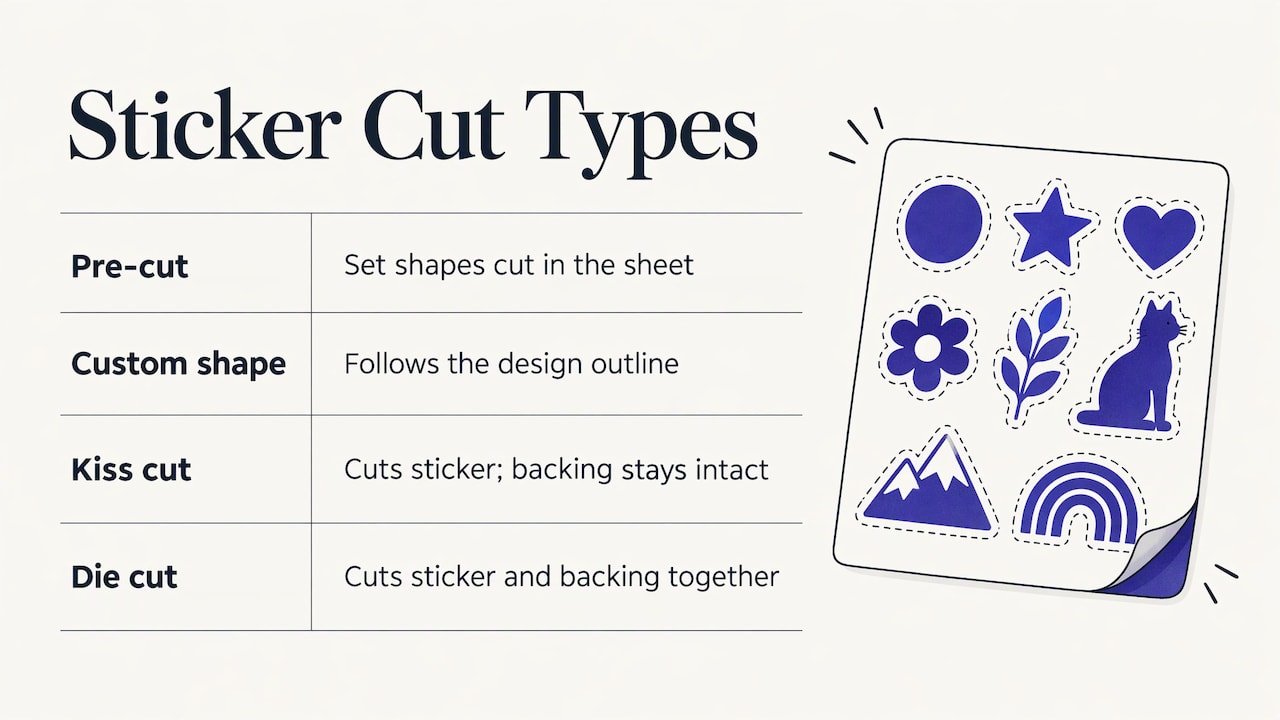
When you search sticker cut types, two more terms come up. Cricut’s explanation of sticker cuts separates four: pre-cut stickers come in set shapes already cut into the sheet, custom-shape stickers follow whatever outline your design has, kiss cut leaves the backing intact, and die cut cuts the sticker and backing together.
Two of those describe what the sticker looks like (set shape or custom shape), and two describe how deep the blade goes (kiss or die). They overlap. A custom-shape sticker can be die cut or kiss cut. For a purchasing decision, the two that matter are depth of cut and whether the design is a standard shape or a custom one, because custom outlines are where cost and lead time grow.
Why die cut can cost more
Buyers ask this often, and the honest answer is that the cut type is one factor among several. What usually pushes a quote up or down:
- Quantity. Setup work, including any custom die, is spread across the run. A bigger run lowers the per-piece share. Our guide to setup charge vs run charge explains how those two lines work on a custom order and how to read them on a quote.
- Shape complexity. A simple rectangle or circle is easier to cut than an intricate outline with tight curves or internal cutouts.
- Material. Paper, standard vinyl, and specialty films or foils sit at different price points.
- Finish. Gloss, matte, UV spot coating or soft-touch finishes add steps.
- Artwork. More colors and fine detail add print and finishing time.
- Turnaround and shipping. Rush timelines and the number of delivery addresses change the total.
Because a die-cut sticker is handled as an individual piece, it usually carries more handling than a sheet where many stickers come off in one pass. That is why many buyers see die cut quoted higher per sticker, and why a sheet of several designs can be an efficient way to put more of your brand in a recipient’s hands.
The practical move is to request quotes with the same quantity, size, material and finish for both cuts, so the difference you see is the cut and nothing else.
Which one fits your campaign
Start from how the sticker reaches the person, not from the cut name.
Trade shows and booth handouts
A kiss-cut sticker on a backing is easy to hand over, easy to stack in a bowl and easy to peel on the spot. A die-cut logo sticker works well as the single item a visitor sees first. If you want people to take one thing and keep it, die cut feels more intentional. If you want them to pick through designs, use a kiss-cut sheet.
Welcome kits and onboarding boxes
Kits are where kiss cut earns its place. A small sheet slides flat into a box or folder, survives shipping without the edges lifting, and gives the new hire several options: laptop, bottle, notebook. The border can hold an internal channel, a team name or a short welcome line. If your program ships kits to several offices or remote employees, our fully custom branded boxes and kit fulfillment are built for that kind of multi-location send.
Campus recruiting
Students trade and stack stickers. Sheets travel well in a tote or a folder, and a QR code on the border can lead to your careers page. For ideas on what else belongs in a recruiting handout, see our guide to campus recruiting swag.
Product packaging and customer thank-yous
When the sticker is part of the unboxing, die cut gives a clean, finished look. It stands alone on a mailer, a box lid or a notebook cover without a border.
Executive and client gifts
A single die-cut sticker rarely carries a high-value gift on its own, but it can be a finishing touch inside a premium box. Where the gift is the main event, put the budget there and use the sticker as the detail.
Using the border: QR codes and brand messages
The biggest advantage of kiss cut for a marketing team is the border. It is real estate you do not have to pay for in design space. You can print a URL, a campaign hashtag, a short offer line or a QR code on the backing, and it travels with the sticker until the recipient peels it.
A few rules keep that space working:
- Keep the message to one line and one action.
- If you use a code, size it so a phone can read it from a normal holding distance, and put it on a plain, high-contrast background. Our guide to QR codes on swag covers size, placement and tracking.
- Make the border message match the sticker’s campaign, so someone who finds a stray sheet in a drawer still knows where it came from.
- Keep colors and typography consistent with your wider identity. If your sticker program sits inside a broader refresh, a clear approach to corporate identity and branding helps every printed piece, from sticker borders to boxes, read as one brand.
Die cut has no border, so any message has to live inside the artwork. That works for a logo or a slogan. It works less well for a URL or a code.
Surfaces and application
Readers often ask whether a kiss-cut sticker can go on any surface. Cut style does not decide that. The adhesive and the material do, and both die cut and kiss cut can use the same ones. Smooth, clean, dry surfaces such as laptop lids, bottles and hard cases take stickers best. Rough, textured, dusty or oily surfaces are harder for any sticker. Outdoor, cold or wet use calls for a weather-resistant material and the right adhesive, which you should name when you request a quote.
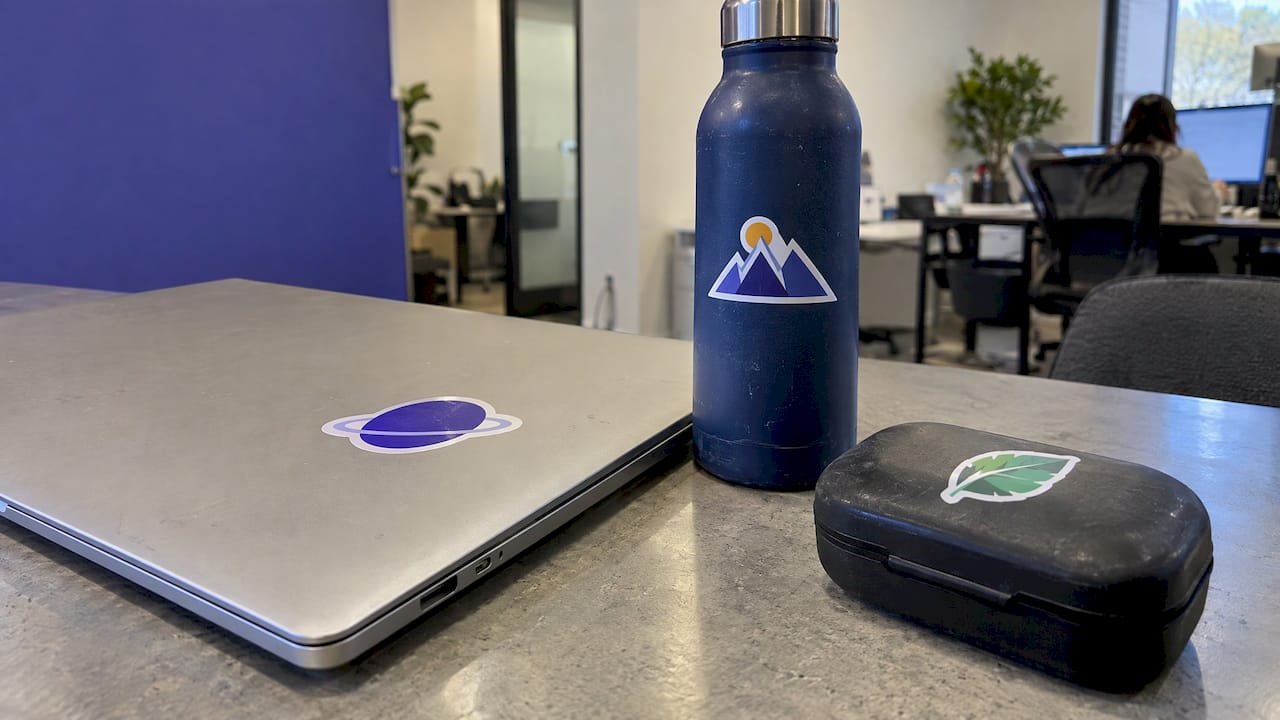
One point worth settling early: if stickers will go on your own branded drinkware or tech items, confirm the finish and adhesive suit that surface before you order the full quantity.
A quick buying checklist
Before you send a request, write down:
- Purpose: standalone giveaway, kit insert, packaging seal or event sheet.
- Quantity per location and in total. This sets the per-piece price and the delivery plan.
- Shape: standard or custom outline.
- Material and finish: paper, vinyl, matte, gloss, special coatings.
- Environment: indoor, outdoor, wet, cold.
- Border message: URL, code, offer or none.
- Deadline and delivery points: one warehouse, several offices, or direct to recipients.
The last item is the one most often left until the end, and it is often the hardest part of the project. A sticker order that is perfect on paper but arrives late to the wrong city does nothing for the campaign.
A worked example
Imagine a marketing team planning a regional sales kickoff for six offices.
- Each attendee gets a welcome box. A kiss-cut sheet of three designs goes inside, with a QR code on the border that leads to the event page.
- The team also wants one die-cut logo sticker for the lid of the box, because it is the first thing people see.
- The kickoff is on a fixed date, and two offices are added late.
The sheet is cheap to add to the box and gives people options. The die-cut lid sticker is a small premium touch. The late offices are a fulfillment problem, not a sticker problem, and the plan should assume rush time from the start.
Using both cuts in one program is common. The decision is per item, not per brand.
Our perspective
Most of the sticker questions we hear are really program questions. Which cut do I pick matters less than: how many people get it, where are they, and when does it have to land?
Our view is that a promo item earns its budget when it arrives on time, in the right quantity, at every location. We built Discount Swag around that. We offer curated products from trusted suppliers, branded kits and fully custom branded boxes, distribution to single or multiple locations, and rush orders for the projects that suddenly get a date.
When you are choosing between die cut and kiss cut, think of the sticker as one part of the kit or the box, not a separate project. Decide the format that suits the moment, line up the quantities by location, and let the rest of the program support it.
Jerry
Plan your kit with us
If stickers are one part of a larger program, such as a welcome kit, a recruiting giveaway or an event pack, we can help you build the rest around it. Discount Swag is an online distributor of customizable corporate promotional products: apparel, drinkware, bags, technology, gifts and event swag, with branded kits, fully custom branded boxes and fulfillment to single or multiple locations. We also support rush orders, and we promise 10% or more in savings versus any competitor’s online price.
Browse the full range and start your order at Discount Swag.
FAQ
Why is die cut more expensive than kiss cut?
Die cut is usually handled as an individual piece with a shape that may need a custom die, and more intricate outlines add setup time. Kiss cut leaves the backing whole and often puts several stickers on one sheet, which is simpler to run. Quantity, material and finish also move the price, so compare quotes with those held equal.
Why is it called kiss cutting?
The blade cuts only through the sticker layer and just touches the backing, a light contact like a kiss. The backing is left whole, which is why the sticker peels off easily and the sheet stays in one piece.
Can a kiss-cut sticker go on any surface?
The cut does not decide that: the material and adhesive do. Clean, smooth and dry surfaces work best for both cuts. If stickers will be used outdoors, in the cold or on textured items, tell your supplier before you order so the right material and adhesive are chosen.
Is a die-cut sticker the same as a custom-shape sticker?
Not exactly. Die cut describes how deep the cut goes: through the sticker and its backing. Custom shape describes the outline of the sticker. A custom-shape sticker can be die cut or kiss cut, depending on whether the backing is cut too.
Which is better for giveaways at events?
For people choosing from a bowl or a table, kiss-cut stickers on a backing or in a sheet are easy to hand out and peel. For a single signature item that stands alone, die cut gives a cleaner look. Many programs use both.
Sources
- Kiss Cut vs. Die Cut Stickers: How To Choose the Right Option, Shopify
- What is the difference between custom-shape, pre-cut, kiss-cut and die-cut stickers?, Cricut
 Bottle Carriers
 Mugs