

Structured vs Unstructured Hats: How to Choose for Branded Orders

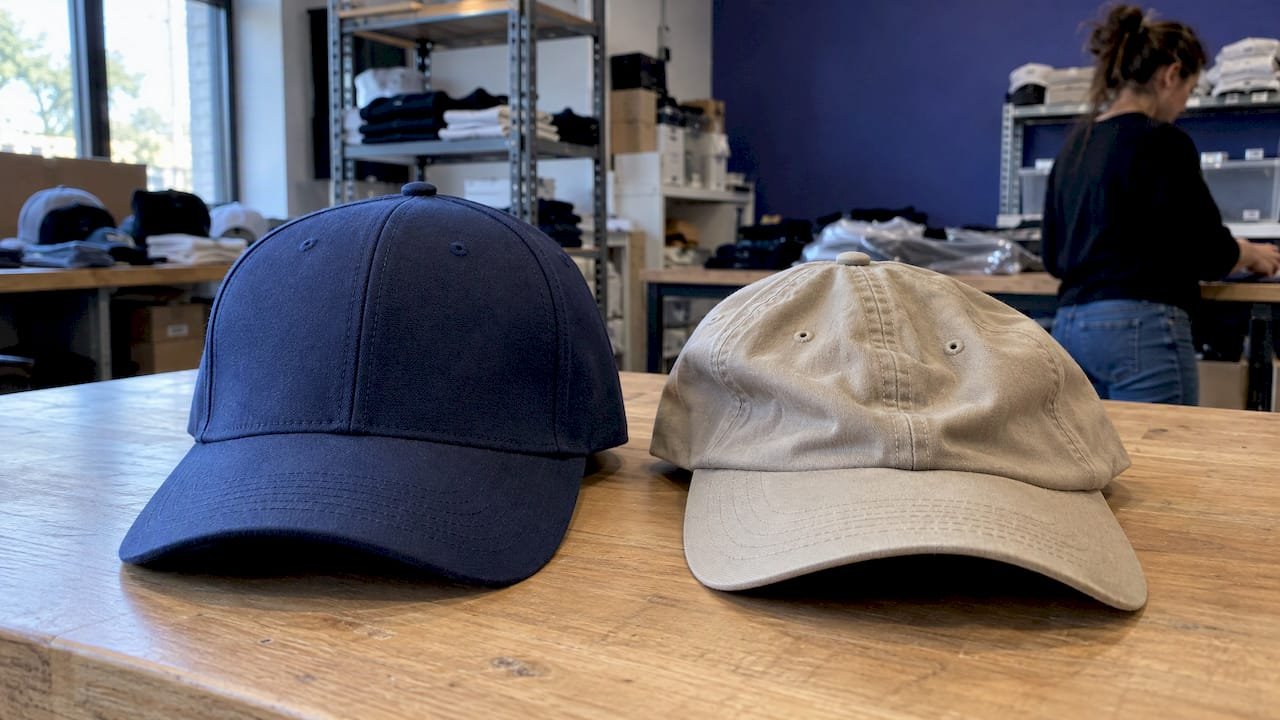
A structured hat has a stiffened front, so the crown stands tall and the logo sits on a firm, flat surface. An unstructured hat has no stiffener, so the crown is soft, low and relaxed, and it molds to the wearer’s head. For a branded order, the choice comes down to one question: do you want a crisp, uniform billboard for your logo, or a soft, wearable cap that people choose to put on after the event?
This guide is written for marketing teams and buyers who order hats in volume. It covers how each construction works, how snapback and fitted hats fit into the picture, and how to pick a style for a specific giveaway, uniform, or event program.
TL;DR
- Structured: a stiff lining (usually buckram or foam) sits behind the front panels, so the crown holds its shape and the logo stays flat and sharp.
- Unstructured: no front lining, so the crown is soft, sits lower and packs flat. Dad hats are the best-known example.
- Snapback and fitted are not the same question. They describe the back closure and sizing. Construction (structured or not) describes the crown. A hat can be a structured snapback, an unstructured strapback, or a structured fitted cap.
- For bulk giveaways, an adjustable closure removes sizing risk. Choose structured for a polished, uniform look and unstructured for comfort and everyday wear.
- Decide by audience and use: field staff and trade-show crews often suit structured; campus, wellness and lifestyle giveaways often suit unstructured.
Table of Contents
- What “structured” and “unstructured” actually mean
- Side-by-side comparison
- How each style looks and feels on the wearer
- Which one shows a logo better?
- Durability and care
- Dad hats: the best-known unstructured style
- Snapback vs fitted: a different question
- Choosing by use case
- Questions to settle before you order
- Can you turn a structured hat into an unstructured one?
- Perspective
- How we can help with a branded headwear program
- FAQ
- Sources
What “structured” and “unstructured” actually mean
Both terms describe what is inside the front of the crown, the part of the cap that rises from the brim and covers the forehead. Fabric on the outside can be identical: cotton twill, polyester, or a blend. The difference is the support behind it.
A structured hat has buckram, a stiff woven fabric, or a similar stiffener behind the two front panels. That reinforcement keeps the front upright even when the cap sits on a desk. An unstructured cap has no extra support behind those panels, so it collapses slightly when it is not on a head.
A third category, semi-structured, sits between the two. It has a lighter lining that gives some shape but bends more easily. If a supplier’s product page lists a hat as “mid-profile” or “semi-structured,” expect a crown that is neither rigid nor limp.
Two practical terms help when you read product listings:
- Profile is how tall the crown stands. Structured hats are often high or mid profile. Unstructured hats are usually low profile.
- Panels are the sections of fabric that form the crown. Most baseball-style caps have six. The front two panels are where the stiffener goes and where your logo usually sits.
Side-by-side comparison
| Feature | Structured hat | Unstructured hat |
|---|---|---|
| Front panels | Reinforced with buckram or foam | No reinforcement |
| Crown shape | Stands upright, holds its form | Soft, collapses, molds to the head |
| Typical profile | Mid to high | Low |
| Look | Sharp, athletic, polished | Relaxed, casual, “broken-in” |
| Logo surface | Firm and flat, even edges | Slightly flexible, can follow the head’s curve |
| Packing and shipping | Bulkier, can crush or dent | Folds flat, easy to bag and mail |
| Comfort out of the box | Firmer, can feel tight on the forehead | Soft from the first wear |
| Best for | Uniforms, trade-show crews, brand-forward looks | Casual swag, campus, wellness, lifestyle programs |
How each style looks and feels on the wearer
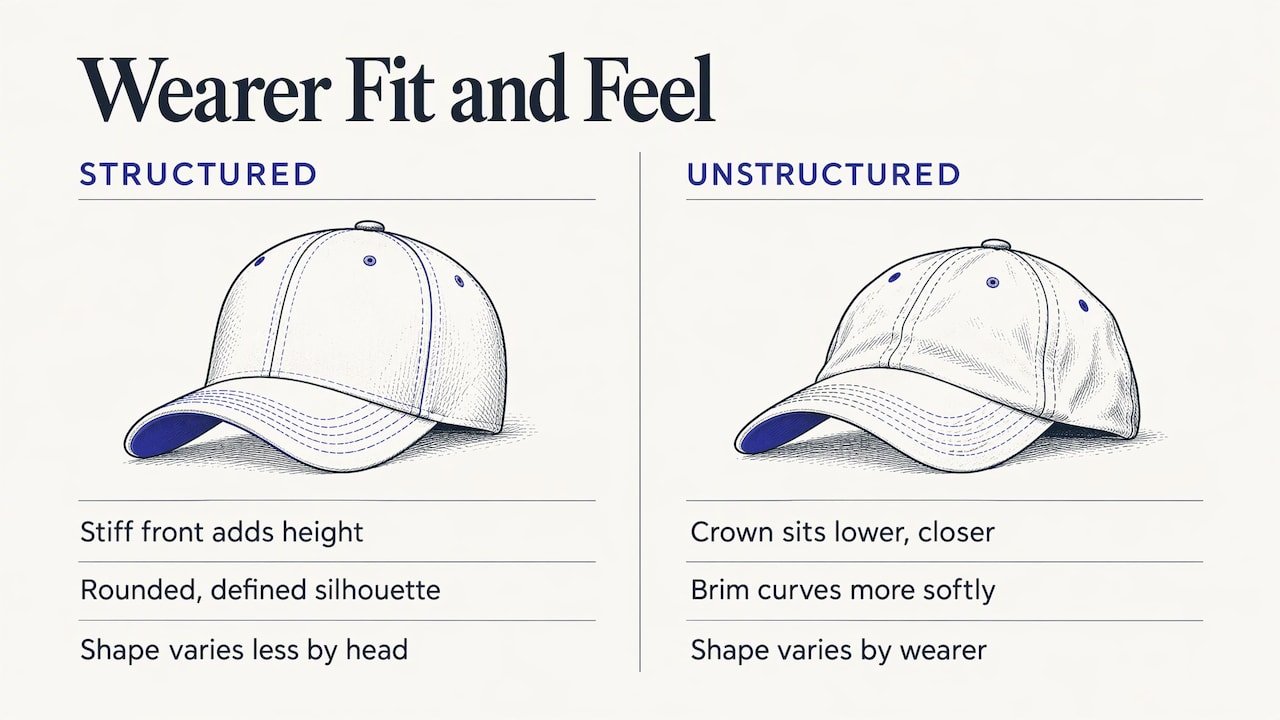
Structured caps build height. The stiff front lifts away from the forehead and gives a rounded, defined silhouette. People who want a hat to look the same on every head tend to like this, because the stiffener does the shaping and the wearer’s head shape matters less.
Unstructured caps follow the head. The crown sits closer and lower, and the brim usually curves more softly. That is why they read as casual and why many people find them more comfortable for long wear. The tradeoff is that the shape varies from person to person, which matters if you want a uniform look across a team.
Both styles come in a range of fabric weights, so comfort is not only about construction. A lightweight cotton twill unstructured cap feels very different from a heavier, brushed one, and a structured cap in a breathable fabric can be more comfortable than a thick unstructured one in hot weather.
Which one shows a logo better?
This is the question that matters most for a promotional order. The short answer: structured caps give the cleaner logo presentation, and unstructured caps give the more wearable one.
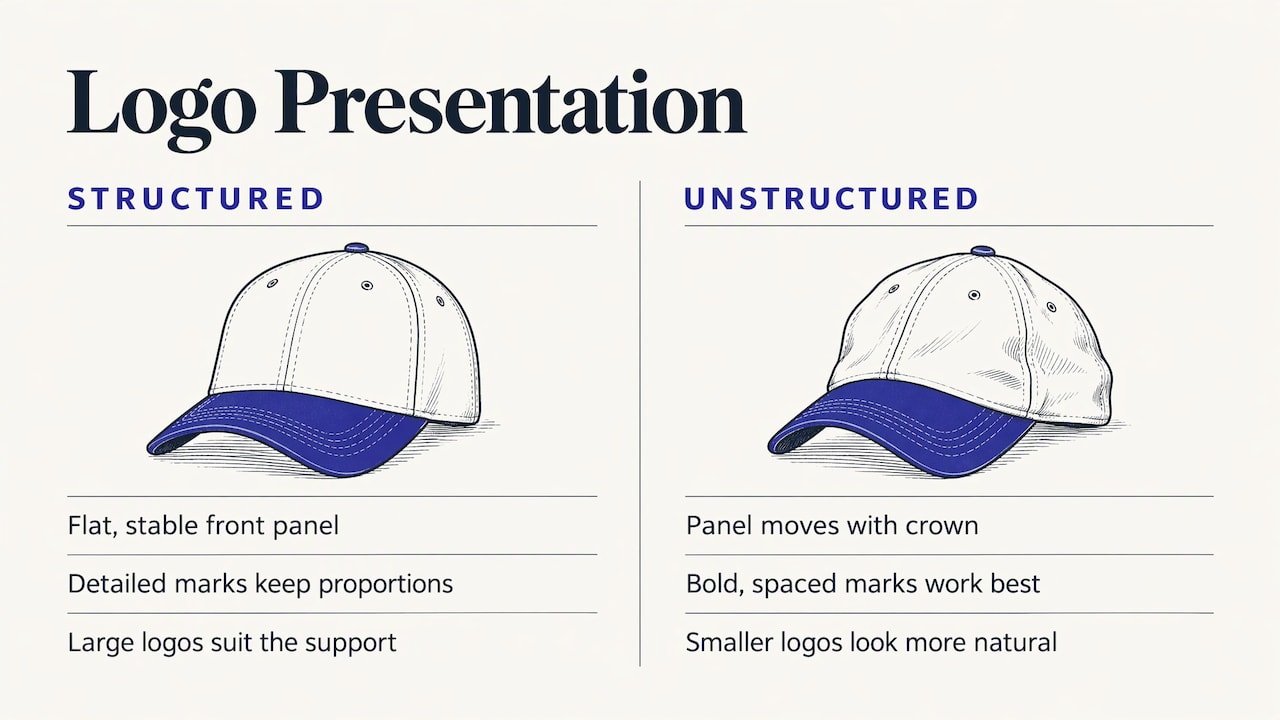
A stiffened front panel is flat and stable, so an embroidered logo sits on an even surface and keeps its proportions. A large, detailed mark with fine lines, a tagline or a small icon-plus-wordmark layout benefits from that support.
On an unstructured cap the panel moves. The logo bends slightly with the crown and can look a little softer, especially when the cap is worn and folded. Simple, bold marks with generous spacing work best here, and a smaller logo placement often looks more natural than a large one.
This is also where your artwork matters. A full logo lockup that looks right on a letterhead may be too wide or too detailed for a cap front. Having a compact version prepared in advance is standard practice, and guides to logo variations for small spaces explain what those versions usually look like. Send that compact mark with your order rather than leaving it to be shrunk at the last minute.
Durability and care
Unstructured hats are not less durable. Without a stiffener there is nothing inside to crack or bend permanently, which is why they handle being stuffed into a bag, a pocket or a carry-on. They are easier to pack and carry.
Structured hats keep their shape only if they are stored with some care. A crushed buckram front can stay dented. If your giveaway involves handing out hats in a tote at a conference or mailing them in a box, think about how the hats will travel. Unstructured styles tolerate that far better, while structured caps do better in a box where they can sit upright, or on a display.
For employees who will wear the hat outdoors for hours, durability is more about fabric, stitching and sweatband quality than about structure, so check those details on the product page when you compare options.
Dad hats: the best-known unstructured style
People searching this topic often ask whether dad hats are structured. They are not. A dad cap is a six-panel, unstructured baseball cap with a soft crown, a gently curved brim and an adjustable strap, usually a fabric strap with a metal buckle. What separates it from a structured cap is the missing front lining.
That makes the dad hat a natural fit for swag aimed at people who will wear it on their own time: new hires, campus recruits, wellness-program participants, customers at a casual event. It looks like something they would buy for themselves, not like a uniform piece. For ideas on what resonates with younger audiences, see our guide to campus recruiting swag.
Snapback vs fitted: a different question
Many buyers mix up structure with closure, and that leads to ordering the wrong hat. Here is the clean split:
- Construction (structured, semi-structured, unstructured) describes the crown.
- Closure (snapback, fitted, strapback, buckle, stretch) describes the back of the cap and how it sizes.
A snapback uses a plastic snap closure that adjusts to a range of head sizes. A fitted hat has no closure at all: it is sewn to one specific size, so it fits or it does not. A strapback is the adjustable alternative with a fabric strap and buckle, and it is the usual closure on dad hats.
Snapbacks are most often built with a structured crown and a flat brim, and fitted caps are commonly structured too, but neither is a rule. You can find unstructured snapbacks and structured strapbacks. When you compare options, read both lines of the product description: the crown type and the closure.
Which is easier for a bulk order?
For a group order, adjustable closures (snapback, strapback, buckle) are the lower-risk choice. One size covers a wide range of head sizes, so you do not have to collect sizes from recipients, and you do not end up with boxes of leftover sizes that fit nobody. Fitted caps give a clean, close fit and a traditional look, but you need a size run and a plan for who gets which size. They suit a defined team where you can collect sizes in advance, not an open giveaway at a booth.
Choosing by use case
The right hat depends on who wears it and where. These are the pairings that tend to work for corporate programs.
Uniforms and branded workwear
Choose structured. A stiff front keeps the logo flat and the cap looking identical across a team. If different roles wear it daily, specify an adjustable closure so every employee has a fit.
Trade shows and field events
Structured caps give booth staff a coordinated look, and a cap on a display stand holds its shape. If you are also handing hats out to attendees, think about shipping and carrying: unstructured caps fold into a tote, so attendees are more likely to take one and bring it home.
Employee welcome kits and onboarding
Unstructured is a good default. It feels personal rather than corporate, and a soft cap is comfortable straight out of the box. Pair it with drinkware, bags or tech items in a branded kit so that every item carries the same compact logo.
Customer and client gifts
It depends on the relationship. A structured cap in a clean, neutral color reads as premium. An unstructured cap reads as friendly. Law firms, banks and professional services tend to prefer quieter, more refined presentation, and our piece on law firm swag shows how a considered gift outperforms a bigger, louder one.
Wellness, community and casual events
Choose unstructured. People wear what feels easy, and a hat that is worn gets your logo seen for months.
Questions to settle before you order
Work through these with your team and you will usually land on the right style without a long debate.
- Who is the wearer? A uniformed team needs consistency. Open-audience recipients need a hat that fits most heads and that they actually want to wear.
- How complex is the logo? Detailed logos belong on a stable surface. Simple, bold logos work on either.
- How will the hats travel? If they are going in totes, mailers or fulfillment boxes, soft hats arrive in better shape.
- Do you need sizes? If you cannot collect them, choose an adjustable closure.
- What is the tone of the brand? Polished and athletic points to structured. Relaxed and approachable points to unstructured.
- Can you test a look? Review a digital mockup of the logo on the exact style before you commit to the full quantity.
Can you turn a structured hat into an unstructured one?
Some people soften a structured cap by hand, by bending the front and wearing it in, but the stiffener inside stays and the cap rarely looks like a true unstructured one. Since the style is built in at the factory, the reliable approach for a branded order is to choose the construction you want when you place it, not to change it afterward. For hundreds of hats, you want every one to look the same, and that only happens when the construction is specified up front.
Perspective
Most hat orders go sideways for a simple reason: someone picks a cap because it looks good in a photo, and nobody asks who is going to wear it, how it is going to get there, or whether the logo will sit well on it.
When we help marketing teams plan a program, we treat the hat as one piece of a larger set. A structured cap might anchor a field-team kit, while an unstructured one goes into a welcome box with drinkware and a bag. The goal is a program where everything looks like it belongs together, arrives on time, and reaches every location it needs to.
That is where we put our effort: curated products from trusted suppliers, rush ordering that does not turn into a scramble, and distribution to a single office or many locations from one order. Our guarantee is 10% or more in savings against any competitor’s online price, which matters when a hat is one line item in a program that runs into the thousands of units.
Pick the style by the wearer and the use, plan the logo for a small surface, and choose an adjustable closure when you cannot collect sizes. Do those three things and the structured versus unstructured decision mostly makes itself.
Jerry
How we can help with a branded headwear program
Discount Swag is an online distributor of customizable corporate promotional products, including apparel, bags, drinkware, technology items, gifts and event swag. We support rush orders, branded kits and fulfillment to single or multiple locations, and we guarantee 10% or more in savings versus any competitor’s online price.
If your hats are part of a bigger program, such as a welcome kit, a campus recruiting push or an event giveaway, you can build the whole set with us and ship it where it needs to go. Start at Discount Swag and browse the apparel category.
For finishing ideas that apply to other items in the same kit, our guide to embossing vs. debossing shows how different branding finishes change the look of a product.
FAQ
Are dad hats structured or unstructured?
Dad hats are unstructured. They have a soft, low crown with no stiffener behind the front panels, a gently curved brim and an adjustable strap. That soft construction is what gives them their relaxed, worn-in look.
What is the difference between a snapback and a fitted hat?
A snapback has an adjustable plastic snap closure at the back and fits a range of head sizes. A fitted hat has no closure and comes in one exact size. For bulk giveaways, adjustable closures remove the need to collect sizes.
Is a snapback structured or unstructured?
Snapbacks are usually structured and flat-brimmed, but snapback describes the closure, not the crown. You can find both structured and unstructured caps with adjustable closures, so check the product description for the crown type.
Which hat style is better for a company giveaway?
Unstructured caps with an adjustable closure are a strong default for open giveaways, because they fit most people, pack flat and feel comfortable right away. Choose structured when you want a uniform, polished look for a defined team or event crew.
Do structured hats show a logo better?
Yes, in most cases. The stiff front panel gives an embroidered logo a flat, stable surface, so detailed marks keep their shape. Unstructured caps work best with simple, bold logos.
Sources
- Structured Vs Unstructured Hats: Everything you Need to Know
- What Is a Dad Cap? Style, Fit, and Outfit Formulas
- What Is a Snapback Cap? Explained and Compared
- Logo variations explained
 Bottle Carriers
 Mugs