

Soft Enamel vs Hard Enamel Pins: Which Finish to Order

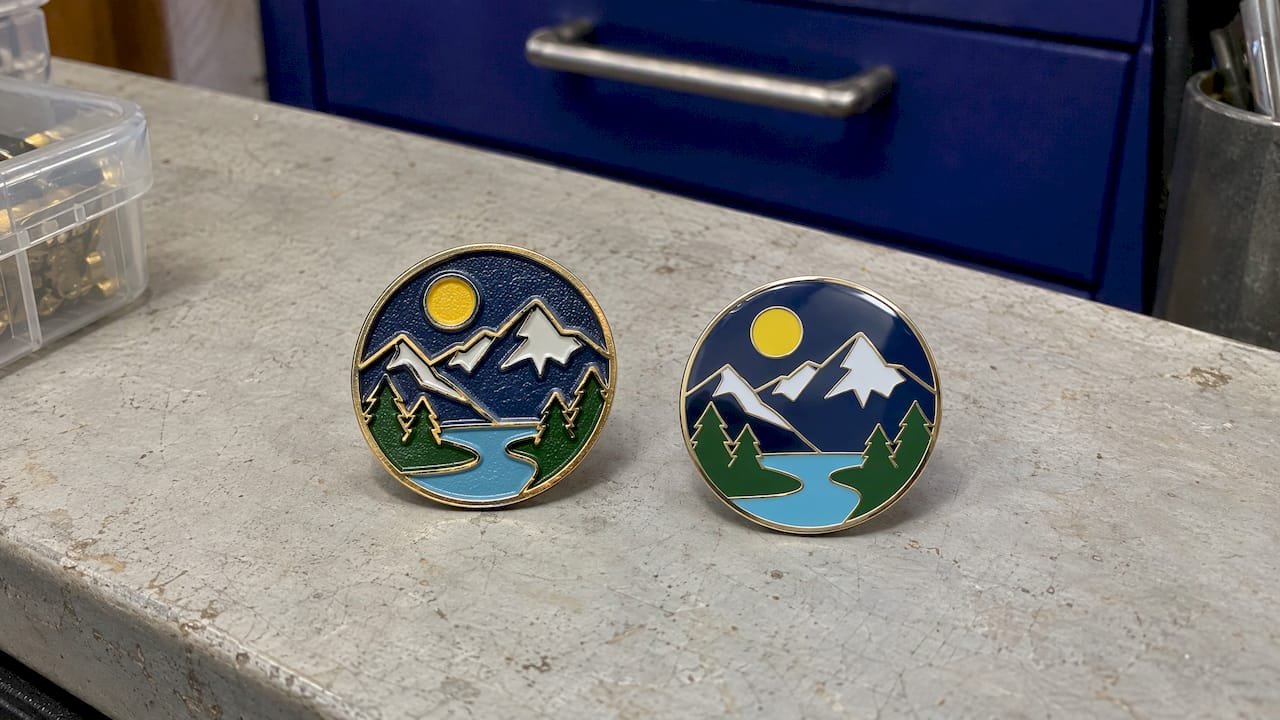
Soft enamel has raised metal lines with color sitting below them, so you can feel the design. Hard enamel is filled flush and polished smooth, so the surface feels like glass. For most corporate programs the choice comes down to the job: soft enamel for large giveaways, events and fast turnarounds, hard enamel for recognition, service awards and anything people will wear for years.
This guide is written for marketing teams and buyers who have to approve a pin order, not for hobbyists designing a single run. It covers how each finish looks and is made, what moves the price, which one fits which campaign, and what to settle before you request a quote.
TL;DR
- Soft enamel: textured, with color recessed below raised metal edges. Lower cost and faster turnaround, so it suits events, trade shows and large giveaways.
- Hard enamel: polished flat, smooth and glossy, with a more durable finish. It costs more and takes longer, so it suits awards, milestones and premium kits.
- Cost: hard enamel needs extra curing and polishing, which is why it is the more expensive finish at the same size and quantity.
- Decide by use: a pin handed to 2,000 attendees and a pin presented to a 10-year employee are different jobs, so they get different finishes.
- Before you order: lock the size, number of colors, backing, packaging and delivery locations, since these change the quote as much as the finish does.
Table of Contents
- The difference you can see and feel
- How each type is made, and why it matters to your order
- Soft enamel vs hard enamel at a glance
- What each finish costs and what else moves the price
- Which finish fits which campaign
- Size, backing and design choices that matter more than people expect
- A related option for formal recognition
- How to order pins for a corporate program: a practical checklist
- Where we fit in
- Our view on choosing a finish
- FAQ
- Sources
The difference you can see and feel
Both finishes start the same way: a design is cut into a metal die, the pin is stamped, and the raised lines of the artwork form walls that hold the colors apart. What differs is how far the enamel color fills those walls and what happens to the surface afterward.
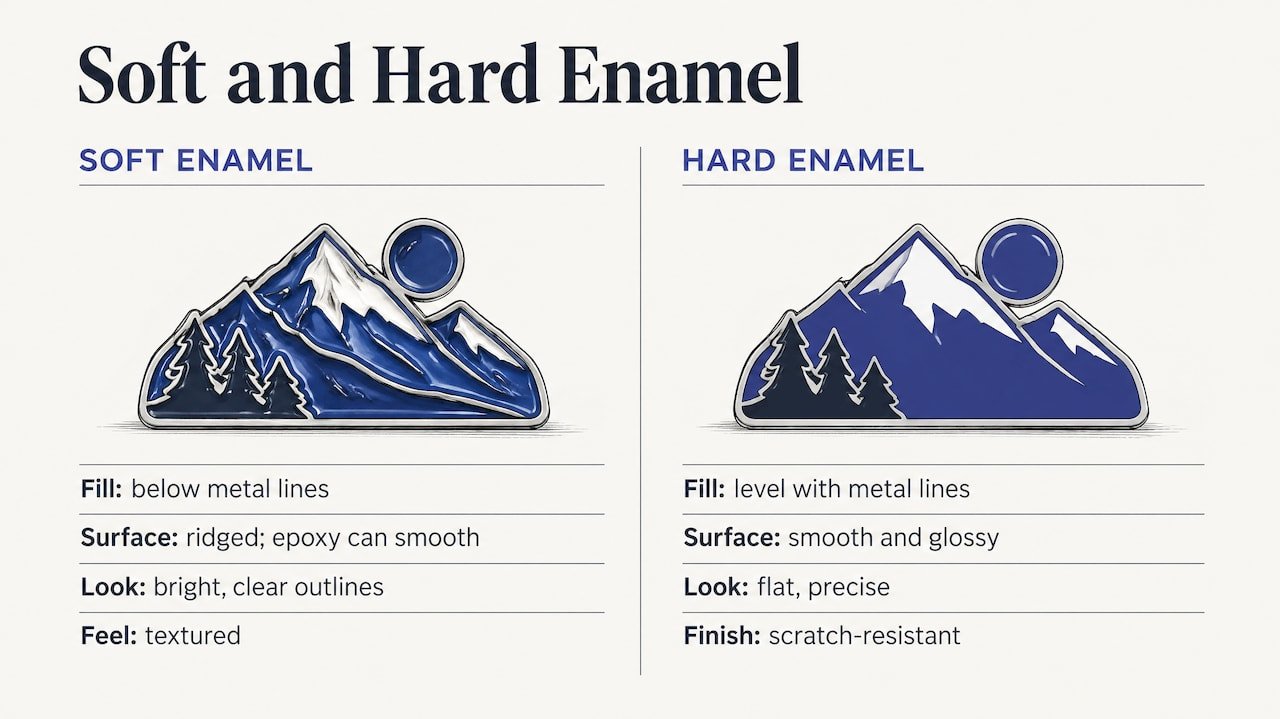
Soft enamel. The color fills the recessed areas but stops below the top of the metal lines. Run a finger over the pin and you feel ridges. Colors tend to look bright and the metal outlines read clearly, which gives the pin a dimensional, crafted look. Because of that texture, it is common to protect a soft enamel pin with a clear epoxy dome on top, which smooths the surface and adds a shiny layer.
Hard enamel. The color is filled to the top of the metal lines, then the whole face is ground and polished until enamel and metal sit level. The surface is smooth and glossy. Shopify’s manufacturing guide describes the result as a smooth, glass-like, scratch-resistant finish produced by baking the colors at high temperature and polishing them flat.
A quick way to remember it: soft enamel is something you feel, hard enamel is something you see. If your brand look is bold, graphic and playful, texture helps. If it is refined, formal or built around a precise logo, the flat finish usually flatters it.
How each type is made, and why it matters to your order
You do not need to run a pin factory, but the process explains the price and the schedule.
Soft enamel
After stamping and plating, enamel paint is applied into the recessed areas. Per the same Shopify guide, soft enamel paint can be air-dried rather than heat-cured, which lowers manufacturing cost, allows vivid colors and shortens turnaround. There is no polishing step that levels the surface, which is why the raised edges remain.
Hard enamel
Hard enamel goes through repeated fill-and-cure rounds. The guide notes that its colors are baked at roughly 160°C to 200°C to harden, and then polished until the surface is level. Those extra rounds are why the finish is costlier and slower, and also why it is the more durable of the two.
One practical consequence for brand teams: because hard enamel is polished flat, the plated metal lines between colors stay at the same height as the color. Exact color matching is a conversation worth having early with any pin supplier, whichever finish you pick. Give your Pantone references when you brief the order, and ask how the supplier matches them in the chosen finish.
Soft enamel vs hard enamel at a glance
| Factor | Soft enamel | Hard enamel |
|---|---|---|
| Surface | Textured, raised metal edges | Smooth, flush and polished |
| Look | Bold, dimensional, bright | Refined, glossy, formal |
| Durability | Good for everyday use, often protected with epoxy | Higher scratch resistance |
| Cost | Lower | Higher |
| Turnaround | Faster | Longer |
| Best for | Events, giveaways, large quantities | Awards, recognition, premium kits |
What each finish costs and what else moves the price
Hard enamel costs more than soft enamel at the same size and quantity because of the extra curing and polishing. Suppliers publish different per-pin rates, and the gap between the two finishes narrows or widens with quantity, so use the figures on your own quote rather than a rule of thumb.
For a marketing budget, finish is only one of several levers. These usually matter as much:
- Quantity. Pin pricing is tiered. Per-pin cost drops as you cross quantity breaks, so 1,500 pins may cost noticeably less per unit than 500.
- Size. A 1-inch pin and a 1.5-inch pin use different amounts of metal and enamel. Size also decides how much detail fits legibly. Fine text on a very small pin reads poorly in either finish.
- Number of colors. More color fills mean more labor.
- Plating. Gold, silver, nickel, black nickel and antique finishes are priced differently and change the whole mood of the pin.
- Extras. Epoxy domes, glitter, custom die shapes, special backings (butterfly clutch, magnet, locking clasp) and individual packaging each add cost.
- Setup and artwork. Some suppliers charge a mold or die fee and some fold it in. Always compare quotes on the same specification, including whether setup is included.
When you compare quotes, line them up by finish, size, colors, plating, backing, packaging and delivery. A quote that looks cheaper often leaves one of those out.
Which finish fits which campaign
Choose soft enamel when volume and speed lead
- Trade shows and conferences. You are handing out hundreds or thousands of pins, and the goal is visibility and collectability. Soft enamel keeps per-unit cost low.
- Employee swag drops and onboarding. A bright, tactile pin fits a welcome kit where it sits beside a notebook, a mug and a bag.
- Product launches and limited runs. Short timelines favor the faster finish.
- Community and partner programs. Pins that people trade or collect work well when the design has strong lines and bold colors.
Choose hard enamel when the pin is the recognition
- Service anniversaries and milestone awards. The polished surface feels more like a keepsake than a giveaway.
- Executive, client and VIP gifts. A smooth, jewelry-like pin reads as a considered gift, particularly when presented in a box.
- Uniform and brand-ambassador pins. Pins that are worn daily benefit from the more durable surface.
- Detailed logos. A clean, flat face shows a precise mark crisply.
A simple rule for mixed programs
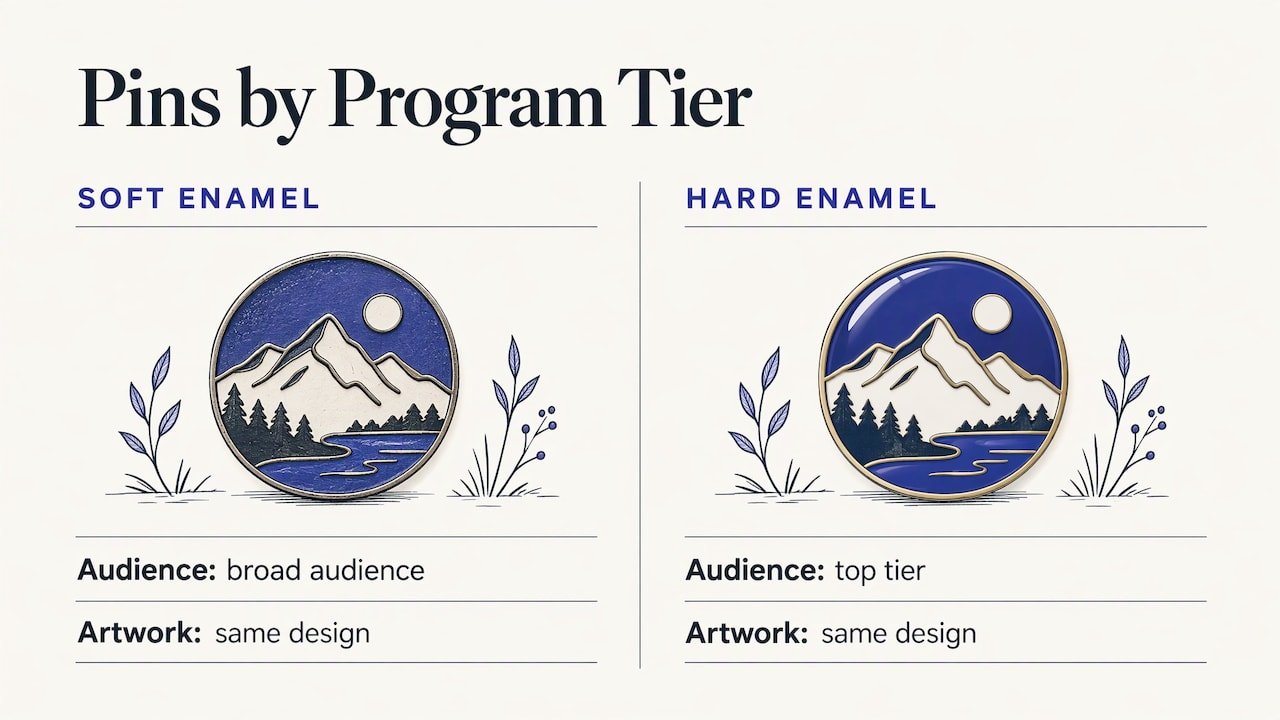
Buy both when your program has tiers. A common approach is soft enamel for the broad audience and hard enamel for the top tier, with the same artwork, so the two pins look related while the premium one feels like a step up. That keeps average cost per recipient sensible without diluting the recognition pin.
When the pin is part of a wider mix, think about how it works as one piece of a campaign. A goal-first view of promotional offer types helps you decide whether a pin is a thank-you, an incentive or a keepsake before you choose the finish.
Size, backing and design choices that matter more than people expect
People searching this topic often ask whether 1 inch or 1.25 inch is better. There is no universal answer, but a few points help you decide:
- 1 inch is a classic lapel size. It suits a simple logo or icon and keeps costs down.
- 1.25 inches and above gives room for wordmarks, small text and multiple colors. Larger pins cost more.
- Detail limits. Very thin lines and tiny text are hard to fill cleanly in either finish. Ask for a digital proof and look at it at actual size.
- Backings. A standard butterfly clutch works for most programs. Magnetic or locking backs suit people who wear pins daily, such as front-line teams.
- Packaging. Each pin on a branded backing card or in a small box makes a giveaway feel intentional and keeps pins undamaged through shipping.
A reader also commonly asks about travel. Pins are small metal items, and when staff fly to events with boxes of them, check the current guidance directly on the TSA website for the specific items you carry, because screening rules are set by the agency and can change.
A related option for formal recognition
If you are weighing a hard enamel pin for an award, the same thinking applies to other die-struck metal items. Our guide to ordering custom challenge coins walks through specifications for companies, and the finish questions are similar: raised or flat, plating, colors and packaging. Our piece on embossing vs. debossing covers the same kind of texture decision for other branded merchandise.
How to order pins for a corporate program: a practical checklist
- Define the job. Giveaway, recognition, onboarding or sales incentive. This sets the finish.
- Set quantity and tiers. Decide how many pins each audience gets, and whether the top tier gets hard enamel.
- Prepare the artwork. Vector files with Pantone color references prevent proofing delays.
- Choose size, plating and backing. Settle these before asking for quotes so every quote is comparable.
- Plan packaging and kitting. Decide whether pins ship loose, carded or inside a branded box with other items.
- Map delivery. List every location, whether one event, one warehouse or offices in several cities.
- Build in time. Custom metal items have proofing and production stages. Work backward from the date you need them in hand, and tell your supplier early if the date is firm.
- Approve the proof. Check colors, spelling and dimensions at actual size before production starts.
Where we fit in
Corporate programs rarely stop at one item. A pin is usually one piece of a welcome kit, a campaign box or an event handout, and the work is in getting the right pieces to the right people on time. Discount Swag is an online distributor of customizable corporate promotional products, with apparel, drinkware, bags, technology items, gifts and event swag. We support rush orders, branded kits and fulfillment to single or multiple locations, and we guarantee 10% or more savings versus any competitor’s online price.
If your pin is going into a kit, you can build the rest of it from our range, such as a custom Stanley travel mug or a recycled drawstring bag. When you are ready to plan an order, start at discountswag.store.
Fully custom branded boxes are also part of what we offer, which suits programs where presentation matters as much as the items inside.
Our view on choosing a finish
Buyers often treat the finish as the whole decision. In our experience of how corporate programs are run, the finish is one line on a larger plan: who receives the item, when it must arrive, and where it needs to go.
Our advice is to pick the finish from the audience. Broad audience and tight timeline, go with the lighter-cost option. Recognition and keepsakes, go with the polished one. Then think about the whole program, because a pin that arrives late or at the wrong office does nothing for your brand.
That is why we built our service around the operational side of large programs: rush orders without stress, curated products from trusted suppliers, branded kits and distribution to single or multiple locations. We want the person approving the order to have one clear plan instead of five loose ends.
Jerry
FAQ
Is hard enamel always better than soft enamel?
Not for every job. Hard enamel has the smoother, more durable finish, which suits awards and daily wear. Soft enamel costs less and moves faster, which is the better fit for large giveaways and events. The right pin is the one matched to its audience and budget.
Can soft enamel pins look smooth?
Yes. A clear epoxy dome over a soft enamel pin fills in the texture and gives a glossy, smooth surface. The metal edges beneath are still raised, but the top layer feels flat. Check what the epoxy adds to your quote.
Which finish is more expensive?
Hard enamel. Its repeated curing and polishing make it costlier and slower than soft enamel, as the Shopify manufacturing guide explains. Quantity, size, colors, plating and backing then set the final figure, so compare quotes with identical specifications.
What should I send before requesting a quote?
Send vector artwork, Pantone references, the pin size, the quantity, the finish you want, the backing type and the delivery locations. Add your in-hand date as well. With those details, a quote can be accurate and quick to compare.
Can I order pins together with other promotional items?
Yes, and many teams do. Pairing a pin with apparel, drinkware, a bag or a notebook in one branded kit gives recipients a more complete gift and gives you one program to manage. Our team supports branded kits and fulfillment to multiple locations.
 Bottle Carriers
 Mugs