


Cut DIM Charges on Swag: 6 Dimensional Weight Shipping Tactics


Dimensional weight is a carrier’s way of charging for the space a package takes up, not just what it weighs on a scale. Every major carrier bills whichever is greater: your package’s actual weight or its dimensional weight, calculated as length times width times height divided by a published divisor. Understanding that one rule is the fastest way to stop overpaying on light, bulky shipments.
TL;DR:
- Using a lower contracted divisor can significantly reduce dimensional weight charges compared to the standard 166 used in retail, especially for bulk shipments.
- Always round each dimension up to the nearest inch before multiplying and dividing by the divisor to avoid overestimating the billable weight.
- Small measurement errors in box dimensions are amplified due to rounding, making consistent measurement practices important to prevent extra fees.
- Shrinking box size and consolidating shipments can lower dimensional weight charges more effectively than relying on actual weight alone.
- Verifying your carrier’s specific divisor and maintaining accurate measurement records are key steps to avoiding unnecessary dimensional weight surcharges.
Table of Contents
- How to calculate dimensional weight step by step
- What UPS, FedEx and USPS actually do differently
- Measurement and rounding mistakes that trigger extra charges
- Packaging tactics that reduce your dimensional weight bill
- How this plays out with promotional kits and swag boxes
- Three priorities worth tackling this week
- Right-sized packaging that keeps DIM charges down
- FAQ
- Sources
How to calculate dimensional weight step by step
The formula is simple: multiply length by width by height in inches, then divide by the carrier’s divisor. Retail divisors commonly land at 166, though contracted shippers often qualify for a lower divisor such as 139, which directly reduces the billable figure. Always check your own rate agreement before assuming the retail number applies.
Two rules matter before you multiply anything:
- Measure each side of the box in inches and round every single dimension up to the nearest whole inch, even a quarter inch over.
- Multiply the three rounded dimensions to get cubic inches, divide by the divisor, then round that result up to the nearest whole pound.
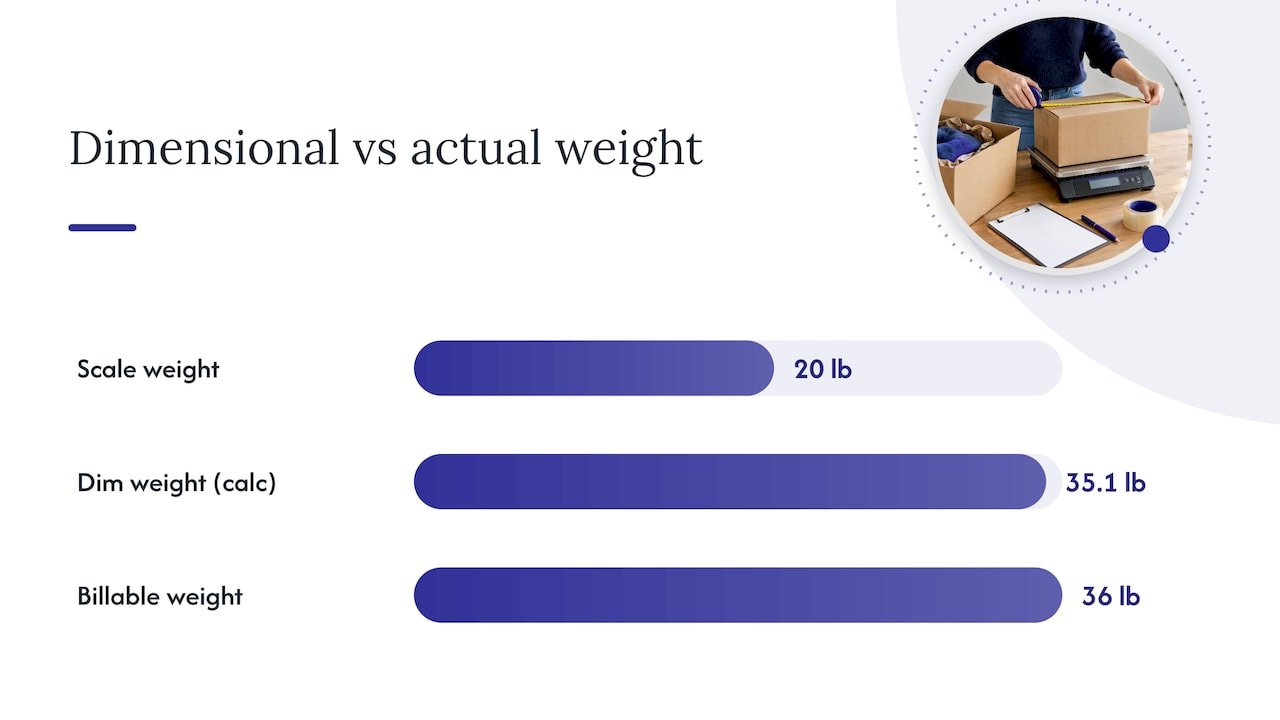
Here’s a worked example. Say a box measures 17.5 x 17.5 x 17.5 inches and weighs 20 pounds on a scale. Round each side up to 18 inches. Multiply: 18 x 18 x 18 equals 5,832 cubic inches. Divide by 166, and you get roughly 35.1 pounds, which rounds up to 36 pounds. Since 36 is greater than the actual 20 pounds, the carrier bills you for 36. That gap, not the scale weight, is what shows up on your invoice.
Carriers also publish a nonrectangular adjustment factor, often 0.785, for irregularly shaped parcels like tubes or odd packaging, so the formula shifts slightly when a box isn’t a clean rectangle.
What UPS, FedEx and USPS actually do differently
Carrier rules share a common structure but differ enough in the details to change your actual invoice.
- UPS applies dimensional weight pricing broadly across its services and publishes separate divisors for retail versus daily or contracted rates, with shipping software like WorldShip or CampusShip calculating DIM automatically once dimensions are entered.
- USPS uses dimensional weight mainly on parcels over a cubic-inch threshold, and its Quick Service Guide sets a 166 divisor for many rectangular parcels along with the 0.785 nonrectangular factor.
- FedEx applies dimensional weight across most ground and express services using divisor practices similar to UPS, so light, bulky boxes get re-rated the same way.
- Contracted shippers at any carrier frequently negotiate divisors below the retail standard, meaning two companies shipping the identical box can be billed different amounts.
- Always verify the divisor in your own service guide or contract rather than assuming the number that applies to a different account.
The takeaway is that your divisor isn’t fixed. It depends on which carrier you use, whether you ship retail or under contract, and which service level you select. A five-minute check of your actual contract terms can reveal a cheaper divisor you’re not currently using.
Measurement and rounding mistakes that trigger extra charges
Small measurement errors compound quickly. Because carriers round each dimension up before multiplying, a box that’s 17.6 inches on a side rounds to 18, and that rounding happens three times before you divide, so the final dimensional weight climbs faster than the actual size difference suggests.
- Round every dimension up to the next whole inch before you calculate, never after.
- Use the same measuring method every time: a tape measure against a flat surface, not a visual estimate.
- Missing or inconsistent dimensions on a manifest can trigger dimension-noncompliance fees, separate from the DIM charge itself.
- Automated dimensioning equipment reduces disputes versus manual tape measurements, and keeping photo evidence of the packed box protects you if a carrier’s measurement doesn’t match yours.
Pro Tip: Keep a dated photo and the manifest record for every disputed package. It’s the fastest way to get a noncompliance fee reversed.
Packaging tactics that reduce your dimensional weight bill
Cutting DIM charges comes down to shrinking the box and the empty space inside it, since carriers reward density over sheer weight for light, bulky items like apparel, bags, and swag kits.
- Right-size the box first. Switching from a generic box to one that fits the product within an inch or two on each side often drops the billable weight by a full pound or more, since rounding compounds across all three dimensions.
- Compress soft goods. Folded apparel, tote bags, and similar items compress well; reducing void space with better fold techniques or vacuum-sealed poly bags shrinks the outer carton size.
- Consolidate into fewer, denser shipments. When billable weight on several parcels adds up to more than a palletized load would cost, switching to pallet or LTL freight can beat per-parcel DIM pricing.
- Capture accurate dimensions in your systems. Feeding correct box dimensions into your warehouse or transportation management system avoids both overestimating and underestimating, which prevents noncompliance fees and billing surprises alike.
- Negotiate your divisor. If your shipment volume supports it, ask your carrier rep about contracted divisors below the retail standard.
- Reassess class or carrier when DIM consistently wins. If a given SKU always triggers dimensional pricing, it may be cheaper on a different service tier or even a different carrier entirely.
A simple weekly box audit, test-packing your most common SKUs into two or three alternate box sizes and projecting the billed weight under both retail and contracted divisors, surfaces savings most teams never bother to check.
How this plays out with promotional kits and swag boxes
Promotional merchandise is a textbook dimensional weight problem: tote bags, apparel, and drinkware are light but bulky, so the box size drives the invoice far more than the scale weight does. Shrinking a standard kit box by even an inch or two per side, paired with tighter void-fill, routinely moves a shipment from a dimensional charge back down toward its actual weight.
- Our promotional item packaging options guide covers right-sizing choices for common swag categories.
- Our guide to shipping swag kits without delays walks through the operational checklist for multi-item kits.
- We also cover why box density affects campaign budgets in our piece on branded merchandise that delivers more.
Three priorities worth tackling this week
If you only have time for three fixes, start here. First, audit your last ten invoices against your own measurements. Mismatches reveal whether rounding or manifest errors are costing you. Second, test one right-sized box against your current default. Third, confirm which divisor your contract actually uses instead of assuming the retail rate.
— Jerry
Right-sized packaging that keeps DIM charges down
Custom branded boxes sized to the actual product inside, not a one-size-fits-all carton, can be the single biggest lever against dimensional weight charges on promotional kits. Pairing that with rush orders and distribution to single or multiple locations means a tighter box doesn’t slow down your campaign timeline.

- Custom-fit swag boxes sized to reduce void space and billable weight.
- Rush order support when campaign timelines are tight.
- Coordinated distribution to one address or many without separate vendor setups.
See our custom swag boxes built to fit your budget or start with our full distribution and custom box services to plan your next shipment.
FAQ
Does USPS use dimensional weight for packages?
Yes, USPS applies dimensional weight to many rectangular parcels once they exceed a cubic-inch threshold, using a 166 divisor and a 0.785 adjustment factor for nonrectangular parcels. Below that threshold, actual weight typically applies instead.
How do I calculate dimensional weight for UPS?
Measure length, width, and height in inches, round each one up to the nearest whole inch, multiply them together, then divide by UPS’s published divisor for your rate type, retail or contracted. The result, rounded up, is compared against actual weight, and the higher number is billed.
How do I calculate dimensional weight in pounds?
Multiply the rounded length, width, and height in inches to get cubic inches, then divide by the applicable divisor, commonly 166 for retail rates. For an 18 x 18 x 18 inch box, that’s 5,832 cubic inches divided by 166, which rounds up to 36 pounds.
How does dimensional weight affect international shipping costs?
International parcels are generally more sensitive to dimensional weight because space on international flights and transport legs is at a premium, so carrier documentation ties international dimensional calculations to the same 166 divisor framework used domestically. The core formula stays the same; what changes is how aggressively low-density shipments get re-rated on international lanes.
What causes a dimension-noncompliance fee?
These fees typically appear when a shipment’s manifest is missing dimensions or lists numbers that don’t match the carrier’s own measurement. Accurate, complete dimension fields on electronic manifests reduce disputes and avoid these added charges.
Sources
- Shipping Dimensions and Weight | UPS – United States
- 150 Quick Service Guide | Postal Explorer
- Decoding shipping costs: actual weight vs volumetric weight | DHL
- 250 Commercial Mail Parcel Select | Postal Explorer
 Bottle Carriers
 Mugs