


Start by July: U.S. 2026 Holiday Gift Deadlines to Hit Dec 5–15


Start full custom holiday gift programs by June or July 2026, and treat July as the last safe start date for most standard corporate gifting orders. Plan backward from a domestic delivery target of December 5 to December 15, not December 20 or later. Givenly’s planning research and vendor timelines from Brandit both point to the same pressure point: procurement teams that wait until October are choosing from whatever’s left, not what they actually wanted.
TL;DR:
- Starting full custom holiday gift programs by July ensures vendor availability and allows adequate lead time for design approval and production.
- Missing the mid-October deadline for finalizing quantities and personalization files increases the risk of late delivery and manual reshipping.
- Domestic shipping deadlines generally close around December 1 to 5, and any arrivals after December 15 are at high risk of delays or carrier capacity issues.
- International shipments require three to four additional weeks for customs clearance and duties, making early planning critical for worldwide recipients.
- If starting late in October or November, consider stock-adapted or digital gifts and delay full customization projects to January to avoid costly rush fees.
Table of Contents
- The 2026 Holiday Gift Deadlines Calendar, Month by Month
- Which Production Route Fits Your Approval Date?
- Your Execution Checklist: Owners, Files, and Hard Cutoffs
- What to Do When You’re Starting Late
- International Shipping and Customs Timelines to Plan Around
- Setting Carrier and Vendor Deadlines by Shipping Method
- Tracking and Monitoring Orders After You Place Them
- Managing Recipient Expectations Around Delivery Dates
- Why Most Programs Fail in October, Not December
- How Discount Swag Keeps Your Holiday Program on Schedule
- Sources
The 2026 Holiday Gift Deadlines Calendar, Month by Month
Every missed holiday gifting deadline traces back to the same root cause: a decision that should have happened in July got pushed to September. Here’s what the corporate gifting calendar actually looks like when you work backward from a mid-December delivery target.
July is brief-and-decide month. Get executive sign-off on budget, request samples from two or three vendors, and pick your production route (more on that below). This is also when you should lock your recipient list format, because address collection takes longer than anyone expects.
August is when custom vendor calendars fill up. Finalize sample approvals and design files now. Brandit’s research found that many artisan and high-end vendors lock their production calendars by mid-August, and companies that commit in July instead of waiting typically save 10 to 15% versus fall pricing. Waiting past mid-August often means losing your first-choice vendor entirely.
September is when semi-custom production should start, and it’s also your window for address verification and recipient list collection. Don’t treat this as a formality: it can take three weeks to verify addresses, and 10 to 15% of any distributed list is typically stale by the time you need it.
Early to mid October is your lock date for final quantities, addresses, and personalization files. If you’re still negotiating headcount or waiting on a recipient list past mid-October, you’ve entered the risk zone for holiday gift delivery.
November is shipping season. Ship domestic waves in early to mid-November rather than waiting for a single late blast; that buffer protects you against carrier delays during the industry’s busiest freight month. Monitor delivery daily once packages move.
December is not for new orders. Standard production for holiday delivery typically closes around December 1 to 5, and anything targeting arrival after December 15 is gambling with carrier capacity. Use December only for small, high-touch sends, like a leadership-only gift or a same-day local delivery.
| Month | Key action | Deadline risk if missed |
|---|---|---|
| July | Brief, sign-off, samples, route decision | Loses full-custom eligibility |
| August | Finalize design and vendor booking | Vendor calendars close mid-month |
| September | Start semi-custom production, begin address collection | Address errors compound later |
| Early-mid October | Lock quantities and personalization files | Forces manual personalization or reship |
| November | Ship domestic waves, monitor daily | Carrier peak delays with no buffer |
| December | Small/local sends only | Rush premiums, missed arrival |
Which Production Route Fits Your Approval Date?
The route you choose should be dictated by your delivery date, not by which option looks best in a deck. FYB’s production guide lays out three tiers with meaningfully different lead times:
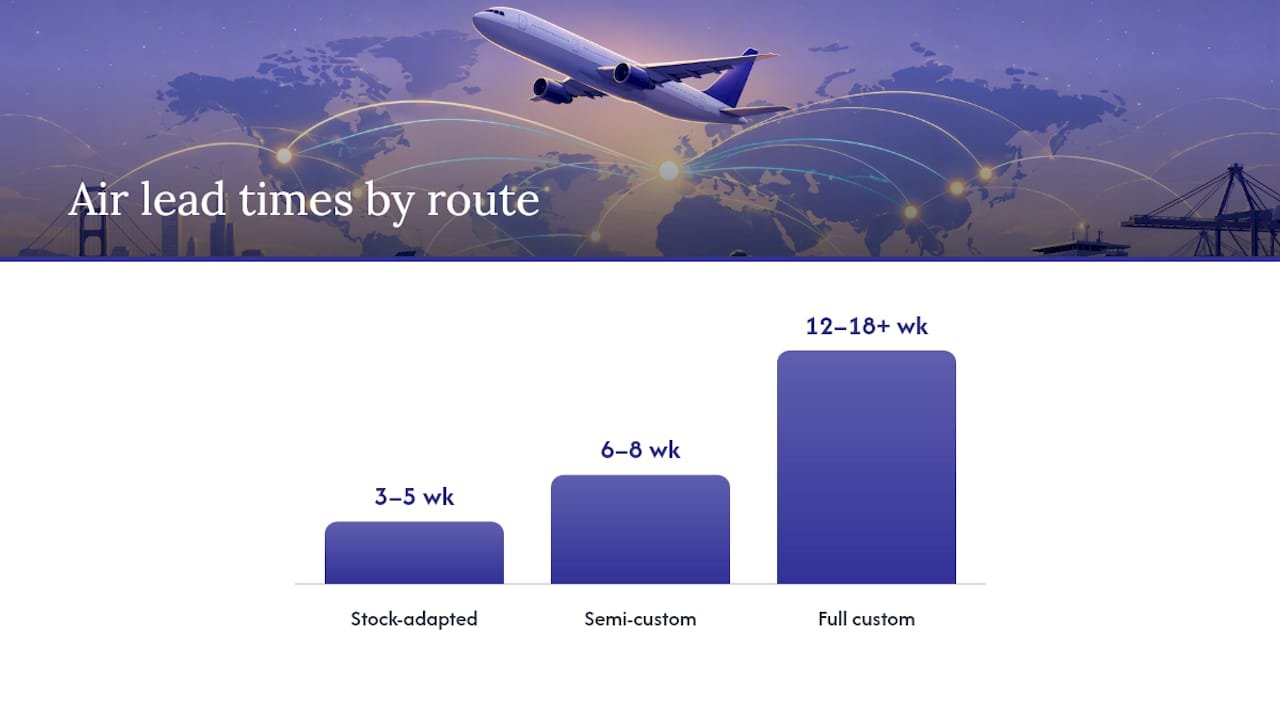
- Stock-adapted (existing product, your logo added): 3 to 5 weeks by air freight, 7 to 9 weeks by ocean. This is your fallback when approval slips.
- Semi-custom (modified stock item, some material or color changes): 6 to 8 weeks by air, 10 to 12 weeks by ocean.
- Full custom (built from scratch, unique tooling or molds): 12 to 18-plus weeks, almost always requiring a Q2 or early Q3 brief.
Air freight adds real cost, often significantly more than ocean shipping for the same volume, but it’s the only way to compress a semi-custom or stock-adapted order into a four-to-six-week window. Ocean and sea-air blended shipping stay viable when you have eight or more weeks of runway and want to protect margin on a large order.
The decision rule is simple: count the weeks between today and your December 5 to 15 delivery target, then match that number against the lead times above. If you have 14 weeks left, full custom is still on the table. If you have seven, you’re choosing between semi-custom by air or stock-adapted by ocean. Let the calendar make the call instead of assuming your dream design will somehow still fit.
Pro Tip: Ask your vendor for the exact date their personalization uploads close, not just their “production start” date. Factories often close name-file submissions 48 to 72 hours after finishing a print run, and that detail rarely appears on the quote.
Your Execution Checklist: Owners, Files, and Hard Cutoffs
Assign a single owner to each of these steps. Vague ownership is how a two-week delay becomes a six-week one.
- Sample approval. Route samples to decision makers with a five-business-day approval clock. Whoever signs the purchase order should see the sample first, not after production starts.
- Personalization files. Lock name files within one week of PO issuance. Address files should land two to three weeks before the dispatch date, giving your fulfillment team room to catch errors.
- Kitting decisions. Decide early whether items ship as individual kits or arrive bulk at a single site for local assembly. Kitting adds one to two weeks of calendar time that’s easy to forget when you’re focused on production.
- Wave shipping. Split large orders into shipping waves rather than one mass release. It spreads carrier risk and gives you a built-in reship queue if a batch gets flagged.
- Budget contingency. Line-item your total cost: product, setup and customization fees, freight, and peak-season surcharges. Add a 10% contingency on top. Rush fees and peak surcharges on late orders commonly add 25 to 50% or more to the base cost.
Missing the personalization file deadline is the single most common reason a “perfectly planned” program still ships late. Factories run print jobs in batches, and once that batch closes, adding a name means manual work or a second production run.
What to Do When You’re Starting Late
If you’re reading this in late October or November, full custom is off the table. Here’s how to still land a program that looks intentional rather than rushed.
Late October still allows stock-adapted items shipped by air, or a simplified single-color imprint on an existing product. Customization options narrow considerably, so pick stock items with strong baseline appeal rather than chasing a complex design that won’t be ready in time.
November is the point where digital gifting or redemption-based gifts become the more responsible choice over a rushed physical order. An alternative worth serious consideration: push the physical gift to a January “New Year” send instead of paying steep rush premiums for a December 20 arrival nobody’s excited about.
To cut landed cost fast, standardize your packaging size across the whole order, avoid bulky items that spike freight weight, consolidate kitting into fewer shipment origins, and switch to lightweight poly mailers where branding allows it.

Your decision flow: check your deadline, check your budget, check how much customization you actually need, then let those three answers point to stock-adapted, digital, or January.
International Shipping and Customs Timelines to Plan Around
If any part of your recipient list sits outside the United States, add real time to every deadline above. International fulfillment typically requires three to four additional weeks beyond domestic timelines, covering customs clearance, duties processing, and regional carrier handoffs.
That buffer isn’t optional padding. Customs holds are unpredictable by nature, and a package that clears in two days for one country might sit for a week in another depending on the item category and declared value. Duties and import taxes also vary by destination, and getting the harmonized tariff code wrong on your customs paperwork is one of the most common causes of a stalled shipment.
The practical move for a mostly domestic recipient list with a handful of international recipients: treat international as its own separate wave with its own earlier deadline, rather than folding it into your main domestic ship date. Ship that wave in October, not November, so a customs delay doesn’t collide with your December delivery window. If your program is majority international, build your entire calendar around the longer timeline from the start rather than treating it as an exception.
Setting Carrier and Vendor Deadlines by Shipping Method
Different shipping methods carry different risk profiles during peak season, and your cutoff dates should reflect that. Ground shipping within the continental United States needs the widest buffer during November and December because carrier networks are running at peak volume industry-wide, which means normal transit windows can stretch without warning.
Air freight and expedited ground service compress that risk but at a real cost premium, and even expedited options can face delays once regional hubs hit capacity in late November. The safest posture is to build your shipment plan around your slowest reasonable transit estimate, not your fastest one, and add a few days of buffer on top of whatever your carrier quotes.
For bulk kitted shipments arriving at a single corporate site, request a specific delivery appointment window from your carrier rather than a general delivery date. Loading docks and mailrooms get backed up during peak season, and an unscheduled bulk delivery can sit in a receiving queue for days even after it technically “arrived.” If your program ships to multiple office locations, stagger your dispatch dates by region so you’re not asking every local team to receive and distribute a large shipment in the same 48-hour window.
Tracking and Monitoring Orders After You Place Them
Once your order ships, monitoring becomes a daily task, not a weekly check-in. Set up tracking notifications for every wave of shipments, and assign someone on your team to scan for exceptions rather than assuming no news is good news.
Watch specifically for three warning signs: a tracking number that hasn’t updated in more than 48 hours during transit, a delivery exception notice (weather, address issue, or customs hold), and any shipment still marked “label created” more than three days after your expected ship date. Each of these needs a same-day follow-up call to your vendor or carrier, not a wait-and-see approach.
Build a simple shared tracking sheet with expected delivery dates, actual delivery status, and a flag column to track delays. For programs distributed across multiple offices or a long recipient list, this sheet becomes your early warning system for reship decisions. If a batch is going to miss its window, you want to know with enough lead time to either expedite a replacement or notify recipients proactively, not after the delivery date has already passed.
Managing Recipient Expectations Around Delivery Dates
The programs that generate the fewest complaints aren’t necessarily the ones that ship fastest. They’re the ones where recipients know what to expect before the gift is even in transit.
Send a short heads-up communication when the order ships, giving recipients a realistic delivery window rather than a specific promised date. “Arriving the week of December 8” holds up better than “arriving December 10” if a carrier delay pushes it to December 11. For distributed teams, this notice also gives recipients a chance to flag an address problem before it becomes a failed delivery.
If your program includes any international recipients or falls late enough in the calendar that customs delays are a real possibility, say so directly in that communication. Recipients tolerate a slightly later arrival far better when they were warned in advance than when a gift that was framed as guaranteed for a specific date shows up a week late. A short note from leadership acknowledging the delay, if one happens, does more for goodwill than staying silent and hoping nobody notices.
Why Most Programs Fail in October, Not December
The failures I see most often in corporate gifting don’t happen in December. They happen in October, when a program that had no owner in July suddenly needs an owner, a route, and a vendor all at once, with none of the lead time those decisions require.
Three things fix most of what goes wrong. First, name one person accountable for the whole program by name, not “marketing” as a department. Second, treat file deadlines, personalization names, and shipping addresses as production milestones with real dates, not paperwork to finish “eventually.” Third, price out landed cost (product, customization, freight, surcharges) in July, before vendor quotes start climbing with the calendar.
One mid-size services firm approached us in early July with a 400-person distributed gift list and no finalized design. Because they locked their route and file deadlines that same month, every package landed before December 10, with zero rush fees. The team that starts in July almost always outperforms the team that starts in September, not because they work harder, but because they never enter the compressed window at all.
— Jerry
How Discount Swag Keeps Your Holiday Program on Schedule
Discount Swag built its rush ordering, kitting, and multi-location fulfillment specifically for the calendar you just read through, so a July start isn’t your only path to an on-time December delivery.
You get sample turnaround fast enough to hit that five-day approval window, production routes that map directly to stock-adapted, semi-custom, and full custom lead times, and support staging wave shipments across multiple office locations without you managing three separate vendor relationships.
A dedicated account manager tracks your personalization file deadlines and address verification alongside you, so the hidden failure points, like a name file that misses the print run, get caught before they become a reship. Whether you’re comparing promotional products against traditional corporate gifts for this year’s program or you already know you need branded merchandise with real fulfillment support behind it, the next step is the same: request a holiday timeline review or a quote now, while your route options are still wide open.
Sources
- Corporate Holiday Gift Bags: The 8-Week Year-End Program Guide
- Corporate Gifting Timeline: Why Q4 Planning Starts in July – Brandit
- Q4 Corporate Gifting Guide 2026: From Thanksgiving to New Year Budget & Ideas
 Bottle Carriers
 Mugs
Mugs