

Tech Promotional Gift Selection for Marketers in 2026


Tech promotional gift selection is the process of choosing branded technology products that align with your marketing goals and engage customers through utility and daily use. Done right, promotional tech items generate an average of 3,300 brand impressions over their lifetime at roughly $0.006 per impression, outperforming most traditional ad channels. That makes branded USB drives, power banks, NFC stickers, and GaN chargers far more than giveaways. They are working media placements that live in pockets, on desks, and in laptop bags. The challenge for U.S. marketing professionals is not finding tech gifts. It is selecting the right ones so recipients actually keep and use them.
What criteria should you prioritize in tech promotional gift selection?
Usefulness is the single non-negotiable criterion. Nearly 8 in 10 consumers cite usefulness as the primary reason they keep a promotional item, and ASI’s 2026 Ad Impressions Study confirms that tech accessories like USB drives and power banks score even higher on retention than most other product categories. A gift that sits in a drawer delivers zero impressions. A gift that charges a phone every morning delivers hundreds per year.
Beyond usefulness, five criteria separate high-performing corporate tech gifts from wasted budget:
- Practicality and daily utility. The gift must solve a real, recurring problem. Multi-port cables, compact power banks, and phone stands all qualify. Novelty gadgets that do one trick rarely do.
- Durability and build quality. Recipients associate the quality of the gift with the quality of your brand. A power bank that fails after two weeks sends a message you do not want to send.
- Technological compatibility. USB-C universality and shrinking GaN chargers are the dominant compatibility trends in 2026. Gifts built around USB-A only are already becoming friction points for recipients with newer devices.
- Engagement potential. Interactive features like NFC stickers add a digital layer to a physical gift without requiring app downloads, creating a direct path from the gift to your brand content.
- Cost-effectiveness. At $0.006 per impression, promotional tech already beats digital display advertising on a cost-per-view basis. Your job is to select SKUs that sustain that efficiency over months, not days.
Pro Tip: Before finalizing any SKU, ask yourself whether a recipient would carry this item on a typical Tuesday. If the honest answer is no, the gift will not deliver the impressions you are paying for.
Which tech gift categories deliver the best brand visibility?
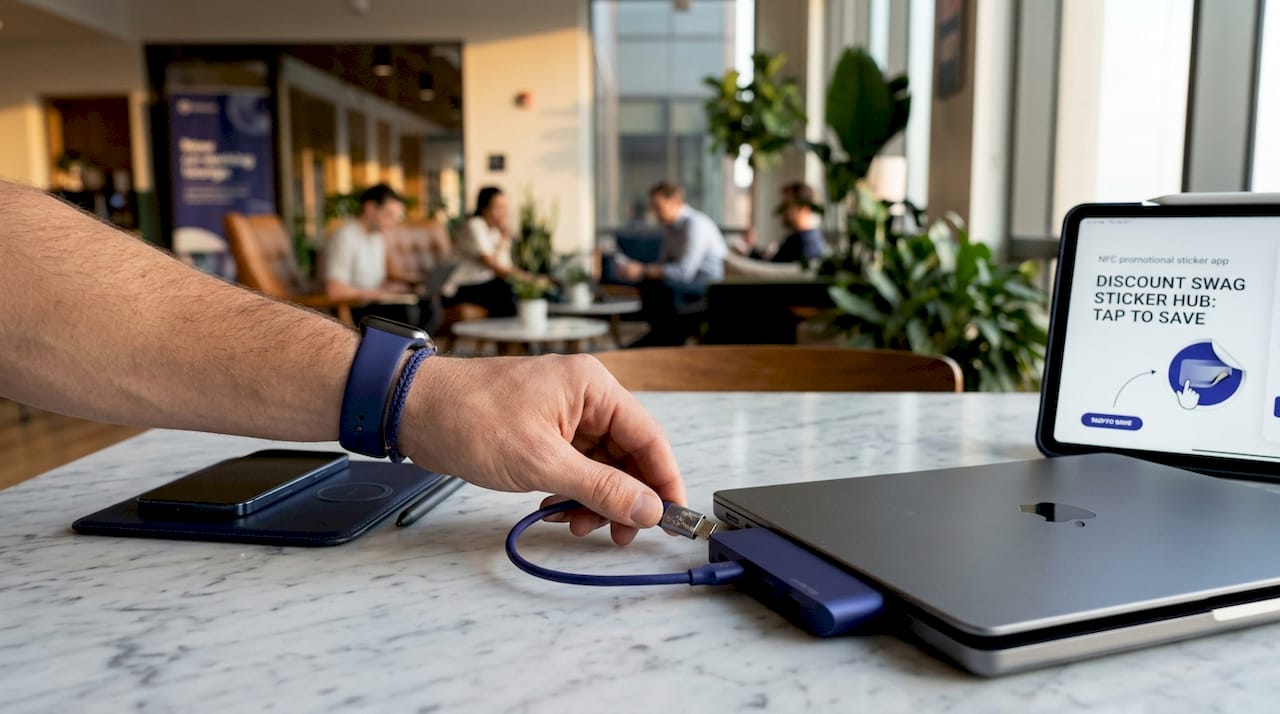
Not all promotional tech items perform equally. The categories below represent the strongest performers for brand visibility and recipient retention, based on current market data and usage patterns.
| Category | Top Examples | Visibility Strength |
|---|---|---|
| Charging devices | Power banks, GaN chargers, travel adapters | Very high: daily use, desk and bag presence |
| Audio and wearable tech | Earbuds, headphones, fitness trackers | High: worn in public, strong brand surface area |
| Data and tracking tools | USB drives, dual-network Bluetooth trackers | Moderate to high: frequent use, practical utility |
| Interactive tech | NFC promo stickers, digital business card tech | High engagement: tap-to-connect, no app required |
| Accessories | Multi-port cables, phone stands, desk organizers | High: constant desk visibility, daily touchpoints |
Charging devices remain the most reliable category for customized tech giveaways. Power banks travel everywhere, and a branded GaN charger on a conference room table generates passive impressions from every person in the room. The category is mature enough that quality tiers are well understood, which makes supplier vetting straightforward.
Audio tech offers the largest physical branding surface of any wearable category. Branded earbuds or over-ear headphones carry your logo into gyms, commutes, and open offices. The tradeoff is higher unit cost, which makes audio tech better suited to high-value customer or employee gifting than mass event giveaways.
NFC promo stickers represent the most interesting development in unique tech promotional gifts right now. A tap-to-connect sticker can be pre-encoded with your brand URL, requires no app, and ships with fast turnaround times. Placed on a laptop, notebook, or phone case, it becomes a persistent digital entry point to your brand content. For gifts for tech enthusiasts specifically, NFC items signal that your brand understands current technology rather than defaulting to legacy formats.
Multi-functional devices like dual-network Bluetooth trackers and multi-port cables are gaining ground because they solve more than one daily problem. A tracker that works on both Apple Find My and Google Find Hub networks is useful to nearly every smartphone owner, regardless of platform. That universality directly expands the effective audience for your gift.
How to run a successful tech promotional gift campaign step by step
Effective campaigns follow a repeatable process. Skipping steps, particularly the audience analysis and supplier vetting phases, is the most common source of wasted budget in promotional tech programs.
-
Define your audience and messaging goal. Are you targeting existing customers, trade show prospects, or employees? Each group has different utility needs. A field sales team needs portable charging. A remote workforce values desk accessories. Align the gift to the daily context of the recipient.
-
Set a realistic budget with impression ROI in mind. Promotional products deliver brand impressions at a fraction of a cent, which means even a modest per-unit budget can generate thousands of impressions per recipient over the gift’s lifetime. Calculate your target cost-per-impression before selecting a price tier, not after.
-
Vet suppliers on quality consistency and lead times. Supplier variability is a real operational risk. A fulfillment model that produces and ships gifts in response to actual conversions reduces inventory exposure and keeps quality consistent across production runs. Ask suppliers for samples from multiple production batches, not just a single prototype.
-
Select SKUs that maximize recurring utility. The best tech promotional gifts replace a bulky personal gadget or solve an everyday frustration, which creates permanent carry and repeated brand exposure. Prioritize items recipients would have bought for themselves. That is the clearest signal of genuine utility.
-
Plan your fulfillment and distribution strategy. Campaign-based production tied to specific conversion events reduces the risk of holding unsold inventory. For trade shows, plan for trade show giveaway logistics at least six to eight weeks in advance to account for custom branding lead times.
-
Measure results with a defined framework. Track redemption rates for NFC-enabled gifts, gather post-event feedback, and monitor brand recall metrics where possible. 85% of recipients remember the advertiser after receiving a promotional product, which gives you a strong baseline expectation for brand recall campaigns.
Pro Tip: Build a short post-campaign survey into your distribution workflow. Even three questions about gift usefulness and brand recall will give you the data to improve SKU selection for the next campaign.
The data point on brand recall deserves emphasis. When 76% of consumers say they are more likely to do business with a brand that gave them merchandise, and 78% view that brand more favorably, the ROI case for corporate tech gifts extends well beyond impressions into pipeline and customer retention outcomes.
What mistakes should you avoid in tech promo gift selection?
The most expensive mistake in promotional tech is selecting gifts based on novelty rather than recurring utility. A gadget that impresses at unboxing but serves no ongoing purpose is discarded within weeks. That means your brand impressions stop at the moment the recipient loses interest, which is often before the item ever leaves the event venue.
- Ignoring compatibility trends. Gifts built around outdated connectors or proprietary formats frustrate recipients and signal that your brand is behind the curve. USB-C compatibility is now a baseline expectation, not a premium feature.
- Underestimating lead times. Custom branding adds production time. Suppliers with inconsistent quality control add risk. Ordering too close to a campaign launch date forces you to accept whatever is available rather than what is best.
- Skipping the multi-function test. Recipients keep gifts that do more than one thing. A power bank with a built-in cable is more useful than a standalone power bank. A phone stand that also organizes cables earns permanent desk space. Single-function novelty items rarely survive the first desk cleanout.
- Failing to measure. Without a measurement framework, you cannot distinguish between a gift that generated 3,000 brand impressions and one that generated 300. NFC-enabled gifts make this measurable by tracking tap events directly.
Pro Tip: Run a quick branded merchandise audit of your last three campaigns. Count how many SKUs were still in use six months after distribution. That number tells you more about your selection quality than any pre-campaign estimate.
Key takeaways
Effective tech promotional gift selection requires prioritizing daily utility, technological compatibility, and measurable engagement over novelty or low unit cost.
| Point | Details |
|---|---|
| Usefulness drives retention | Nearly 8 in 10 consumers keep promotional items because they are useful; tech accessories rank highest. |
| Compatibility is non-negotiable | USB-C and GaN charger compatibility are 2026 baseline standards; outdated connectors reduce recipient satisfaction. |
| NFC adds measurable engagement | Tap-to-connect NFC stickers create trackable brand interactions without requiring app downloads. |
| Campaign fulfillment reduces risk | Producing gifts in response to conversions cuts inventory costs and maintains consistent quality. |
| Measure brand recall, not just distribution | 85% of recipients remember the advertiser; build recall measurement into every campaign framework. |
What I have learned about tech gift selection after years in the industry
The conventional wisdom says to pick the most popular tech item in your budget tier and brand it. That approach produces average results at best. What I have seen work consistently is a different question: what does this specific recipient already carry, and what daily problem does this gift solve better than what they have now?
The shift to multi-functional devices is not a trend. It is a permanent change in what recipients expect from a branded tech gift. When someone receives a dual-network Bluetooth tracker that works with both their iPhone and their partner’s Android device, they do not think of it as a promotional item. They think of it as a useful tool that happens to carry your logo. That mental reclassification is where brand loyalty actually forms.
NFC stickers are the most underused category I see in U.S. corporate gifting right now. Marketers who have tried QR codes know the friction problem: recipients have to open a camera app, frame the code, and wait for a redirect. NFC requires a single tap. The engagement rate difference is significant, and the production cost is low enough to include in almost any budget tier. If you are not testing NFC-enabled gifts in your next campaign, you are leaving a measurable engagement channel unused.
The sustainability angle is also becoming a real selection factor, not just a talking point. Recipients notice when a gift is built to last versus built to the lowest acceptable standard. A power bank that fails after three months does not just stop generating impressions. It actively damages brand perception. Quality is not a premium option in tech gifting. It is the minimum viable standard for any campaign you want to defend in a budget review.
— Jerry
How Discountswag can support your next tech gift campaign
Discountswag carries a broad selection of branded tech accessories built for marketing campaigns that need consistent quality and reliable lead times. From power banks and GaN chargers to NFC-enabled items and multi-port cables, the catalog covers the categories that deliver the highest retention and brand recall rates.
Whether you are planning a trade show distribution, a customer loyalty program, or a corporate gifting initiative, Discountswag’s team can help you match SKUs to your audience, budget, and brand objectives. The goal is not to fill a box. It is to put a useful, well-branded item in the hands of someone who will carry it for months. Explore the full range of logo tech giveaway ideas to find the right fit for your next campaign.
FAQ
What makes a tech gift worth keeping?
Usefulness is the primary driver. Nearly 8 in 10 consumers keep promotional items because they are practical, and tech accessories like power banks and USB drives score highest on retention among all promotional product categories.
How do NFC promotional items work?
NFC promo stickers use tap-to-connect technology that links directly to a pre-encoded URL without requiring an app or QR code scan. Recipients tap their smartphone to the sticker and land on your brand content instantly, creating a low-friction digital engagement point from a physical gift.
What is the cost-per-impression for promotional tech gifts?
Promotional products deliver brand impressions at approximately $0.006 per impression and generate around 3,300 total brand views over a product’s lifetime. That cost efficiency outperforms most digital and traditional advertising channels on a per-impression basis.
Which tech gift category works best for trade shows?
Charging devices, particularly compact power banks and GaN chargers, perform best at trade shows because recipients have an immediate, on-site need for them. Items that solve a problem the recipient is experiencing right now have the highest on-the-spot keep rates.
How far in advance should you order custom tech gifts?
Plan for a minimum of six to eight weeks when custom branding is involved, and longer for complex items or large quantities. Supplier lead times and quality control reviews add time that most marketers underestimate when building campaign timelines.
 Bottle Carriers
 Mugs
Mugs