

UV Printing vs Screen Printing: Why Swag Teams Often Need Both


Choose UV printing for short runs and photo-real detail on rigid goods like drinkware, signage, and tech accessories. Choose screen printing for bulk apparel and anything that needs to survive repeated washing. The right call depends on substrate, order size, finish, and how fast you need product in hand, and those four questions will settle almost any UV-versus-screen decision.
TL;DR:
- Screen printing’s setup cost falls per unit as volume grows, but every color needs a screen, and changed artwork requires new screens.
- UV ink cures on contact and handles plastic, metal, glass, and wood, but its rigid finish can crack on stretchable fabric.
- A batch of 500 staff polos favors screen printing, while UV suits personalized short runs, but its per unit cost can rise on large orders.
- A mixed swag program can use screen printing for shirts and UV printing for mugs or tech items, matching each process to its substrate.
- Send vector artwork and exact Pantone references, then request a physical sample proof and material swatch before approving the full production run.
Table of Contents
- How the two printing processes actually work
- Advantages and practical limitations of UV printing
- Advantages and practical limitations of screen printing
- Comparing cost, speed, quality, and durability side by side
- Matching products to the right printing method
- A checklist for finalizing your printing method
- What buying teams get wrong about file prep and ordering
- Why most swag programs end up using both methods
- How we handle both UV and screen printed swag orders
- FAQ
- Sources
How the two printing processes actually work
UV printing sends digital artwork straight to a printhead, which lays ink directly on the substrate while a UV lamp cures it almost instantly. There is no screen, no drying rack, and no waiting between colors because the light bonds the ink the moment it hits the surface.
Screen printing works differently. Each color needs its own stencil, called a screen, and ink gets pushed through the mesh onto the product one layer at a time. More colors mean more screens, more setup, and more time before the first finished piece comes off the line.
- UV: digital file to printhead to instant UV cure, ready to handle right away
- Screen: one screen per color, ink pushed through mesh, then cured or air-dried
Ink chemistry explains most of the downstream differences. UV inks cure instantly when exposed to ultraviolet light and sit on top of the substrate rather than soaking in, which is why they work on both porous and non-porous materials. Screen printing inks, especially plastisol, are formulated to penetrate textile fibers and cure into a thick, opaque layer built for flexing and washing.
Advantages and practical limitations of UV printing
UV printing earns its reputation on rigid goods and short runs. Because the ink cures the instant it is exposed to light, finishing happens immediately instead of after a drying cycle, which cuts spoilage and keeps small or variable-quantity orders moving fast.
- Cures instantly, so finishing and packing can start right away
- Handles a wide range of rigid substrates: plastic, metal, glass, and wood
- Captures fine detail and gradients closer to photographic quality
- Produces minimal volatile organic compounds during curing
The trade-offs show up on soft goods. Cured UV ink forms a hard polymer skin that can crack when stretched, so it is a poor fit for knit fabrics without special transfer processes. Per-unit costs can also climb on very large runs, and not every print shop owns the specialized curing equipment UV work requires.
Pro Tip: Ask your printer whether they run UV in-house or outsource it. Outsourced UV jobs usually mean longer lead times and less control over color matching.
Advantages and practical limitations of screen printing
Screen printing remains the standard for apparel because the thick, opaque ink deposit holds up to repeated washing and abrasion far better than most digital alternatives. That durability, combined with lower per-unit ink costs once screens are set up, is why screen printing dominates bulk uniform and t-shirt programs.
- Deposits thick, opaque ink that resists fading through many wash cycles
- Lowest per-unit cost once setup is amortized across large quantities
- Supports specialty finishes like puff, discharge, and metallic inks
- Gives apparel a tactile, slightly raised feel buyers associate with quality
The catch is setup. Every color requires a new screen, so small or highly variable orders get expensive fast, and reprinting a design with different artwork means starting the screen-making process over. Fine photographic detail is also harder to reproduce than it is with a digital UV process.
Comparing cost, speed, quality, and durability side by side
The two methods trade advantages depending on which axis matters most for your order.
- Cost structure: UV has low setup cost but can carry higher per-unit pricing at volume; screen printing has higher setup cost that drops sharply per unit as quantity grows.
- Turnaround: UV cures instantly and moves to packing fast; screen printing needs screen-making time upfront, though production itself runs quickly once screens are ready.
- Print fidelity: UV reproduces photographic detail and color gradients; screen printing delivers bold, opaque color blocks and tactile specialty finishes.
- Durability: screen-printed apparel holds up to washing and abrasion better on fabric; UV-cured inks resist scratching, fading, and moisture on rigid, non-flexing surfaces.
- Substrate fit: UV covers plastic, metal, glass, wood, and other rigid goods; screen printing is built for textiles and other flexible materials.
Edge cases matter here. A metal water bottle with a photo-quality logo favors UV every time, while a batch of 500 staff polos favors screen printing even if the artwork is simple.
Matching products to the right printing method
Mapping your product type to a method takes most of the guesswork out of ordering.
- Drinkware, phone accessories, and hard-goods gifts: UV printing handles curved and rigid surfaces with fine detail in short runs.
- Event swag and personalized items: UV suits one-off or low-quantity personalization, like named name tags or individualized gift sets.
- Bulk t-shirts and staff uniforms: screen printing holds up through wash after wash and is more economical at volume.
- Large tote bag or tradeshow apparel programs: screen printing’s per-unit cost drops as order size climbs.
- Mixed programs: many buyers split a single swag box, using screen printing for the shirt and UV for the mug or tech item inside it.
A checklist for finalizing your printing method
Before you commit, run your project through a short checklist: substrate, order size, image complexity, durability needs, turnaround window, and budget ceiling. Most decisions become obvious once you lay those six factors side by side.
When you talk to a printer, ask directly:
- What is your proof policy, and how many rounds are included?
- What is the maximum printable area for this substrate?
- Which ink type do you recommend for this product, and why?
- Do you run wash or abrasion testing, and can I see results?
- What is your realistic lead time, including proofing?
Request a physical sample proof and a material swatch before approving a full run, not just a digital mockup.
Pro Tip: Keep a folder of past proofs and swatches. It speeds up reorders and gives you a quick reference when comparing printers on quality.
What buying teams get wrong about file prep and ordering
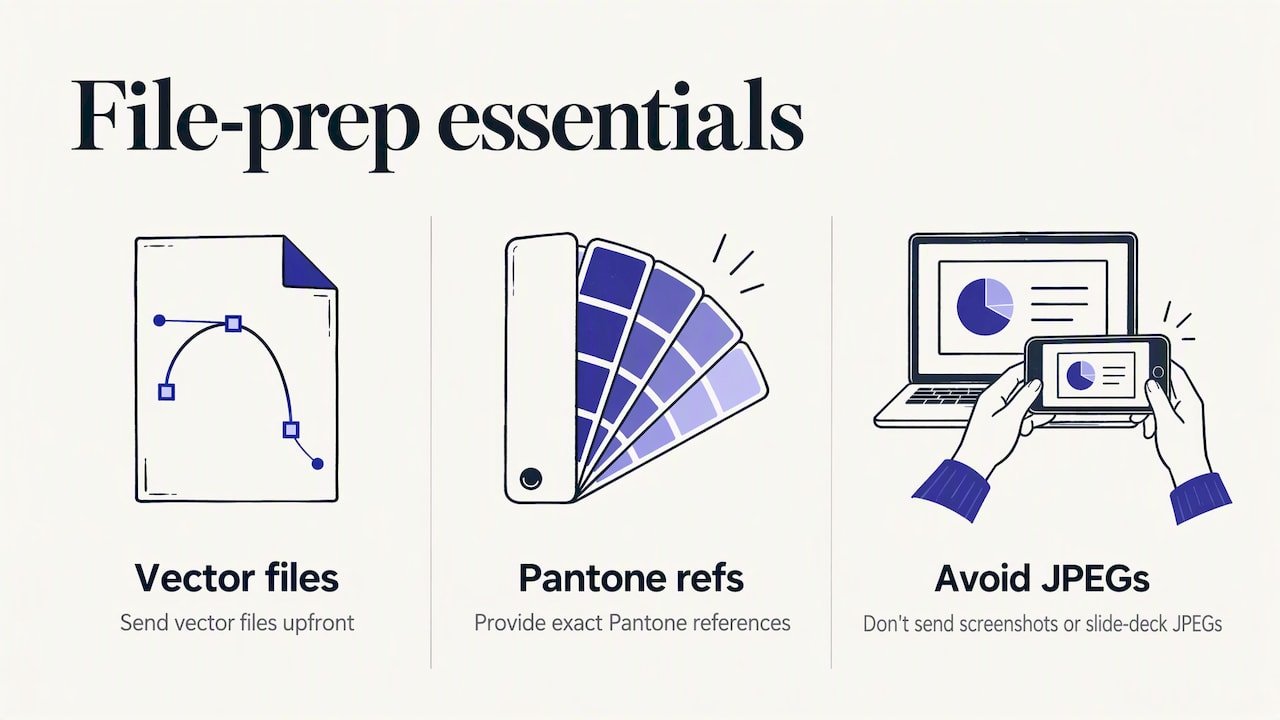
Most reprint requests trace back to the same mistake: low-resolution logos or wrong file formats. We’ve seen that sending vector files and exact Pantone references upfront, rather than a screenshot or a JPEG pulled from a slide deck, prevents most color-matching headaches before they start.
For teams juggling both apparel and hard-goods in one program, rush ordering and coordinated fulfillment matter as much as the print method itself. Our guidance on logo sizes and pixel specs and on ordering branded merch without delays covers the file prep and timeline questions that come up most often. Always request a physical sample to check tactile feel and durability before signing off on a full production run.
Why most swag programs end up using both methods
Apparel and hard-goods rarely come from the same print process, and that’s normal. A shirt needs wash durability, a mug needs photo-real detail, so most programs end up blending UV and screen printing. The coordination work, not the printing itself, is what determines whether your timeline holds.
— Jerry
How we handle both UV and screen printed swag orders
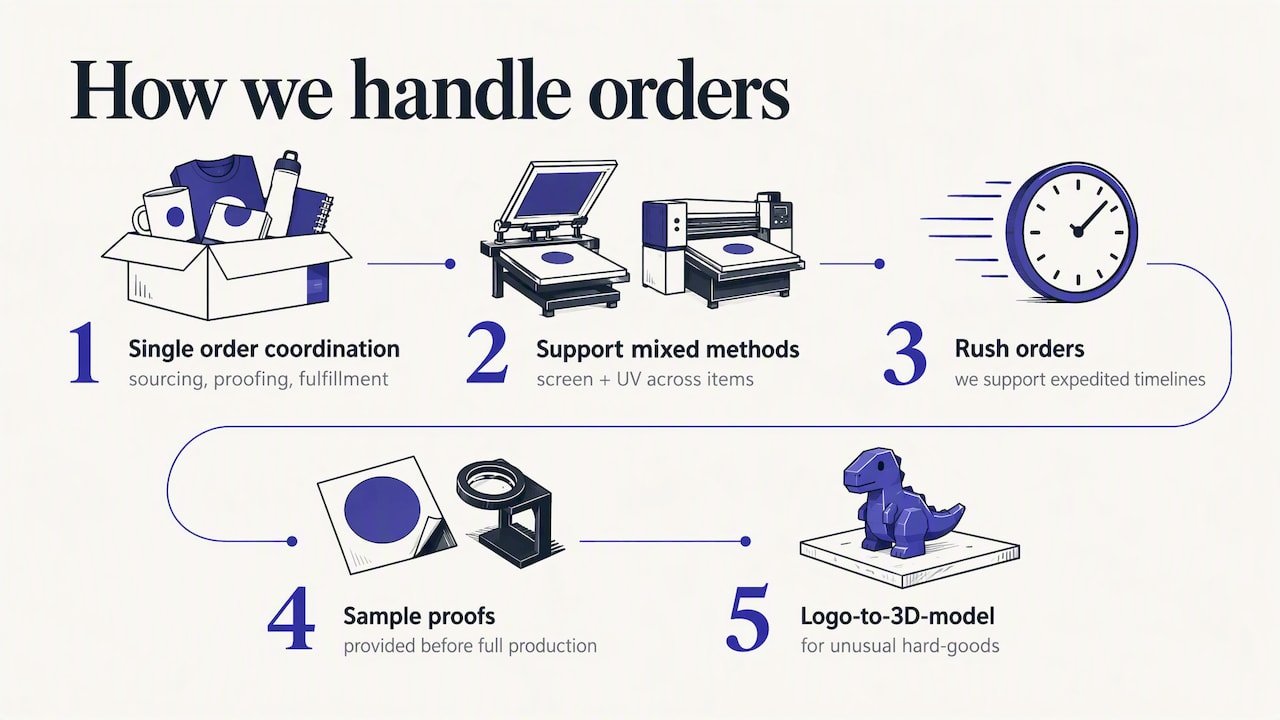
We work with curated suppliers across both printing methods, so you are not stuck choosing one process and hoping it fits every item in your box. Whether your program calls for screen-printed polos, UV-printed drinkware, or a mix of both, we coordinate sourcing, proofing, and fulfillment to single or multiple locations from one order.
We support rush orders and can provide sample proofs before you commit to a full production run. If your program includes unusual hard-goods beyond standard drinkware, a logo-to-3D-model service is worth a look for novelty gifts that go past what UV printing typically covers.
Ready to see what fits your project? Request a quote through our main catalog and we’ll help you map your items to the right printing method.
FAQ
What are the downsides of UV printing?
UV printing can struggle on stretchable fabrics because the cured ink forms a rigid layer that may crack with repeated flexing. Per-unit costs can also run higher on very large orders compared to screen printing, and not every supplier owns the specialized curing equipment the process requires.
Can UV printing be done on T-shirts?
UV printing on fabric is technically possible through UV DTF transfers, but the cured layer tends to stiffen and can crack or peel after repeated stretching and washing. Most buyers choose screen printing instead for shirts and other apparel that need to hold up through regular laundering.
Is UV DTF better than DTF?
Neither method is categorically better; they suit different needs. UV DTF produces a glossier, more rigid finish that can crack on flexible fabric over time, while standard DTF transfers tend to flex more naturally with the garment, which makes DTF the more common choice for apparel.
Can a UV printer print on anything?
UV printers cover a wide range of surfaces, including plastic, metal, glass, wood, and other rigid substrates, because the ink cures on contact rather than soaking in. They are not well suited to stretchable fabrics, where screen printing or specialized fabric processes perform better.
Which method costs less for a large order?
Screen printing typically becomes more economical as order size grows because the setup cost for screens gets spread across more units. UV printing tends to be more cost-effective for short runs where screen setup would not pay off.
 Bottle Carriers
 Mugs