


What Is a Co-Branded Product? A Guide for Marketers


A co-branded product is a single product or service that carries the identities of two or more brands through a formal contractual arrangement, combining each brand’s strengths to reach wider audiences and increase perceived value. This is not a casual logo swap. Co-branding requires licensing agreements, trademark compliance, and strict brand governance to work legally and strategically. For marketing professionals and brand managers, understanding what makes a co-branded product work, and what makes it fail, is the difference between a partnership that builds equity and one that dilutes it. This guide covers the types, legal foundations, real-world examples, and implementation strategies you need to execute co-branding with confidence.
What is a co-branded product and how does it work?
A co-branded product is defined as a marketing arrangement where multiple brands jointly appear on one product or service, typically enabled by a license agreement. Each brand contributes its identity, reputation, and customer base to the shared offering. The result is a product that signals value from more than one trusted source.
The mechanism behind co-branding is brand licensing. One party, the licensor, grants another party, the licensee, the right to use its brand assets under defined conditions. The licensee typically manages production, design, and distribution, while the licensor enforces brand guidelines through a governance process. This licensing arrangement keeps both brands protected and ensures the final product meets quality and identity standards.

What separates co-branding from simple sponsorship or endorsement is the product itself. Both brand marks appear independently and visibly on the product, signaling that each brand is a distinct source of value. A co-branded product is not a product with a logo slapped on it. It is a product whose identity is genuinely shaped by both partners.
The strategic purpose is clear: combining brand strengths makes the offering more resistant to copying and opens the door to premium pricing. When two trusted brands align on a single product, the perceived value exceeds what either could deliver alone.
What are the main types of co-branding?
Co-branding takes several distinct forms, and choosing the right type depends on your marketing goals and the nature of the partnership.
Product-based co-branding involves two brands combining directly on a physical product. There are two primary variants within this category.
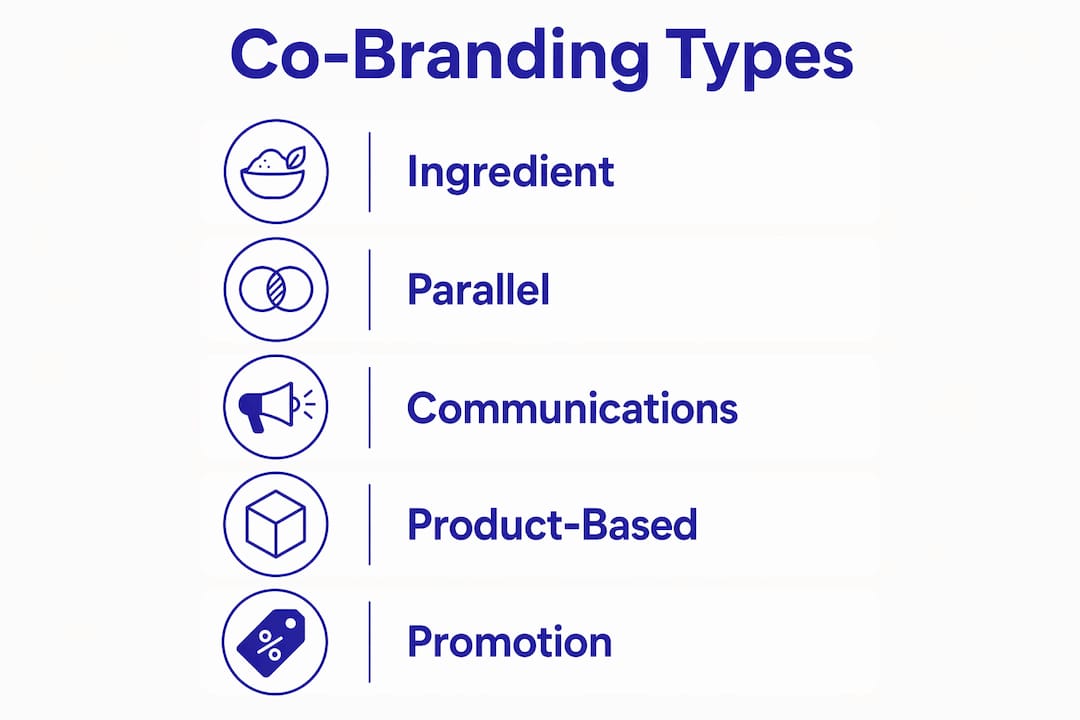
- Ingredient co-branding features one brand as a named component inside another brand’s product. Intel Inside on a Dell laptop is the textbook example. The ingredient brand differentiates the host product by signaling a specific quality or capability that the host brand alone cannot claim.
- Parallel co-branding places two independent brands side by side on a product neither could produce alone. Think of a co-branded credit card between a major bank and an airline. Both brands are equal contributors, and the product only exists because of the partnership.
Communications-based co-branding does not change the product itself. Instead, two brands run joint marketing campaigns, promotions, or sponsorships that associate their identities without creating a new shared product. A fast food chain partnering with a movie studio for a promotional campaign is a classic example of this approach.
The strategic motivations differ significantly. Product-based co-branding builds a tangible asset that lives in the market long after the campaign ends. Communications-based co-branding generates short-term visibility and association without the legal complexity of shared product development.
Pro Tip: Before selecting a co-branding type, map your brand’s core equity attributes against your potential partner’s. If the overlap is high, parallel co-branding creates the strongest signal. If one brand has a specific capability the other lacks, ingredient co-branding is the more credible choice.
Understanding branding strategy types at a structural level helps brand managers position co-branding correctly within a broader portfolio strategy.
How do legal frameworks and brand licensing shape co-branded products?
Legal structure is not a formality in co-branding. It is the foundation that determines whether the partnership creates value or creates liability.
-
Establish a formal licensing agreement. Brand licensing permits another party to use brand assets under contractual conditions. The agreement must define the scope of use, the term of the license, approved product categories, geographic territories, and quality control standards. Vague agreements are the single most common source of co-branding disputes.
-
Verify trademark ownership and scope. Trademark compliance requires confirming the licensor’s actual ownership, the scope of registered goods and services, and the categories of authorized use. Due diligence goes beyond checking whether a trademark is registered. You must confirm that the registration covers the specific product category you are entering and that the licensor has the authority to sublicense.
-
Define brand governance processes. The licensor must enforce brand guidelines throughout production. This means approving design files, reviewing product samples, and auditing final outputs before market launch. Without a structured governance process, brand dilution is almost inevitable.
-
Document all commercial use. Active trademark use during co-branding must be documented with commercial proof, including signed agreements, product photographs, and sales records. This documentation defends against non-use cancellation challenges and protects both parties’ trademark rights over time.
-
Plan for exit. Every co-branding agreement needs a clear termination clause. What happens to existing inventory when the partnership ends? Who owns the product molds, packaging designs, or co-created assets? These questions are far easier to answer before the partnership launches than after it dissolves.
Pro Tip: Engage an intellectual property attorney before signing any co-branding agreement, not after. The cost of a legal review upfront is a fraction of the cost of a trademark dispute or brand governance failure mid-campaign.
What are notable co-branding examples and what can marketers learn?
Real-world co-branding partnerships reveal patterns that separate successful collaborations from costly missteps.
The Nike and Apple partnership produced the Nike+ running ecosystem, a product line that combined Nike’s athletic credibility with Apple’s technology platform. These partnerships increase exclusivity and appeal, driving additional revenue streams that neither brand could generate independently. The lesson here is that complementary brand values, not just complementary audiences, create the strongest co-branded products.
Automotive and apparel co-brands offer another instructive case. Porsche Design and BMW Lifestyle both produce co-branded merchandise that extends the automotive brand into everyday consumer products. These partnerships work because the core brand values, precision, performance, and premium quality, translate directly into the product category.
| Co-branding example | What made it work |
|---|---|
| Nike + Apple (Nike+) | Complementary capabilities: athletic hardware meets digital software |
| BMW + Louis Vuitton | Shared premium positioning across automotive and luxury goods |
| GoPro + Red Bull | Aligned brand values around extreme performance and adventure |
| Doritos + Taco Bell | Shared audience and flavor profile created a genuinely new product |
The pattern across all successful examples is the same: both brands bring something the other cannot replicate, and the product is better because of both contributions. Co-branding fails when one brand is simply licensing its name for revenue without contributing genuine product value. Consumers recognize that immediately.
For brand managers, the selection of a co-branding partner deserves the same rigor as a major hire. Audit the partner’s brand equity, customer perception data, and existing partnerships before committing. A partner whose brand is declining transfers that decline to your product.
How can marketing professionals implement co-branded marketing strategies?
Execution is where most co-branding strategies succeed or fail. The concept is straightforward; the operational reality is not.
Assess brand alignment before everything else. Map your brand’s core attributes against your potential partner’s. The strongest co-branded products share values at the identity level, not just at the audience demographic level. Two brands targeting the same age group but standing for different things will produce a confused product.
Align messaging across every channel. Co-branded marketing strategies require both brands to communicate a unified story. That means coordinating social media, email, retail displays, and promotional materials so the partnership reads as intentional and coherent. Inconsistent messaging across channels signals to consumers that the partnership is transactional rather than genuine.
- Develop a shared creative brief that both brand teams approve before any assets are produced.
- Establish a single point of contact on each side to manage approvals and prevent conflicting direction.
- Agree on which brand leads communications in which channels, based on audience ownership.
Leverage promotional products as a tangible co-branding vehicle. Physical products carry both brand marks into the hands of customers in a way that digital campaigns cannot replicate. Branded merchandise in press kits is one of the most effective ways to launch a co-branded partnership with immediate visibility. Logo tech accessories, co-branded apparel, and custom packaging all extend the partnership into physical spaces where both brands gain exposure simultaneously.
Build in performance measurement from day one. Define what success looks like before the campaign launches. Track brand awareness lift, new customer acquisition from the partner’s base, and revenue attributed to the co-branded product specifically. Without baseline metrics, you cannot prove the partnership’s value internally or to your partner.
Pro Tip: Run a small-scale pilot before committing to a full co-branded product launch. A limited promotional product run or a regional campaign gives you real consumer data on how the partnership lands before you invest in full production.
Key takeaways
Co-branding works when both partners contribute genuine brand equity, operate under a formal licensing agreement, and align their marketing execution across every channel.
| Point | Details |
|---|---|
| Definition of co-branding | A co-branded product carries two or more brand identities on a single product through a formal licensing contract. |
| Types matter strategically | Ingredient, parallel, and communications-based co-branding serve different goals and require different legal structures. |
| Legal foundation is non-negotiable | Trademark verification, brand governance, and commercial documentation protect both parties throughout the partnership. |
| Partner selection drives outcomes | Complementary brand values, not just shared audiences, determine whether a co-branded product succeeds or confuses. |
| Promotional products amplify reach | Physical co-branded items extend partnership visibility into tangible customer touchpoints that digital campaigns cannot replicate. |
Why most co-branding advice misses the hard part
I have watched brand managers spend months negotiating the creative side of a co-branding partnership and then rush the legal and governance work in the final two weeks before launch. That sequence almost always creates problems. The logo placement looks great. The brand guidelines document is 40 pages long. And then six months in, one partner starts using the co-branded mark in a product category the agreement never covered, and you are suddenly in a dispute that costs more to resolve than the partnership ever generated.
The uncomfortable truth about co-branding is that the strategic value is real, but it is fragile. The hidden risks in trademark scope and licensing terms are where partnerships quietly unravel. Most marketers treat legal compliance as a checkbox. The ones who build durable co-branded products treat it as a core competency.
The other thing I would push back on is the obsession with iconic examples. Nike and Apple is not a template. It is an outlier. Most successful co-branding happens at a much smaller scale, between regional brands, between a manufacturer and a retailer, or between a corporate brand and a nonprofit. Those partnerships succeed for the same reasons the famous ones do: genuine complementarity, clear agreements, and disciplined execution. The scale is different. The principles are identical.
If you are evaluating a co-branding opportunity right now, spend as much time on the exit strategy as you do on the launch plan. Knowing how you will unwind the partnership cleanly is not pessimism. It is the mark of a professional who has seen what happens when that conversation gets skipped.
— Jerry
How Discountswag supports your co-branding campaigns
Co-branded promotional products are one of the fastest ways to put a partnership in front of customers in a format they keep and use. Discountswag specializes in corporate promotional products that carry your brand and your partner’s brand with the quality and consistency both parties require.
From co-branded tech accessories to custom apparel and event giveaways, Discountswag produces items that meet the brand governance standards your licensing agreements demand. Explore the full range of branded promotional products available for marketing teams, or learn how branded merchandise drives engagement across partnership campaigns. When your co-branding strategy needs a physical presence, Discountswag delivers the product quality that protects both brands.
FAQ
What is the definition of a co-branded product?
A co-branded product is a single product or service that carries the identities of two or more brands through a formal licensing agreement. Both brand marks appear independently on the product, and each brand contributes distinct value to the offering.
How does ingredient co-branding differ from parallel co-branding?
Ingredient co-branding features one brand as a named component inside another brand’s product, such as Intel Inside on a laptop. Parallel co-branding places two independent brands side by side on a product that neither could produce alone, such as a co-branded airline credit card.
What legal documents are required for a co-branding partnership?
A formal licensing agreement is required, covering trademark scope, authorized product categories, brand governance processes, and termination terms. Commercial documentation including signed agreements, product photos, and sales records must also be maintained to protect trademark rights.
What makes a co-branding partnership successful?
Successful co-branding partnerships share complementary brand values, not just overlapping audiences. Both brands must contribute genuine product value, operate under a clear legal framework, and align their marketing execution across all channels from launch.
Can promotional products be used as co-branded marketing tools?
Yes. Physical promotional products carrying both brand marks are one of the most effective co-branded marketing vehicles because they deliver tangible, lasting brand exposure. Items like co-branded tech accessories, apparel, and custom packaging extend partnership visibility into everyday customer touchpoints.
 Bottle Carriers
 Mugs
Mugs