

Tariffs on Promotional Goods: What U.S. Buyers Must Know

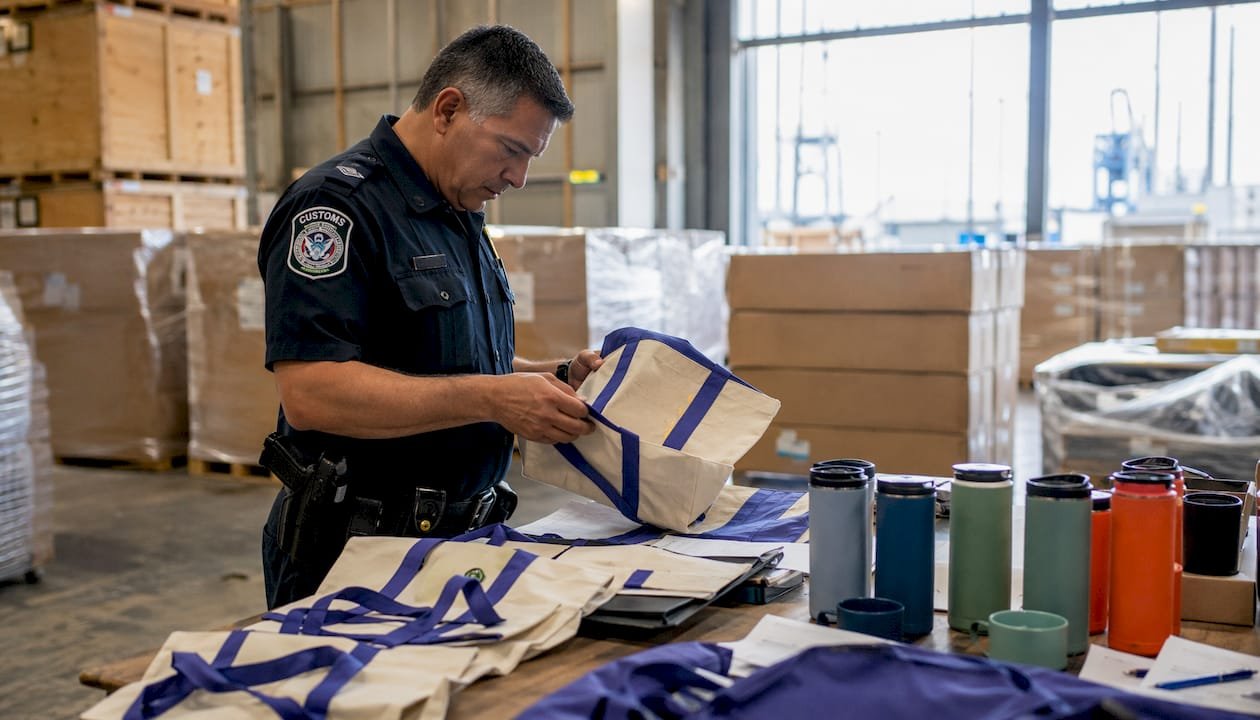
A tariff on promotional goods is the import duty assessed on each item based on its HTS classification, country of origin, and any additional trade measures such as Section 301. The fact that an item is a giveaway, a conference bag, or a branded pen does not create any exemption. CBP collects the duty from the importer of record, and that cost flows directly into your landed price.
Three things to do before your next PO:
-
Verify the HTS code. Ask your supplier for the 10-digit Harmonized Tariff Schedule number and cross-check it on the USITC tariff lookup. A wrong code is the single most common source of surprise duties.
-
Request a landed-cost quote. Get a line-item breakdown that includes freight, insurance, duty, and broker fees before you commit to a price.
-
Confirm importer of record and Incoterms. Know who is legally responsible for paying duty before the shipment leaves the factory.
TL;DR for promo buyers:
- Tariffs typically add meaningful cost on top of your FOB price, and stacked measures (base rate + Section 301) can push that figure significantly higher for China-origin goods.
- Lead times lengthen when shipments are held for customs examination, which is more likely when documentation is incomplete.
- Misclassification and misdeclared value carry civil penalties and potential seizure.
Table of Contents
- What is a tariff on promotional goods, legally speaking?
- How common promo categories map to HTS chapters
- How tariffs change your landed cost: a worked example
- Who pays, and how does customs clearance actually work?
- Mitigation strategies for marketing and procurement teams
- How Discountswag helps buyers manage tariff complexity
- Key Takeaways
- The tariff conversation most buyers are having too late
- Discountswag makes landed-cost quoting part of the order process
What is a tariff on promotional goods, legally speaking?
A tariff is a tax levied by the U.S. government on the value of imported merchandise, collected at the port of entry by U.S. Customs and Border Protection. The rate is set by the Harmonized Tariff Schedule of the United States (HTS), a 10-digit classification system administered by the U.S. International Trade Commission (USITC). Every physical product imported into the U.S. gets an HTS code, and that code determines the base duty rate.
What matters here: promotional use does not exempt an item from duty. CBP classifies goods by their material composition and function, not by what you plan to do with them. A branded stainless steel tumbler is classified as a household article of stainless steel. The fact that you are giving it away at a trade show is irrelevant to the duty calculation.
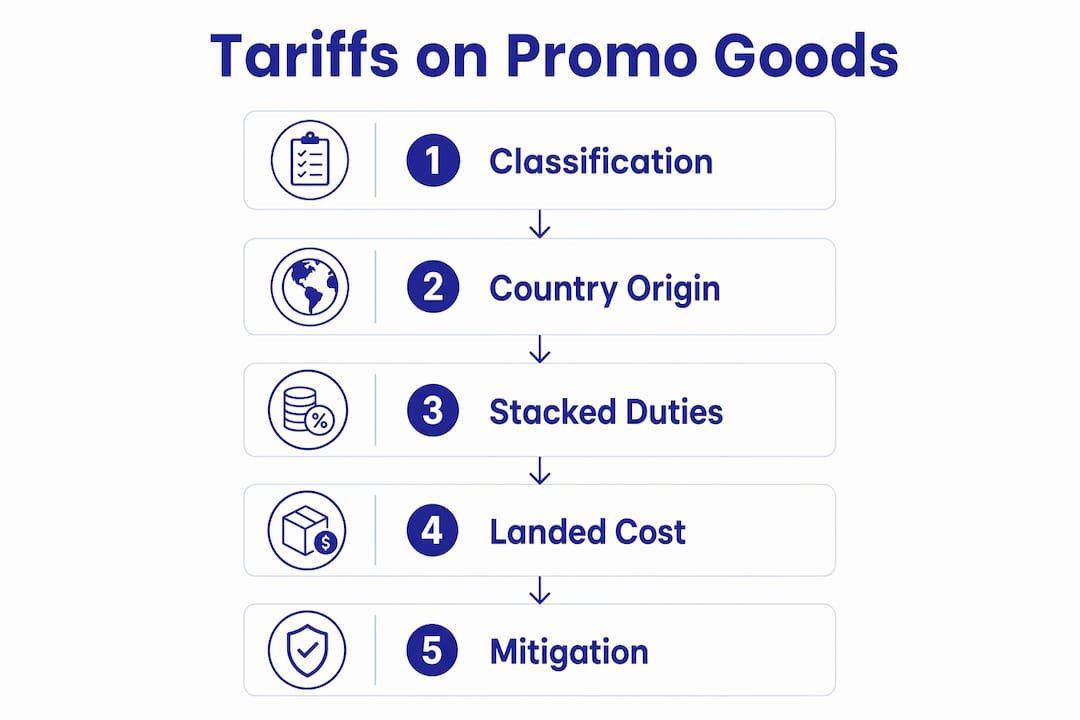
How stacked duties work
Most imports face a base Most Favored Nation (MFN) rate, which applies to goods from WTO member countries. On top of that, multiple trade measures can operate simultaneously: Section 301 tariffs (targeting China-origin goods), Section 232 measures (steel and aluminum), and anti-dumping or countervailing duties (AD/CVD) where applicable. For a China-origin promotional item, a buyer might face a base MFN rate plus additional Section 301 duties, bringing the effective duty rate significantly higher before any other fees.

The Tax Policy Center has tracked the average effective tariff rate on U.S. imports at approximately 9.3%, but that average masks wide variation by product category and origin. For China-sourced promo goods, the real number is often significantly higher depending on HTS classification and applied trade remedies.
Pro Tip: Always ask your supplier for their proposed HTS code in writing before placing a purchase order. If they cannot provide one, that is a red flag for compliance risk down the line.
How common promo categories map to HTS chapters
Understanding where your SKUs land in the HTS is the first step to estimating duty exposure. The category-to-chapter mapping below reflects where most promo items typically fall, though exact classification depends on construction, materials, and function.
| Category | Typical HTS Chapter(s) | Common Duty Exposure |
|---|---|---|
| Apparel (T-shirts, polos, hats) | — | MFN rate + Section 301 if China-origin |
| Drinkware (tumblers, mugs, bottles) | — | MFN rate + Section 301; AD/CVD on some steel |
| Bags (totes, backpacks, drawstring) | — | MFN rate + Section 301 if China-origin |
| Tech accessories (USB drives, cables, chargers) | — | MFN rate + Section 301 (often elevated) |
| Printed materials (catalogs, brochures) | — | Often duty-free under specific headings |
A few categories deserve extra attention:
- Tech accessories carry some of the highest combined rates. USB drives and wireless chargers from China can face MFN rates plus substantial Section 301 additions under USTR Section 301 actions.
- Kitted shipments (a bag containing a tumbler, a pen, and a USB drive) require component-by-component classification. CBP examiners can require a separate HTS code and value for each item in the kit. Get an itemized component list from your supplier before the shipment ships.
- Printed advertising material can qualify for duty-free treatment under specific HTS headings, but the item must genuinely meet the heading’s requirements. Printed matter bundled with a physical product does not automatically inherit duty-free status.
Labeling an invoice “sample” or “promotional” does not exempt the shipment from duties. The HTS 9811.00.60 exception has strict requirements — including a $1 declared value and physical mutilation of the goods — that virtually never apply to saleable corporate giveaways.
The de minimis rule (Section 321, $800 threshold) lets individuals import low-value shipments duty-free, but it rarely protects commercial promo orders. CBP can deny de minimis treatment based on commercial intent, repeated shipments from the same supplier, or kitted orders. Do not build your budget around it.
Pro Tip: When sourcing branded promotional products across multiple categories, request a separate HTS code and unit value for each SKU — even if they ship together. That documentation protects you if CBP examines the shipment.
How tariffs change your landed cost: a worked example
Landed cost is the total you actually pay to get a product to your warehouse or event venue. It includes more than the factory price. Here is the formula:
Landed Cost = FOB Price + Freight + Insurance + Customs Value Additions (Assists) + Duty + Broker Fees + Harbor Maintenance Fee (HMF)
One item that buyers routinely miss: assists. If you provide free artwork files, molds, or tooling to your supplier, customs valuation rules require that the value of those assists be added to the declared transaction value before duty is calculated. Omitting assists is one of the most common audit triggers CBP encounters.
Worked example: 500 branded stainless steel tumblers from China
| Line Item | Assumption | Amount |
|---|---|---|
| FOB unit price | $8.00 × 500 units | — |
| Freight (ocean + drayage) | Estimated | — |
| Assists (artwork files provided free) | Declared value | $150 |
| Customs value (duty base) | FOB + assists | — |
| Base MFN duty (~3%) | 3% × declared value | — |
| Section 301 addition | Section 301 addition × declared value | — |
| Customs broker fee | Flat estimate | — |
Compare that to a naive calculation using only the FOB price: $8.00 per unit. The actual landed cost is significantly higher. That gap is what tariff volatility does to a promo budget.
Sensitivity scenarios for the same SKU
| Scenario | Effective Duty Rate | Landed Cost/Unit |
|---|---|---|
| MFN only (no Section 301) | ~3% | — |
| MFN + additional duties | higher | — |
| MFN + 25% Section 301 (China) | much higher | — |
Assumptions: FOB $8.00, freight/insurance/broker as above, assists $150 on 500 units. Verify current HTS rates via USITC and confirm Section 301 applicability with your broker before quoting.
For buyers managing a bulk promotional products order across multiple SKUs, running this math per category before finalizing a PO is the difference between a profitable campaign and an over-budget one.
Who pays, and how does customs clearance actually work?
The importer of record (IOR) is the party legally responsible for paying duties, filing the entry, and ensuring the goods comply with all U.S. import requirements. That is usually the U.S. buyer, unless your Incoterms specify otherwise (DDP means the supplier delivers duty-paid; EXW or FOB puts the obligation on the buyer). Misunderstanding this is expensive.
The customs clearance flow
- Shipment arrives at a U.S. port of entry.
- Entry filing — the IOR or their licensed customs broker submits an entry (CBP Form 3461 for informal, 7501 for formal entries over $2,500).
- Duty assessment — CBP reviews the HTS classification, declared value, and country of origin.
- Release or examination — most shipments are released electronically; a percentage are selected for physical or document examination, which adds days or weeks.
- Delivery — goods are released to the IOR after duties are paid or a bond is posted.
Documents that speed clearance
- Commercial invoice (with unit prices, HTS codes, and country of origin)
- Packing list (itemized, with weights and dimensions)
- Country-of-origin markings on each item and its packaging
- Bill of lading or airway bill
- Any applicable certificates (e.g., CPSC compliance for electronics)
The practical entry requirements are clear: a valid HTS code, accurate transaction value including assists, and a complete commercial invoice are the minimum. Missing any of these increases the probability of a customs hold.
Pro Tip: Negotiate DDP (Delivered Duty Paid) Incoterms with suppliers when you want cost certainty. The supplier quotes a single all-in price and handles customs. The tradeoff: you lose visibility into the duty breakdown, so ask for an itemized landed-cost statement anyway.
For teams evaluating U.S. fulfillment solutions that include third-party IOR services, bonded warehousing, or distributed delivery, those options can shift duty-payment timing and reduce per-shipment clearance complexity.
Mitigation strategies for marketing and procurement teams
Higher unit costs, compressed margins, longer lead times, and forecasting uncertainty are the four concrete impacts tariffs impose on promo buyers. None of them are unavoidable. Here is what actually moves the needle.
HTS verification and binding ruling requests
Before placing a large PO, verify the HTS code yourself using the USITC lookup. If the classification is ambiguous, request a binding ruling from CBP (Form 4228). A binding ruling locks in the classification and protects you from reclassification at the port. This costs nothing but time and is one of the highest-impact, lowest-cost steps available.
Alternative-country sourcing
Many promo categories are manufactured in Vietnam, Bangladesh, India, and Mexico, which carry lower or zero Section 301 exposure. Apparel and bags in particular have robust supply chains outside China. The tradeoff is often longer development timelines and higher minimum order quantities, so build that into your calendar.
Bonded warehousing and temporary importation
For trade show exhibits and temporary display items, a Temporary Importation under Bond (TIB) or ATA Carnet lets you bring goods into the U.S. duty-free as long as they are re-exported within the bond period. This works for display samples and exhibit materials, not for giveaways that will be distributed domestically.
Duty drawback
If you import goods, use them in a manufacturing or assembly process, and then export the finished product, you may be eligible to recover up to 99% of duties paid through the duty drawback program. For most promo distributors this is a niche tool, but it is worth flagging for buyers who also export finished kits internationally.
Contract language and pricing buffers
A tariff buffer built into your per-unit budget at the planning stage is a reasonable starting point for China-origin goods under current conditions. For promotional item cost negotiation, that buffer also gives you room to absorb minor rate fluctuations without repricing the entire campaign.
Compliance risks and recordkeeping
Misclassification and misdeclared value carry civil penalties under 19 U.S.C. § 1592, which can reach the full domestic value of the goods in cases of fraud. Even negligent errors carry meaningful penalties. Keep commercial invoices, packing lists, HTS classification records, and any supplier-provided assists documentation for at least five years. CBP can audit entries retroactively, and a clean paper trail is your primary defense.
How Discountswag helps buyers manage tariff complexity
Discountswag works with marketing managers and procurement teams who need more than a product catalog. When you request a quote, the team verifies the HTS classification for each SKU, flags any Section 301 or AD/CVD exposure, and returns a landed-cost breakdown that shows duty scenarios side by side. You see the MFN-only cost, the stacked-duty cost, and the impact of alternative sourcing options before you commit.
For kitted orders, Discountswag provides itemized component documentation, which is what CBP examiners require and what most buyers never think to ask for until a shipment is held. Fulfillment options include DDP shipping to a single location or distributed delivery to multiple offices or event venues, with documentation structured to support clean customs clearance.
The workflow is straightforward: submit your SKU list and target quantity, specify your event date or delivery deadline, and Discountswag returns a landed-cost quote with Incoterm options. From there, you choose the fulfillment path that fits your budget and timeline.
For teams building out their brand awareness campaigns and needing to understand how tariffs affect per-unit cost before finalizing a product mix, that upfront landed-cost visibility is what makes the difference between a campaign that hits budget and one that doesn’t.
Key Takeaways
Tariffs on promotional goods are determined by HTS classification, country of origin, and stacked trade measures — not by promotional intent — and buyers who verify these factors before placing a PO avoid the most costly surprises.
| Point | Details |
|---|---|
| HTS classification drives duty | Duty is set by material and function, not promotional use; verify the 10-digit HTS code before every PO. |
| Stacked duties compound fast | China-origin goods can face MFN rates plus Section 301 additions, pushing effective rates well above the average reported by the Tax Policy Center. |
| Assists increase your duty base | Free artwork, molds, or tooling provided to suppliers must be declared in transaction value or risk audit penalties. |
| De minimis rarely protects commercial orders | CBP can deny the $800 Section 321 threshold for commercial-intent or kitted promotional shipments. |
| Discountswag | Provides HTS verification, landed-cost quoting with duty scenarios, and itemized kitting documentation before you commit to a PO. |
The tariff conversation most buyers are having too late
The procurement teams that handle tariff volatility best share one habit: they treat landed cost as the real price from day one, not as a line item to reconcile after the invoice arrives. What I see repeatedly is buyers locking in a supplier quote based on FOB price, building a campaign budget around it, and then absorbing a 20–30% cost increase at customs because no one verified the HTS code or asked about Section 301 applicability.
The shift to alternative-country sourcing is real and accelerating. Teams that moved apparel and bag programs to Vietnam or Bangladesh during earlier tariff spikes found that the transition took one to two additional product development cycles, but the long-term cost stability was worth it. The buyers who waited until a rate increase hit scrambled to requalify suppliers mid-campaign.
One thing that gets overlooked: bonded warehousing is not just for large importers. For teams ordering conference kits six to eight months in advance, a bonded warehouse lets you time the duty payment to your cash flow rather than to the shipment arrival date. That flexibility has real budget value when you are managing multiple events across a fiscal year.
Document everything. Store commercial invoices, HTS classification records, and any supplier-provided assists documentation for at least five years. CBP audits are not common, but when they happen, the paper trail is the only thing standing between you and a penalty.
Discountswag makes landed-cost quoting part of the order process
Tariff complexity should not stop you from ordering the right promotional products. Discountswag builds HTS verification and landed-cost quoting directly into the quote process, so you know your real per-unit cost before you approve a PO. Submit your SKU list, target quantity, and event date, and you get back a landed-cost breakdown with duty scenarios and Incoterm options.
Discountswag serves marketing teams and procurement buyers across the U.S. with customizable apparel, drinkware, bags, tech accessories, and event kits, with fulfillment to single or multiple locations. Whether you need branded items for awareness campaigns or want to explore fulfillment cost reduction options that work alongside your tariff strategy, the next step is simple: request a landed-cost quote at discountswag.store and get the real number before you commit.
 Bottle Carriers
 Mugs
Mugs