


The Role of Branded Donations in Corporate Strategy


Branded philanthropy is defined as the deliberate alignment of a company’s charitable giving with its brand identity, values, and marketing goals. The role of branded donations extends far beyond writing a check. When done well, corporate giving builds consumer trust, differentiates a brand in crowded markets, and delivers measurable financial returns. Research confirms that companies with strong social impact programs reported 32% higher revenue and 45% higher pre-tax profit in 2023. That gap between purpose-led companies and their peers is not a coincidence. It reflects what happens when giving is woven into a brand’s core identity rather than treated as a line item.
What is the role of branded donations in brand perception?
Branded donations shape how consumers perceive a company at a psychological level. The mechanism is not simply goodwill. Research on branding and charity advertising shows that brand familiarity influences donation intention through brand attitudes, not directly. That distinction matters. A consumer who recognizes your brand but holds neutral or negative attitudes toward it will not be moved to support your cause or buy your product because of a donation announcement.
Positive brand attitudes are the bridge. They form when a brand communicates its giving with clarity, consistency, and proof of impact. Trust in nonprofit brands builds through exactly these three pillars, and the same logic applies to corporate giving programs. A company that announces a donation once and never follows up with results fails the consistency and proof tests.
The psychological drivers behind donation behavior and brand loyalty overlap more than most CSR managers realize. Consumers who feel a brand shares their values are more likely to advocate for it, forgive its mistakes, and pay a premium for its products. 59% of global consumers say they will pay more for brands with positive social impact. That willingness to pay more is a direct financial signal that brand perception and giving strategy are inseparable.
Three factors determine whether branded donations shift consumer attitudes in your favor:
- Clarity: Consumers must understand exactly what cause you support and why it connects to your business.
- Consistency: One-time donations read as opportunistic. Repeated, structured giving reads as genuine commitment.
- Proof: Verified outcomes, not just pledges, convert skeptical consumers into loyal advocates.
Pro Tip: Run a brief brand attitude survey before and after a donation campaign. The delta in positive sentiment is your clearest signal that the campaign is working beyond awareness.
How should companies integrate giving into daily operations?

The sharpest distinction in corporate philanthropy is between transactional giving and integrated giving. Transactional giving is a year-end check to a charity. Integrated giving ties donations to specific business events: a new client onboarding, a product sale, a team milestone. The difference in consumer perception is significant.
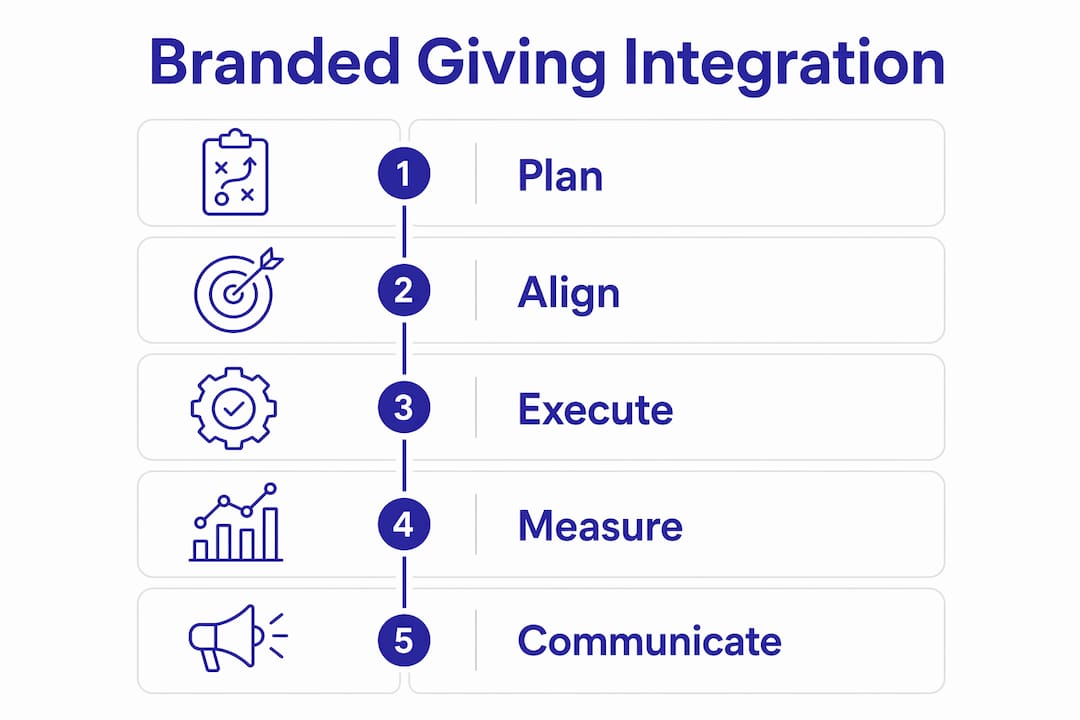
Businesses that embed giving into daily operations create authentic, trackable impact that differentiates their brand. When a donation is triggered by a business milestone, it creates a visible record tied to real activity. Platforms that align giving to the United Nations Sustainable Development Goals (UN SDGs) make that record publicly verifiable, which adds another layer of credibility.
Timing also matters more than most companies expect. Research from the Kelley School of Business at Indiana University shows that periodic substantial donations improve consumer trust more than equivalent lump sums. Small periodic amounts, however, can backfire. Consumers interpret trivial recurring donations as performative rather than sincere.
Consumers perceive periodic donations as signals of authentic prosocial behavior. The size and regularity of giving communicate intent. A company that gives meaningfully and often signals that giving is part of how it operates, not a PR exercise layered on top.
A practical framework for integrated giving follows four steps:
- Map your business milestones. Identify recurring events: sales closed, employees hired, products shipped, client anniversaries.
- Assign a giving trigger to each milestone. Tie a specific donation amount or action to each event so giving becomes automatic.
- Select causes aligned with your brand values. Misaligned causes confuse consumers and dilute brand identity.
- Document and publish outcomes. Use verified data to show what each trigger produced in real-world impact.
Post-2026 U.S. tax changes add another layer of planning complexity. A new 1% charitable deduction floor means milestone-based giving and earlier cross-departmental collaboration between legal, tax, and finance teams are now critical to maximizing both philanthropic impact and deductibility.
How do you measure and communicate donation impact?
Measurement is where most branded donation programs lose credibility. A pledge without a result is marketing noise. Verified outcomes tied to social goals are what convert skeptical stakeholders into believers.
The table below outlines a practical framework for tracking and reporting donation impact:
| Reporting Element | What to Measure | Why It Matters |
|---|---|---|
| Output metrics | Meals provided, trees planted, hours volunteered | Shows concrete, tangible results |
| Outcome metrics | Community health rates, literacy scores, employment rates | Demonstrates long-term social change |
| Brand sentiment | Pre and post-campaign consumer trust scores | Links giving to business value |
| Employee engagement | Participation rates in giving programs | Signals internal culture alignment |
| Financial correlation | Revenue trends alongside giving milestones | Supports the business case for CSR |
Transparency in reporting is not optional. 88% of business leaders say purpose-led strategies enhance long-term value. That belief only holds when leaders can point to evidence. Annual CSR reports, real-time impact dashboards, and third-party audits all serve as proof mechanisms that sustain stakeholder confidence.
Aligning brand messaging with evidence of impact requires discipline. Every communication channel, from email newsletters to social media to press kits, should carry consistent impact data. A branded swag campaign strategy that incorporates impact metrics on physical materials, such as a tote bag printed with “Your purchase funded 10 meals,” turns every product into a proof point.
Pro Tip: Publish a quarterly impact update, not just an annual report. Quarterly cadence keeps your giving visible and signals ongoing commitment rather than a once-a-year PR push.
How do branded donations affect employee engagement and recruitment?
Branded donation programs are internal marketing tools as much as external ones. Employees who see their company giving in ways that align with their own values report higher morale, stronger loyalty, and greater pride in their work. That internal effect has direct business consequences.
CSR programs increase recruitment by 69%, reduce turnover by 57%, and improve morale by 57%. Those are not soft metrics. Reduced turnover translates directly to lower hiring costs and retained institutional knowledge.
The talent acquisition angle is particularly powerful for companies competing for mission-aligned candidates. More than 70% of employees consider community impact when choosing an employer. A company with a visible, well-documented giving program signals to candidates that it operates with values beyond profit. That signal attracts people who stay longer and perform at a higher level.
Branded donation campaigns also give employees something to talk about. When a company ties a donation to a team milestone, such as a new hire’s first week or a project completion, employees become ambassadors for the giving program. That word-of-mouth effect extends the brand’s reach without additional marketing spend.
- Volunteer programs tied to giving campaigns increase employee participation and deepen the connection between personal values and company identity.
- Matching gift programs amplify individual employee contributions, making each person feel their giving matters at scale.
- Internal impact reporting shared with employees, not just external stakeholders, builds pride and reinforces the company’s commitment to its stated values.
- Branded merchandise distributed during giving campaigns creates a physical reminder of shared purpose, reinforcing team identity around the cause. Discountswag’s branded merchandise for engagement covers how physical products extend that internal brand signal.
Key Takeaways
Branded donations build measurable business value when giving is integrated into daily operations, communicated with verified proof, and aligned with both consumer and employee values.
| Point | Details |
|---|---|
| Integration beats transactions | Tie donations to business milestones to create authentic, trackable giving records. |
| Brand attitudes drive results | Familiarity alone does not move consumers; positive brand attitudes generate donation intent and loyalty. |
| Timing and size signal sincerity | Periodic substantial donations build more trust than lump sums or trivial recurring amounts. |
| Proof sustains credibility | Verified impact data across all channels converts skeptics into advocates and sustains stakeholder confidence. |
| CSR drives talent outcomes | Branded giving programs increase recruitment by 69% and reduce turnover by 57%, delivering direct cost savings. |
Why most branded donation programs underperform
The most common mistake I see is treating branded donations as a communications problem rather than an operations problem. Companies spend months crafting the announcement and almost no time designing the giving mechanism itself. The result is a campaign that generates a press release and then disappears.
The programs that actually move brand perception are the ones where giving is automatic. It happens when a sale closes, when a new employee joins, when a product ships. Consumers and employees do not need to be told the company cares. They can see it in the cadence of giving, and that visibility does the persuasion work that no press release can.
The other pattern I have watched consistently underperform is cause selection driven by executive preference rather than brand alignment. A financial services firm donating to an arts program is not wrong, but it requires far more explanation than a food company donating to hunger relief. The closer the cause sits to your core business, the less work your communications team has to do to make the connection feel genuine.
Measurement is the third gap. Most teams track outputs, such as dollars donated or meals funded, but skip outcome metrics. Outcome data, like literacy rates improved or employment rates changed, is what converts a donation into a story that stakeholders actually remember. The impact of corporate giving becomes defensible only when you can show what changed, not just what you spent.
— Jerry
Branded merchandise that amplifies your CSR campaigns
Discountswag works with marketing and CSR teams that want their giving programs to leave a physical impression. Branded promotional products, from custom tote bags printed with impact data to logo merchandise distributed at community events, turn a donation campaign into a tangible experience that recipients carry with them.
The promotional items for brand awareness guide covers how to select products that reinforce your CSR message at every touchpoint. For teams building internal giving campaigns, the branded merchandise guide shows how physical products extend your giving story to employees and clients alike. Discountswag sources and produces the merchandise that makes your impact visible.
FAQ
What are branded donations in corporate strategy?
Branded donations are charitable contributions that a company ties directly to its brand identity, values, and business operations. They differ from standard philanthropy by creating a visible, consistent link between giving and the company’s market positioning.
How do branded donations build consumer trust?
Trust builds through clarity, consistency, and proof of impact. Consumers respond more positively to periodic substantial donations than to one-time lump sums, which they interpret as more authentic signals of prosocial commitment.
What is the financial impact of branded philanthropy?
Companies with strong social impact programs reported 32% higher revenue and 45% higher pre-tax profit in 2023, showing that purpose-led giving correlates directly with financial performance.
How does corporate giving affect employee retention?
CSR programs reduce turnover by 57% and increase recruitment effectiveness by 69%. Employees who see their company giving in alignment with shared values report higher morale and stronger organizational loyalty.
What metrics should CSR managers track for donation programs?
Track both output metrics, such as meals funded or hours volunteered, and outcome metrics, such as community health or employment rates. Pairing those with brand sentiment scores and employee engagement data gives a complete picture of a program’s business and social value.
 Bottle Carriers
 Mugs
Mugs